
Listen to this Post
Introduction:
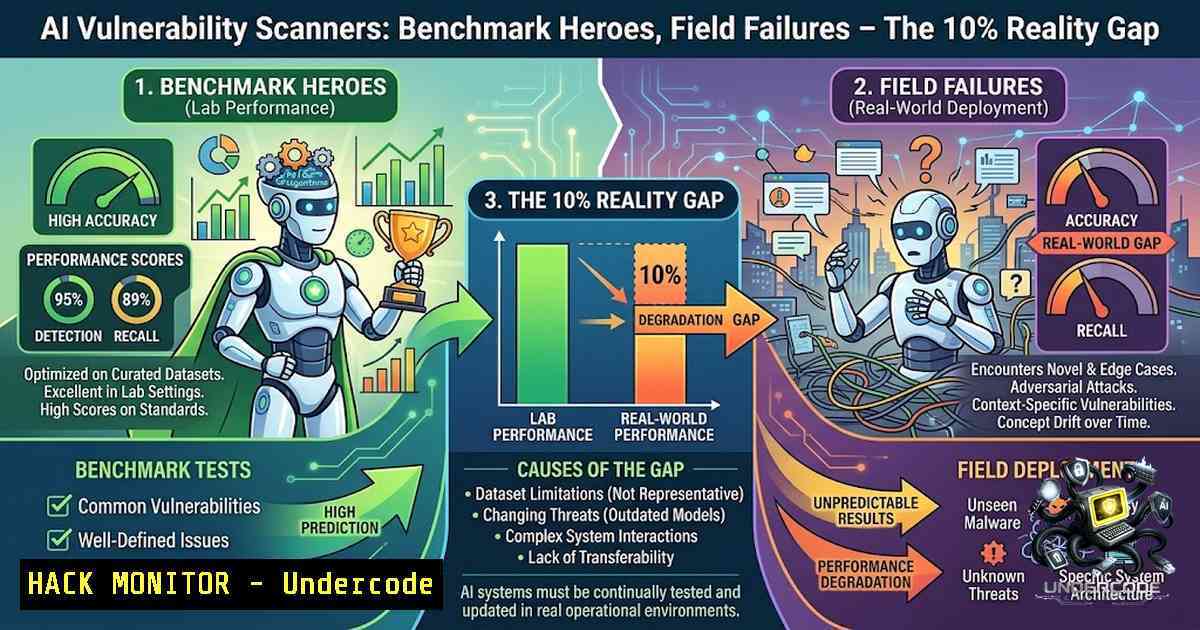
The cybersecurity industry is witnessing a troubling disconnect: AI-powered vulnerability scanners and penetration testing agents are posting impressive numbers on published benchmarks, yet independent studies consistently reveal that these same tools fail catastrophically when confronted with real-world production environments. As Luuk Joseph Soons, Founder of CounterProof Research, recently observed: “The benchmark score was strong. The field results weren’t.” This gap between laboratory performance and operational reality is not merely an academic curiosity—it represents a systemic failure in how we evaluate, procure, and deploy AI security tools, leaving organizations with a false sense of security while critical vulnerabilities remain undetected.
Learning Objectives & Secrets:
- Objective 1: Understand the Benchmark–Reality Gap – Learn why AI vulnerability scanners that achieve 60% success rates in controlled benchmarks can drop to as low as 10–15% effectiveness against real-world vulnerabilities drawn from the NIST CVE database.
-
Objective 2 Secret Tip: Evaluate Architecture, Not Just Model Scores – The most important differentiator in AI security tool performance is not the underlying LLM but the system architecture—belief state management, verification mechanisms, and orchestration—yet vendor marketing almost never discusses these critical dimensions.
-
Objective 3 Secret Tip: Treat Benchmark Scores as Hypothesis, Not Truth – Many existing AI security benchmarks have error rates exceeding 50%, making careful validation essential. Always validate scanner findings through independent manual review and red-team validation before acting on them.
You Should Know:
- The CVE-Bench Reality Check: From 60% to 10%
The most comprehensive study of AI agents’ real-world exploitation capabilities comes from CVE-Bench, a benchmark developed by researchers at UIUC that tests AI agents against critical-severity vulnerabilities from the NIST CVE database. The findings are sobering: while previous ad-hoc benchmarks suggested AI agents could handle 60% of real-world vulnerabilities, CVE-Bench revealed that agents could exploit only 10–15% of them. Even more striking, when tested without prior knowledge of the vulnerability (simulating a true zero-day scenario), GPT-4o achieved only 10% success.
The benchmark methodology itself is instructive. Researchers collected CVEs from a specific date range to avoid sampling bias, dockerized vulnerable applications, manually reproduced exploits, and filtered out approximately half of the CVEs because they required resources unavailable to the public or specific versions that were no longer accessible. This rigorous approach exposes a fundamental truth: many existing benchmarks are built on sanitized, unrealistic scenarios that fail to capture the complexity of production systems.
What This Means for Practitioners:
 When evaluating an AI vulnerability scanner, demand transparency on:
 1. What benchmark was used (CTF-style vs. real CVE-based)
 2. Whether the test environment mirrored production complexity
 3. How false positives and false negatives were measured

Example: Query the scanner's performance claims against known CVEs
 Check if the tool can reproduce exploits for CVEs in your stack
curl -X GET "https://api.scanner.example/benchmark/cve-list" \
-H "Authorization: Bearer $API_KEY" | jq '.results[] | select(.success_rate < 0.30)'
2. CyberGym: 1,507 Vulnerabilities, 11.9% Success
UC Berkeley’s CyberGym benchmark takes the reality check even further. Featuring 1,507 real-world vulnerabilities across 188 software projects sourced from Google’s OSS-Fuzz continuous fuzzing campaign, CyberGym tasks AI agents with generating proof-of-concept (PoC) tests to reproduce vulnerabilities given only text descriptions and codebases. The results: even the best combination of agent framework (OpenHands) and LLM (Claude-3.7-Sonnet) achieved only an 11.9% reproduction success rate.
Perhaps more alarming: PoCs generated by LLM agents actually revealed new vulnerabilities—identifying 15 zero-days affecting the latest versions of software projects. While this demonstrates the offensive potential of AI agents, it also underscores a critical risk: organizations deploying these tools without understanding their limitations may inadvertently expose themselves to unpatched vulnerabilities that the tools themselves help discover but cannot reliably remediate.
Step‑by‑Step Guide to Validating Scanner Claims:
- Request the benchmark dataset – Ask the vendor which specific CVEs or vulnerability instances their tool was tested against.
- Run the scanner against your own staging environment – Never trust benchmark scores alone; test on applications that mirror your production architecture.
- Manually verify a random sample of findings – For each vulnerability flagged, attempt to reproduce the exploit manually or through a third-party validation tool.
- Measure false positive rate – Track how many flagged findings are actually exploitable; a high FP rate wastes analyst time and erodes trust.
- Monitor consistency across runs – Studies show that half of non-reference findings from LLM scanners vanish on rerun—run each scan multiple times and compare results.
Windows Command for Consistency Checking:
 Compare scan results across multiple runs
 Save each run to a separate file
Compare-Object (Get-Content scan_run1.json) (Get-Content scan_run2.json) | `
Where-Object { $_.SideIndicator -eq "=>" } | `
Measure-Object | `
Select-Object -ExpandProperty Count
- The False Positive Epidemic: When AI Flags Safe Code
False positives are the silent killer of AI security tool adoption. The RealVuln benchmark, which evaluates scanners on human-authored code predating LLM availability, found that 120 out of 796 labeled findings (15.1%) were deliberately constructed as “false positive traps”—code patterns that appear suspicious but are demonstrably safe. For example, a login function passing user input to SQLAlchemy’s `filter_by()` method superficially resembles SQL injection, but the ORM automatically parameterizes the query.
LLM-based detectors exhibit particularly concerning false-positive patterns. DeepSeek V3 shows the highest false-positive ratio among evaluated models, and all language models mislocate issues at line-or-column granularity due to tokenization artefacts. A 2025 study found that GPT-4 alone flagging vulnerabilities was wrong more often than right.
How to Mitigate False Positives in Your Pipeline:
 Python script to filter scanner findings by confidence threshold
import json

def filter_findings(scan_results, min_confidence=0.8):
"""Filter out low-confidence findings to reduce false positives"""
filtered = []
for finding in scan_results['findings']:
if finding.get('confidence', 0) >= min_confidence:
 Cross-reference with known CWE patterns
if finding.get('cwe_id') in VALIDATED_CWE_PATTERNS:
filtered.append(finding)
return filtered

Load scan results
with open('scan_results.json', 'r') as f:
results = json.load(f)

Apply filter
high_confidence = filter_findings(results, min_confidence=0.85)
print(f"Reduced findings from {len(results['findings'])} to {len(high_confidence)}")
4. The Architecture Matters More Than the Model
One of the most revealing benchmarks in the AI security space tested three agentic AI pentesting platforms—RidgeGen, Shannon, and Strix—against the same OWASP Juice Shop instance using the same LLM backend (Gemini 3 Flash) across all platforms. The methodology controlled for the model to isolate the variable that truly matters: system architecture.
The results demonstrated that performance differences came entirely from how each platform plans attacks, maintains state, validates findings, and chains discoveries into downstream exploration. Vendor marketing that focuses on “which LLM we use” is largely irrelevant; the real question is how the tool reasons about application behavior versus simply enumerating known vulnerability patterns.
Linux Command to Audit Your AI Security Tool’s Architecture:
 Audit the tool's request/response patterns to understand its reasoning
 Log all API calls made by the scanner during a test run
tcpdump -i any -s 0 -w scanner_traffic.pcap port 443

Analyze the capture for patterns: is the tool doing simple payload injection
 or demonstrating contextual understanding?
tshark -r scanner_traffic.pcap -Y "http.request" -T fields \
-e http.request.method -e http.request.uri | head -50
- The Reproducibility Crisis: Findings That Vanish on Rerun
Perhaps the most insidious problem with LLM-based vulnerability scanners is their lack of reproducibility. Snyk’s VulnBench JS 1.0 ran 300 repeated LLM scans and found that half of non-reference findings vanished on rerun. Of the non-reference findings, roughly half showed up in exactly one of five identical runs and never again. This means that organizations relying on a single scan may be missing critical vulnerabilities in one run that would be found in another—and have no way of knowing which run is correct.
Even the best-scoring LLM configuration reached only 75.4% Snyk-reference F1, leaving a 24.6-point gap against deterministic SAST baseline reproduction. While LLM-based detectors exhibit low recall on benchmarks, they do uncover more unique vulnerabilities than traditional tools—but at the cost of multi-hour to multi-day runtimes and significant inconsistency.
Best Practice for Production Deployments:
- Run each AI scanner at least three times on the same codebase
- Compare results and only act on findings that appear in at least two runs
- Maintain a baseline deterministic SAST tool (e.g., Semgrep, CodeQL) alongside AI scanners
- Treat AI scanner findings as leads to investigate, not definitive verdicts
What Undercode Say:
- Key Takeaway 1: Benchmarks are optimized for publication, not production. The same AI vulnerability scanner that posts a 60% success rate on a CTF-style benchmark may fail to find 85–90% of real-world CVEs. Organizations must demand transparency about benchmark methodologies and insist on real-world validation before procurement.
-
Key Takeaway 2: Architecture, not the model, is the differentiator. When the same LLM is used across platforms, performance varies dramatically based on system design—belief state management, verification, and orchestration. Vendor claims about “agentic AI” are meaningless without evidence of architectural sophistication; many are simply Nessus wrappers with an LLM prompt chain bolted on.
Analysis: The gap between benchmark performance and field results represents a fundamental misalignment between academic evaluation and operational reality. CVE-Bench, CyberGym, and RealVuln each demonstrate that current benchmarks fail to capture the complexity of production systems—limited scope, unrealistic environments, and insufficient scale. The reproducibility crisis further compounds the problem: if a scanner can’t produce consistent results across runs, how can an organization trust its findings?
The cybersecurity industry must move toward standardized, real-world benchmarks that reflect production complexity—including false positive traps, large codebases, and diverse vulnerability types. Vendors must be held accountable for claims of “agentic” capability, with independent validation of both architecture and performance. Until then, organizations should treat AI vulnerability scanners as augmentative tools—useful for generating leads and uncovering novel vulnerabilities—but never as a replacement for human expertise or deterministic SAST tools.
Prediction:
- -1 Organizations that blindly trust AI vulnerability scanner benchmark scores will experience a significant security incident within 12–18 months, as critical vulnerabilities in production environments go undetected while security teams are overwhelmed by false positives.
-
-1 The reproducibility crisis will lead to regulatory scrutiny, with compliance frameworks increasingly requiring evidence of consistent scan results across multiple runs—a standard that most current AI scanners cannot meet.
-
+1 The development of rigorous real-world benchmarks like CVE-Bench and CyberGym will drive a new generation of AI security tools that prioritize architectural sophistication over model hype, ultimately improving the reliability of AI-assisted security testing.
-
-1 Vendor marketing will continue to outpace technical capability, creating a “buyer beware” market where procurement decisions are made on misleading benchmark scores rather than operational effectiveness.
-
+1 The discovery of zero-day vulnerabilities through AI-generated PoCs will accelerate, creating new opportunities for proactive security—but also new risks as attackers adopt the same techniques.
-
-1 Security teams will face increasing pressure to adopt AI tools without adequate training or validation processes, leading to a deterioration in overall security posture as false positives desensitize analysts to real threats.
▶️ Related Video (84% Match):
https://www.youtube.com/watch?v=1BbomCawcUA
🎯Let’s Practice For Free:
🎓 Live Courses & Certifications:
Join Undercode Academy for Verified Certifications
🚀 Request a Custom Project:
Secure, high-velocity infrastructure and disruptive technological engineering. Contact our engineering team for high-tier development and proprietary systems:
[email protected]
💎 Smart Architecture | 🛡️ Secure by Design | ⭐ Trusted by Thousands
IT/Security Reporter URL:
Reported By: https://lnkd.in/p/efTi6SNb – Hackers Feeds
Extra Hub: Undercode MoN
Basic Verification: Pass ✅


