Listen to this Post
Introduction
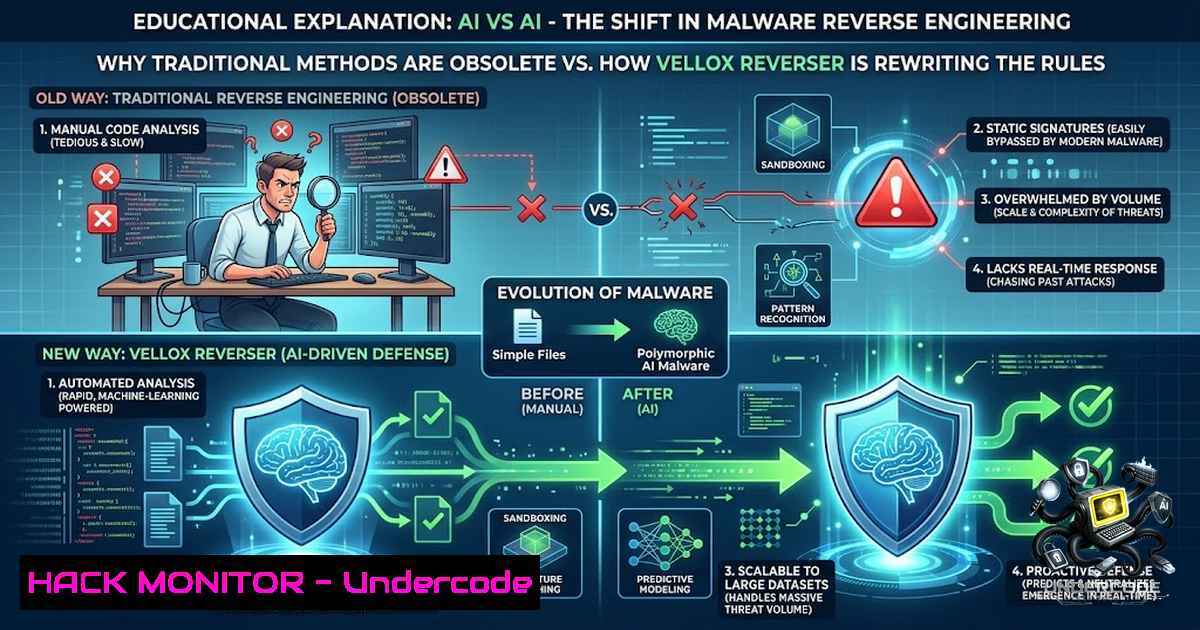
The cybersecurity industry has reached an inflection point: attackers now operate at machine speed, with AI-powered malware that can mutate, evade detection, and move laterally across networks in under 30 minutes—sometimes in seconds. Traditional reverse engineering workflows, which rely on human analysts manually unpacking and deconstructing malware over days or weeks, were never designed for this reality. Enter Vellox Reverser™, Booz Allen’s AI-1ative product that compresses malware analysis timelines from weeks to minutes by embedding decades of cyber defense tradecraft into expert-trained AI agents.
Learning Objectives
- Understand how agentic AI architectures are transforming malware reverse engineering and threat intelligence workflows
- Learn the technical underpinnings of Vellox Reverser, including its use of AWS Lambda, Amazon Bedrock, and serverless orchestration
- Acquire practical commands and techniques for integrating AI-powered malware analysis into existing security operations
You Should Know
1. The Agentic AI Revolution in Malware Analysis
Vellox Reverser represents a fundamental shift from traditional reverse engineering—which relies on highly specialized human analysts manually deconstructing malware samples—to an autonomous, AI-driven approach. Built with a resilient agentic AI architecture, the product uses intelligent agents trained on proprietary tools, instructions from Booz Allen’s in-house reverse engineers, and the company’s unique understanding of cyberthreats gained from protecting government and commercial infrastructure.
What makes this “agentic” rather than simply “automated” is the system’s ability to continuously learn from malware patterns, adapt over time, and dynamically adjust analysis strategies based on sample behavior in real time. Unlike static signature-based detection, Vellox Reverser’s AI agents don’t just match known patterns—they reason about code, unpack evasive malware, and reconstruct malicious intent with the precision of a seasoned reverse engineer.
Step-by-Step: How Agentic AI Orchestration Works
- Ingestion: Malware samples are submitted to the Vellox Reverser cloud environment
- Task Assignment: AWS Lambda functions trigger agentic workflows that decompose the analysis into discrete tasks
- Dynamic Analysis: Agentic AI orchestrators adapt analysis strategies based on observed sample behavior
- Live Binary Patching: Real-time patches are applied to force full malware execution, exposing behaviors often missed by traditional sandboxing
- Function-Level Analysis: Machine learning analyzes malware down to individual functions, uncovering hidden logic
- Report Generation: Automated reports produce executive summaries, technical findings, and MITRE ATT&CK mappings
Key Linux/Windows Commands for Traditional RE (for comparison):
 Linux: Static analysis with strings and objdump
strings -1 8 suspicious_sample | grep -i "http|cmd|powershell"
objdump -d -M intel suspicious_sample | head -100

Linux: Dynamic analysis with strace and ltrace
strace -f -e trace=file,network,process ./suspicious_sample 2>&1 | tee strace.log
ltrace -f -e '' ./suspicious_sample 2>&1 | tee ltrace.log

Windows (PowerShell): Basic PE analysis
Get-PEHeader -Path .\suspicious_sample.exe
Get-PESection -Path .\suspicious_sample.exe
Note: These commands represent the manual, time-intensive workflows that Vellox Reverser automates at machine speed.
2. Under the Hood: AWS-Powered Serverless Architecture
Vellox Reverser is built on a cloud-1ative serverless architecture using AWS Lambda and Amazon Bedrock. This architecture enables the product to scale elastically with demand, processing multiple malware samples simultaneously without provisioning dedicated infrastructure.
The orchestration layer is provided by AWS Step Functions, which uses serverless orchestration to create a decision tree that identifies the next step in threat elimination. This means the system can branch dynamically based on analysis findings—for example, if initial static analysis suggests packing or obfuscation, the workflow can automatically trigger additional unpacking and deobfuscation steps without human intervention.
Technical Deep Dive: Serverless Malware Analysis Pipeline
┌─────────────────┐ ┌──────────────────┐ ┌─────────────────────┐
│ Malware Sample │────▶│ AWS Lambda │────▶│ Amazon Bedrock │
│ Submission │ │ (Ingestion) │ │ (AI Agent Runtime) │
└─────────────────┘ └──────────────────┘ └─────────────────────┘
│
▼
┌─────────────────┐ ┌──────────────────┐ ┌─────────────────────┐
│ MITRE ATT&CK │◀────│ AWS Step │◀────│ Agentic AI │
│ Mapping │ │ Functions │ │ Orchestration │
└─────────────────┘ └──────────────────┘ └─────────────────────┘
Example AWS CLI Commands for Security Teams:
 List Lambda functions (to understand serverless footprint)
aws lambda list-functions --region us-east-1

Invoke a Lambda function for testing (simulating malware submission)
aws lambda invoke --function-1ame vellox-ingestion \
--payload '{"sample_id":"malware_001","source":"s3://malware-bucket/sample.exe"}' \
output.json

Check Step Functions state machine execution status
aws stepfunctions describe-execution \
--execution-arn arn:aws:states:us-east-1:account:execution:vellox-workflow:exec001

Monitor Bedrock model invocations
aws bedrock-runtime invoke-model \
--model-id anthropic.claude-v2 \
--body '{"prompt":"Analyze this malware behavior...","max_tokens":1000}' \
response.json
- Binary and Function Similarity Matching: From Historical Intelligence to Proactive Defense
One of Vellox Reverser’s most significant capabilities is Binary and Function Similarity Matching, a feature refined during the 2025 public preview. This capability compares newly analyzed samples against a database of previously analyzed malware sets, dramatically reducing investigation time and revealing links to broader adversarial cyber campaigns.
This isn’t just signature matching—it’s behavioral and structural similarity analysis at the function level. By understanding how malware families evolve over time, security teams can build stronger, more scalable detection and threat hunting strategies, turning historical insights into proactive defense.
Practical Application: Integrating Similarity Matching into Threat Hunting
- Submit a new suspicious file to Vellox Reverser for analysis
- The system performs function-level reverse engineering using ML
- Similarity matching algorithms compare against the database of previously analyzed samples
- If matches are found, the system reveals links to known adversary campaigns
- The generated report includes MITRE ATT&CK mappings and deployable defensive measures
Open-Source Alternatives for Function Similarity (for reference):
 Using BinDiff (IDA Pro plugin) for binary diffing
 https://www.zynamics.com/bindiff.html
bindiff --primary malware_v1.exe --secondary malware_v2.exe --output diff_report

Using Diaphora for IDA Pro
 Python script within IDA: File -> Script File -> diaphora.py

Using radare2 for basic comparison
r2 -A malware_sample1.exe

<blockquote>
  iz  list strings
  afl  list functions
   Compare with second sample manually
- The Speed Imperative: Closing the “Breakout Time” Gap
Booz Allen’s threat report, “When Cyberattacks Happen at AI Speed,” reveals a alarming trend: in 2025, the average breakout time—from initial access to lateral movement—dropped to under 30 minutes, with the fastest cases measured in seconds. Compromising the enterprise boundary, a process that once took weeks or months, can now take as little as a few minutes.
Vellox Reverser directly addresses this speed gap. In a recent evaluation of a sophisticated malware sample, the product completed analysis in just 2.5 minutes, evaluating more than 120 functions and flagging 39 as malicious. It then generated a comprehensive report with indicators of compromise mapped to the MITRE ATT&CK framework, along with deployable defensive measures for rapid response.
What This Means for Security Operations:
| Metric | Traditional RE | Vellox Reverser |
|–||–|
| Time to analyze | 7-10 days | 2.5 minutes |
| Functions analyzed | Limited by analyst capacity | 120+ per sample |
| Report generation | Manual, hours-days | Automated, instantaneous |
| MITRE ATT&CK mapping | Manual | Automated |
5. Operationalizing AI-Powered Malware Defense
For security teams looking to integrate AI-powered malware analysis into their workflows, Vellox Reverser offers several practical entry points:
Integration Capabilities:
- Seamless integration with existing security workflows and technology stacks
- API-driven submission for automated sample processing
- 30-day free trial available for hands-on evaluation
Recommended Implementation Approach:
- Phase 1 – Trial: Start with the 30-day free trial on a subset of suspicious files
- Phase 2 – Parallel Run: Run Vellox Reverser alongside existing analysis tools for validation
- Phase 3 – Workflow Integration: Automate sample submission via API for high-priority alerts
- Phase 4 – Scale: Expand to full production, clearing backlogs and boosting productivity
Sample API Integration (Conceptual):
 Conceptual API submission (not actual Vellox API)
import requests
import base64

def submit_sample(file_path):
with open(file_path, 'rb') as f:
encoded = base64.b64encode(f.read()).decode('utf-8')

response = requests.post(
'https://api.vellox.boozallen.com/v1/analyze',
headers={'Authorization': 'Bearer YOUR_API_KEY'},
json={'sample': encoded, 'filename': file_path}
)
return response.json()

Submit and retrieve results
result = submit_sample('suspicious_file.exe')
print(f"Analysis ID: {result['analysis_id']}")
print(f"Malicious functions: {result['threats_found']}")
print(f"MITRE ATT&CK: {result['mitre_mapping']}")
What Undercode Say
- Traditional reverse engineering is no longer viable against AI-powered threats—the speed and scale of modern malware variants (80% of ransomware attacks now use AI) demand autonomous, machine-speed analysis. Security teams that continue to rely on manual RE will be permanently behind.
-
The “democratization” of cyber warfare—with attackers using LLMs to build sophisticated malware without coding expertise—has created an explosion in malware variants. Vellox Reverser’s ability to analyze 120+ functions in 2.5 minutes isn’t just incremental improvement; it’s a fundamental rethinking of what’s possible in malware defense.
Analysis: The cybersecurity industry is witnessing a paradigm shift analogous to the transition from manual assembly lines to robotic automation in manufacturing. Just as robots didn’t replace human factory workers but rather augmented their capabilities and scaled production, AI-1ative tools like Vellox Reverser won’t replace human analysts—they’ll free them from tedious, repetitive analysis to focus on strategic threat hunting and response. The organizations that adopt these tools early will gain a decisive advantage, while those that cling to traditional workflows risk being overwhelmed by the sheer volume and velocity of AI-generated threats. The 7-10 days of manual work that Vellox Reverser saves per sample translates directly into faster containment, reduced dwell time, and lower breach costs.
Prediction
- +1 AI-1ative malware analysis will become the industry standard within 24-36 months, as the cost of manual RE becomes unsustainable against AI-generated threat volumes.
-
+1 The Vellox product suite will expand to create a fully autonomous cyber defense ecosystem, with Vellox Reverser feeding intelligence directly into Vellox Responder for automated remediation.
-
-1 Organizations that delay adoption of AI-powered reverse engineering will experience increased breach costs and longer dwell times, as attackers continue to outpace human-speed defenses.
-
+1 The integration of agentic AI with serverless architectures (AWS Lambda, Bedrock, Step Functions) will become the reference architecture for next-generation security products.
-
-1 As AI-powered defense becomes more widespread, attackers will develop new evasion techniques specifically targeting AI analysis systems, creating an ongoing arms race between offensive and defensive AI.
▶️ Related Video (68% Match):
https://www.youtube.com/watch?v=84i9AiIsJqs
🎯Let’s Practice For Free:
🎓 Live Courses & Certifications:
Join Undercode Academy for Verified Certifications
🚀 Request a Custom Project:
Secure, high-velocity infrastructure and disruptive technological engineering. Contact our engineering team for high-tier development and proprietary systems:
[email protected]
💎 Smart Architecture | 🛡️ Secure by Design | ⭐ Trusted by Thousands
IT/Security Reporter URL:
Reported By: Deanna De – Hackers Feeds
Extra Hub: Undercode MoN
Basic Verification: Pass ✅


