Listen to this Post
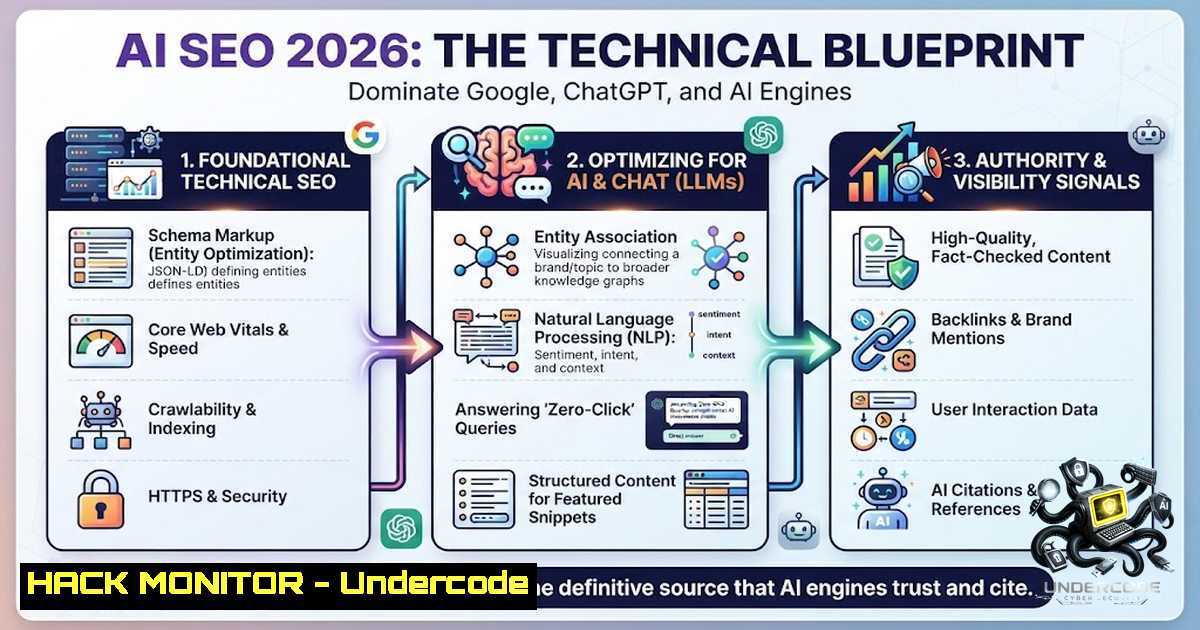
Introduction:
Search has fundamentally broken its twenty-year contract with users. The era of “ten blue links” is over—users now expect direct, synthesized answers delivered instantly by AI engines. In 2026, zero-click searches have reached roughly 60 percent of all Google queries, and AI Overviews now appear on close to half of all searches. This structural shift means traditional keyword-and-backlink SEO is no longer sufficient. The new battleground is Generative Engine Optimization (GEO)—the science of being cited as the primary source of truth inside AI-generated responses from ChatGPT, Gemini, Perplexity, Claude, and Google AI Overviews.
Learning Objectives:
- Master the technical implementation of GEO and AEO to secure citations across all major AI platforms
- Build an AI-ready technical foundation including JSON-LD schema,
llms.txt, and server-side rendering - Strengthen Entity SEO and E-E-A-T signals to become a recognizable, trusted entity in knowledge graphs
- Implement automated workflows and command-line tools to audit, track, and optimize AI visibility at scale
You Should Know:
- Understanding the Shift: From SEO to GEO and AEO
The traditional SEO playbook—optimizing for keywords, backlinks, and page-one rankings—is fighting a war that ended two years ago. Generative Engine Optimization (GEO) is the multi-disciplinary science of structuring content, brand entities, and data infrastructure so AI models select your brand as the primary source of truth. Answer Engine Optimization (AEO), a subset of GEO, focuses specifically on being the source an engine quotes when it answers a question directly.
The core difference is fundamental: SEO fights for a click on a ranked link; GEO fights for a citation inside the synthesized answer. A 2024 Princeton/KDD study found that applying GEO techniques can lift a source’s visibility by up to 40 percent in generative engine responses. However, the platforms are not interchangeable—a 2026 study of 34,234 AI responses found ChatGPT cited brands in just 0.59 percent of answers versus 13.05 percent for Perplexity, a roughly 46x gap.
To succeed, you must understand Retrieval-Augmented Generation (RAG): AI retrieves data, augments it into context, and generates a natural language answer. Your content must survive this retrieval process—if your semantic hierarchy is broken or entities lack clear definitions, the model treats your content like a malformed API response and ignores it.
2. Build an AI-Ready Technical Foundation
AI visibility starts with letting AI crawlers in. The most common reason a brand is missing from AI answers is that its site is blocking the relevant bots in robots.txt, sometimes by accident. Each AI engine runs one or more crawlers with different access patterns and rendering capabilities:
| Crawler | Operator | What It Does |
||-|–|
| GPTBot | OpenAI | Trains future ChatGPT models |
| OAI-SearchBot | OpenAI | Powers ChatGPT’s browsing/search mode—required for live citations |
| PerplexityBot | Perplexity | Crawls for Perplexity’s AI search engine |
| Google-Extended | Google | Controls whether Google can use your content for Gemini training |
| ClaudeBot / Claude-SearchBot | Anthropic | Crawls for Claude training data and search experiences |
| CCBot | Common Crawl | Open dataset used as training data by many AI models |
Step-by-Step: Configure Your `robots.txt` for AI Crawlers
- Audit current bot access by checking your `robots.txt` file (typically at
yoursite.com/robots.txt). - Allow essential AI crawlers by adding or uncommenting:
User-agent: OAI-SearchBot
Allow: /</li>
</ol>

User-agent: GPTBot
Allow: /

User-agent: PerplexityBot
Allow: /

User-agent: Google-Extended
Allow: /

User-agent: ClaudeBot
Allow: /

User-agent: Claude-SearchBot
Allow: /
3. Block unwanted crawlers if necessary, but be aware that blocking any crawler blocks the corresponding AI surface.
4. Validate your `robots.txt` using Google Search Console or Bing Webmaster Tools.Critical Technical Consideration: Many AI crawlers do a poor job with JavaScript-rendered content. Use server-side rendering or static site generation—a page that renders fine in Google Search Console can come back as empty or incomplete from an AI crawler.
3. Schema Markup: The Language AI Understands
Structured data tells AI systems what a page is about in a format they can parse without ambiguity. For GEO, schema markup reduces the guesswork AI systems must do when parsing your content. The core schema set that makes a brand citable includes:
- Organization: Declare legal name, logo, founding date, and business description—the anchor entity every engine maps other facts onto
- sameAs: Link Organization and Person entities to LinkedIn, Crunchbase, Wikipedia, and Wikidata profiles—the single highest-leverage property for disambiguation
- Person: For founder-led or expert-driven brands, mark up key individuals with credentials
- , FAQPage, HowTo: Classify content types so AI systems know what they’re reading
Step-by-Step: Implement JSON-LD Schema Markup
- Identify your primary entities: Your business, key authors, products, and content types.
- Generate JSON-LD schema using Schema.org vocabulary. Example for Organization:
</li>
</ol>

<script type="application/ld+json">
{
"@context": "https://schema.org",
"@type": "Organization",
"name": "Your Company Name",
"url": "https://yoursite.com",
"logo": "https://yoursite.com/logo.png",
"sameAs": [
"https://linkedin.com/company/yourcompany",
"https://crunchbase.com/organization/yourcompany"
],
"foundingDate": "2020-01-01",
"description": "What your company does"
}
</script>
3. Add Person schema for authors on blog posts and about pages:
<script type="application/ld+json">
{
"@context": "https://schema.org",
"@type": "Person",
"name": "Dr. Jane Doe",
"jobTitle": "Chief AI Strategist",
"worksFor": {
"@type": "Organization",
"name": "Your Company"
},
"sameAs": [
"https://linkedin.com/in/janedoe"
]
}
</script>
4. Validate JSON-LD schema on every deployment—broken markup is worse than no markup. Use Google’s Rich Results Test or Schema.org’s validator.
5. Keep entity references consistent with the same `@id` URLs so AI models build a unified knowledge graph.4. The `llms.txt` Standard: Direct Access for AI
The emerging `llms.txt` standard is a low-effort signal worth implementing—a file that gives AI direct access to your key content. Think of it as a sitemap specifically for large language models.
Step-by-Step: Create Your `llms.txt` File
- Create a file at `yoursite.com/llms.txt` (similar to
robots.txt). - List your most important content in a machine-readable format:
LLMs.txt for YourSite.com
Last updated: 2026-07-12</li>
</ol>

Core Documentation
- https://yoursite.com/about
- https://yoursite.com/services
- https://yoursite.com/contact

Key Articles
- https://yoursite.com/blog/ai-seo-2026
- https://yoursite.com/blog/technical-geo-guide

API Documentation
- https://yoursite.com/api/docs
3. Update regularly as you publish new high-value content.
4. Monitor whether AI engines reference this file—while no AI engine officially requires it yet, it’s a future-proofing signal.- Audit and Track AI Visibility with Open-Source Tools
Traditional SEO tools track rankings but fail to explain why an LLM chose to cite Competitor A over Competitor B. The open-source GEO Optimizer toolkit (from Auriti-Labs) solves this—it audits, optimizes, and tracks whether ChatGPT, Perplexity, Gemini, Claude, and Google AI Overviews can crawl, understand, and cite your website.
Step-by-Step: Run a GEO Audit with GEO Optimizer
1. Install GEO Optimizer (requires Python 3.8+):
 Zero install method (recommended)
uvx --from geo-optimizer-skill geo audit --url https://yoursite.com

Or install globally
pip install geo-optimizer-skill
geo audit --url https://yoursite.com
This scores your site 0–100 on AI-search readiness against 47 research-backed methods.
2. Generate a detailed report with specific fixes:
geo audit --url https://yoursite.com --format json --output geo-report.json
3. Check citation status across specific AI engines:
geo check --url https://yoursite.com --engine chatgpt
geo check --url https://yoursite.com --engine perplexity
geo check --url https://yoursite.com --engine gemini
- Monitor changes over time by running audits weekly and tracking your score.
Alternative: Track with SERP APIs
Use APIs like Serpstack and Zenserp to programmatically monitor SERP features, scrape generated answers, analyze citation patterns, and reverse-engineer the “preference” of these models.
- Entity SEO and E-E-A-T: Becoming a Recognized Entity
Google’s shift to “things, not strings” means optimizing for entities is now essential. As Jason Barnard explains: “If Google understands who you are, then it can apply [E-E-A-T] signals fully. If it has to guess who you are, then it can only apply them in a dampened manner”. Your great content and links won’t count for nearly as much if Google can’t tie them to a credible entity.
Step-by-Step: Build Entity Authority
- Designate an “Entity Home” on your website—typically your About Us page—that explicitly describes your organization or yourself.
- Use consistent entity references across your site and the web. The same company name, logo, and description should appear everywhere.
- Highlight authors with credentials—create author pages with Person schema, brief bios, and links to professional profiles.
- Build corroborating mentions across LinkedIn, Crunchbase, Wikipedia, Wikidata, and industry publications.
- Feed the machine the right information so it can verify your EEAT signals.
7. Content Strategy for AI Extraction
AI doesn’t pick the best page and show it—it picks the best fragments from many pages and weaves them together. Content that is one long unbroken argument is hard to ground; content that states a fact in one sentence, defines a term cleanly, and backs a number with a source is easy to ground.
Step-by-Step: Optimize Content for AI Extraction
- Use the inverted pyramid structure—put the most important information first.
- Write concise, data-dense sentences that can stand alone as fragments.
- Cite credible sources within your content—the most effective single GEO technique produced a 115.1% visibility increase for websites that weren’t already ranking in top positions.
- Avoid authoritative or persuasive tone—AI systems don’t respond to rhetorical style; they respond to verifiable information.
- Cover related questions and subtopics to build topical authority.
- Use clear headings (H1, H2, H3) to structure content for AI parsing.
What Undercode Say:
- GEO is not a replacement for SEO—it’s a layer on top of it. AEO and GEO sit on top of solid SEO. You still need crawlable pages, fast load times, and clean HTML.
-
AI visibility is not one channel—it’s many. ChatGPT, Perplexity, Gemini, Claude, and Google AI Overviews each retrieve from different source pools, weight different signals, and cite brands at wildly different rates, sometimes by a factor of more than 40x for the same query. A one-size-fits-all approach fails.
-
Citation frequency is the new primary metric. In GEO, 8-15% citation frequency is good; 15-25% is market leader territory. Track this instead of (or alongside) traditional CTR.
-
AI-referred traffic converts at 4-5x the rate of standard organic traffic. This isn’t about losing traffic—it’s about gaining higher-quality, more qualified visitors who are looking to verify the source.
-
The window for free AI citations is closing. AI citations are still earnable through content and PR, but SEO veterans warn that window is closing fast—some categories are already fenced off. The time to act is now.
Prediction:
-
+1 AI search will account for over 25% of all informational queries by the end of 2027, up from 12-18% in early 2026. Organizations that build GEO capabilities now will have a compounding first-mover advantage.
-
+1 The `llms.txt` standard will become officially required by major AI engines within 18-24 months, similar to how `sitemap.xml` became standard for search engines.
-
-1 Brands that fail to implement proper AI crawler access and schema markup will become functionally invisible in AI-generated answers, regardless of their traditional search rankings.
-
-1 The gap between AI citation rates across platforms will widen, forcing organizations to develop platform-specific optimization strategies rather than one unified approach.
-
+1 Open-source tools like GEO Optimizer will become essential infrastructure for digital teams, similar to how Google Search Console became standard for SEO.
-
+1 AI visibility will become a reportable line item in marketing budgets, with clients demanding to know why competitors appear in ChatGPT answers and they don’t.
▶️ Related Video (76% Match):
https://www.youtube.com/watch?v=39o0uYPo4jU
🎯Let’s Practice For Free:
🎓 Live Courses & Certifications:
Join Undercode Academy for Verified Certifications
🚀 Request a Custom Project:
Secure, high-velocity infrastructure and disruptive technological engineering. Contact our engineering team for high-tier development and proprietary systems:
[email protected]
💎 Smart Architecture | 🛡️ Secure by Design | ⭐ Trusted by ThousandsIT/Security Reporter URL:
Reported By: Digi Dinesh – Hackers Feeds
Extra Hub: Undercode MoN
Basic Verification: Pass ✅🔐JOIN OUR CYBER WORLD [ CVE News • HackMonitor • UndercodeNews ]
📢 Follow UndercodeTesting & Stay Tuned:
- Create a file at `yoursite.com/llms.txt` (similar to


