Listen to this Post
Introduction
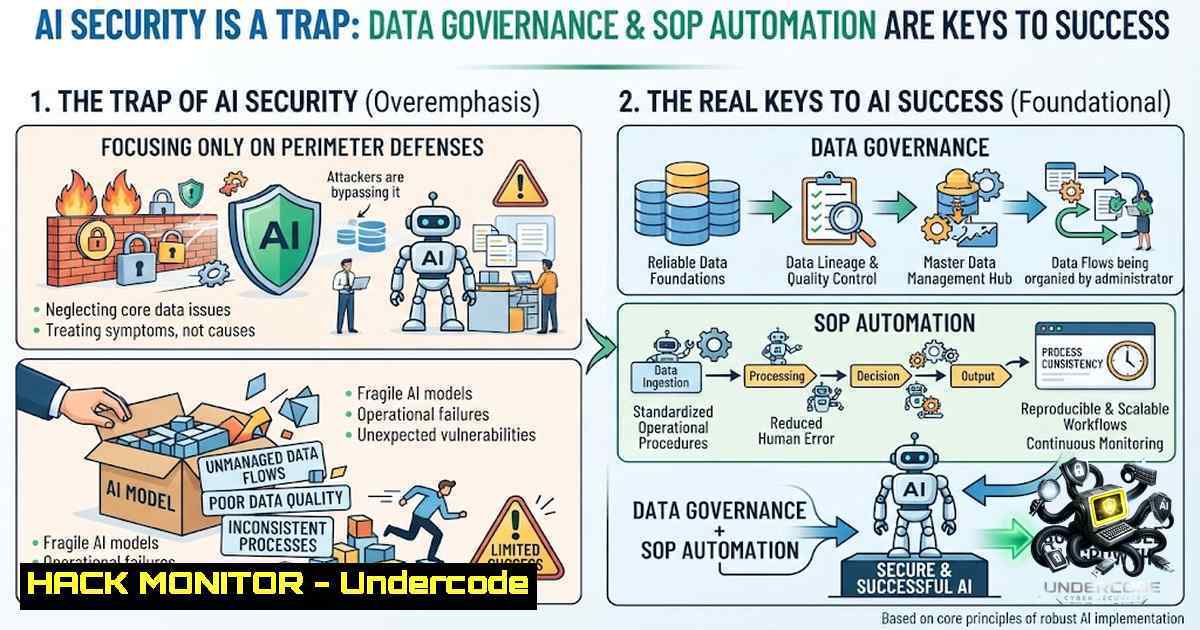
Organizations are rapidly deploying artificial intelligence systems expecting transformative results, only to find themselves producing erroneous outputs at unprecedented speed. The fundamental problem isn’t the AI technology itself but the operational chaos it’s being pointed at. AI doesn’t possess magical intuition that untangles years of poor documentation and inconsistent processes—it simply accelerates whatever already exists, polished or flawed.
Learning Objectives
- Understand the critical importance of data architecture and process documentation before AI implementation
- Master the three pillars of AI-ready infrastructure: structure, upkeep, and access
- Learn practical techniques for mapping organizational workflows using AI-assisted interviews
- Identify and mitigate the “exception gap” where undocumented human judgment breaks automated systems
- Implement continuous feedback loops to prevent AI systems from degrading over time
You Should Know
1. The Three Pillars of AI-Ready Infrastructure
The foundation for successful AI implementation rests on three non-1egotiable pillars that must be established before any automation begins.
Structure requires that your information exists in a shape AI can actually read. This means one owner per workflow, one source of truth for pricing, brand, and process—not five versions scattered across five tools that disagree with each other. Without this structural integrity, AI systems will confidently generate incorrect outputs at scale.
Upkeep demands a written standard for what “good” looks like, a decision log, and a feedback loop. This ensures your AI system stays honest instead of quietly rotting back into operational chaos. Regular audits and validation checks prevent the subtle degradation that often goes unnoticed until major failures occur.
Access requires a comprehensive list of every tool and login, with no critical information trapped inside one person’s head. This eliminates single points of failure and ensures continuity when team members leave or change roles.
Step-by-step guide to assessing your AI readiness:
- Audit your current data sources – Document every tool, database, and spreadsheet containing operational information
- Identify conflicting data – Find instances where the same information exists in multiple places with different values
- Establish ownership – Assign one person per workflow as the authoritative source
- Create your “source of truth” – Consolidate conflicting information into a single, authoritative location
- Document the standard – Write down what “good” looks like for each process, including decision criteria
- List all access points – Create a complete inventory of credentials, tools, and documentation
Linux commands for data auditing:
 Find all configuration files across the system
find / -1ame ".conf" -o -1ame ".cfg" -o -1ame ".ini" 2>/dev/null

Audit file permissions for sensitive directories
ls -la /etc/ /var/ /home/ | grep -E "(passwd|shadow|config)"

Check for duplicate files that might create data inconsistencies
find / -type f -exec md5sum {} \; 2>/dev/null | sort | uniq -w32 -dD
Windows PowerShell commands for data auditing:
 Find all configuration files
Get-ChildItem -Path C:\ -Recurse -Include .conf,.cfg,.ini -ErrorAction SilentlyContinue

Check file permissions on sensitive directories
icacls C:\Windows\System32\config\

Find duplicate files
Get-ChildItem -Recurse | Get-FileHash | Group-Object -Property Hash | Where-Object Count -gt 1
2. Process Mapping Using AI-Assisted Interviews
The most overlooked step in AI implementation is capturing the undocumented expertise that lives in your team members’ heads. Rather than building this documentation manually, you can leverage AI to interview team members about how they actually perform their jobs. This approach yields structured documents covering steps, rules, and formats in days instead of months.
The key insight here is that people rarely document the exceptions and judgment calls they make instinctively. When an AI system is built solely from documented procedures, it will quietly break when encountering situations that require this undocumented judgment.
Step-by-step guide to conducting AI-assisted process mapping:
- Select the right person – Choose someone who performs the process well and can articulate their workflow
- Define interview scope – Clearly identify the specific process to be mapped
- Ask about standard steps – Document the typical flow from start to finish
- Probe for exceptions – Ask “What happens when…” questions to surface variations
- Capture decision points – Document every point where judgment is required
- Identify warning signs – Ask what signals indicate something is going wrong
- Have a second person validate – Run someone else through the document cold to identify gaps
Python script for interview transcription and analysis:
import os
import json
from datetime import datetime

class ProcessInterview:
def <strong>init</strong>(self, process_name, interviewee):
self.process_name = process_name
self.interviewee = interviewee
self.timestamp = datetime.now().isoformat()
self.standard_steps = []
self.exceptions = []
self.decision_points = []
self.warning_signs = []
self.artifacts = []

def add_standard_step(self, step, description, owner, tools_used):
self.standard_steps.append({
"step": step,
"description": description,
"owner": owner,
"tools": tools_used
})

def add_exception(self, scenario, handling):
self.exceptions.append({
"scenario": scenario,
"handling": handling
})

def export_to_sop(self):
sop = f" Standard Operating Procedure: {self.process_name}\n\n"
sop += f"Owner: {self.interviewee}\n"
sop += f"Last Updated: {self.timestamp}\n\n"
sop += " Standard Workflow\n\n"
for step in self.standard_steps:
sop += f" Step {step['step']}: {step['description']}\n"
sop += f"- Owner: {step['owner']}\n"
sop += f"- Tools: {', '.join(step['tools'])}\n\n"
if self.exceptions:
sop += " Exceptions and Edge Cases\n\n"
for exception in self.exceptions:
sop += f"- {exception['scenario']}: {exception['handling']}\n"
return sop

Usage example
interview = ProcessInterview("Client Onboarding", "Sarah Johnson")
interview.add_standard_step("1", "Receive client inquiry", "Sarah", ["CRM", "Email"])
interview.add_standard_step("2", "Collect client information", "Sarah", ["CRM", "Form"])
interview.add_exception("Client references private lender", "Escalate to finance for verification")
with open("onboarding_sop.md", "w") as f:
f.write(interview.export_to_sop())
3. Creating Your Source of Truth Repository
Everything must feed into one source of truth—one place your business actually remembers things, that every AI tool reads from and writes back to. This eliminates the data conflicts and fragmentation that cause AI systems to produce garbage.
Git-based documentation structure:
docs/
├── processes/
│ ├── onboarding.md
│ ├── billing.md
│ └── support.md
├── decisions/
│ ├── 2024/
│ │ └── q1_decisions.md
│ └── current_decisions.md
├── standards/
│ ├── data_quality.md
│ ├── security_policy.md
│ └── compliance.md
├── tools/
│ ├── inventory.md
│ └── access_matrix.md
└── README.md
Automating documentation with Git hooks:
!/bin/bash
 .git/hooks/pre-commit - Validate documentation before commit

echo "Validating documentation structure..."

Check that required directories exist
if [ ! -d "docs/processes" ]; then
echo "Error: docs/processes directory missing"
exit 1
fi

Check for required metadata in markdown files
for file in docs/processes/.md; do
if ! grep -q " Owner:" "$file"; then
echo "Warning: $file missing owner metadata"
fi
done

echo "Documentation validation complete"
4. Continuous Feedback Loop Implementation
A written standard for what “good” looks like, a decision log, and a feedback loop prevents AI systems from degrading over time. Without this, AI systems quietly rot back into operational chaos.
Step-by-step guide to implementing a feedback loop:
- Define what “good” looks like – Create measurable standards for output quality
- Log all decisions – Document every decision the AI makes, including context
- Collect human validation – Have subject matter experts review AI outputs
- Track exceptions – Document every case where the AI’s output required human correction
- Run regular audits – Schedule periodic reviews of AI decision logs
- Update training data – Incorporate validated corrections into your training set
- Adjust thresholds – Fine-tune confidence thresholds and decision rules based on audit results
Creating an audit log with Python:
import logging
import json
from datetime import datetime

class AIAuditLogger:
def <strong>init</strong>(self, log_file="audit.log"):
logging.basicConfig(
filename=log_file,
level=logging.INFO,
format='%(asctime)s - %(levelname)s - %(message)s'
)

def log_decision(self, process_id, input_data, output, confidence, human_review=None):
entry = {
"timestamp": datetime.now().isoformat(),
"process_id": process_id,
"input": input_data,
"output": output,
"confidence": confidence,
"human_review": human_review
}
logging.info(json.dumps(entry))

def log_exception(self, process_id, exception, resolution):
entry = {
"timestamp": datetime.now().isoformat(),
"process_id": process_id,
"type": "EXCEPTION",
"exception": exception,
"resolution": resolution
}
logging.warning(json.dumps(entry))

def get_audit_report(self, start_date, end_date):
 Parse log and generate report
pass

audit = AIAuditLogger()
audit.log_decision(
process_id="onboarding_001",
input_data={"client": "ABC Corp", "size": "Enterprise"},
output={"risk_score": 0.3, "required_checks": ["financial"]},
confidence=0.87,
human_review="approved"
)
5. Security and Access Management
One comprehensive list of every tool and login is essential, with nothing important trapped inside one person’s head. This requires implementing proper access control and credential management.
Password and access management best practices:
 Windows - Audit Active Directory users and groups
Get-ADUser -Filter  -Properties MemberOf | Select-Object Name, MemberOf

Windows - List all local user accounts
Get-LocalUser

Windows - Check service account permissions
Get-Service | Where-Object {$_.ServiceType -eq "Win32OwnProcess"} |
Select-Object Name, ServiceType, StartName
Linux access auditing commands:
 List all users and their groups
for user in $(cut -d: -f1 /etc/passwd); do
echo "User: $user, Groups: $(id -Gn $user)";
done

Check sudo access
grep -v '^' /etc/sudoers | grep -v '^$'

Find all files with SUID/SGID bits set
find / -type f ( -perm -4000 -o -perm -2000 ) -exec ls -la {} \; 2>/dev/null

Check for SSH keys across the system
find /home -1ame "id_rsa" -o -1ame "id_dsa" -o -1ame "authorized_keys" 2>/dev/null
Centralized credential management approach:
 credential_inventory.yaml
tools:
crm:
name: "SalesForce"
owner: "Sales Team Lead"
access_level: "Team members, Management"
last_review: "2024-01-15"
database:
name: "PostgreSQL"
owner: "DevOps Lead"
access_level: "Engineers, QA"
last_review: "2024-01-10"
ai_system:
name: "Custom GPT Interface"
owner: "AI Specialist"
access_level: "All team members"
last_review: "2024-01-12"
6. Moving from Documentation to Automation
Once a workflow is written down properly, it’s one step away from becoming an agent itself. The transition from documented process to automated agent requires careful implementation.
Step-by-step guide for agent creation:
- Validate the documentation – Ensure the SOP accurately reflects the actual process
- Identify automation boundaries – Determine what can be automated vs. what requires human judgment
- Break down into steps – Create discrete, testable components
- Implement error handling – Build in exception handling for every edge case documented
- Start with a pilot – Run the agent alongside humans for validation
- Collect performance data – Measure accuracy, speed, and exception rate
- Iterate and improve – Update based on real-world performance data
Sample agent configuration in YAML:
 agent_config.yaml
name: "ClientOnboardingAgent"
version: "1.0.0"
sop_reference: "docs/processes/onboarding.md"
steps:
- id: "receive_inquiry"
action: "email_monitor"
parameters:
mailbox: "[email protected]"
subject_pattern: "New Client Inquiry"
next_on_success: "validate_client"
next_on_failure: "escalate_human"
- id: "validate_client"
action: "api_call"
parameters:
endpoint: "https://api.riskcheck.com/validate"
timeout: 30
next_on_success: "assign_team"
next_on_failure: "manual_review"
exceptions:
- condition: "risk_score > 0.7"
action: "escalate_management"
- condition: "missing_documents"
action: "trigger_email_notification"
7. Maintaining AI System Integrity Over Time
AI systems are not set-and-forget implementations. Regular maintenance and oversight are essential to prevent degradation.
Key maintenance activities:
- Monthly accuracy audits against human-validated samples
- Quarterly process reviews to update for business changes
- Continuous feedback integration from human operators
- Regular security reviews and permission audits
- Performance monitoring against baseline metrics
Monitoring script for AI system performance:
import requests
import json
from datetime import datetime, timedelta

class AIMonitor:
def <strong>init</strong>(self, api_endpoint, threshold=0.85):
self.api_endpoint = api_endpoint
self.threshold = threshold
self.history = []

def test_accuracy(self, test_cases):
results = []
for case in test_cases:
response = requests.post(f"{self.api_endpoint}/predict", json=case["input"])
prediction = response.json()
correct = prediction["result"] == case["expected"]
results.append({
"input": case["input"],
"predicted": prediction["result"],
"expected": case["expected"],
"confidence": prediction.get("confidence", 0.0),
"correct": correct
})
accuracy = sum(1 for r in results if r["correct"]) / len(results)
self.history.append({
"timestamp": datetime.now().isoformat(),
"accuracy": accuracy
})
return results, accuracy

def trigger_alert(self, message):
 Send alert to monitoring system
print(f"ALERT: {message}")
 Could integrate with Slack, PagerDuty, etc.

monitor = AIMonitor("https://api.ai-system.com/v1")
test_data = [
{"input": {"client_type": "Enterprise", "size": 1000}, "expected": "Full Review"},
{"input": {"client_type": "SMB", "size": 10}, "expected": "Quick Review"}
]
results, accuracy = monitor.test_accuracy(test_data)
if accuracy < monitor.threshold:
monitor.trigger_alert(f"Accuracy dropped to {accuracy:.2%}")
What Undercode Say
- Key Takeaway 1: The phrase “garbage in, garbage out” has evolved into “garbage in, garbage at warp speed.” AI success depends entirely on the quality and structure of your underlying data architecture.
- Key Takeaway 2: Most AI project failures aren’t technology failures—they’re foundation failures. Organizations that invest in documentation, data governance, and process mapping before automation consistently outperform those that rush to implement AI on chaotic systems.
Analysis: The conversation highlights a critical insight that’s often overlooked in the rush to implement AI: operational clarity is the prerequisite for automation success. The feedback loop between documented processes and actual human judgment creates a governance framework that prevents AI systems from degrading over time. The technique of using AI to interview team members and build documentation is particularly valuable because it accelerates what is traditionally a months-long process. The “exception gap”—where human intuition and undocumented judgment come into play—represents the single biggest risk factor in AI implementation. Organizations that validate their documentation through multiple perspectives before automation are far more likely to succeed. The discussion also reveals that AI systems are mirrors of organizational health; they amplify both strengths and weaknesses without discrimination. Building a comprehensive source of truth repository addresses the fragmentation that plagues most organizations and enables AI systems to operate with the context they need to be effective.
Prediction
- +1 Organizations that implement the groundwork approach described here will achieve 3-5x better ROI on their AI investments compared to those that rush to implementation. The methodical approach to documentation and process mapping will become a competitive advantage that separates successful AI adopters from those who waste resources.
-
+1 The technique of using AI to interview team members and build process documentation will evolve into a standard consulting practice, creating an entirely new category of AI service delivery. This democratization of process mapping will enable small and medium businesses to achieve AI implementation success rates previously reserved for enterprises with large consulting budgets.
-
-1 Failure to address the “exception gap” documented in this discussion will become the leading cause of AI system failures in the next 12-18 months, as more organizations rush to implement agents without proper validation. The industry will see a wave of post-implementation failures that could set back AI adoption by creating skepticism about its value.
-
-1 Organizations that skip the groundwork will face growing technical debt and operational chaos as their AI systems produce increasingly confident but increasingly incorrect outputs. The polished presentation of these errors will make them harder to detect and correct, leading to costly operational mistakes that multiply as AI usage expands.
-
+1 The standardization of data governance and process documentation through frameworks like the one described will create new opportunities for AI interoperability and workflow integration between organizations, fostering ecosystem-level innovation that benefits the entire industry.
▶️ Related Video (72% Match):
https://www.youtube.com/watch?v=3A855rN_9pE
🎯Let’s Practice For Free:
🎓 Live Courses & Certifications:
Join Undercode Academy for Verified Certifications
🚀 Request a Custom Project:
Secure, high-velocity infrastructure and disruptive technological engineering. Contact our engineering team for high-tier development and proprietary systems:
[email protected]
💎 Smart Architecture | 🛡️ Secure by Design | ⭐ Trusted by Thousands
IT/Security Reporter URL:
Reported By: Nicholas Puruczky – Hackers Feeds
Extra Hub: Undercode MoN
Basic Verification: Pass ✅


