Listen to this Post
Introduction
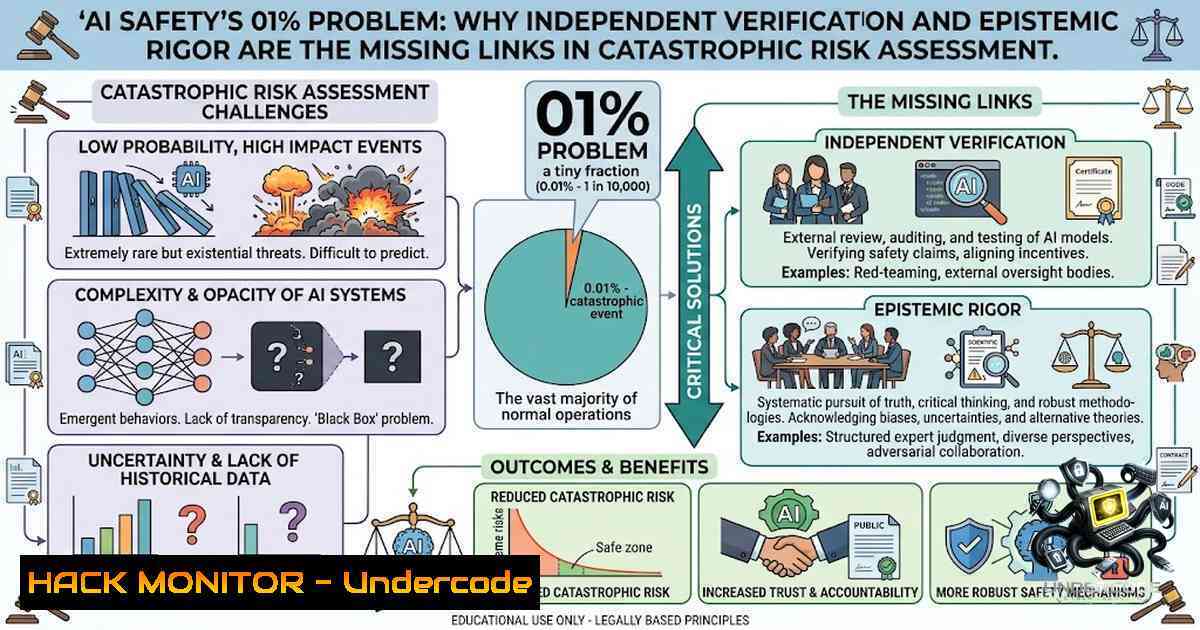
The artificial intelligence community finds itself at a critical juncture where traditional performance metrics—accuracy, benchmark scores, and publication velocity—fail to address the fundamental challenge of catastrophic system failure. While mainstream AI research celebrates 99.9% success rates, the emerging field of AI safety and alignment must confront a sobering reality: that remaining 0.1% may represent the difference between beneficial deployment and existential risk. This epistemic gap, identified by Professor Keivan Navaie in forthcoming research published in Springer Nature’s Artificial Intelligence Review, demands a fundamental rethinking of how we validate, verify, and govern AI systems capable of causing widespread harm.
Learning Objectives
- Understand the epistemic limitations of current AI safety research and the need for independent verification frameworks
- Master the ECAISA (Epistemic Code for AI Safety and Alignment) principles and their practical implementation
- Develop capabilities to implement technical controls, logging mechanisms, and verification procedures for AI systems in production environments
You Should Know
1. The Epistemic Gap: Moving Beyond Average-Case Performance
The fundamental challenge in AI safety lies in assessing catastrophic failure under conditions of sparse evidence and fat-tailed risk. Unlike traditional software engineering, where systems can be tested to failure in controlled environments, AI systems that could cause catastrophic harm cannot ethically be pushed to their breaking points. This creates what Navaie identifies as an “epistemic gap”—a disconnect between the evidential standards common in mainstream AI research and those required for safety-critical systems.
The aviation industry provides a compelling parallel. As Ewa Węgrzynek, an aviation quality professional, points out, the rigor of DO-178C and AC 25.1309-1B standards is not merely about documentation—it’s backed by mandatory incident reporting, independent accident investigators with statutory authority, and regulators who can ground entire fleets. AI safety lacks this institutional enforcement machinery, making it what Donald A. describes as a system that “may reward well-documented claims without proving the underlying system is understood or controllable.”
Technical Implementation: Verifying AI System Boundaries
To implement epistemic rigor in practice, organizations must establish verification mechanisms that go beyond standard logging. Here are essential commands and configurations for Linux and Windows environments:
Linux System Monitoring for AI Workloads:
 Monitor system resources for AI model execution
htop
 Track all processes with detailed resource usage
ps aux --sort=-%mem | head -20

Set up auditd for comprehensive system call logging
sudo apt-get install auditd audispd-plugins
 Create audit rules for AI model execution
sudo auditctl -a exit,always -F uid=1000 -S execve
 Monitor file access for model weights
sudo auditctl -w /opt/ai_models/ -p rwxa -k ai_model_access

Implement process restrictions with AppArmor
sudo aa-status
 Create profile for AI runtime
sudo aa-genprof /usr/local/bin/ai-runtime
Windows PowerShell for AI System Auditing:
 Enable advanced process auditing
auditpol /set /subcategory:"Process Creation" /success:enable /failure:enable

Monitor AI service performance
Get-Counter -Counter "\Process(ai-runtime)\% Processor Time" -SampleInterval 2 -MaxSamples 10

Track access to model directories
Get-WinEvent -LogName Security | Where-Object { $_.Id -in 4663, 4664 } | Select-Object TimeCreated, Message

Enable Windows Defender Application Guard for AI sandboxing
Set-MpPreference -EnableControlledFolderAccess Enabled
Add-MpPreference -ControlledFolderAccessProtectedFolders "C:\AIModels"
2. ECAISA Framework Implementation: Eight Principles for Verification
The ECAISA framework proposed by Navaie offers a structured approach to improving safety claims through eight core principles, a scoring rubric, and a disclosure ladder. The framework’s strength lies not in certification but in making safety claims “better documented, independently checkable and open to challenge,” as Navaie states.
Donald A.’s critique, however, raises important considerations: “Scoring rubrics and disclosure ladders can also become another compliance layer that rewards well-documented claims without proving the underlying system is understood or controllable.” This highlights the need for technical controls that enforce rather than merely document safety practices.
Technical Implementation: Container Security and Isolation
Docker Security Configuration:
 Create secure Dockerfile with non-root user and minimal permissions
FROM python:3.11-slim
RUN useradd -m -u 1000 aimodel && \
apt-get update && \
apt-get install -y --1o-install-recommends \
libsecp256k1-dev \
&& rm -rf /var/lib/apt/lists/
USER aimodel
WORKDIR /home/aimodel
COPY --chown=aimodel:aimodel requirements.txt .
RUN pip install --1o-cache-dir -r requirements.txt
COPY --chown=aimodel:aimodel . .

Run with minimal capabilities
docker run --rm \
--cap-drop ALL \
--cap-add NET_BIND_SERVICE \
--read-only \
--tmpfs /tmp \
--security-opt=no-1ew-privileges \
-v /opt/ai_models/readonly:/models:ro \
aimodel:latest
Kubernetes Pod Security for AI Workloads:
apiVersion: v1
kind: Pod
metadata:
name: ai-inference-pod
annotations:
container.apparmor.security.beta.kubernetes.io/ai-container: runtime/default
spec:
securityContext:
runAsNonRoot: true
runAsUser: 1000
fsGroup: 2000
seccompProfile:
type: RuntimeDefault
containers:
- name: ai-container
image: ai-inference:latest
securityContext:
allowPrivilegeEscalation: false
readOnlyRootFilesystem: true
capabilities:
drop: ["ALL"]
resources:
limits:
cpu: "4"
memory: "16Gi"
nvidia.com/gpu: "1"
3. Independent Verification and Auditability: Operationalizing Challenge
Scott Lee raises a crucial distinction: “auditability is not certification.” The question extends beyond whether a claim can be reconstructed and challenged—it becomes whether that claim “may be relied upon for one complete, exact proposed action now.” Organizations must implement systems that maintain what Lee calls “the last reversible moment”—the point at which an AI decision can still be questioned, rolled back, or escalated.
This requires traceability at multiple levels: the evidence retrieved, policies applied, model versions, prompts, approvals, and the chain of decisions leading to outcomes. As Robert Schneider notes, “without that provenance, independent verification becomes extraordinarily difficult.”
Technical Implementation: Logging and Traceability Systems
Centralized Logging with ELK Stack Configuration:
 docker-compose.yml for audit logging
version: '3'
services:
elasticsearch:
image: docker.elastic.co/elasticsearch/elasticsearch:8.10.0
environment:
- discovery.type=single-1ode
- xpack.security.enabled=false
volumes:
- es_data:/usr/share/elasticsearch/data
ports:
- "9200:9200"

logstash:
image: docker.elastic.co/logstash/logstash:8.10.0
volumes:
- ./logstash.conf:/usr/share/logstash/pipeline/logstash.conf
ports:
- "5000:5000"

kibana:
image: docker.elastic.co/kibana/kibana:8.10.0
ports:
- "5601:5601"
environment:
- ELASTICSEARCH_HOSTS=http://elasticsearch:9200
Logstash Configuration for AI System Auditing:
 logstash.conf
input {
file {
path => "/var/log/ai-system/.log"
start_position => "beginning"
sincedb_path => "/dev/null"
}
}

filter {
grok {
match => {
"message" => "%{TIMESTAMP_ISO8601:timestamp} [%{LOGLEVEL:level}] %{GREEDYDATA:component} - %{GREEDYDATA:details}"
}
}
json {
source => "details"
target => "ai_audit"
}
date {
match => [ "timestamp", "ISO8601" ]
target => "@timestamp"
}
}

output {
elasticsearch {
hosts => ["elasticsearch:9200"]
index => "ai-audit-%{+YYYY.MM.dd}"
}
}
Python Implementation for AI Decision Traceability:
import json
import hashlib
from datetime import datetime
from typing import Dict, Any
import logging

class AIDecisionAuditor:
def <strong>init</strong>(self, audit_log_path: str):
self.audit_log_path = audit_log_path
logging.basicConfig(
filename=audit_log_path,
level=logging.INFO,
format='%(asctime)s [%(levelname)s] %(message)s'
)

def record_decision(self,
decision_id: str,
model_version: str,
prompt: str,
evidence: Dict[str, Any],
policies_applied: list,
output: Any,
confidence: float) -> str:
"""Record an AI decision with full traceability"""

decision_record = {
"decision_id": decision_id,
"timestamp": datetime.utcnow().isoformat(),
"model_version": model_version,
"prompt_hash": hashlib.sha256(prompt.encode()).hexdigest(),
"evidence": evidence,
"policies_applied": policies_applied,
"output": output,
"confidence": confidence,
"decision_hash": hashlib.sha256(json.dumps({
"decision_id": decision_id,
"output": str(output)
}, sort_keys=True).encode()).hexdigest()
}

logging.info(json.dumps(decision_record))
return decision_record["decision_hash"]

def retrieve_decision(self, decision_id: str) -> Dict[str, Any]:
"""Retrieve a decision record from audit logs"""
import os
records = []
with open(self.audit_log_path, 'r') as f:
for line in f:
try:
record = json.loads(line.split('] ')[bash])
if record.get('decision_id') == decision_id:
records.append(record)
except:
continue
return records
4. API Security and Model Access Control
When deploying AI systems in production environments, API security becomes paramount. Organizations must implement robust authentication, authorization, and monitoring to prevent unauthorized access to model endpoints and data poisoning attacks.
Technical Implementation: API Gateway with Rate Limiting
Nginx Configuration for AI API Gateway:
 /etc/nginx/sites-available/ai-gateway
upstream ai_backend {
server 127.0.0.1:8000 max_fails=3 fail_timeout=30s;
server 127.0.0.1:8001 max_fails=3 fail_timeout=30s;
}

limit_req_zone $binary_remote_addr zone=api_limit:10m rate=10r/s;
limit_req_zone $binary_remote_addr zone=ai_limit:10m rate=1r/m;

server {
listen 443 ssl http2;
server_name ai-api.example.com;

ssl_certificate /etc/ssl/certs/ai-api.crt;
ssl_certificate_key /etc/ssl/private/ai-api.key;

location /api/v1/inference {
limit_req zone=ai_limit burst=2 nodelay;
limit_req_status 429;

proxy_pass http://ai_backend;
proxy_set_header Host $host;
proxy_set_header X-Real-IP $remote_addr;
proxy_set_header X-Forwarded-For $proxy_add_x_forwarded_for;

Enhanced logging for audit
access_log /var/log/nginx/ai-inference.log inference_log;

Response caching for idempotent requests
proxy_cache ai_cache;
proxy_cache_key "$request_uri|$request_body";
proxy_cache_valid 200 302 1h;
proxy_cache_valid 404 1m;
proxy_cache_bypass $http_cache_control;
}

location /api/v1/health {
access_log off;
return 200 "OK\n";
add_header Content-Type text/plain;
}
}

Custom log format for audit
log_format inference_log '$remote_addr - $remote_user [$time_local] "$request" '
'$status $body_bytes_sent "$http_referer" '
'"$http_user_agent" "$http_x_forwarded_for" '
'rt=$request_time uct="$upstream_connect_time" '
'uht="$upstream_header_time" urt="$upstream_response_time" '
'cache_status="$upstream_cache_status"';
Python API with Authentication and Rate Limiting:
from fastapi import FastAPI, HTTPException, Depends, Request
from fastapi.security import HTTPBearer, HTTPAuthorizationCredentials
import redis
import jwt
from datetime import datetime, timedelta
import os

app = FastAPI()
security = HTTPBearer()
redis_client = redis.Redis(host='localhost', port=6379, decode_responses=True)

Configuration
SECRET_KEY = os.getenv('JWT_SECRET_KEY', 'your-secret-key-here')
MODEL_ACCESS_CONTROL = {
'enterprise': {'daily_limit': 10000, 'models': ['gpt-4', 'claude-3']},
'standard': {'daily_limit': 1000, 'models': ['gpt-3.5']},
'trial': {'daily_limit': 100, 'models': ['gpt-3.5']}
}

def verify_token(auth: HTTPAuthorizationCredentials = Depends(security)):
"""Verify JWT token and return user context"""
try:
token = auth.credentials
payload = jwt.decode(token, SECRET_KEY, algorithms=['HS256'])

Check token expiration
exp = datetime.fromtimestamp(payload['exp'])
if exp < datetime.now():
raise HTTPException(status_code=401, detail="Token expired")

return payload
except jwt.InvalidTokenError:
raise HTTPException(status_code=401, detail="Invalid token")

def check_rate_limit(user_id: str, tier: str, endpoint: str):
"""Check and enforce rate limits per user"""
key = f"ratelimit:{user_id}:{endpoint}"

Get user's plan configuration
config = MODEL_ACCESS_CONTROL.get(tier, MODEL_ACCESS_CONTROL['trial'])

Check daily limit
daily_key = f"daily:{user_id}:{datetime.now().strftime('%Y-%m-%d')}"
daily_used = redis_client.get(daily_key) or 0

if int(daily_used) >= config['daily_limit']:
raise HTTPException(status_code=429, detail="Daily request limit exceeded")

Increment counters
redis_client.incr(key)
redis_client.expire(key, 60)  1 minute window

redis_client.incr(daily_key)
redis_client.expire(daily_key, 86400)  24 hours

return True

@app.post("/api/v1/inference")
async def ai_inference(
request: Request,
user: dict = Depends(verify_token),
rate_check: bool = Depends(check_rate_limit)
):
"""Process AI inference request with full audit trail"""

Log request for audit
request_body = await request.json()
request_id = str(datetime.utcnow().timestamp())

Check if user has access to requested model
requested_model = request_body.get('model', 'gpt-3.5')
user_tier = user.get('tier', 'trial')
allowed_models = MODEL_ACCESS_CONTROL[bash]['models']

if requested_model not in allowed_models:
raise HTTPException(
status_code=403,
detail=f"Model {requested_model} not available for tier {user_tier}"
)

Decision auditor
auditor = AIDecisionAuditor("/var/log/ai-system/audit.log")
decision_hash = auditor.record_decision(
decision_id=request_id,
model_version=requested_model,
prompt=str(request_body.get('prompt', '')),
evidence={'user': user.get('sub'), 'timestamp': datetime.utcnow().isoformat()},
policies_applied=['rate_limiting', 'model_access_control'],
output='Processing...',
confidence=0.95
)

return {
"request_id": request_id,
"decision_hash": decision_hash,
"status": "processing",
"message": "Request accepted for processing"
}
5. Incident Response and Recovery Mechanisms
Robert Schneider’s emphasis on provenance extends naturally to incident response. Organizations must be able to reconstruct what an AI system knew, when it knew it, and how it arrived at decisions—especially when failures occur. This requires comprehensive logging, version control for all system components, and automated recovery procedures.
Technical Implementation: Automated Incident Response
Linux Incident Response Playbook:
!/bin/bash
 ai-incident-response.sh - Automated incident response for AI systems

INCIDENT_ID=$(date +%Y%m%d-%H%M%S)
LOG_DIR="/var/log/incidents/${INCIDENT_ID}"
AUDIT_LOG="/var/log/audit/audit.log"
AI_MODEL_DIR="/opt/ai_models/"
PRODUCTION_API_PORT=8000

Create incident directory
mkdir -p ${LOG_DIR}

<ol>
<li>Isolate potentially compromised AI instance
echo "[] Isolating AI service..."
systemctl stop ai-inference.service
iptables -A OUTPUT -m owner --uid-owner aimodel -j DROP</p></li>
<li><p>Capture system state
echo "[] Capturing system state..."
ps auxf > ${LOG_DIR}/process_snapshot.txt
netstat -tulpn > ${LOG_DIR}/network_connections.txt
lsof -1P -u aimodel > ${LOG_DIR}/open_files.txt</p></li>
<li><p>Collect AI-specific artifacts
echo "[] Collecting model and configuration artifacts..."
cp -r ${AI_MODEL_DIR} ${LOG_DIR}/model_snapshot/
cp -r /etc/ai-inference/ ${LOG_DIR}/config_snapshot/</p></li>
<li><p>Extract recent decision logs
echo "[] Extracting decision logs..."
journalctl --since "1 hour ago" -u ai-inference.service > ${LOG_DIR}/service_logs.txt</p></li>
<li><p>Generate evidence hash for chain of custody
echo "[] Generating integrity hashes..."
find ${LOG_DIR} -type f -exec sha256sum {} \; > ${LOG_DIR}/file_hashes.txt</p></li>
<li><p>Trigger rollback if necessary
echo "[] Checking for rollback conditions..."
if grep -q "anomaly_detected" ${LOG_DIR}/service_logs.txt; then
echo "Anomaly detected - initiating rollback..."
Rollback to previous model version
cp -r /opt/ai_models/previous_version/ ${AI_MODEL_DIR}
Restart with sandboxed environment
docker run --security-opt=no-1ew-privileges \
--cap-drop ALL \
-v ${AI_MODEL_DIR}:/models:ro \
ai-sandbox:latest &
fi</p></li>
</ol>

<p>echo "[] Incident response completed. Logs saved to ${LOG_DIR}"
echo "[] File hashes saved to ${LOG_DIR}/file_hashes.txt"
Windows PowerShell Incident Response Script:
 ai-incident-response.ps1
$IncidentID = Get-Date -Format "yyyyMMdd-HHmmss"
$LogDir = "C:\Incidents\$IncidentID"
$ModelDir = "C:\AIModels\"
$ServiceName = "ai-inference-service"

Create incident directory
New-Item -ItemType Directory -Path $LogDir -Force

Stop and isolate service
Write-Host "[] Isolating AI service..."
Stop-Service -1ame $ServiceName -Force
Set-Service -1ame $ServiceName -StartupType Disabled

Block network access for service account
$AccountSID = (Get-WmiObject Win32_UserAccount -Filter "Name='ai-svc' AND Domain='$env:COMPUTERNAME'").SID
New-1etFirewallRule -DisplayName "Block AI Service Outbound" -Direction Outbound -Action Block -LocalUser $AccountSID

Collect process and network information
Get-Process | Export-Csv -Path "$LogDir\process_snapshot.csv" -1oTypeInformation
Get-1etTCPConnection | Export-Csv -Path "$LogDir\network_connections.csv" -1oTypeInformation

Copy model and configuration snapshots
Copy-Item -Recurse -Path $ModelDir -Destination "$LogDir\ModelSnapshot\"
Copy-Item -Recurse -Path "C:\ProgramData\AIConfig\" -Destination "$LogDir\ConfigSnapshot\"

Extract recent event logs
Get-WinEvent -LogName Application -MaxEvents 1000 | Where-Object { $_.ProviderName -match "AI" } | Export-Csv "$LogDir\application_events.csv"

Generate integrity hashes
Get-ChildItem -Recurse $LogDir | ForEach-Object {
$hash = Get-FileHash $<em>.FullName -Algorithm SHA256
"$($hash.Hash) $($</em>.FullName)" | Out-File -Append "$LogDir\file_hashes.txt"
}

Check for rollback triggers
if (Select-String -Path "$LogDir\application_events.csv" -Pattern "anomaly_detected") {
Write-Host "Anomaly detected - initiating rollback..."
Copy-Item -Recurse -Path "C:\AIModels\PreviousVersion\" -Destination $ModelDir -Force
Start-Process -FilePath "docker.exe" -ArgumentList "run --security-opt no-1ew-privileges --cap-drop ALL -v ${ModelDir}:/models:ro ai-sandbox:latest"
}

Write-Host "[] Incident response completed. Logs saved to $LogDir"
6. Compliance and Regulatory Readiness
As Ewa Węgrzynek pointed out, aviation safety’s effectiveness comes from institutional enforcement. Organizations deploying AI systems must prepare for emerging regulatory frameworks by implementing comprehensive compliance monitoring and reporting mechanisms.
Technical Implementation: Compliance Automation
OpenSCAP Security Compliance Scanning:
 Install OpenSCAP for security compliance scanning
sudo apt-get install openscap-scanner scap-security-guide

Scan against AI security baseline
sudo oscap xccdf eval \
--profile xccdf_org.ssgproject.content_profile_ai_hardened \
--results /var/log/compliance/ai-compliance-$(date +%Y%m%d).xml \
--report /var/log/compliance/ai-compliance-$(date +%Y%m%d).html \
/usr/share/scap-security-guide/ssg-ubuntu-2004-ds.xml

Generate compliance report
oscap xccdf generate report \
/var/log/compliance/ai-compliance-$(date +%Y%m%d).xml \

<blockquote>
  /var/log/compliance/report.html
Docker Security Scanning with Trivy:
 Install Trivy
curl -sfL https://raw.githubusercontent.com/aquasecurity/trivy/main/contrib/install.sh | sh -s -- -b /usr/local/bin

Scan AI container image for vulnerabilities
trivy image --severity HIGH,CRITICAL --exit-code 1 --vuln-type os,library ai-inference:latest

Scan for misconfigurations
trivy config --severity HIGH,CRITICAL --exit-code 1 /path/to/docker-compose.yml

Generate SARIF report for compliance
trivy image --format sarif --output report.sarif ai-inference:latest
Python Compliance Monitoring Framework:
import json
import subprocess
import sqlite3
from datetime import datetime, timedelta
from typing import Dict, List, Any
import logging

class ComplianceMonitor:
def <strong>init</strong>(self, db_path: str = "/var/lib/compliance/ai_compliance.db"):
self.db_path = db_path
self.init_database()
logging.basicConfig(
filename="/var/log/compliance/compliance.log",
level=logging.INFO,
format='%(asctime)s [%(levelname)s] %(message)s'
)

def init_database(self):
"""Initialize SQLite database for compliance records"""
conn = sqlite3.connect(self.db_path)
cursor = conn.cursor()
cursor.execute('''
CREATE TABLE IF NOT EXISTS compliance_checks (
check_id TEXT PRIMARY KEY,
check_type TEXT,
timestamp TEXT,
status TEXT,
details TEXT,
score REAL
)
''')
cursor.execute('''
CREATE TABLE IF NOT EXISTS ai_decisions (
decision_id TEXT PRIMARY KEY,
timestamp TEXT,
model_version TEXT,
user_id TEXT,
outcome TEXT,
confidence REAL,
hash TEXT
)
''')
conn.commit()
conn.close()

def run_vulnerability_scan(self, image_name: str) -> Dict[str, Any]:
"""Execute Trivy scan and parse results"""
try:
result = subprocess.run(
['trivy', 'image', '--format', 'json', '--severity', 'HIGH,CRITICAL', image_name],
capture_output=True,
text=True,
check=True
)
data = json.loads(result.stdout)

vulnerabilities = data.get('Results', [])[bash].get('Vulnerabilities', [])
critical_count = sum(1 for v in vulnerabilities if v['Severity'] == 'CRITICAL')
high_count = sum(1 for v in vulnerabilities if v['Severity'] == 'HIGH')

status = 'PASS' if critical_count == 0 and high_count == 0 else 'FAIL'

Record compliance check
self.record_compliance_check(
check_type="vulnerability_scan",
status=status,
details=f"Critical: {critical_count}, High: {high_count}",
score=1.0 if status == 'PASS' else 0.0
)

return {'status': status, 'critical': critical_count, 'high': high_count}

except subprocess.CalledProcessError as e:
logging.error(f"Vulnerability scan failed: {e}")
return {'status': 'ERROR', 'message': str(e)}

def run_configuration_scan(self, config_path: str) -> Dict[str, Any]:
"""Execute Trivy config scan"""
try:
result = subprocess.run(
['trivy', 'config', '--format', 'json', '--severity', 'HIGH,CRITICAL', config_path],
capture_output=True,
text=True,
check=True
)
data = json.loads(result.stdout)

misconfigurations = data.get('Results', [])[bash].get('Misconfigurations', [])
critical_count = sum(1 for m in misconfigurations if m['Severity'] == 'CRITICAL')
high_count = sum(1 for m in misconfigurations if m['Severity'] == 'HIGH')

status = 'PASS' if critical_count == 0 and high_count == 0 else 'FAIL'

self.record_compliance_check(
check_type="configuration_scan",
status=status,
details=f"Critical: {critical_count}, High: {high_count}",
score=1.0 if status == 'PASS' else 0.0
)

return {'status': status, 'critical': critical_count, 'high': high_count}

except subprocess.CalledProcessError as e:
logging.error(f"Configuration scan failed: {e}")
return {'status': 'ERROR', 'message': str(e)}

def record_compliance_check(self, check_type: str, status: str, details: str, score: float):
"""Record compliance check results"""
conn = sqlite3.connect(self.db_path)
cursor = conn.cursor()
check_id = f"{check_type}_{datetime.utcnow().timestamp()}"
cursor.execute(
"INSERT OR REPLACE INTO compliance_checks VALUES (?, ?, ?, ?, ?, ?)",
(check_id, check_type, datetime.utcnow().isoformat(), status, details, score)
)
conn.commit()
conn.close()
logging.info(f"Compliance check recorded: {check_type} - {status}")

def generate_compliance_report(self, days: int = 30) -> Dict[str, Any]:
"""Generate compliance report for the specified period"""
conn = sqlite3.connect(self.db_path)
conn.row_factory = sqlite3.Row
cursor = conn.cursor()

since = (datetime.utcnow() - timedelta(days=days)).isoformat()

Get summary statistics
cursor.execute('''
SELECT check_type, status, COUNT() as count
FROM compliance_checks
WHERE timestamp > ?
GROUP BY check_type, status
''', (since,))

summary = {}
for row in cursor.fetchall():
key = row['check_type']
if key not in summary:
summary[bash] = {'PASS': 0, 'FAIL': 0, 'ERROR': 0}
summary[bash][row['status']] = row['count']

Get detailed results
cursor.execute('''
SELECT  FROM compliance_checks
WHERE timestamp > ?
ORDER BY timestamp DESC
LIMIT 100
''', (since,))

details = [dict(row) for row in cursor.fetchall()]

conn.close()

return {'summary': summary, 'details': details}
7. Operational Governance: The Last Reversible Moment
Scott Lee’s concept of the “last reversible moment” requires organizations to implement governance mechanisms that allow for real-time intervention in AI decision-making processes. This includes escalation paths, human-in-the-loop checkpoints, and automated fallback mechanisms.
Technical Implementation: Governance with Human-in-the-Loop
Python Implementation of Human-in-the-Loop System:
import json
import asyncio
import logging
from datetime import datetime
from typing import Dict, Any, Optional
from dataclasses import dataclass
from enum import Enum

class DecisionState(Enum):
PENDING = "pending"
REVIEW_REQUIRED = "review_required"
APPROVED = "approved"
REJECTED = "rejected"
ESCALATED = "escalated"
FAILED_CLOSED = "failed_closed"

@dataclass
class DecisionContext:
decision_id: str
system_state: Dict[str, Any]
confidence: float
consequences: Dict[str, Any]
reversible_until: datetime
escalation_level: int
failure_mode: Optional[bash] = None

class OperationalGovernance:
def <strong>init</strong>(self, audit_log_path: str, max_escalation_level: int = 3):
self.audit_log_path = audit_log_path
self.max_escalation_level = max_escalation_level
self.decision_queue = {}
self.setup_logging()

def setup_logging(self):
logging.basicConfig(
filename=self.audit_log_path,
level=logging.INFO,
format='%(asctime)s [%(levelname)s] %(message)s'
)

async def evaluate_decision(self, context: DecisionContext) -> DecisionState:
"""Evaluate if a decision requires human review"""

Check confidence threshold
if context.confidence < 0.85:
logging.warning(f"Low confidence decision: {context.decision_id}")
return DecisionState.REVIEW_REQUIRED

Check if decision involves high-stakes consequences
if context.consequences.get('impact_level', 'low') in ['high', 'critical']:
logging.info(f"High-stakes decision requiring review: {context.decision_id}")
return DecisionState.REVIEW_REQUIRED

Check for system anomalies
if context.system_state.get('anomaly_detected', False):
logging.warning(f"Anomaly detected in decision: {context.decision_id}")
return DecisionState.ESCALATED

Check reversibility window
if datetime.utcnow() > context.reversible_until:
logging.error(f"Decision irreversible: {context.decision_id}")
return DecisionState.FAILED_CLOSED

return DecisionState.APPROVED

async def process_decision(self, context: DecisionContext) -> str:
"""Process a decision through the governance pipeline"""

decision_state = await self.evaluate_decision(context)
context.system_state['decision_state'] = decision_state.value
context.system_state['processed_at'] = datetime.utcnow().isoformat()

if decision_state == DecisionState.APPROVED:
logging.info(f"Decision approved: {context.decision_id}")
await self.execute_decision(context)
return "approved"

elif decision_state == DecisionState.REVIEW_REQUIRED:
logging.info(f"Decision sent for human review: {context.decision_id}")
return await self.escalate_for_review(context)

elif decision_state == DecisionState.ESCALATED:
logging.warning(f"Decision escalated: {context.decision_id}")
return await self.escalate_to_higher_level(context)

elif decision_state == DecisionState.FAILED_CLOSED:
logging.error(f"Decision failed closed: {context.decision_id}")
await self.trigger_fail_closed(context)
return "failed_closed"

return "unknown"

async def escalate_for_review(self, context: DecisionContext) -> str:
"""Escalate decision for human review"""

Simulate human review queue
review_id = f"review_{context.decision_id}"
self.decision_queue[bash] = {
'context': context,
'queued_at': datetime.utcnow().isoformat(),
'status': 'pending_review'
}

Log for audit
logging.info(f"Decision queued for human review: {review_id}")

In production, this would integrate with a review system
 For now, simulate review with timeout
await asyncio.sleep(5)  Wait for "human review"

Simulate review outcome
if context.confidence > 0.9:
logging.info(f"Human review approved: {review_id}")
await self.execute_decision(context)
return "approved_after_review"
else:
logging.warning(f"Human review rejected: {review_id}")
await self.trigger_fail_closed(context)
return "rejected"

async def escalate_to_higher_level(self, context: DecisionContext) -> str:
"""Escalate to higher review level"""

if context.escalation_level >= self.max_escalation_level:
logging.error(f"Max escalation reached for decision: {context.decision_id}")
await self.trigger_fail_closed(context)
return "failed_closed_max_escalation"

context.escalation_level += 1
logging.info(f"Escalation level {context.escalation_level} for decision: {context.decision_id}")

Re-evaluate with higher scrutiny
return await self.escalate_for_review(context)

async def execute_decision(self, context: DecisionContext):
"""Execute an approved decision"""
logging.info(f"Executing decision: {context.decision_id}")
 Implementation would execute the actual system action

async def trigger_fail_closed(self, context: DecisionContext):
"""Trigger fail-closed state - prevent the decision from executing"""
logging.critical(f"FAIL CLOSED triggered for decision: {context.decision_id}")
context.failure_mode = "fail_closed"

Record the fail-closed state for audit
failure_record = {
"decision_id": context.decision_id,
"timestamp": datetime.utcnow().isoformat(),
"failure_mode": "fail_closed",
"state": context.system_state,
"reversible_until": context.reversible_until.isoformat()
}

logging.critical(json.dumps(failure_record))

In production, this would trigger automated recovery procedures

class AISystem:
"""Example AI System implementation with governance integration"""

def <strong>init</strong>(self, governance: OperationalGovernance):
self.governance = governance
self.review_queue = {}

async def make_decision(self,
decision_id: str,
system_state: Dict[str, Any],
confidence: float,
consequences: Dict[str, Any]) -> str:
"""Make a decision through the governance pipeline"""

context = DecisionContext(
decision_id=decision_id,
system_state=system_state,
confidence=confidence,
consequences=consequences,
reversible_until=datetime.utcnow() + timedelta(minutes=5),  5 minute reversibility window
escalation_level=0
)

result = await self.governance.process_decision(context)

Record for audit
audit_record = {
"decision_id": decision_id,
"result": result,
"timestamp": datetime.utcnow().isoformat(),
"confidence": confidence,
"consequences": consequences
}

logging.info(f"Decision result: {json.dumps(audit_record)}")

return result

Usage example
if <strong>name</strong> == "<strong>main</strong>":
governance = OperationalGovernance("/var/log/ai-system/governance.log")
system = AISystem(governance)

Simulate a decision
asyncio.run(system.make_decision(
decision_id="dec_12345",
system_state={"anomaly_detected": False, "load": 0.4},
confidence=0.88,
consequences={"impact_level": "medium", "users_affected": 100}
))
What Undercode Say
- The epistemic gap in AI safety requires fundamental changes to verification standards, not incremental improvements to documentation practices, as the distinction between auditability and certification is critical for operational governance.
-
Independent verification mechanisms must be technically enforced, not merely documented, which is why organizations must implement comprehensive logging, monitoring, and automated incident response systems that maintain provenance of all AI decisions and actions.
-
The aviation analogy reveals that epistemic rigor without institutional enforcement machinery is insufficient, as the effectiveness of safety frameworks depends on the authority to intervene, deny approval, or ground systems when evidence does not hold.
-
Organizations must implement the “last reversible moment” as a control surface within a broader lifecycle of contestability and recovery, recognizing that AI-supported decisions may have multiple nested points of reversibility—before belief is shaped, workflows are queued, or external commitments occur.
-
Technical controls such as container isolation, API security, vulnerability scanning, and compliance automation provide the enforcement mechanisms that translate epistemic principles into operational reality.
-
The strongest test of any safety framework is whether independent challenge can access evidence, reproduce claims, expose what was excluded, and force safety conclusions to change when evidence does not hold—this demands unprecedented levels of transparency and technical rigor.
Prediction
-1 The lack of institutional enforcement machinery in AI safety creates a dangerous gap between epistemic frameworks and operational reality. Without regulators with authority similar to aviation agencies, organizations may treat documentation as sufficient compliance without implementing the technical controls that actually prevent catastrophic failure.
-P The ECAISA framework represents a crucial first step toward establishing industry-wide verification standards. As adoption grows and regulatory pressures increase, we can expect to see integration of these principles into compliance requirements, potentially through executive orders or international agreements similar to those governing nuclear safety.
+1 Technical implementations of safety mechanisms—such as the container isolation, API security, and governance pipelines detailed in this article—will become standard practice in enterprise AI deployments. Organizations that adopt these practices early will gain competitive advantage through demonstrated trustworthiness and regulatory readiness.
-1 The governance challenge of AI decisions remains unresolved at the operational level. The question of who has the authority to make binding safety decisions and enforce them across organizational boundaries remains unanswered by current frameworks.
+1 The focus on provenance and independent verification will drive innovation in AI observability and audit tools. We can expect rapid growth in commercial and open-source solutions for AI decision traceability, compliance automation, and real-time governance.
-1 The 99.9% success rate problem persists as a fundamental challenge. Without the ability to test systems to failure and without institutional mechanisms to enforce safety standards, catastrophic failures remain a real risk that no amount of documentation alone can address.
+1 The community’s recognition of the epistemic gap and the development of practical frameworks like ECAISA indicate that the field is maturing. This self-awareness and willingness to subject safety claims to challenge and verification represents a positive trajectory for the AI safety discipline.
▶️ Related Video (72% Match):
🎯Let’s Practice For Free:
🎓 Live Courses & Certifications:
Join Undercode Academy for Verified Certifications
🚀 Request a Custom Project:
Secure, high-velocity infrastructure and disruptive technological engineering. Contact our engineering team for high-tier development and proprietary systems:
[email protected]
💎 Smart Architecture | 🛡️ Secure by Design | ⭐ Trusted by Thousands
IT/Security Reporter URL:
Reported By: Keivan Navaie – Hackers Feeds
Extra Hub: Undercode MoN
Basic Verification: Pass ✅


