Listen to this Post
Introduction:
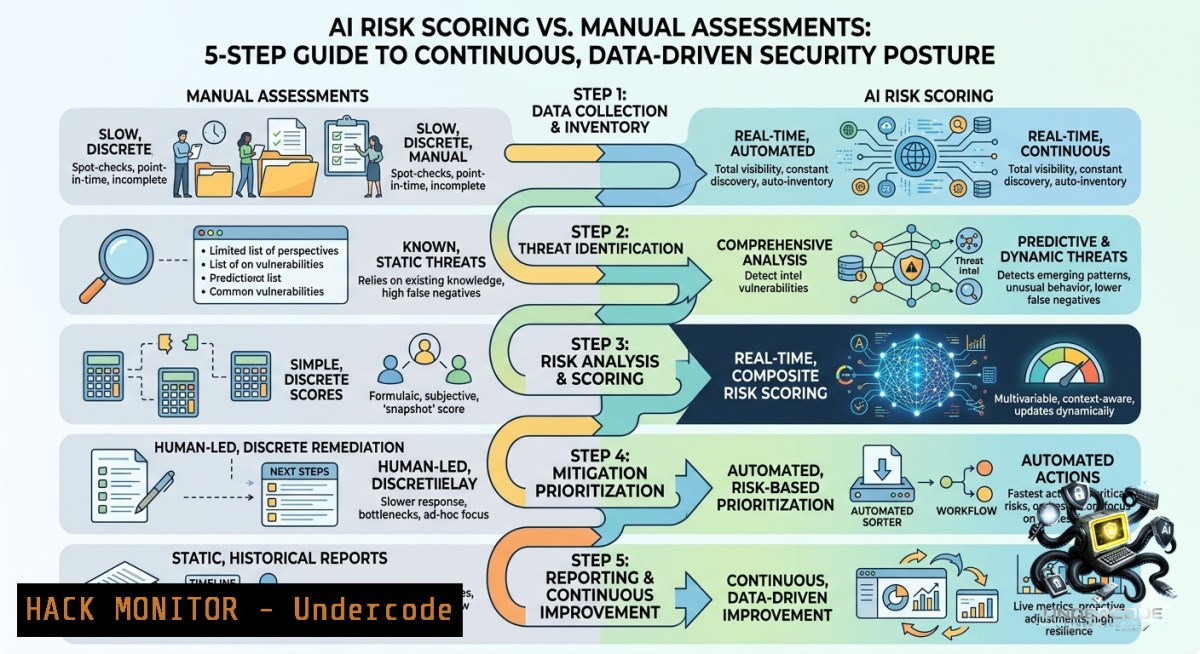
Traditional risk assessments rely on periodic surveys and human intuition—methods that introduce delays, bias, and blind spots. AI-driven risk scoring replaces static snapshots with real‑time telemetry, behavioral analytics, and continuous monitoring, enabling security teams to adapt policies dynamically and prioritize threats by actual impact.
Learning Objectives:
- Differentiate manual risk assessment workflows from AI‑driven, continuous risk scoring architectures.
- Implement Linux and Windows commands to collect real‑time logs, telemetry, and behavioral data for automated risk scoring.
- Configure open‑source tools to build a minimal AI‑driven risk scoring pipeline and integrate it with cloud hardening and compliance checks.
You Should Know:
1. Collecting Real‑Time Telemetry for AI‑Driven Scoring
Step‑by‑step guide – AI models need live data: system logs, network flows, and authentication events. Below are commands to stream that data from both Linux and Windows hosts.
Linux (systemd‑journal + auditd)
 Enable auditd to track file access and privilege changes
sudo auditctl -w /etc/passwd -p wa -k identity_changes
sudo auditctl -w /etc/sudoers -p wa -k sudo_changes

Stream real‑time logs to a central collector (e.g., syslog or Wazuh)
journalctl -f -o json | nc your-ai-collector 514
Windows (PowerShell + Get‑WinEvent)
 Monitor security events (4624=logon, 4672=admin logon)
Get-WinEvent -FilterHashtable @{LogName='Security'; ID=4624,4672} -MaxEvents 50 | ConvertTo-Json

Continuous streaming using wevtutil + PowerShell loop
while ($true) { wevtutil qe Security /rd:true /c:1 /f:text; Start-Sleep -Seconds 5 }
Use these outputs as inputs to a risk scoring engine (e.g., ELK + custom ML model).
- Building a Baseline Risk Score with Open‑Source Tools
Step‑by‑step guide – You don’t need enterprise AI. Use `openscap` (Linux) and `PSAudit` (Windows) to generate numeric risk baselines.
Linux – OpenSCAP vulnerability scoring
 Install and run a CIS benchmark scan
sudo apt install openscap-scanner -y
oscap xccdf eval --profile xccdf_org.ssgproject.content_profile_cis --results risk-baseline.xml /usr/share/xml/scap/ssg/content/ssg-ubuntu2004-ds.xml

Extract score (0‑100, lower is better)
grep "score" risk-baseline.xml
Windows – PSAudit risk baseline
Install-Module -1ame PSAudit -Force
Invoke-PSAudit -Policy Basic -OutputJson | Out-File risk_baseline.json
 Score is under "ComplianceScore" (100 = fully compliant)
Compare baseline scores to real‑time telemetry; any deviation >20% triggers dynamic risk recalculation.
- AI Model Setup for Continuous Risk Scoring
Step‑by‑step guide – Use a pre‑trained isolation forest model (Python) to score live events.
 risk_scorer.py
import pandas as pd
from sklearn.ensemble import IsolationForest
import json, sys

Load live telemetry (JSON lines from step 1)
data = [json.loads(line) for line in sys.stdin]
df = pd.DataFrame(data)
 Feature engineering: event frequency, failed logins, privilege escalations
features = df[['EventID', 'UserID', 'ProcessID']].fillna(0)
model = IsolationForest(contamination=0.05, random_state=42)
df['risk_score'] = model.fit_predict(features)  -1 = anomalous (high risk)

Output high-risk events
print(df[df['risk_score'] == -1].to_json(orient='records'))
Run this pipeline:
 Linux side: stream logs into the scorer
journalctl -f -o json | python3 risk_scorer.py > high_risk_alerts.log
This creates a dynamic, context‑aware risk score without manual spreadsheets.
- Cloud Hardening & API Security for Risk Context
Step‑by‑step guide – AI risk scoring improves when you also enforce cloud misconfiguration checks.
AWS – Detect publicly exposed S3 buckets (high risk)
aws s3api list-buckets --query "Buckets[].Name" --output text | xargs -I {} aws s3api get-bucket-acl --bucket {} --query "Grants[?Grantee.URI=='http://acs.amazonaws.com/groups/global/AllUsers']" --output table
API security (REST endpoint validation)
 Use OWASP ZAP in automation mode to score API risk
docker run -v $(pwd):/zap/wrk/:rw -t ghcr.io/zaproxy/zaproxy:stable zap-api-scan.py -t https://your-api.com/swagger.json -f openapi -r api_risk_report.html
Integrate the report’s “alert count” as a risk input: critical alerts raise the AI score by 30 points.
5. Vulnerability Exploitation & Mitigation Commands
Step‑by‑step guide – Understand how attackers exploit static risk assessments, then apply mitigations that feed into AI scoring.
Simulate a manual‑risk blind spot (unpatched SMB vulnerability)
 Linux attacker using Metasploit against Windows
msfconsole -q -x "use exploit/windows/smb/ms17_010_eternalblue; set RHOSTS 192.168.1.100; run"
Mitigation – Deploy automated patch validation as a dynamic risk input
 Linux (Debian/Ubuntu) – list pending security updates (high risk if >5)
apt list --upgradable 2>/dev/null | grep -c security

Windows – check missing patches via PowerShell
Get-HotFix | Select-Object -ExpandProperty HotFixID
wmic qfe list brief /format:textcsv > patches.csv  feed into AI pipeline
Set a rule: if unpatched critical CVEs > 3, the host’s AI risk score automatically goes to 100 (maximum).
What Undercode Say:
- Key Takeaway 1: Manual risk assessments are inherently lagging and subjective. AI‑driven scoring turns every log, API call, and cloud misconfiguration into a real‑time risk factor, slashing detection gaps from weeks to seconds.
- Key Takeaway 2: You do not need a full SIEM or expensive ML platform. Combining open‑source telemetry collectors (auditd, wevtutil), basic Python anomaly detection, and cloud hardening checks gives you 80% of the value of enterprise AI risk scoring.
Analysis (~10 lines):
The post correctly highlights that static risk reviews fail against fast‑moving threats. However, AI risk scoring is not a silver bullet – it requires clean data pipelines and a feedback loop to avoid alert fatigue. The commands above show how to build that pipeline with minimal cost, focusing on event frequency and privilege changes as primary risk indicators. One major gap often ignored is false positive calibration; isolation forest models need periodic retraining with labeled data. Also, compliance teams must map AI‑derived scores to frameworks like NIST CSF or ISO 27001. Combining manual expertise (validating high‑risk alerts) with AI‑driven triage yields the best results. Finally, cloud and API risks are underrepresented in many AI models – the included AWS and ZAP commands fix that blind spot.
Prediction:
- +1 Automated policy adaptation – Within 2 years, AI risk scoring will directly modify firewall rules and IAM policies without human intervention, using anomaly thresholds as triggers.
- -1 Model drift attacks – Attackers will learn to subtly manipulate telemetry (e.g., pacing events) to stay below detection thresholds, forcing defenders to adopt adversarial‑resistant scoring models.
- +1 Unified risk language – Expect GRC platforms to adopt a standard “Dynamic Risk Score” API (like STIX/TAXII) that ingests AI outputs from any vendor, ending spreadsheet‑based compliance.
- -1 Skill gap crisis – Most security teams lack the data engineering skills to build and maintain these pipelines, leading to an over‑reliance on black‑box AI vendors and potential audit failures.
- +1 Low‑code risk scoring – Open‑source projects will release drag‑and‑drop telemetry connectors (e.g., Node‑RED for security logs), democratizing AI risk assessment for small IT teams.
▶️ Related Video (80% Match):
🎯Let’s Practice For Free:
🎓 Live Courses & Certifications:
Join Undercode Academy for Verified Certifications
🚀 Request a Custom Project:
Secure, high-velocity infrastructure and disruptive technological engineering. Contact our engineering team for high-tier development and proprietary systems:
[email protected]
💎 Smart Architecture | 🛡️ Secure by Design | ⭐ Trusted by Thousands
IT/Security Reporter URL:
Reported By: Cybersecurity Riskmanagement – Hackers Feeds
Extra Hub: Undercode MoN
Basic Verification: Pass ✅


