Listen to this Post
Introduction
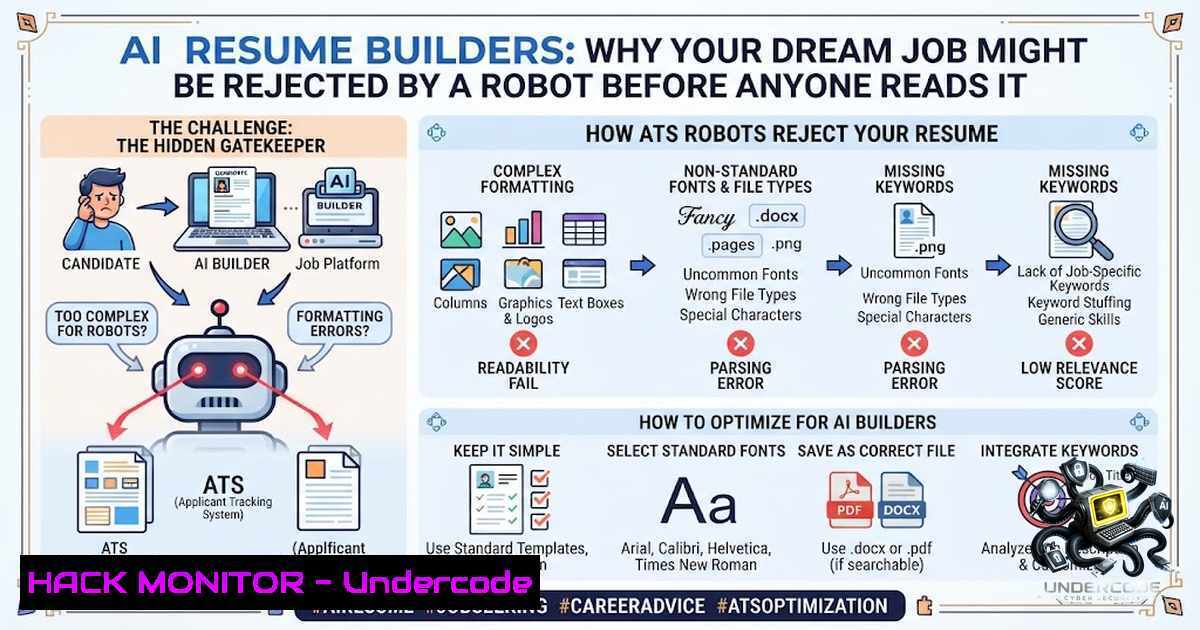
In today’s competitive job market, your carefully crafted resume faces an invisible gatekeeper before any human recruiter lays eyes on it. Applicant Tracking Systems (ATS) now process over 75% of all job applications, using algorithms to scan, rank, and often discard resumes based on keyword density and formatting compatibility. While artificial intelligence tools have democratized resume creation—enabling candidates to generate professional documents in minutes—they’ve simultaneously created a new battlefield where technical optimization matters as much as professional experience. Understanding how these systems work and leveraging AI strategically can mean the difference between landing an interview and disappearing into the digital void.
Learning Objectives
- Understand ATS architecture, parsing algorithms, and how AI tools interact with recruitment workflows
- Master prompt engineering techniques for generating ATS-optimized resumes using ChatGPT and specialized platforms
- Implement keyword extraction strategies and formatting requirements that ensure 90%+ ATS compatibility
You Should Know
1. Understanding ATS Architecture and Parsing Mechanics
Applicant Tracking Systems operate through a complex pipeline of text extraction, normalization, and scoring algorithms. When you submit a resume, the ATS first parses the document using Optical Character Recognition (OCR) and text extraction libraries to convert your formatted document into plain text. Modern ATS platforms like Workday, Greenhouse, and Lever employ Natural Language Processing (NLP) models that analyze semantic relationships between your experience and job descriptions.
The ranking algorithm typically evaluates:
- Keyword frequency: How often critical terms appear relative to document length
- Proximity scoring: Whether keywords appear in relevant contexts (e.g., “Python” in skills section versus “used Python” in experience)
- Recency weighting: More recent experience often receives higher scores
- Education matching: Degree types, institutions, and graduation dates
- Employment duration: Stability indicators and career progression
To test your resume’s ATS compatibility, you can use open-source tools:
Linux Command (using pdftotext to extract and analyze text):
 Install poppler-utils
sudo apt-get install poppler-utils

Extract text from PDF
pdftotext -layout resume.pdf resume.txt

Count keyword occurrences
grep -o -i "python" resume.txt | wc -l

Analyze keyword density
for keyword in "python" "sql" "cloud" "aws"; do
count=$(grep -o -i "$keyword" resume.txt | wc -l)
total=$(wc -w < resume.txt)
density=$(echo "scale=4; $count/$total  100" | bc)
echo "$keyword: $count occurrences, density: $density%"
done
Windows PowerShell (similar analysis):
 Extract text from PDF using iTextSharp or similar
$resume = Get-Content -Path .\resume.txt -Raw

Keyword frequency analysis
$keywords = @("python", "sql", "cloud", "aws", "project management")
foreach ($keyword in $keywords) {
$matches = ([bash]::Matches($resume, $keyword, "IgnoreCase")).Count
Write-Host "$keyword : $matches matches"
}
2. AI-Powered Resume Generation: Tools and Optimization Strategies
Popular AI tools have revolutionized resume creation, each with distinct capabilities. ChatGPT (GPT-4) excels at generating tailored content through prompt engineering—you can instruct it to match specific tone, industry terminology, and ATS keyword requirements. Teal provides comprehensive job tracking alongside resume optimization, while Rezi specifically targets ATS compatibility with its scoring system. Jobscan functions as a comparison tool, analyzing your resume against specific job descriptions.
For maximum effectiveness, implement this prompt engineering framework:
[bash] Act as an ATS optimization specialist
[bash] Rewrite this resume section
[bash] For a Senior DevOps Engineer position at a cloud-first company
[bash] Kubernetes, Terraform, AWS, CI/CD, Docker
[bash] Use action verbs, quantify achievements, maintain professional tone
[bash] Return only the optimized text
Python Script for ATS Keyword Extraction:
import re
from collections import Counter

def extract_keywords(job_description):
"""Extract technical keywords from job description"""
 Common technical patterns
patterns = {
'languages': ['python', 'java', 'javascript', 'sql', 'go', 'rust'],
'cloud': ['aws', 'azure', 'gcp', 'kubernetes', 'docker'],
'tools': ['jenkins', 'git', 'terraform', 'ansible', 'prometheus'],
'certifications': ['cissp', 'ceh', 'oscp', 'aws certified']
}

all_keywords = []
job_text = job_description.lower()

for category, terms in patterns.items():
for term in terms:
if term in job_text:
all_keywords.append(term)

Count frequencies
return Counter(all_keywords)

Example usage
job_desc = """We're seeking a Senior DevOps Engineer with AWS experience,
Kubernetes expertise, and Python programming skills. Must have
strong understanding of CI/CD pipelines and infrastructure as code."""

keywords = extract_keywords(job_desc)
print("Extracted Keywords:", dict(keywords))
3. ATS Formatting Requirements and Common Pitfalls
ATS systems struggle with specific formatting elements. Complex tables, text boxes, headers/footers, and graphics often cause parsing failures. The safest approach uses single-column layouts with standard fonts. File formats matter significantly—PDFs are generally preferred but must be text-based (not scanned images). Word documents (.docx) offer excellent compatibility with most systems.
Critical formatting rules:
- Use standard section headers: “Summary,” “Experience,” “Education,” “Skills”
- Avoid special characters, bullets (except standard dashes), and multiple columns
- Include a skills section with exact keyword matches
- Place contact information in the header, not footer
- Save as PDF using “Save As” not “Print to PDF”
Command-line tool for PDF validation:
 Verify PDF is text-based (not scanned)
pdffonts resume.pdf

Check for embedded fonts
pdfinfo -meta resume.pdf | grep -i font

Convert PDF to text and check readability
pdftotext -layout resume.pdf - | head -20
4. API Security and Data Privacy Considerations
When using AI resume tools, you’re submitting sensitive personal data—contact information, employment history, education details—to third-party APIs. Understanding the security posture of these platforms is crucial. Most AI tools use OpenAI’s API infrastructure, which has robust security but retains data for 30 days by default.
Best practices for secure AI resume processing:
- Redact PII: Remove specific contact details before processing with general AI
- Check data retention policies: Opt out of data collection where possible
- Use enterprise versions: Tools like ChatGPT Enterprise offer stronger privacy guarantees
- Implement local solutions: Consider running local LLMs (Llama 2, Mistral) for complete control
Secure API Call Template (Python):
import requests
import hashlib

Anonymize before sending
def anonymize_resume(text):
patterns = {
r'\b[A-Za-z0-9._%+-]+@[A-Za-z0-9.-]+.[A-Z|a-z]{2,}\b': '[bash]',
r'\b\d{3}-\d{3}-\d{4}\b': '[bash]',
r'[A-Z][a-z]\s[A-Z][a-z]': '[bash]'
}
for pattern, replacement in patterns.items():
text = re.sub(pattern, replacement, text)
return text

Example with OpenAI API
response = requests.post(
'https://api.openai.com/v1/chat/completions',
headers={'Authorization': f'Bearer {API_KEY}'},
json={
'model': 'gpt-4',
'messages': [
{'role': 'system', 'content': 'Optimize this resume for ATS'},
{'role': 'user', 'content': anonymize_resume(resume_text)}
]
}
)
5. Cloud-Based Resume Deployment and Job Application Security
Modern job seekers often host their resumes on cloud platforms, creating potential security vulnerabilities. When using services like Google Drive, Dropbox, or personal websites to share resumes, implement appropriate access controls. Additionally, the rise of AI-driven application systems means you should consider how your digital footprint affects hiring decisions.
Hardening resume sharing security:
- Use one-time links when sharing with specific employers
2. Enable expiration dates for shared documents
3. Monitor access logs to detect unauthorized viewing
- Consider QR code deployment for printed resumes linking to secure hosted versions
AWS S3 secure resume hosting (command line):
 Create a bucket with public read, private write
aws s3 mb s3://my-resume-bucket-$(uuidgen)

Upload with server-side encryption
aws s3 cp resume.pdf s3://my-resume-bucket/resume.pdf \
--server-side-encryption AES256 \
--storage-class STANDARD_IA

Generate a presigned URL (expires in 7 days)
aws s3 presign s3://my-resume-bucket/resume.pdf --expires-in 604800
6. Continuous Improvement: ATS Monitoring and Analytics
The modern job search requires a data-driven approach. Maintain a spreadsheet tracking application submissions, ATS scores (where available), and interview outcomes. This data reveals patterns in keyword effectiveness, optimal file formats, and seasonal hiring trends.
Creating an Application Tracker Database (SQLite):
CREATE TABLE applications (
id INTEGER PRIMARY KEY,
company TEXT,
position TEXT,
date_applied DATE,
ats_score INTEGER,
resume_version TEXT,
interview_status TEXT
);

-- Analytics query
SELECT
position,
AVG(ats_score) as avg_score,
COUNT() as total_apps,
SUM(CASE WHEN interview_status = 'Invited' THEN 1 ELSE 0 END) as interviews
FROM applications
GROUP BY position
ORDER BY avg_score DESC;
What Undercode Say
- ATS optimization is table stakes: With over 400 job applications per corporate posting, AI optimization isn’t optional—it’s mandatory. Your resume must be engineered for algorithms before it can impress humans.
-
The tools don’t replace strategy: While AI generates content, human judgment remains crucial. Tools like ChatGPT produce generic content; strategic customization based on each job’s specific requirements creates differentiation.
-
Security implications are underdiscussed: Most job seekers overlook the security risks of feeding personal data to AI tools. Implementing anonymization and understanding data retention policies protects your privacy and reduces identity theft risk.
-
The future involves AI-to-AI interactions: As ATS incorporate more sophisticated AI, resumes will increasingly be evaluated by NLP models before recruiter review. This creates opportunities for adversarial optimization—crafting content that AI finds appealing while maintaining human readability.
-
Continuous learning beats one-time optimization: The job market evolves rapidly; ATS algorithms update frequently. Successful candidates treat resume optimization as an ongoing process, not a one-time task, maintaining multiple versions for different role types.
Prediction
+1 AI-powered resume tools will become standard career management platforms, integrating with LinkedIn and job boards to provide real-time keyword analysis and application tracking, reducing time-to-hire for qualified candidates by 40% over the next three years.
+1 The democratization of professional resume creation through AI will level the playing field, allowing candidates from non-traditional backgrounds to present their experience effectively, increasing diversity in STEM and leadership positions.
+N Increased reliance on ATS algorithms may inadvertently perpetuate bias, as keyword-matching systems favor candidates who understand and game the system rather than those with superior but less quantifiable qualifications.
-1 Data privacy concerns will escalate as more resume information is processed through AI systems, potentially leading to regulatory actions similar to GDPR around automated hiring decisions.
+1 Hybrid models combining AI optimization with human coaching will emerge as the premium solution, offering the best of both worlds—algorithmic keyword optimization paired with strategic career counseling and narrative crafting.
+N The arms race between ATS algorithms and optimization tools will intensify, creating a “SEO for resumes” industry where candidates must constantly adapt to changing scoring criteria, disadvantaging less tech-savvy applicants.
▶️ Related Video (74% Match):
🎯Let’s Practice For Free:
🎓 Live Courses & Certifications:
Join Undercode Academy for Verified Certifications
🚀 Request a Custom Project:
Secure, high-velocity infrastructure and disruptive technological engineering. Contact our engineering team for high-tier development and proprietary systems:
[email protected]
💎 Smart Architecture | 🛡️ Secure by Design | ⭐ Trusted by Thousands
IT/Security Reporter URL:
Reported By: Gyanendra Jha – Hackers Feeds
Extra Hub: Undercode MoN
Basic Verification: Pass ✅


