Listen to this Post
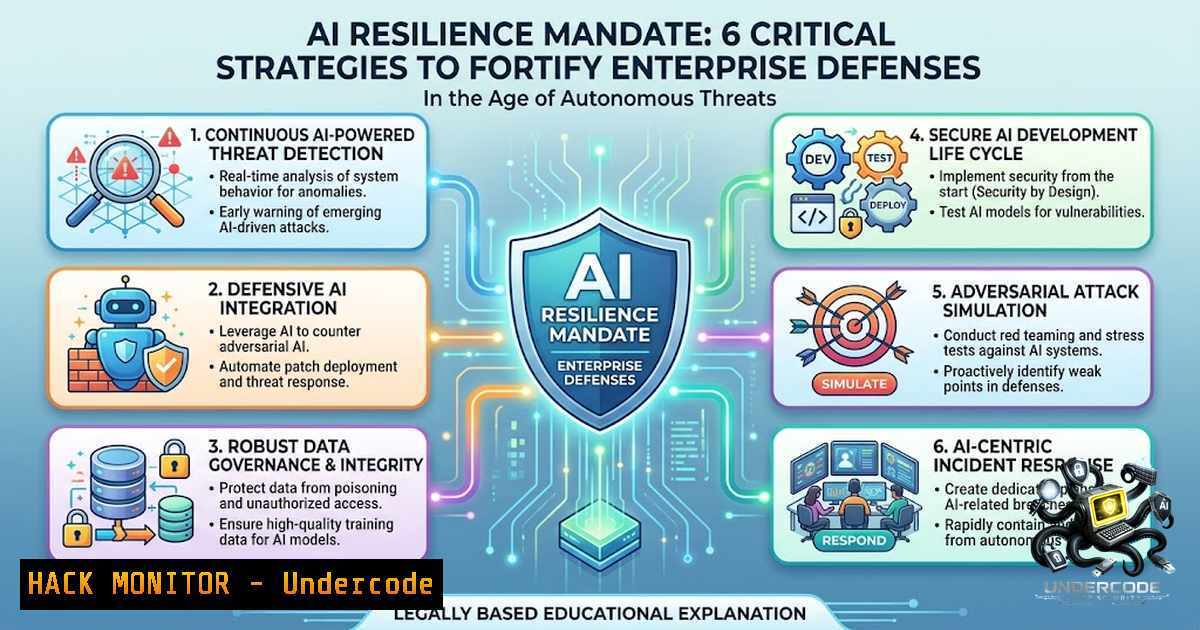
Introduction:
The next cyber crisis may not be a crisis of downtime but a crisis of trust. As AI automates attack chains and scales social engineering at machine speed, the traditional perimeter-defense mindset has become obsolete. Cyber resilience must evolve beyond recovery to verification, ensuring businesses can operate safely even when trust in shared platforms is fundamentally challenged.
Learning Objectives:
- Master the shift from reactive defense to proactive resilience by implementing security-by-design across AI data, models, and identity layers.
- Deploy automated detection and response frameworks to reduce false positives and accelerate threat containment.
- Operationalize AI governance and integrity validation to prevent model poisoning, data leakage, and unauthorized access.
You Should Know:
- Modernizing AI Foundations: Security-by-Design from Data to Deployment
Building intelligent resilience starts with securing the entire AI stack — data pipelines, model training, application interfaces, and identity management. Organizations must treat AI infrastructure with the same rigor as finance-grade systems, implementing strict data handling rules, clear classification, and a habit of verifying outputs before they drive decisions. This means replacing legacy security tools with AI-ready platforms that support predictive threat modeling and automated remediation.
Step-by-Step Guide: Hardening AI Data Pipelines
1. Audit data ingestion points for unauthorized access:
 Linux: Check permissions on training data directories
find /data/ai_pipelines -type f -exec ls -la {} \; | grep -E "^.(rwx){3}"
 Windows PowerShell: Audit folder permissions
Get-Acl -Path "C:\AIData\Training" | Format-List
- Implement immutable backups for model checkpoints and training datasets:
Linux: Set immutable attribute on critical model files sudo chattr +i /models/production/.h5 AWS CLI: Enable S3 object lock for versioned buckets aws s3api put-object-lock-configuration --bucket ai-model-repo --object-lock-configuration '{ "ObjectLockEnabled": "Enabled" }' -
Enforce strict identity and access management (IAM) for AI workloads:
Azure CLI: Restrict AI service principals
az role assignment list --assignee <principal-id> --query "[?roleDefinitionName=='Contributor']"
GCP: Verify minimal IAM permissions on Vertex AI
gcloud projects get-iam-policy <project-id> --flatten="bindings[].members" --filter="roles:roles/aiplatform.user"
2. Deploying AI-Driven Threat Detection and Automated Response
The scale of modern attacks exceeds what human-only security operations can manage. Organizations are moving toward AI-powered predictive analytics that detect abnormal behavior early and act decisively. AI can automate detection and response, reduce false positives, and speed tasks such as vulnerability scanning and cyber intelligence reporting. However, clear guardrails for autonomous actions and workforce training must keep humans in the loop.
Step-by-Step Guide: Implementing AI-Enhanced SOC Operations
- Deploy behavioral detection tools to monitor AI agent activities:
Linux: Monitor API call anomalies with auditd
sudo auditctl -w /var/log/ai_api/ -p wa -k ai_activity
sudo ausearch -k ai_activity --format raw | grep -E "ERROR|FAIL"
-
Integrate AI-driven SIEM correlation to reduce false positives:
Windows PowerShell: Query security logs for AI-related anomalies
Get-WinEvent -LogName "Security" | Where-Object { $_.Message -match "AI|Machine Learning|Model" } | Select-Object TimeCreated, Id, Message
3. Automate containment workflows using playbooks:
 Example SOAR playbook snippet for AI threat isolation
- name: Isolate compromised AI endpoint
ansible.builtin.shell: |
iptables -A INPUT -s {{ source_ip }} -j DROP
systemctl stop model-inference.service
when: threat_severity == "critical"
3. Verifying AI Outputs and Preventing Data Leakage
Compromised data can disrupt critical decisions even when systems remain online. The WEF’s Global Cybersecurity Outlook 2026 highlights that leaders’ concerns are shifting from offensive AI use to unintended data exposure. Verifying outputs before they drive decisions is no longer optional — it is a resilience imperative. This requires finance-grade governance, continuous guardrail testing, and strict data handling rules.
Step-by-Step Guide: Implementing AI Output Verification
1. Deploy deterministic validation layers alongside generative AI:
 Python: Validate AI output against schema and business rules
import jsonschema
def validate_ai_response(response, schema):
try:
jsonschema.validate(instance=response, schema=schema)
return True
except jsonschema.ValidationError as e:
log_security_event("AI_OUTPUT_INVALID", str(e))
return False
- Monitor for prompt injection and jailbreak attempts using open-source tools:
Install and run OWASP LLM Top 10 scanner
pip install llm-audit
llm-audit audit https://your-ai-endpoint.com/chat -k $API_KEY --severity high --format html --output report.html
-
Red-team AI endpoints with AI penetration testing frameworks:
Install AIX framework and run reconnaissance
pip install aix-framework
aix recon https://api.target.com/chat -k $API_KEY
aix inject https://api.target.com/chat -k $API_KEY --ai openai --ai-key $OPENAI_KEY
-
Strengthening Identity and Access Management for AI Workloads
AI agents and autonomous workflows are becoming common in business operations, making IAM attack surface reduction a top priority. Zero Trust architecture must extend to AI systems, with strict enforcement of least privilege, workload identity, and service-to-service authentication.
Step-by-Step Guide: Hardening AI IAM
1. Implement workload identity federation for AI services:
 GCP: Configure Workload Identity for Vertex AI
gcloud iam service-accounts add-iam-policy-binding [email protected] \
--member="serviceAccount:[email protected]" \
--role="roles/iam.workloadIdentityUser"
2. Enforce short-lived credentials and rotate secrets:
 AWS CLI: Rotate IAM access keys for AI service accounts
aws iam create-access-key --user-1ame ai-service-user
aws iam update-access-key --access-key-id <OLD_KEY> --status Inactive --user-1ame ai-service-user
- Audit privilege escalation paths in AI agent configurations:
Linux: Check for excessive sudo permissions
sudo cat /etc/sudoers | grep -v "^" | grep -E "NOPASSWD|ALL"
Windows PowerShell: List high-privilege service accounts
Get-ADUser -Filter {Enabled -eq $true} -Properties MemberOf | Where-Object { $_.MemberOf -match "Domain Admins" }
5. Securing Cloud Infrastructure and AI Workloads
AI workloads often span multi-cloud environments, expanding the attack surface through new APIs, third-party services, and “shadow AI” adoption. Hardening cloud infrastructure requires private networking, dynamic address groups, and automated security guardrails that prevent destructive commands.
Step-by-Step Guide: Cloud Hardening for AI Deployments
1. Provision secure VPCs with private networking:
 GCP: Create a secure VPC for Vertex AI
gcloud compute networks create ai-vpc --subnet-mode=custom
gcloud compute networks subnets create ai-subnet --1etwork=ai-vpc --range=10.0.0.0/24 --region=us-central1
- Implement VPC Service Controls (VPC-SC) to prevent data exfiltration:
GCP: Configure VPC-SC perimeter for AI services
gcloud access-context-manager perimeters create ai-perimeter --title="AI Workload Perimeter" \
--resources="projects/<project-id>" --restricted-services="aiplatform.googleapis.com,storage.googleapis.com"
-
Block dangerous cloud CLI commands with agent guardrails:
Install hardstop to prevent destructive commands
npm install -g hardstop
hardstop --block "aws s3 rb --force" --block "gcloud projects delete" --block "kubectl delete namespace"
6. Building Collective Resilience Through Ecosystem Collaboration
The WEF emphasizes that strengthening collective cyber resilience has become both an economic and a societal imperative. Resilience requires collaboration between organizations and their ecosystem partners to keep critical services running. This means sharing threat intelligence, aligning on security standards, and conducting joint tabletop exercises aligned with key drivers.
Step-by-Step Guide: Operationalizing Collective Resilience
1. Establish threat intelligence sharing pipelines:
 Linux: Set up automated STIX/TAXII feed ingestion
sudo apt-get install stix-taxii-client
taxii-client --discovery https://threatfeed.example.com/taxii-discovery --collection "AI-Threats"
2. Conduct AI-specific tabletop exercises:
 Exercise scenario: Model poisoning attack simulation
scenario: "Adversarial data injection in training pipeline"
injects:
- "Training data integrity alert triggers at 02:00 UTC"
- "Model drift detected in production at 06:00 UTC"
objectives:
- "Contain compromised model within 15 minutes"
- "Rollback to verified checkpoint within 1 hour"
3. Integrate security testing into CI/CD pipelines:
 GitHub Actions workflow for AI security scanning
name: AI Security Scan
on: [bash]
jobs:
security-scan:
runs-on: ubuntu-latest
steps:
- uses: actions/checkout@v3
- name: Run LLM audit
run: |
pip install llm-audit
llm-audit audit ${{ secrets.AI_ENDPOINT }} -k ${{ secrets.API_KEY }} --fail-on high
What Undercode Say:
- Key Takeaway 1: Cyber resilience in the AI era is fundamentally about trust verification, not just recovery. Organizations must shift from asking “How do we prevent breaches?” to “How do we operate safely when breaches occur?”. The WEF’s 2026 Global Cybersecurity Outlook makes it clear: cyber risk is no longer an IT issue but a systemic business threat. With 94% of leaders naming AI as the main driver of change in cybersecurity, inaction carries real, measurable risk.
-
Key Takeaway 2: Security-by-design across the AI lifecycle — from data pipelines to model outputs — is non-1egotiable. NIST’s Cyber AI Profile emphasizes three focus areas: securing AI systems, conducting AI-enabled cyber defense, and thwarting AI-enabled cyberattacks. Organizations must treat AI governance not as a compliance exercise but as a resilience strategy. The accelerating speed of AI-driven vulnerability discovery compresses remediation timelines from weeks to minutes, demanding automation, visibility, and operational readiness. Attackers are already weaponizing data exfiltration, resale, and reuse long after the initial breach — resilience programs must assume compromise and design for rapid, verified recovery.
Prediction:
-
+1: Organizations that invest early in AI-1ative security frameworks — including automated guardrails, behavioral detection, and immutable recovery — will achieve a significant competitive advantage by 2027. These “digitally immune” enterprises will demonstrate faster breach containment, lower regulatory fines, and higher customer trust, turning resilience into a market differentiator.
-
-1: The widening cyber inequity — unequal access to AI security resources and expertise — will create a two-tiered resilience landscape. Smaller organizations and developing economies will face disproportionate risk from AI-driven attacks, potentially triggering systemic failures in global supply chains and critical infrastructure.
-
+1: The emergence of agent-first cybersecurity operations, where autonomous AI agents act as active defenders managing identities, monitoring attack surfaces, and conducting agent-led penetration testing, will redefine security team roles. By 2028, security analysts will transition from constant firefighting to strategic oversight, focusing on threat modeling and resilience planning rather than alert triage.
-
-1: As AI systems like Anthropic’s Mythos demonstrate breakthrough capabilities in identifying complex software vulnerabilities at unprecedented speed and scale, defenders face a fundamental challenge: ensuring security programs can operate at the speed of AI rather than relying on defenses built for yesterday’s threats. Organizations that fail to automate their response pipelines will be overwhelmed by the volume of machine-speed attacks.
-
+1: Regulatory frameworks like the EU’s Action Plan on Cybersecurity and AI and NIST’s Cyber AI Profile will drive standardization of AI security practices. By 2029, certification for AI system resilience will become as critical as SOC 2 compliance is today, creating a new ecosystem of security auditing and assurance services.
-
-1: The shift in attacker economics — where slowing an attack becomes an economic strategy — means adversaries will increasingly target AI supply chains, including training data providers, third-party model libraries, and API dependencies. These attacks may go undetected for extended periods, causing cascading failures across interconnected AI ecosystems.
▶️ Related Video (76% Match):
https://www.youtube.com/watch?v=5aEU6FG1I6Y
🎯Let’s Practice For Free:
🎓 Live Courses & Certifications:
Join Undercode Academy for Verified Certifications
🚀 Request a Custom Project:
Secure, high-velocity infrastructure and disruptive technological engineering. Contact our engineering team for high-tier development and proprietary systems:
[email protected]
💎 Smart Architecture | 🛡️ Secure by Design | ⭐ Trusted by Thousands
IT/Security Reporter URL:
Reported By: Centralbank 6 – Hackers Feeds
Extra Hub: Undercode MoN
Basic Verification: Pass ✅


