Listen to this Post
Introduction:
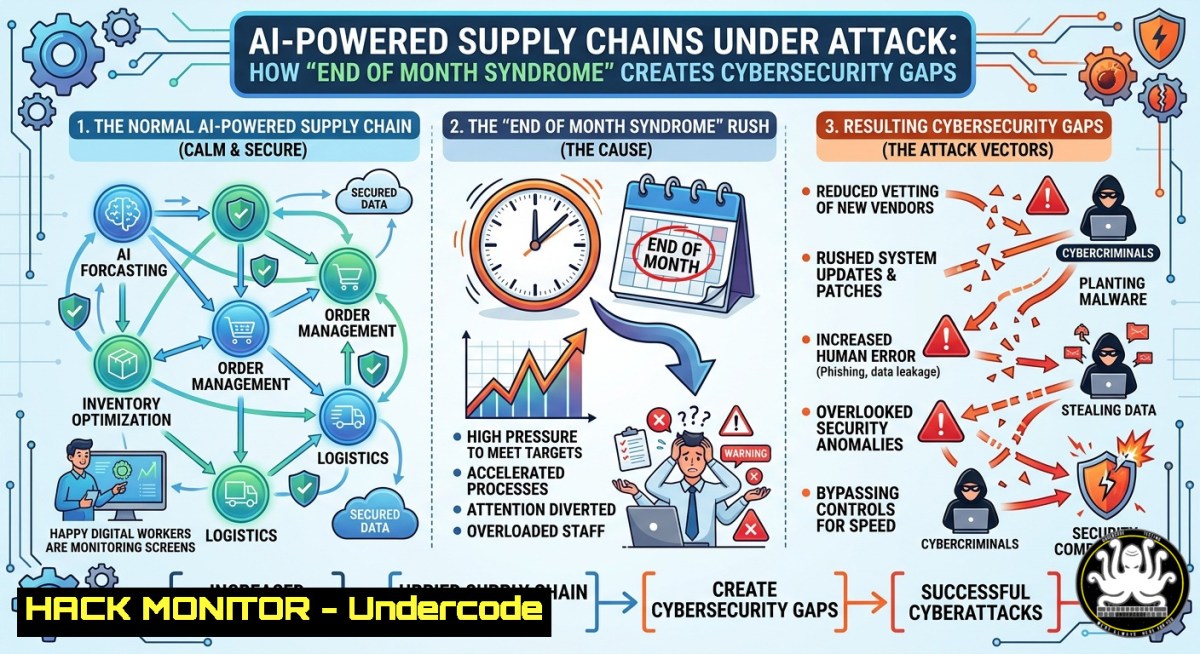
Seasonal demand fluctuations—known in logistics as the “end-of-month syndrome”—force businesses to rely heavily on historical data, real-time inventory APIs, and AI-driven forecasting. However, this rush to scale operations often leaves cybersecurity controls neglected, creating attack surfaces that adversaries exploit through API abuse, data poisoning, and ransomware targeting supply chain systems.
Learning Objectives:
- Identify vulnerabilities in AI-based demand forecasting pipelines and implement model integrity checks.
- Harden Linux and Windows systems that host inventory, logistics, and historical data repositories.
- Apply API security best practices to real-time order and distribution endpoints.
You Should Know:
- Securing AI-Driven Demand Forecasting Models Against Data Poisoning
Attackers can inject malicious training data during peak seasons (Black Friday, holidays) to skew predictions, causing overstocking or stockouts. This section provides commands to verify model integrity and monitor data drift.
Step‑by‑step guide:
- Linux – Compute SHA‑256 hash of training dataset to detect tampering
sha256sum historical_sales_2024.csv > baseline_hash.txt
Verify later:
sha256sum -c baseline_hash.txt
- Linux – Monitor real‑time data streams for anomalies using `jq` and `tail`
tail -f /var/log/ingest/sales_api.log | jq 'select(.quantity > 10000)'
- Windows – Use PowerShell to compare file hashes
Get-FileHash historical_sales_2024.csv -Algorithm SHA256 | Out-File baseline_hash.txt Verify: if ((Get-FileHash historical_sales_2024.csv -Algorithm SHA256).Hash -eq (Get-Content baseline_hash.txt)) { "OK" } else { "Tampered" } - Implement model input validation – Reject anomalous requests (e.g., unrealistic order volumes) before feeding into AI. Use a simple Python Flask filter:
@app.route('/predict', methods=['POST'])
def predict():
data = request.json
if data['qty'] > 50000 or data['price'] < 0:
return {'error': 'Invalid input'}, 400
return model.predict(data)
2. Hardening Supply Chain Data Repositories Against Ransomware
Historical databases (the “rearview mirror”) are prime targets during seasonal rushes. Apply these commands to lock down file permissions and enable file integrity monitoring.
Step‑by‑step guide:
- Linux – Restrict access to critical inventory files
sudo chmod 640 /var/lib/mysql/supply_data.
sudo setfacl -m g:logistics:r /var/lib/mysql/supply_data.
- Linux – Enable auditd to track file modifications
sudo auditctl -w /srv/warehouse/data/ -p wa -k inventory_changes
sudo aureport -k inventory_changes
- Windows – Configure SACL and use `icacls` to block ransomware write attempts
icacls "D:\SupplyData" /grant "SYSTEM:(OI)(CI)F" /inheritance:r
icacls "D:\SupplyData" /deny "Everyone:(WD,AD,DE)"
Enable file audit:
auditpol /set /subcategory:"File System" /success:enable /failure:enable
- Schedule immutable backups using `borg` (Linux) or `wbadmin` (Windows) before peak weeks.
- API Security for Real‑Time Inventory and Transportation Endpoints
Seasonal demand spikes increase API calls, exposing endpoints to injection, rate‑limiting bypasses, and broken object‑level authorization (BOLA). Hardening steps below.
Step‑by‑step guide:
- Test for BOLA – From Linux, try accessing another customer’s inventory:
curl -X GET "https://api.logistics.com/v1/inventory/12345" -H "Authorization: Bearer $TOKEN"
curl -X GET "https://api.logistics.com/v1/inventory/12346"  Should fail
- Implement rate limiting with `nginx` (config excerpt):
limit_req_zone $binary_remote_addr zone=inv:10m rate=10r/s; location /api/inventory { limit_req zone=inv burst=20 nodelay; proxy_pass http://inventory_backend; } - Windows – Monitor API abuse using PowerShell with IIS logs:
Get-Content "C:\inetpub\logs\LogFiles\W3SVC1\u_ex.log" | Select-String "429" | Group-Object {($_ -split ' ')[bash]} | Sort-Object Count -Descending - Add API gateway authentication – Require JWT with short expiration and rotate secrets before each seasonal campaign.
- Anomaly Detection with SIEM to Mitigate Sazonalidade Attacks
Unexpected order volumes (e.g., a fake “weekend sale”) can trigger automated inventory moves. Deploy SIEM rules to detect volumetric anomalies.
Step‑by‑step guide:
- Linux – Use `fail2ban` to block IPs that exceed normal request patterns
sudo apt install fail2ban Create /etc/fail2ban/filter.d/inventory-api.conf: [bash] failregex = ^<HOST> - - . "POST /order" 200 . "qty": [5-9][0-9]{4} - ELK Stack – Create anomaly detection rule (Kibana console):
POST _ml/anomaly_detectors/supply_demand { "analysis_config": { "bucket_span": "15m", "detectors": [{"function": "high_count", "field_name": "order_quantity"}] }, "data_description": {"time_field": "@timestamp"} } - Windows – Forward event logs to SIEM using `nxlog` or
Winlogbeat. Verify forwarding:.\winlogbeat.exe test config -c .\winlogbeat.yml
- Set alert threshold – If order volume exceeds 3 standard deviations of historical (non‑seasonal) baseline, trigger incident response.
5. Cloud Hardening for Scalable Logistics Platforms
Many firms auto‑scale cloud resources during end‑of‑month pushes, leaving misconfigured storage buckets and over‑privileged IAM roles.
Step‑by‑step guide:
- AWS – Enforce bucket private ACL and block public access
aws s3api put-bucket-acl --bucket logistics-data --acl private
aws s3api put-public-access-block --bucket logistics-data --public-access-block-configuration BlockPublicAcls=true,IgnorePublicAcls=true
- Audit IAM roles for over‑provisioned permissions:
aws iam list-roles | jq '.Roles[] | select(.AssumeRolePolicyDocument.Statement[].Effect=="Allow")'
- Azure – Enable just‑in‑time (JIT) VM access for inventory management servers:
Using Azure CLI
az vm management-timer enable --resource-group supplychain --vm-name inventory-vm
- Google Cloud – Restrict service account scopes to only required APIs (Storage, Compute):
gcloud iam service-accounts set-iam-policy [email protected] policy.yaml
- Training Your Team to Avoid Phishing During Peak Seasons
Attackers send fake “urgent delivery” or “price table update” emails before salary payment days (days 30 to 5th). Simulate and defend.
Step‑by‑step guide:
- Linux – Set up a Gophish campaign (phishing simulation):
wget https://github.com/gophish/gophish/releases/download/v0.12.1/gophish-v0.12.1-linux-64bit.zip
unzip gophish-.zip && sudo ./gophish
- Windows – Extract suspicious email headers for analysis:
$headers = Get-Content "phishing.eml" -Raw
$headers -match "Received: from" | Out-File header_analysis.txt
- Create a detection rule in Microsoft 365 Defender for keywords like “inflación”, “precio especial fin de mes”, “adjunto factura”.
- Run weekly simulated attacks in December, January, February, and July (vacation months mentioned in post). Track click rates and remediate.
What Undercode Say:
- Key Takeaway 1: Seasonal demand is a business necessity, but it must not override secure coding, API throttling, and immutable backup practices – otherwise the “cost of the syndrome” includes breach response.
- Key Takeaway 2: Historical data is both a treasure and a target. Hash‑verified datasets and strict file permissions (Linux
setfacl, Windowsicacls) are the minimum controls to prevent poisoning or ransomware.
Analysis (10 lines):
The post highlights how decades‑old “end‑of‑month” price‑turn policies have evolved into systemic supply chain stress, amplified by AI and real‑time data. Where the original author focuses on logistics efficiency, the cybersecurity angle reveals a perfect storm: rushed API deployments, over‑reliance on untampered historical data, and human fatigue during payday weeks. Attackers know these rhythms and will time phishing, BOLA exploits, and ransomware to coincide with peak inventory movements. Defenders must embed security into the planning phase – not as an afterthought. Commands like `sha256sum` and `auditctl` become as essential as demand forecasting. Companies that ignore this will face not only stockouts but also regulatory fines and reputational collapse. The shift from isolated transactions to integrated supply chains multiplies blast radius; a single compromised API can drain warehouses globally. Therefore, every “sazonalidade” event requires a parallel security playbook. Without it, the syndrome becomes a breach catalyst.
Prediction:
Within 24 months, AI‑driven supply chain platforms will adopt self‑healing security orch
▶️ Related Video (82% Match):
🎯Let’s Practice For Free:
IT/Security Reporter URL:
Reported By: Reinaldo Moura – Hackers Feeds
Extra Hub: Undercode MoN
Basic Verification: Pass ✅
🎓 Live Courses & Certifications:
Join Undercode Academy for Verified Certifications
🚀 Request a Custom Project:
Secure, high-velocity infrastructure and disruptive technological engineering. Contact our engineering team for high-tier development and proprietary systems:
[email protected]


