Listen to this Post
Introduction:
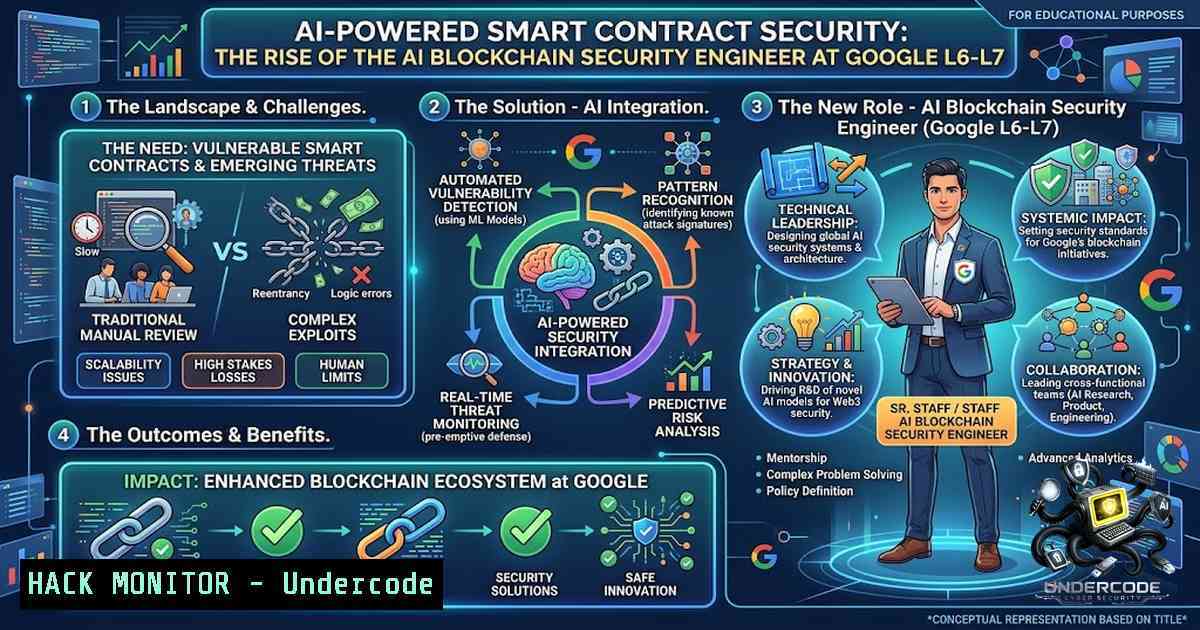
The intersection of artificial intelligence and blockchain security is rapidly evolving, creating a new class of elite cybersecurity roles that demand expertise in both smart contract auditing and AI-driven automation. As decentralized finance (DeFi) and Web3 ecosystems grow, the complexity and frequency of attacks such as flash loan exploits, oracle manipulation, and reentrancy attacks have necessitated a paradigm shift from manual code reviews to continuous, AI-powered monitoring and vulnerability detection. Google’s recruitment for a Staff/Principal AI Blockchain Security Engineer at the L6-L7 level underscores this critical evolution, merging traditional security engineering with cutting-edge LLM applications to safeguard the future of digital assets.
Learning Objectives & Secrets:
- Objective 1: Master Smart Contract Auditing and Exploit Reproduction. Gain a deep understanding of Solidity, EVM internals, and non-EVM chains (Solana/Move) to audit complex protocols and reproduce real-world attack vectors.
- Objective 2 Secret Tips: Build Custom AI Agents for Static and Symbolic Analysis. Don’t just use tools like Slither or Mythril; learn to architect custom AI-driven analysis systems using LLMs to automate the detection of zero-day vulnerabilities.
- Objective 3 Secret Tips: Embed Security into the SDLC via CI/CD Pipelines. Automate security scans and AI monitoring workflows directly into the development lifecycle to catch vulnerabilities before they hit mainnet.
You Should Know:
1. Smart Contract Auditing with Foundry and Slither
To effectively audit smart contracts, one must master both dynamic and static analysis tools. Foundry is a blazing-fast Ethereum development framework written in Rust, while Slither is a static analysis framework written in Python. This combination allows for comprehensive vulnerability assessment.
Step‑by‑Step Guide:
- Install Foundry: `curl -L https://foundry.paradigm.xyz | bash` then run `foundryup` to install `forge` and
cast. - Run Dynamic Analysis: Use `forge test` to execute fuzzing and invariant tests. For example, to test a vulnerable ERC-20 token, write a test that sends a large number of tokens and checks for integer overflow. Use `forge coverage` to ensure your tests cover critical paths.
- Install Slither:
pip3 install slither-analyzer. - Run Static Analysis: `slither . –print human-summary` to get an overview, and `slither . –detect reentrancy-eth` to specifically target reentrancy vulnerabilities. Slither’s output provides a detailed call graph and pinpointed lines of code that are susceptible.
2. AI-Powered Vulnerability Detection using LLMs
The prompt emphasizes building AI-driven analysis systems. This involves leveraging Large Language Models (LLMs) to parse code and identify patterns that traditional static analyzers miss.
Step‑by‑Step Guide:
- Set up the Environment: Create a Python virtual environment and install `openai` or `langchain` libraries.
pip install openai langchain. - Extract the Contract AST: Use `slither` to export the Abstract Syntax Tree (AST) of a Solidity file into a JSON format.
slither example.sol --export-ast ast.json. - Context Preparation: Write a Python script that reads `ast.json` and preprocesses it into a prompt-friendly format (e.g., summarizing function signatures and control flows).
- LLM Query: Utilize an LLM API to analyze the code. For instance, send a prompt: “Analyze the following Solidity code for reentrancy and integer overflow vulnerabilities: [bash]”.
- Automation Loop: Implement a GitHub Actions workflow that runs this Python script on every pull request, automatically commenting on potential vulnerabilities detected by the LLM.
3. Exploit Research: Reproducing Flash Loan Attacks
Flash loans allow users to borrow assets without collateral, provided the liquidity is returned within the same transaction. Attackers exploit this to manipulate oracles.
Step‑by‑Step Guide (Linux/Bash):
- Set up a Fork: Use `anvil` (Foundry’s local blockchain) to fork mainnet.
anvil --fork-url https://mainnet.infura.io/v3/YOUR_KEY --fork-block-1umber 15000000. - POC Script: Write a Solidity script (using
forge script) that executes a flash loan from Aave or Uniswap. - Execute Attack: Inside the script, manipulate the oracle price by swapping a huge amount of assets in a single transaction.
- Mitigation: Implement a time-weighted average price (TWAP) oracle and use `slither` to detect dangerous `block.timestamp` dependencies. Run `slither . –detect timestamp` to find vulnerable code.
4. Securing the SDLC with AI Monitoring
Integrating security into the CI/CD pipeline requires automated tools that run alongside code commits.
Step‑by‑Step Guide:
- Create a Pipeline: Use GitHub Actions. Create
.github/workflows/security.yml. - Run Slither: Add a step `- name: Slither Analysis`
run: slither . --json slither-report.json. - Run AI Check: Add a Python step that parses the `slither-report.json` and feeds findings to a local LLM (e.g., Ollama) for contextual risk scoring.
- Fail the Build: If the AI identifies a “High” severity issue, exit with code `1` to prevent merging.
- Example Commands: `pip install -r requirements.txt` (install dependencies). `python3 ai_analyzer.py –input slither-report.json` (execute custom AI script). This ensures every PR is vetted by both static and AI-based analysis.
5. Formal Verification with Certora
The role prefers experience with Formal Verification (Certora). This goes beyond testing to mathematically prove the absence of bugs.
Step‑by‑Step Guide:
- Install Certora Prover: Follow official documentation to set up the CLI (requires Docker).
- Write Specifications: Create a `.spec` file where you define invariants (e.g., “totalSupply == sum(balances)”).
- Run Verification:
certoraRun path/to/contract.sol --verify ContractName:path/to/spec.spec --msg "Checking Invariants". - Interpret Results: If the verification fails, Certora provides a counterexample trace, which you can replay to understand the violation. This is an advanced skill that separates top-tier engineers from the rest.
What Undercode Say:
Key Takeaway 1: The future of Web3 security lies in hybrid approaches—combining traditional static analysis (Slither, Echidna) with adaptive AI models that learn from past exploits.
Key Takeaway 2: Mastering both EVM (Solidity) and non-EVM (Rust/Move) environments is no longer optional; the ability to secure cross-chain protocols is a critical differentiator for L6-L7 roles.
Analysis: Google’s hiring push signifies a “SecOps in Code” philosophy where AI is not just a tool for chatbots but an integrated part of the adversarial defense mechanism. The use of LLMs for static analysis is disruptive—it shifts the security burden left, making developers more accountable. However, reliance on AI poses a risk: if the training data is poisoned, the model may be susceptible to adversarial attacks. This role demands a security engineer who can think like a hacker, code like a developer, and architect like an AI researcher. The combination of deep audit experience and practical AI application is exceedingly rare, making this one of the most lucrative and technically challenging roles in the cybersecurity landscape. The post emphasizes that vulnerabilities are moving faster than patches; the only way to keep up is automation, but automation must be guided by rigorous human insight.
Prediction:
- +1 The convergence of AI and blockchain security will lead to a 40% reduction in DeFi hack losses by 2028, as automated AI agents will preemptively block zero-day exploits before they can be weaponized.
- +1 The demand for “AI Security Engineers” will outpace traditional security engineers, leading to specialized master’s programs and certifications focused on AI-driven penetration testing.
- -1 Over-reliance on AI models could lead to a “single point of failure” effect; if an attacker finds a way to confuse the AI (adversarial ML), they could bypass the automated defenses entirely.
- +1 The integration of Formal Verification (Certora) with AI will become standard, allowing protocols to mathematically guarantee safety while AI handles the “unknown unknowns.”
- -1 The complexity of these tools will widen the skill gap, making smaller Web3 startups vulnerable as they cannot afford L6-L7 level talent, potentially centralizing security to only the top-tier firms.
▶️ Related Video (78% Match):
🎯Let’s Practice For Free:
🎓 Live Courses & Certifications:
Join Undercode Academy for Verified Certifications
🚀 Request a Custom Project:
Secure, high-velocity infrastructure and disruptive technological engineering. Contact our engineering team for high-tier development and proprietary systems:
[email protected]
💎 Smart Architecture | 🛡️ Secure by Design | ⭐ Trusted by Thousands
IT/Security Reporter URL:
Reported By: https://lnkd.in/p/eg6eFRhD – Hackers Feeds
Extra Hub: Undercode MoN
Basic Verification: Pass ✅


