Listen to this Post
Introduction:
The cybercriminal underground has undergone a rapid industrialization, moving from scattered, manual operations to highly efficient, AI-driven enterprises. At Black Hat USA 2026, Eric Huber, Senior Manager of Adversary Intelligence and Disruption at TD Bank, unveiled original research demonstrating how niche criminal groups are now offering customizable, off-the-shelf AI tools to scam gangs. These tools—including AI-powered translation software, automated reply engines, and full customer relationship management (CRM) platforms—are making devastating scams like “pig butchering” more efficient, more convincing, and exponentially more scalable. With losses from these schemes costing Americans at least $7.2 billion in 2025 alone—a figure believed to significantly underrepresent actual losses—understanding this new threat landscape is critical for cybersecurity professionals and financial institutions alike.
Learning Objectives:
- Understand the technical architecture and operational workflow of AI-powered scam tools, including translation software, reply generators, and victim CRM platforms.
- Identify the specific vulnerabilities and attack vectors exploited by these AI-driven financial fraud campaigns.
- Learn practical detection, mitigation, and disruption strategies, including log analysis, OSINT techniques, and network hardening, to defend against industrialized pig butchering scams.
You Should Know:
- The AI Scam Technology Stack: Translation, Reply Engines, and Victim CRMs
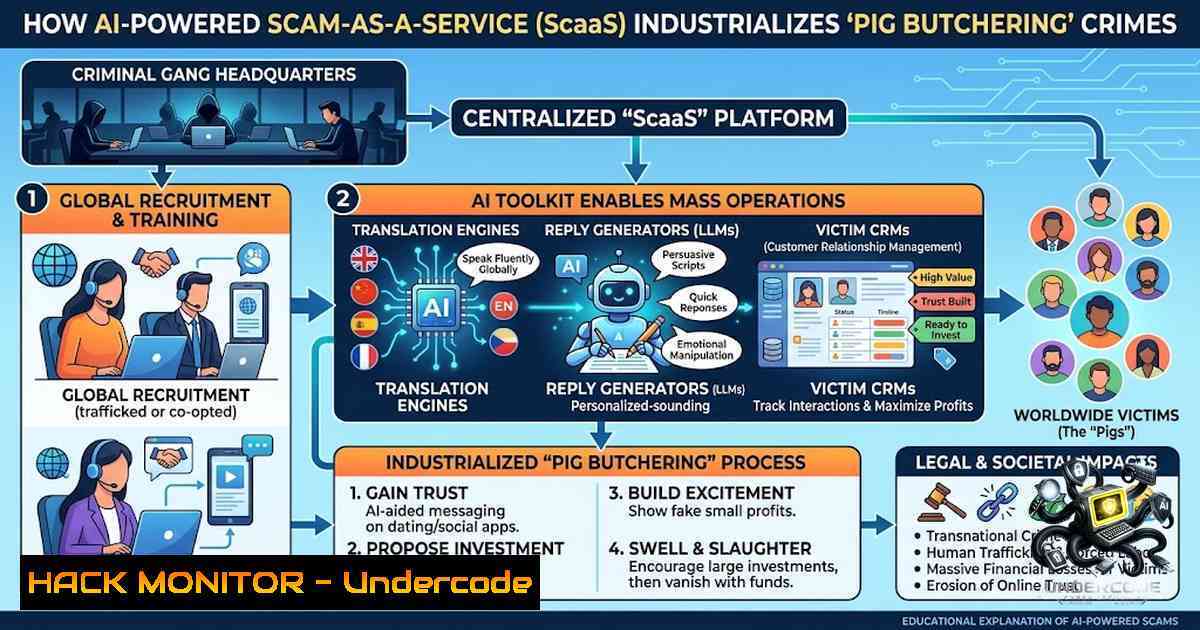
The research presented by Huber reveals a sophisticated, three-tiered technology stack that criminal gangs in countries like Cambodia and Myanmar are using to run their operations. These tools do not fully automate the attacks; rather, they “help some poor person do the scamming by creating responses that are going to be the most effective”. The stack consists of:
- AI-Powered Translation Software: Scam workers, who may only speak one or two languages, are provided with AI translation tools that automatically translate messages into the victim’s native language. One app, Editone, allows an operator to load a victim’s profile and a fabricated persona, generating replies that are contextually and culturally convincing, with voice cloning capabilities built-in. This effectively removes the language barrier that once limited the global reach of these scams.
-
Automated Reply Engines: These systems analyze ongoing conversations and generate contextual, emotionally resonant replies. By using large language models (LLMs), they can maintain consistent personas across thousands of simultaneous conversations, dramatically increasing the number of potential victims a single operator can manage.
-
Victim CRM Platforms: Perhaps the most alarming component is a full-fledged CRM system designed specifically for managing scam victims. This platform tracks each victim’s stage in the fraud pipeline, sets daily contact targets, and enforces penalties for workers who miss their quotas. This industrializes the scam process, turning it into a metrics-driven operation.
Step-by-Step Guide: Detecting AI-Enhanced Scam Infrastructure
To defend against these AI-powered scams, security teams must look beyond traditional indicators. Here’s how to detect the infrastructure behind these operations:
- Analyze Communication Patterns: Use log analysis tools to identify anomalies in message timing, volume, and linguistic consistency. AI-generated replies often exhibit unnatural consistency in tone and response time, regardless of the time of day. Use the following Linux command to parse email headers for suspicious patterns:
Extract and analyze email headers for signs of automation
grep -E "^(Received|From|To|Subject|Message-ID|Date):" suspicious_email.eml | sort
Check for irregularities in time zones and routing paths
-
Monitor for Translation Artifacts: Even the best AI translation tools leave subtle artifacts. Implement NLP-based analysis to flag messages that exhibit unnatural phrasing or cultural inconsistencies. Use Python with libraries like `langdetect` and `textblob` to analyze message sentiment and language patterns:
from langdetect import detect
from textblob import TextBlob
Analyze a sample message
text = "Your investment opportunity is guaranteed to yield high returns."
blob = TextBlob(text)
print(blob.sentiment)  Check for overly positive sentiment
print(detect(text))  Verify language consistency
-
Identify CRM and Command-and-Control (C2) Traffic: Scam CRMs and reply engines often communicate with centralized servers. Use network monitoring tools to detect unusual outbound traffic patterns. On Windows, use `netstat` to identify active connections:
netstat -anob | findstr ESTABLISHED
On Linux, use `ss` or `lsof` to monitor for suspicious connections:
sudo ss -tunap | grep ESTABLISHED
sudo lsof -i -1 -P | grep ESTABLISHED
-
The Pig Butchering Playbook: From Romance to Ruin
Pig butchering scams are a hybrid of romance scams and investment fraud. The term refers to the process of “fattening” the victim with affection and fake profits before “slaughtering” them financially. The integration of AI has supercharged this playbook:
- Initial Contact: Scammers use stolen “character sets”—packages of photos and pre-registered social media accounts—to build convincing personas on dating apps and LinkedIn. AI translation allows them to engage victims in their native language, building trust rapidly.
-
Relationship Building: Over several weeks or months, scammers use AI-powered reply engines to maintain consistent, emotionally engaging conversations. They may use voice cloning to conduct phone calls, further solidifying the illusion.
-
The Investment Pitch: Once trust is established, the scammer introduces a fake cryptocurrency investment platform. They demonstrate “profits” by allowing the victim to withdraw small amounts initially. The CRM tracks the victim’s investment amount and engagement level, triggering more aggressive pitches when the victim is deemed ready.
-
The Slaughter: When the victim has invested a significant sum, the scammers disappear, and the fake platform becomes inaccessible. The CRM system may even categorize the victim for future “re-scamming” attempts.
Step-by-Step Guide: Investigating a Suspected Pig Butchering Campaign
If you suspect a pig butchering campaign is targeting your organization or its employees, follow this investigative approach:
- Collect Digital Artifacts: Gather all communication records, including emails, SMS messages, social media interactions, and transaction details. Preserve metadata such as timestamps and IP addresses.
-
Perform OSINT on the Persona: Use reverse image search (e.g., Google Images, TinEye) to check if the profile photos are stolen. Search for key phrases from the messages to identify if they are part of a known script.
-
Analyze the Investment Platform: Examine the domain registration details using
whois:whois fake-investment-platform.com
Check for recently registered domains, hidden WHOIS information, or domains hosted on known bulletproof hosting providers.
-
Trace Cryptocurrency Transactions: Use blockchain explorers (e.g., Etherscan, Blockchain.com) to trace the flow of funds. Look for patterns such as funds being consolidated into a few wallets or moved through mixers.
3. Refund Fraud Crimeware: Targeting Retailers with AI
Huber’s research also highlighted the use of AI tools to commit refund fraud against major retailers, including Amazon. In this scheme, operators open ordinary retail accounts and “warm” them with a period of normal browsing activity to make them appear legitimate. They then conduct refund fraud attacks, purchasing goods, returning them, and keeping both the item and the refund.
Step-by-Step Guide: Hardening E-commerce Systems Against AI-Powered Refund Fraud
To protect against these sophisticated attacks, e-commerce platforms should implement the following measures:
- Implement Behavioral Analytics: Deploy machine learning models that analyze user behavior patterns, including browsing habits, purchase history, and return frequency. Flag accounts that exhibit anomalous “warming” periods followed by high-value returns.
-
Enhance Identity Verification: Implement multi-factor authentication (MFA) and device fingerprinting to verify user identities. Use the following API security best practices to validate requests:
Example of API request validation using HMAC
import hmac
import hashlib
def validate_request(api_key, signature, payload):
expected_signature = hmac.new(api_key.encode(), payload.encode(), hashlib.sha256).hexdigest()
return hmac.compare_digest(signature, expected_signature)
-
Monitor for Return Abuse Patterns: Use SQL queries to identify accounts with high return-to-purchase ratios or patterns of returning high-value items:
SELECT user_id, COUNT() as return_count, SUM(refund_amount) as total_refund
FROM returns
WHERE return_date > DATE_SUB(NOW(), INTERVAL 30 DAY)
GROUP BY user_id
HAVING return_count > 5 AND total_refund > 1000;
-
Cloud Hardening and API Security for Financial Institutions
The industrialization of AI scams underscores the need for robust cloud security and API hardening, particularly for financial institutions that are prime targets. Attackers often probe APIs for vulnerabilities to gain access to customer data or to conduct fraudulent transactions.
Step-by-Step Guide: Securing Financial APIs Against AI-Driven Attacks
- Implement Rate Limiting and Throttling: Prevent automated brute-force and credential stuffing attacks by implementing rate limiting on all API endpoints. Use a tool like `fail2ban` on Linux to block IPs that exhibit suspicious behavior:
Example fail2ban configuration for API abuse
[api-rate-limit]
enabled = true
filter = api-rate-limit
action = iptables-multiport[name=api-rate-limit, port="443", protocol=tcp]
logpath = /var/log/nginx/access.log
maxretry = 100
findtime = 60
bantime = 3600
-
Deploy API Gateways with WAF Integration: Use an API gateway that integrates with a Web Application Firewall (WAF) to inspect and filter malicious traffic. Configure rules to detect and block common attack patterns, such as SQL injection and cross-site scripting (XSS).
-
Conduct Regular Vulnerability Assessments: Perform quarterly vulnerability scans and penetration tests on all public-facing APIs. Use tools like `OWASP ZAP` or `Burp Suite` to identify weaknesses:
Run a basic ZAP scan against an API endpoint
zap-cli quick-scan -r -s all http://api.example.com/v1/
5. Vulnerability Exploitation and Mitigation in AI Systems
The AI tools used by scammers are themselves vulnerable to exploitation. By understanding how these systems work, defenders can develop countermeasures. For example, AI translation tools can be “poisoned” with adversarial inputs that cause them to produce incorrect or nonsensical translations, disrupting the scammer’s communication.
Step-by-Step Guide: Developing AI Countermeasures
- Adversarial Training: Train defensive AI models on adversarial examples to make them more robust against manipulation. Use frameworks like `TensorFlow` or `PyTorch` to generate adversarial inputs.
-
Prompt Injection Detection: Implement filters to detect and block prompt injection attempts, where attackers try to manipulate an LLM’s behavior. Use regular expressions to identify common injection patterns:
import re
def detect_prompt_injection(input_text):
patterns = [r"ignore previous instructions", r"system:.override", r"you are now"]
for pattern in patterns:
if re.search(pattern, input_text, re.IGNORECASE):
return True
return False
-
Content Moderation and Filtering: Deploy content moderation APIs to flag and block messages that contain scam-related keywords or phrases. Use the `Fraudster Glossary` curated by Eric Huber as a reference for known scam terminology.
What Undercode Say:
- Key Takeaway 1: The cybercriminal ecosystem has fully industrialized, with AI-powered “Scam-as-a-Service” platforms enabling even low-skilled operators to run sophisticated, multi-lingual fraud campaigns at scale.
- Key Takeaway 2: Defenders must shift their mindset from reactive incident response to proactive threat hunting, leveraging the same AI and automation tools used by attackers to detect and disrupt scams before they reach potential victims.
Analysis: The presentation by Eric Huber at Black Hat USA 2026 serves as a critical wake-up call for the cybersecurity industry. The integration of AI into financial fraud is not a future threat—it is happening now, and it is evolving rapidly. The use of AI translation, reply engines, and victim CRMs represents a fundamental shift in the economics of cybercrime, dramatically lowering the barrier to entry while increasing the potential return on investment. For financial institutions, the challenge is twofold: they must not only defend their own systems but also protect their customers from being manipulated by these AI-driven social engineering attacks. This requires a multi-layered defense strategy that combines advanced threat intelligence, behavioral analytics, and user education. Furthermore, the human cost of these scams—with trafficked workers in Southeast Asia being forced into slave labor to support a billion-dollar industry—adds a deeply troubling ethical dimension to the problem. As AI continues to advance, the cat-and-mouse game between attackers and defenders will only intensify, demanding continuous innovation and collaboration across the public and private sectors.
Prediction:
- +1 The democratization of AI-powered fraud tools will force a new wave of regulatory scrutiny and cross-border cooperation, leading to the development of global frameworks for AI governance in financial services.
- -1 The sophistication and scale of AI-driven scams will continue to outpace defensive capabilities, resulting in a significant increase in financial losses and a erosion of public trust in digital financial systems over the next 12-18 months.
- -1 The use of AI in human trafficking and forced criminality will become more prevalent, as criminal organizations seek to optimize their operations and maximize profits from their captive workforce.
▶️ Related Video (74% Match):
🎯Let’s Practice For Free:
🎓 Live Courses & Certifications:
Join Undercode Academy for Verified Certifications
🚀 Request a Custom Project:
Secure, high-velocity infrastructure and disruptive technological engineering. Contact our engineering team for high-tier development and proprietary systems:
[email protected]
💎 Smart Architecture | 🛡️ Secure by Design | ⭐ Trusted by Thousands
IT/Security Reporter URL:
Reported By: Niche Specialized – Hackers Feeds
Extra Hub: Undercode MoN
Basic Verification: Pass ✅


