Listen to this Post
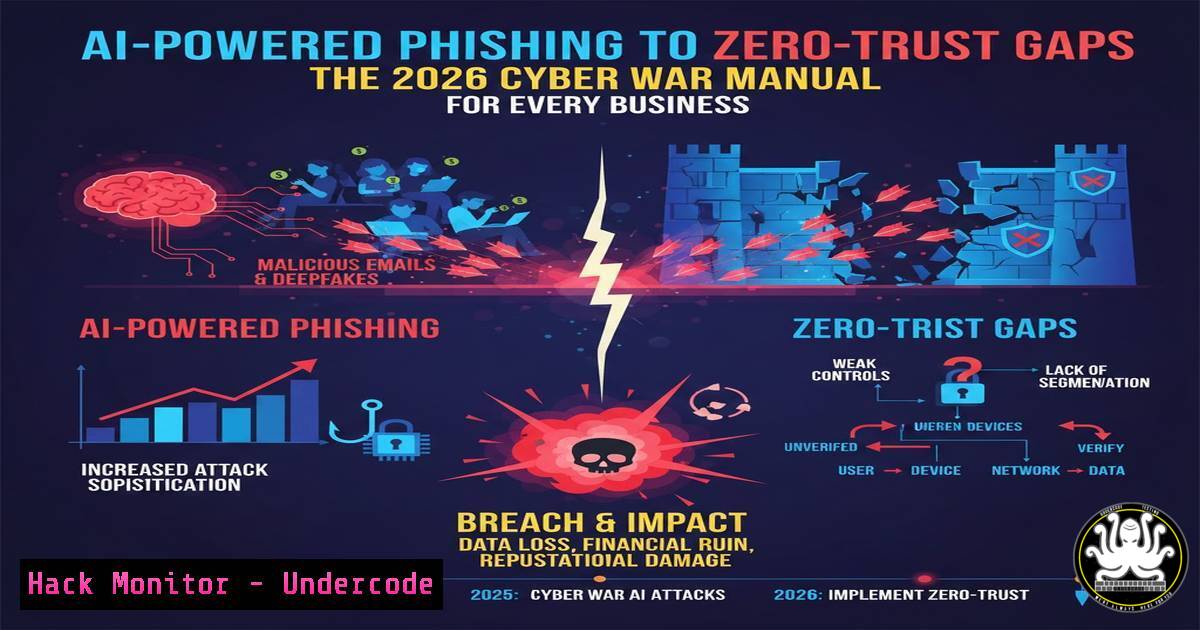
Introduction:
The cybersecurity landscape is accelerating toward a paradigm defined by artificial intelligence and automation—not just for defenders, but for attackers. For small and mid-sized businesses (SMBs) in targeted sectors, this shift means traditional perimeter-based defenses are becoming obsolete overnight. This article decodes the imminent threats and provides a technical blueprint for building resilience against AI-driven phishing, Ransomware-as-a-Service (RaaS), and supply chain compromises.
Learning Objectives:
- Understand the technical mechanisms behind AI-powered phishing and deepfake scams and learn how to configure defenses against them.
- Implement core Zero Trust Architecture (ZTA) principles using practical network segmentation and identity controls on both Linux and Windows environments.
- Develop and pressure-test an incident response (IR) playbook with actionable commands for rapid containment and recovery.
You Should Know:
1. Neutralizing AI-Driven Phishing and Deepfake Threats
The next generation of social engineering uses generative AI to create hyper-personalized, context-aware phishing lures and deepfake audio/video to impersonate executives. Defense must shift from spotting grammatical errors to analyzing behavioral anomalies and enforcing strict transaction verification.
Step‑by‑step guide explaining what this does and how to use it.
Deploy Advanced Email Security Controls:
Implement DMARC, DKIM, and SPF records rigorously. For a domain example.com, a strict DMARC record in your DNS would be:
`v=DMARC1; p=reject; rua=mailto:[email protected];`
Use AI-powered email security gateways that analyze writing style and relationship context, not just links/attachments.
Simulate and Train with AI-Generated Phishing:
Utilize open-source tools like `Gophish` to run internal campaigns using AI-crafted messages. Install and launch a campaign:
 On a Linux training server
sudo apt-get update && sudo apt-get install gophish
cd /opt/gophish/
sudo ./gophish
Access the web interface (`https://your-server:3333`) to configure campaigns using templates generated by LLMs to mimic realistic internal communications.
Implement Transaction Verification Protocols:
For financial or sensitive data transfers, mandate a secondary, out-of-band confirmation (e.g., a verified phone call using a pre-established number, not one provided in the request email).
2. Implementing Zero Trust to Stop Lateral Movement
Zero Trust eliminates the concept of a trusted internal network. The core principle is “never trust, always verify.” This is implemented through micro-segmentation and strict identity-aware access controls.
Step‑by‑step guide explaining what this does and how to use it.
Network Micro-Segmentation:
Linux (using iptables/nftables): Segment a server subnet. For example, to allow only SSH from a management VLAN (192.168.10.0/24) to web servers (192.168.20.0/24):
sudo nft add rule inet filter forward ip saddr 192.168.10.0/24 ip daddr 192.168.20.0/24 tcp dport 22 accept
sudo nft add rule inet filter forward ip daddr 192.168.20.0/24 drop
Windows (using Advanced Firewall): Create isolated server rules via PowerShell:
New-NetFirewallRule -DisplayName "Allow-Mgmt-Subnet" -Direction Inbound -LocalAddress 192.168.20.5 -RemoteAddress 192.168.10.0/24 -Protocol TCP -LocalPort 3389 -Action Allow
Enforce Least-Privilege Access & Identity Management:
Use Microsoft LAPS (Local Administrator Password Solution) or a similar privileged access management (PAM) tool to manage unique, rotating local admin passwords.
Implement Just-In-Time (JIT) access for administrative tasks, requiring elevation via a PAM tool for a limited time window.
3. Building a Rapid Incident Response (IR) Playbook
When prevention fails, containment speed dictates the breach’s cost. An automated IR playbook provides the first line of containment.
Step‑by‑step guide explaining what this does and how to use it.
Isolate a Compromised Endpoint Immediately:
Windows (via PowerShell Remoting or EDR API):
 Isolate a machine from the network (quarantine)
Invoke-Command -ComputerName COMPROMISED-PC -ScriptBlock { Stop-Service -Name "Windows Firewall" -Force; New-NetFirewallProfile -All -DefaultInboundAction Block -DefaultOutboundAction Block -Enabled True }
Linux (via SSH from a jump host):
ssh admin@compromised-host "sudo iptables -P INPUT DROP && sudo iptables -P OUTPUT DROP && sudo iptables -P FORWARD DROP && sudo systemctl isolate rescue.target"
Preserve Forensic Artifacts:
Triaging Memory: Use `DumpIt` (Windows) or `LiME` (Linux) to capture RAM before power-down.
Critical File Collection: Rapidly pull logs.
 Linux: Securely copy critical logs
scp compromised-host:/var/log/{auth.log,secure,syslog} /forensic-collection/
 Windows: Use PsExec and WinSCP or native `wevtutil` to pull event logs.
4. Hardening Against Supply Chain & RaaS Attacks
RaaS kits often exploit weak software supply chains and unpatched public-facing assets. Defense requires aggressive patch management and vendor risk assessment.
Step‑by‑step guide explaining what this does and how to use it.
Automate and Accelerate Patching:
Linux (Debian/Ubuntu): Configure unattended-upgrades for security patches only.
sudo apt-get install unattended-upgrades apt-listchanges
sudo dpkg-reconfigure -plow unattended-upgrades
Windows: Configure and test Windows Server Update Services (WSUS) or Intune to enforce strict update deadlines.
Segment and Monitor Vendor Access:
Create dedicated, audited network segments for vendor access with limited scope and time-bound VPN credentials. Monitor all sessions with full packet capture if possible.
5. Addressing the Insider Threat with Behavioral Analytics
Malicious or negligent insiders bypass most perimeter tools. Detection requires monitoring for anomalous data flows and privilege abuse.
Step‑by‑step guide explaining what this does and how to use it.
Monitor for Data Exfiltration:
Deploy a SIEM with User and Entity Behavior Analytics (UEBA). Create alerts for abnormal data volumes.
Example SIEM Query (Splunk SPL):
index=network_logs sourcetype=bro_http | stats sum(bytes) as totalBytes by src_ip dest_ip | where totalBytes > 1073741824 | alert "High Data Transfer Volume"
Implement Robust Data Loss Prevention (DLP):
On Windows, configure Endpoint DLP policies via Microsoft Purview to block unauthorized uploads of sensitive files to personal cloud storage.
On Linux, use kernel auditing (auditd) to monitor file access on sensitive directories.
sudo auditctl -w /etc/passwd -p war -k identity_files
sudo auditctl -w /var/www/ -p rwxa -k web_content
What Undercode Say:
- Resilience is the New Prevention. The 2026 threat model assumes breaches will occur. Therefore, investment must pivot equally towards detect-contain-recover capabilities, making incident response as critical as firewalls.
- Identity is the Ultimate Control Plane. With perimeters dissolved, every attack path leads to abused credentials. A relentless focus on identity hygiene—phishing-resistant MFA, JIT access, and permission reviews—offsets multiple advanced threats.
Analysis:
The commentary from industry professionals underscores a critical evolution: cybersecurity is moving from a prevention-centric to an resilience-centric model. The emphasis on “pressure-testing” recovery and “reducing how long authority is allowed to persist” points to a focus on minimizing the “dwell time” and “blast radius” of an incident. The integration of AI cuts both ways; while it supercharges attacks, it also empowers defensive tools for behavioral analytics and automated response. For SMBs, the path forward isn’t about outspending threats, but about strategic implementation of Zero Trust principles, rigorous backup/recovery testing, and fostering a security-aware culture that questions anomalies in process, not just in emails.
Prediction:
By 2026, the convergence of AI-driven automation and RaaS economies of scale will create “flash ransomware” campaigns—highly targeted, automated attacks that can encrypt a network in minutes. This will render manual response plans obsolete, forcing widespread adoption of AI-powered Security Orchestration, Automation, and Response (SOAR) platforms as a standard even for SMBs. Cyber insurance will become inextricably linked to demonstrated, automated containment capabilities, not just compliance checklists. Businesses that fail to automate their response and harden their identity infrastructure will face uninsurable risks and potentially unrecoverable operations.
▶️ Related Video (82% Match):
🎯Let’s Practice For Free:
IT/Security Reporter URL:
Reported By: Fred Costa – Hackers Feeds
Extra Hub: Undercode MoN
Basic Verification: Pass ✅


