Listen to this Post
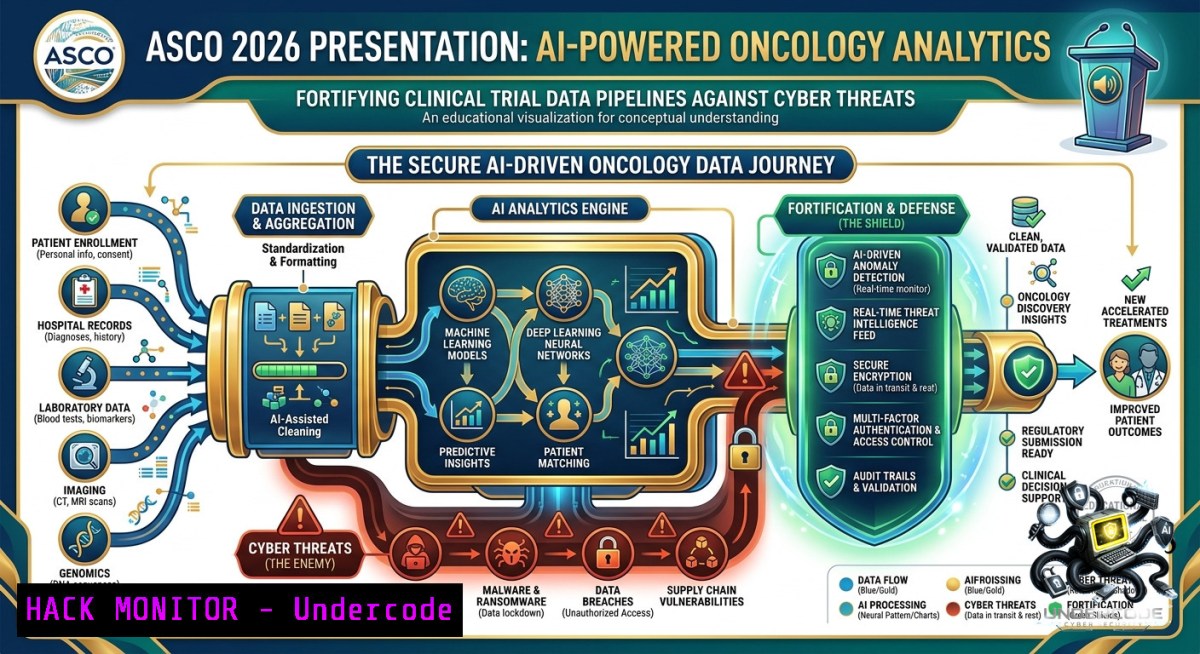
Introduction:
The integration of artificial intelligence (AI) into oncology research, highlighted by the influx of diagnostic company data at the American Society of Clinical Oncology (ASCO) 2026 abstracts, is revolutionizing clinical trial matching and drug development. However, this rapid digitalization expands the attack surface, necessitating robust cybersecurity frameworks to protect sensitive patient information and ensure the integrity of real-world data pipelines.
Learning Objectives:
- Understand the core security challenges in AI-driven oncology data platforms.
- Learn how to implement HIPAA-compliant API security and cloud hardening techniques.
- Acquire hands-on commands for Linux and Windows to monitor and secure clinical trial data infrastructure.
You Should Know:
- The Convergence of AI and Oncology Data: A New Security Frontier
The shift from debating AI’s potential to demonstrating its scale, as exemplified by companies like Massive Bio and LARVOL, introduces critical security and operational requirements. AI models ingest vast, heterogeneous datasets, making data provenance and pipeline integrity paramount. Start by extending the foundational understanding: LARVOL’s platform curates data from over 25,000 sources, including ClinicalTrials.gov, to provide real-time intelligence. This data is often processed using AWS services like EC2, RDS, and ECS, with security enforced via AWS WAF and Secrets Manager. For AI-driven trial matching, architectures like Massive Bio’s three-agent system rely on knowledge graphs to ensure auditable, deterministic outcomes in real-world settings.
To secure such pipelines, implement comprehensive logging and monitoring. Use the following Linux commands to inspect system logs and network connections for anomalies:
 Linux - Check authentication logs for unauthorized access attempts
sudo grep "Failed password" /var/log/auth.log

Linux - Monitor active network connections and listening ports
sudo netstat -tulpn

Windows (PowerShell) - Get a list of running processes with network activity
Get-1etTCPConnection | Where-Object {$_.State -eq "Listen"} | Format-Table LocalPort, OwningProcess -AutoSize

Windows (PowerShell) - Check for failed logon events in the Security log
Get-WinEvent -FilterHashtable @{LogName='Security'; ID=4625} | Select-Object TimeCreated, Message
Additionally, training AI models on sensitive data requires privacy-preserving techniques. Methods such as federated learning and multi-party computation (MPC) allow model training without raw data exchange, a strategy being adopted in projects like SECURED for blood cancer research.
2. Securing Clinical Trial APIs and Data-in-Transit
Clinical trial interoperability heavily relies on HL7 FHIR APIs and OAuth 2.0 frameworks. The increased exchange of electronic health records (EHR) and real-world data demands encryption for data in transit and at rest. Best practices include enforcing TLS 1.3 for all API endpoints, implementing mutual TLS (mTLS) for service-to-service authentication, and using envelope encryption with AES-256 for PHI. For Linux and Windows administrators, hardening API gateways involves strict firewall rules and certificate management:
 Linux - Check SSL/TLS certificate expiration date (replace domain)
echo | openssl s_client -servername api.larvol.com -connect api.larvol.com:443 2>/dev/null | openssl x509 -1oout -dates

Linux - Use iptables to restrict API access to a specific internal subnet
sudo iptables -A INPUT -p tcp --dport 443 -s 192.168.1.0/24 -j ACCEPT
sudo iptables -A INPUT -p tcp --dport 443 -j DROP

Windows (PowerShell) - Test TLS connection and retrieve cipher suite information
Test-1etConnection -Port 443 -ComputerName clin.larvol.com | Select-Object ComputerName, RemoteAddress, RemotePort, TcpTestSucceeded

Windows (PowerShell) - List weak TLS versions enabled on the server (run as admin)
Get-TLS Cipher Suite | Where-Object {$_.Name -match "TLS 1.0|TLS 1.1"}
Zero Trust principles are critical for healthcare data sharing. Implement a pipeline where every data access request is verified, regardless of origin, using confidential computing and attestation before decryption keys are released. Regularly audit access logs and rotate API keys using centralized secret managers like AWS Secrets Manager or Azure Key Vault.
3. Cloud Hardening for Decentralized Clinical Trials
Decentralized clinical trials (DCTs) leverage cloud-1ative data fabrics to integrate data from wearables, mobile apps, and EHRs. This complex web creates numerous attack surfaces that require stringent identity and access management (IAM). Employ Role-Based Access Control (RBAC) with least privilege principles, enforce multi-factor authentication (MFA) via FIDO2 keys, and ensure detailed audit logging for HIPAA and GDPR compliance. Use the following commands to harden Linux and Windows cloud instances:
 Linux - Harden SSH configuration (disable root login, use key-based auth)
sudo sed -i 's/PermitRootLogin yes/PermitRootLogin no/' /etc/ssh/sshd_config
sudo sed -i 's/PasswordAuthentication yes/PasswordAuthentication no/' /etc/ssh/sshd_config
sudo systemctl restart sshd

Linux - Set up auditd to monitor file access to critical PHI directories
sudo auditctl -w /var/www/clinical_data/ -p rwxa -k PHI_ACCESS

Windows (PowerShell) - Configure advanced audit policies for object access
auditpol /set /subcategory:"File System" /success:enable /failure:enable

Windows (Command Prompt) - Enable BitLocker for full-disk encryption (requires TPM)
manage-bde -on C: -rp -sk C:\BitLocker_Key
For cloud configuration management, use tools like Terraform to enforce security policies as code. Regularly scan for misconfigurations using AWS Inspector or Azure Security Center. Implement data sovereignty controls using customer-managed encryption keys to maintain compliance across jurisdictions, especially in international trials.
4. Vulnerability Exploitation and Mitigation in Oncology Platforms
AI models and data pipelines are vulnerable to specific threats, including model poisoning, adversarial attacks, and data extraction through inference. For instance, an attacker could subtly manipulate trial data to skew AI-driven trial matching results. Mitigation requires input validation, differential privacy, and robust model monitoring. Use the following code snippets to implement basic defenses:
 Python - Example of input sanitization for clinical data fields (mitigates injection attacks)
import re
def sanitize_patient_id(patient_id):
 Allow only alphanumeric and hyphens
return re.sub(r'[^a-zA-Z0-9-]', '', patient_id)

Python - Implement rate limiting for API endpoints (using Flask-Limiter)
from flask_limiter import Limiter
limiter = Limiter(app, key_func=lambda: request.remote_addr)
@limiter.limit("5 per minute")
def sensitive_api():
return "Access granted"
Regular vulnerability scanning is essential. Use `nmap` for port scanning and `sqlmap` for testing against SQL injection. On Windows, use the built-in Microsoft Defender Vulnerability Management feature. Develop an incident response plan specific to clinical trial data breaches, including notification procedures under HIPAA and GDPR.
What Undercode Say:
- Key Takeaway 1: AI-driven oncology analytics are transforming clinical research, but the security of data pipelines is a prerequisite for trust and regulatory compliance.
- Key Takeaway 2: Organizations must adopt a layered security approach—encryption, strict IAM, Zero Trust, and continuous auditing—to protect against evolving cyber threats in decentralized clinical environments.
Prediction:
- +1 AI-powered privacy-preserving computation (e.g., federated learning) will become the industry standard, enabling unprecedented cross-institutional collaboration without raw data sharing.
- -1 The proliferation of IoT devices in DCTs will expose a critical vulnerability, leading to at least one major data breach by 2028, prompting stricter FDA guidance on device cybersecurity.
- +1 Cloud-1ative security frameworks will evolve to embed AI-driven threat detection directly into data fabrics, reducing response times to near-zero for PHI exposures.
▶️ Related Video (80% Match):
🎯Let’s Practice For Free:
🎓 Live Courses & Certifications:
Join Undercode Academy for Verified Certifications
🚀 Request a Custom Project:
Secure, high-velocity infrastructure and disruptive technological engineering. Contact our engineering team for high-tier development and proprietary systems:
[email protected]
💎 Smart Architecture | 🛡️ Secure by Design | ⭐ Trusted by Thousands
IT/Security Reporter URL:
Reported By: Asco26 Larvol – Hackers Feeds
Extra Hub: Undercode MoN
Basic Verification: Pass ✅


