
Listen to this Post
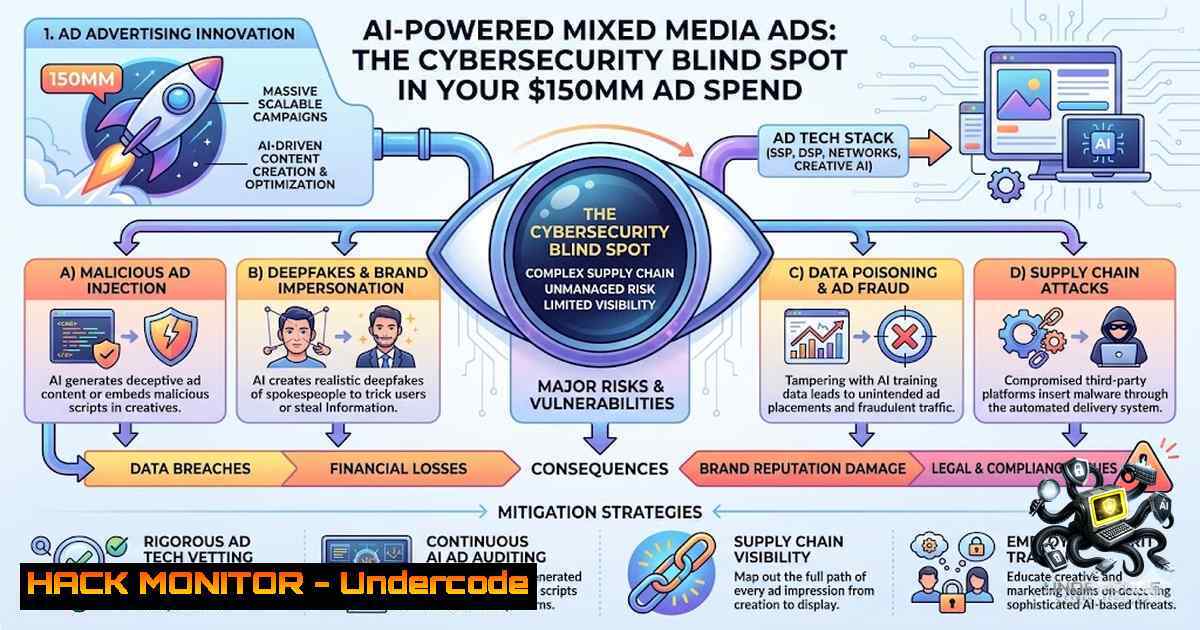
Introduction:
The digital advertising landscape is undergoing a seismic shift as brands merge UGC, HIFI, LOFI, AI-generated content, BTC content, podcast clips, and founder ads into single, high-performance creative assets. While this “mixed media” strategy—championed by industry veterans like Caleb Kruse (400k+ followers, $150MM+ ad spend managed)—delivers unprecedented engagement rates, it also introduces a complex attack surface that security teams are only beginning to understand. As AI-generated content and automated ad delivery become the norm, the intersection of creative strategy and cybersecurity demands immediate attention, particularly when API keys, cloud infrastructure, and user data flow through an increasingly fragmented martech stack.
Learning Objectives:
- Understand the security implications of mixed media ad creation pipelines, including AI-generated asset risks and third-party API exposures
- Identify vulnerabilities in automated ad deployment workflows and implement mitigation strategies across Linux and Windows environments
- Master command-line techniques for monitoring, logging, and securing ad tech infrastructure against data exfiltration and account takeover
You Should Know:
- The Hidden Attack Surface in AI-Generated Creative Assets
Mixed media advertising relies heavily on AI tools for content generation—from synthetic voiceovers to deepfake-style visual assets. Caleb Kruse’s observation that “AI content” is now a core pillar of mixed media strategies【0†L11】 highlights a critical security gap: every AI generation tool you integrate becomes a potential data leakage vector. When creative teams upload brand assets, customer personas, or performance data to third-party AI platforms, they’re often unknowingly exposing sensitive intellectual property and campaign intelligence.
Step‑by‑step guide to securing your AI asset pipeline:
On Linux (Ubuntu/Debian):
 Monitor outbound connections from AI tool processes
sudo netstat -tunap | grep -E 'python|node|docker' | awk '{print $5}' | cut -d: -f1 | sort | uniq -c

Set up iptables rules to restrict AI tool traffic to approved endpoints
sudo iptables -A OUTPUT -d 192.168.1.0/24 -j ACCEPT  Allow internal
sudo iptables -A OUTPUT -d 0.0.0.0/0 -j DROP  Block everything else
sudo iptables -A OUTPUT -m state --state ESTABLISHED,RELATED -j ACCEPT

Audit AI-generated files for metadata leakage
exiftool -All= /path/to/ai_assets/.png 2>/dev/null | grep -i "creator|software|timestamp"
On Windows (PowerShell):
 Monitor AI tool network activity
Get-1etTCPConnection | Where-Object {$_.State -eq "Established"} |
Select-Object LocalAddress, LocalPort, RemoteAddress, RemotePort, OwningProcess

Use Sysmon or Windows Defender to audit file creation events
Get-WinEvent -LogName "Microsoft-Windows-Sysmon/Operational" |
Where-Object {$_.Id -eq 11} | Select-Object TimeCreated, Message |
Out-File -FilePath "C:\Logs\ai_file_creations.log"

Implement AppLocker policies to restrict AI executable execution
Set-AppLockerPolicy -PolicyPath "C:\Policies\AI_Tools.xml" -Merge
What this does: These commands create a hardened environment where AI generation tools can only communicate with whitelisted endpoints, preventing accidental data leakage to unauthorized servers. The metadata audit reveals hidden information within AI-generated files that could expose campaign strategies or internal system details.
2. Securing the Ad Platform API Ecosystem
Mixed media ads are deployed across Facebook, TikTok, Google, and emerging platforms through API integrations. Kruse’s mention of “Ads | Ai | Automation”【0†L7】 underscores the heavy reliance on automated API calls for campaign management. Each API key, OAuth token, and webhook endpoint represents a potential entry point for attackers. The 2024 Cambridge Analytica-style breaches have evolved into sophisticated API harvesting attacks that target ad accounts with millions in daily spend.
Step‑by‑step guide to API security hardening:
Generate and rotate API keys securely (Linux):
 Generate a secure API key using OpenSSL
openssl rand -base64 32 | tr -d "=+/" | cut -c1-32

Store keys in a vault (HashiCorp Vault example)
vault kv put secret/ad_platforms/facebook_api_key key="YOUR_KEY_HERE"
vault kv put secret/ad_platforms/tiktok_api_key key="YOUR_KEY_HERE"

Rotate keys automatically every 30 days via cron
(crontab -l 2>/dev/null; echo "0 0 1   /usr/local/bin/rotate_ad_api_keys.sh") | crontab -
Implement request signing and validation (Node.js example for ad webhooks):
const crypto = require('crypto');

function verifyWebhookSignature(payload, signature, secret) {
const expected = crypto
.createHmac('sha256', secret)
.update(JSON.stringify(payload))
.digest('hex');
return crypto.timingSafeEqual(
Buffer.from(signature),
Buffer.from(expected)
);
}

// Rate limiting for API endpoints
const rateLimit = require('express-rate-limit');
const limiter = rateLimit({
windowMs: 15  60  1000, // 15 minutes
max: 100, // limit each IP to 100 requests
message: 'Too many requests from this IP, please try again later.'
});
app.use('/api/ad-creation', limiter);
Windows PowerShell for API monitoring:
 Monitor API call patterns for anomalies
$apiLogs = Get-Content "C:\Logs\ad_api_calls.log"
$apiLogs | Group-Object {($_ -split ',')[bash]} |
Where-Object {$_.Count -gt 50} |
Export-Csv -Path "C:\Reports\suspicious_api_activity.csv"

Set up Windows Event Forwarding for API authentication events
wevtutil set-log "Security" /enabled:true /retention:false /maxsize:1073741824
wevtutil subscribe "Security" /type:Forward /address:"http://siem.internal:5985" /password:"P@ssw0rd"
3. Cloud Infrastructure Hardening for Ad Delivery Networks
Modern mixed media campaigns leverage CDNs, cloud storage (AWS S3, Google Cloud Storage), and serverless functions to serve dynamic creative assets at scale. The “all mixed into one ad” approach【0†L15】 means multiple cloud services are stitched together, each with its own IAM roles, bucket policies, and access logs. Misconfigured S3 buckets have exposed billions of ad assets and user interaction data in recent years.
Step‑by‑step cloud hardening guide:
AWS CLI commands for securing ad asset storage:
 Enforce bucket encryption and block public access
aws s3api put-bucket-encryption --bucket your-ad-bucket \
--server-side-encryption-configuration '{"Rules":[{"ApplyServerSideEncryptionByDefault":{"SSEAlgorithm":"AES256"}}]}'

aws s3api put-public-access-block --bucket your-ad-bucket \
--public-access-block-configuration "BlockPublicAcls=true,IgnorePublicAcls=true,BlockPublicPolicy=true,RestrictPublicBuckets=true"

Generate and rotate IAM access keys
aws iam create-access-key --user-1ame ad-automation-user
aws iam update-access-key --access-key-id OLD_KEY_ID --status Inactive --user-1ame ad-automation-user

Audit bucket permissions across all regions
aws s3api get-bucket-policy --bucket your-ad-bucket --query Policy --output text | jq '.Statement[] | select(.Effect=="Allow")'
Google Cloud SDK commands:
 Set uniform bucket-level access
gsutil uniformbucketlevelaccess set on gs://your-ad-bucket

Enable VPC Service Controls to restrict data exfiltration
gcloud access-context-manager perimeters create ad-perimeter \
--title="Ad Delivery Perimeter" \
--resources="projects/your-project-id" \
--restricted-services="storage.googleapis.com,bigquery.googleapis.com"

Audit cloud storage for publicly accessible objects
gsutil ls -r gs://your-ad-bucket | while read obj; do
gsutil iam get $obj | grep -q "allUsers" && echo "WARNING: $obj is public"
done
4. Securing the Creative Development Pipeline
The shift toward mixed media means creative teams now use a broader array of tools—video editors, AI image generators, audio processing software, and collaboration platforms. Each tool introduces potential vulnerabilities, from insecure file transfers to compromised dependencies. Kruse’s mention of “UGC, HIFI content, LOFI content, Ai content, BTC content, Podcast clips, Founder ads”【0†L9-L14】 reveals the diversity of the toolchain that must be secured.
Step‑by‑step pipeline security implementation:
Linux environment for creative tool isolation:
 Run creative tools in isolated Docker containers
docker run --rm -it \
--1etwork=none \
--read-only \
--tmpfs /tmp \
-v /data/creative_input:/input:ro \
-v /data/creative_output:/output:rw \
your-creative-tool:latest

Scan all incoming creative assets for malware
clamscan -r --remove /data/creative_input/ && clamscan -r --remove /data/creative_output/

Implement file integrity monitoring for critical creative directories
aide --init
mv /var/lib/aide/aide.db.new.gz /var/lib/aide/aide.db.gz
aide --check
Windows environment for creative tool security:
 Enable Windows Defender Application Guard for untrusted creative tools
Set-WDApplicationGuard -Enabled $true -AllowCameraMicrophone $false -AllowPrinting $false

Monitor file changes in creative directories
$watcher = New-Object System.IO.FileSystemWatcher
$watcher.Path = "C:\CreativeAssets"
$watcher.Filter = "."
$watcher.EnableRaisingEvents = $true
Register-ObjectEvent $watcher "Changed" -Action {
Write-Host "File changed: $($Event.SourceEventArgs.FullPath)"
 Log to SIEM
Write-EventLog -LogName "Application" -Source "CreativeAudit" -EventId 1001 -Message "File change detected"
}

Implement BitLocker encryption for creative asset drives
Manage-bde -on C: -RecoveryPassword -UsedSpaceOnly
5. Monitoring and Incident Response for Ad Campaigns
With $150MM+ in ad spend managed by practitioners like Kruse【0†L7】, the financial impact of a security breach is staggering. Attackers who compromise ad accounts can drain budgets, redirect traffic to phishing sites, or inject malicious creatives that damage brand reputation. Real-time monitoring across the entire mixed media pipeline is non-1egotiable.
Step‑by‑step monitoring implementation:
Centralized logging with ELK Stack (Linux):
 Install and configure Filebeat for ad platform logs
curl -L -O https://artifacts.elastic.co/downloads/beats/filebeat/filebeat-8.11.0-amd64.deb
sudo dpkg -i filebeat-8.11.0-amd64.deb
sudo systemctl enable filebeat
sudo systemctl start filebeat

Configure Logstash pipeline for anomaly detection
cat > /etc/logstash/conf.d/ad_security.conf << 'EOF'
input { beats { port => 5044 } }
filter {
if [bash] =~ /API_KEY/ {
mutate { add_tag => ["sensitive_data_leak"] }
}
if [bash] > 5000 {
mutate { add_tag => ["slow_api_response"] }
}
}
output { elasticsearch { hosts => ["localhost:9200"] } }
EOF
Windows Event Forwarding and SIEM integration:
 Configure Windows Event Collector for ad infrastructure
wecutil qc /q
wecutil cs "AdInfrastructure" /c:"http://siem.internal:5985/wsman/SubscriptionManager/WEC" /a:"kerberos"

Set up PowerShell script to monitor ad account balance anomalies
$currentSpend = (Invoke-RestMethod -Uri "https://api.facebook.com/v19.0/act_123456/insights?access_token=TOKEN").data.spend
$expectedSpend = 10000
if ($currentSpend -gt ($expectedSpend  1.5)) {
Send-MailMessage -To "[email protected]" -Subject "ALERT: Abnormal Ad Spend Detected" -Body "Current spend: $currentSpend"
}
What Undercode Say:
- Key Takeaway 1: The convergence of AI-generated content and automated ad delivery creates a security blind spot that traditional perimeter defenses cannot address. Organizations must treat their creative toolchain as critical infrastructure, implementing the same rigorous security controls applied to financial systems.
-
Key Takeaway 2: API key management and cloud misconfigurations remain the primary attack vectors in ad tech. Regular rotation, least-privilege access, and comprehensive logging are not optional—they are the baseline for any organization running programmatic advertising at scale.
Analysis: Caleb Kruse’s observation that mixed media creatives are “becoming more and more popular”【0†L9】 signals a fundamental shift in how brands approach advertising. However, the security community has been slow to respond to this evolution. While CISOs focus on protecting corporate networks and customer databases, the ad tech stack—often managed by marketing teams with limited security awareness—remains dangerously exposed. The $150MM in ad spend Kruse references【0†L7】 represents not just revenue opportunity but also an attractive target for cybercriminals. Ad platforms have become the new financial services sector, processing billions in transactions daily with often-inadequate security controls. The commands and configurations provided above offer a practical starting point, but the real solution requires a cultural shift: security must become a first-class citizen in the creative development process, not an afterthought.
Prediction:
- +1 The increasing adoption of AI in advertising will drive the development of specialized security tools for creative pipelines, creating a new $2B+ market segment by 2028. Vendors will emerge offering “Creative DevSecOps” platforms that integrate vulnerability scanning, API security, and compliance monitoring directly into ad creation workflows.
-
+1 Regulatory bodies will introduce specific guidelines for AI-generated advertising content, mandating watermarking, provenance tracking, and security audits. This will accelerate the adoption of cryptographic signing for creative assets, making content integrity verification a standard practice.
-
-1 The lag between creative innovation and security implementation will result in at least one major brand suffering a $50M+ breach through compromised ad APIs within the next 18 months. The attack will likely involve AI-generated deepfake assets used to hijack campaign budgets or spread disinformation.
-
-1 Small and medium-sized businesses, which lack dedicated security teams, will be disproportionately affected by ad platform vulnerabilities. Expect a 300% increase in account takeover attacks targeting SMB advertisers as cybercriminals automate the exploitation of poorly secured API integrations.
-
+1 The security community’s response will be swift, with open-source frameworks emerging for ad tech security auditing. Projects like “AdSecKit” and “CampaignGuard” will provide free, community-driven tools that democratize access to enterprise-grade security controls for advertisers of all sizes.
🎯Let’s Practice For Free:
🎓 Live Courses & Certifications:
Join Undercode Academy for Verified Certifications
🚀 Request a Custom Project:
Secure, high-velocity infrastructure and disruptive technological engineering. Contact our engineering team for high-tier development and proprietary systems:
[email protected]
💎 Smart Architecture | 🛡️ Secure by Design | ⭐ Trusted by Thousands
IT/Security Reporter URL:
Reported By: Calebkrusemedia Mixed – Hackers Feeds
Extra Hub: Undercode MoN
Basic Verification: Pass ✅


