Listen to this Post
Introduction
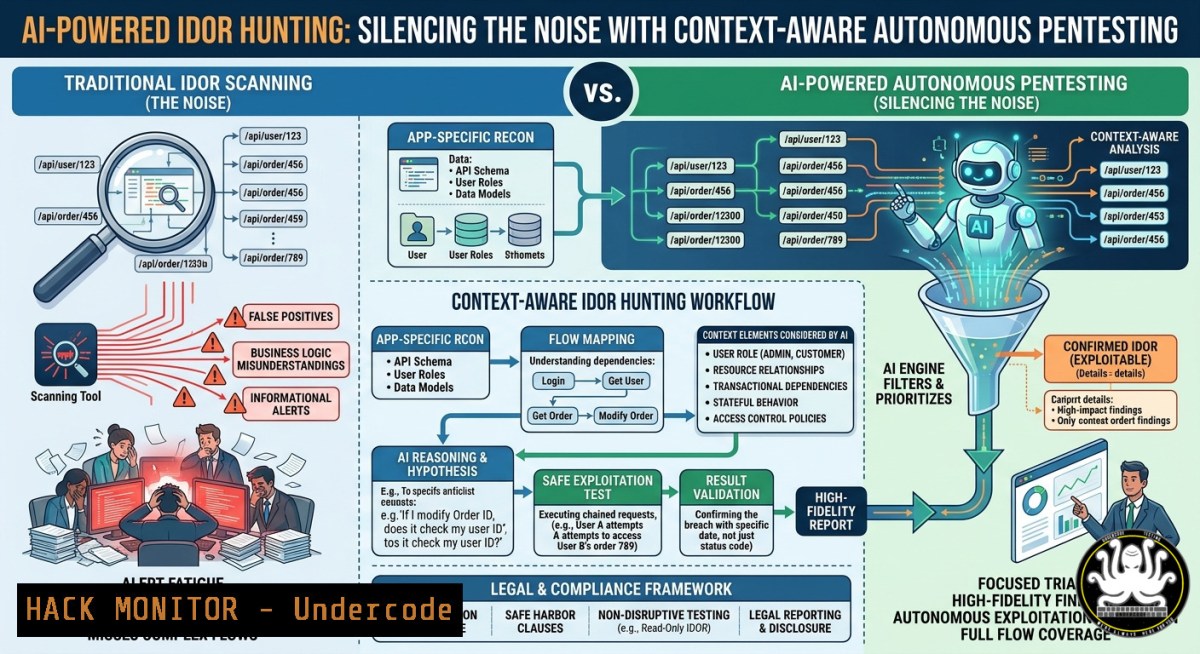
Insecure Direct Object Reference (IDOR) vulnerabilities are not traditional implementation bugs but design-level logic flaws that live in the gap between authentication and authorization. Traditional automated scanners fail at detecting IDORs because they cannot understand application context or distinguish whether a user should have access to an object—they only confirm whether the request is structurally valid. XBOW, an autonomous AI-powered pentesting platform, has cracked this challenge by moving from a “Can I access this?” mindset to a “Should I be able to?” framework, using role-based observation and complex reasoning to ground its findings in actual application behavior rather than assumptions.
Learning Objectives
- Understand why traditional SAST/DAST tools fail to detect IDOR vulnerabilities and how AI-driven, context-aware reasoning solves this problem.
- Learn the multi-phase XBOW methodology, including role-based observation, multi-authentication testing, and evidence-based validation.
- Gain hands-on knowledge of manual IDOR detection techniques, prevention strategies, and modern open-source tools for automated testing.
You Should Know
- Why Traditional Scanners Miss IDORs: The “Can I?” vs. “Should I?” Gap
IDOR vulnerabilities are fundamentally about broken access control—the application knows who you are but doesn’t verify what you should be allowed to touch. Traditional DAST scanners see a valid session token, a structurally correct request, and a 200 OK response, and mark it as passing. They have no concept of ownership and cannot correlate behavior across multiple authenticated sessions, missing the fact that User A just pulled User B’s invoice by changing one number in the URL.
Most of the industry’s approach to catching IDORs has remained unchanged for over a decade: replay requests with different credentials and hope something breaks. As Gary McGraw’s “Bug Parade” concept illustrates, code-level bugs (buffer overflows, SQL injections) are implementation problems that automated scanners can find, but design-level flaws require threat models, security requirements, and an understanding of what the application should enforce versus what it actually does.
Step-by-step manual IDOR detection guide using Burp Suite:
- Intercept and capture. Configure Burp Suite as a proxy, authenticate with two separate user accounts (User A and User B), and record all requests.
- Identify object references. Look for parameters in URLs, JSON bodies, or headers that reference specific objects—for example,
user_id=123,invoice_id=456,/orders/789, or GraphQL queries with object IDs. - Replay with modified identifiers. Using Burp Repeater, take a request from User A and change the object reference to a value belonging to User B (e.g., `id=124` instead of
id=123). - Analyze the response. If the response returns User B’s data, returns a 200 OK with different content, or provides any information that should be restricted, you have likely found an IDOR. Tools like LETHAL IDOR + CSRF EXPLOITER automate this process by comparing responses between authenticated and unauthenticated users.
A practical example: a classic IDOR appears in a URL like /users/123. If a user changes that to `/users/124` and the application returns another person’s data, that is an IDOR. The same issue can appear in hidden form fields, JSON bodies, file paths, and API parameters anywhere object identifiers are exposed and trusted too much.
Command-line example using IDOR-Forge:
 Install and run IDOR Forge
git clone https://github.com/errorfiathck/IDOR-Forge.git
cd IDOR-Forge
pip install -r requirements.txt
python IDOR-Forge.py -u "https://example.com/api/user?id=123" -m GET --proxy "http://127.0.0.1:8080" --test-values '["124","125","126"]' --output results.csv
This tool automates the scanning of parameters, dynamically generating payloads to test for unauthorized access.
- The XBOW Methodology: Learning “Normal” Before Testing for Flaws
The turning point in XBOW’s approach was shifting focus from making the system better at attacking to making it better at understanding. Instead of simply saying “find vulnerabilities,” XBOW instructs its agents to: “Explore the application and tell me what normal looks like”.
Phase 1: Role-based observation. XBOW deploys agents that log in as specific roles (admin, manager, user), browse the application normally, and document what they can and cannot do. No attacking, no exploiting—just observing and learning. By the end of this step, XBOW has a clear picture of each role’s partial view of what’s allowed and a complete map of who can access what and where boundaries exist.
Phase 2: Multi-authentication testing. IDORs involve crossing boundaries: one user accessing another user’s data, a lower-privileged role seeing something it shouldn’t, or lateral movement between accounts. To understand that, multiple perspectives are needed. XBOW logs in as different users, explores accessibility, and compares whether the access matches what was expected from the initial observation phase.
Phase 3: Evidence-based validation. Once context is established, validation becomes a grounded process. When the solver finds something suspicious, the validator asks three questions:
– Does this align with what we observed for this role?
– Does this break a boundary between roles?
– Is this something no role was supposed to do?
Arguments for or against a finding are built from actual observations, not assumptions. Results improve immediately, with significantly fewer false positives because the system compares against what it has already seen rather than guessing.
- Automated AI-Powered IDOR Testing Tools You Can Use Today
Several open-source and commercial tools leverage AI to automate IDOR detection, each offering different capabilities.
BAC Hunter is a comprehensive, AI-powered security testing tool designed to detect Broken Access Control (BAC) vulnerabilities, IDOR issues, and privilege escalation flaws. It includes intelligent reconnaissance (robots.txt analysis, sitemap discovery, JavaScript endpoint mining), differential testing that compares responses between different user identities, and AI-powered anomaly detection using machine learning.
BAC Hunter command-line examples:
 Smart scan with automatic mode selection
bac-hunter smart-scan https://target.com

IDOR vulnerability testing
bac-hunter idor https://target.com --identities config/identities.yaml

Full security audit
bac-hunter audit https://target.com
Repeater Strike, a Burp Suite extension developed by PortSwigger, uses AI to analyze Repeater traffic and generate intelligent regular expressions for automating IDOR discovery. It identifies vulnerabilities, generates JSON objects describing the vulnerability class, then mutates probes and response patterns to find similar issues across the proxy history. This approach converts a single vulnerability discovery into a broader set of actionable findings with minimal effort.
LETHAL IDOR + CSRF EXPLOITER v2.1 automates complete exploitation flows, including IDOR endpoint identification via ID, UUID, hash, or token manipulation, advanced CSRF exploit generation, stealth mode for WAF evasion, and privilege simulation across multiple user roles. It can be used to generate ready-to-submit professional proof-of-concept exploits for bug bounty reports.
- IDOR Prevention: Secure Coding Strategies That Actually Work
IDORs are business logic errors made in the design or implementation phase, and they cannot be mitigated with additional “magical” security appliances like next-generation firewalls or Web Application Firewalls. The only solution is security by design, introduced in the very early stages of software development.
Core prevention strategies:
- Implement object-level authorization for every request. Never assume that having a resource ID means having access to it—treat every request as untrusted. Web frameworks often provide built-in mechanisms to enforce access control checks for each object that users try to access.
-
Avoid exposing internal identifiers altogether. Use indirect object references such as lookup tables or session-based mappings. If you must expose an identifier, use non-guessable values that cannot be enumerated—for example, randomly generated tokens or UUIDs. However, be cautious: UUIDs reduce guessability but do not replace proper authorization checks.
-
Add security requirements to user stories during the design phase. Authorization flaws are easiest to prevent when requirements are specified upfront rather than retrofitted after development. The OWASP prevention cheat sheet emphasizes that IDORs are “rarely about guessing the next integer in a URL” and are instead buried in authorization logic, object lifecycles, and assumptions.
-
Test with multiple accounts and roles during development. Use differential testing: create two accounts and swap the ID numbers between them. If you can view the other user’s content while still logged in with a different account, you’ve found a valid IDOR vulnerability.
Code example (Python – vulnerable vs. secure):
 VULNERABLE: No authorization check
@app.route('/api/user/<user_id>')
def get_user_profile(user_id):
user = User.query.get(user_id)
return jsonify(user.to_dict())

SECURE: Object-level authorization enforced
@app.route('/api/user/<user_id>')
@login_required
def get_user_profile(user_id):
if str(current_user.id) != user_id and not current_user.is_admin:
return jsonify({"error": "Unauthorized"}), 403
user = User.query.get(user_id)
return jsonify(user.to_dict())
- Advanced IDOR Attack Vectors: Beyond Numeric ID Manipulation
Modern IDORs extend far beyond changing an integer in a URL. Attack vectors now include:
- Read access IDOR: A user views another customer’s invoice, support ticket, or profile.
- Write access IDOR: A user modifies another user’s data by changing an object reference in a form or API request.
- File and document access IDOR: An attacker retrieves files, exports, PDFs, or media objects through predictable names or identifiers.
- API object reference IDOR: Modern applications expose this bug in APIs rather than browser URLs. The request may be structurally valid, the user may be authenticated, and the response may even be a clean 200 OK—but the object returned belongs to someone else.
- Multi-step workflow IDOR: The hardest to detect. The issue only appears after a particular sequence: creating one object as one user, switching state, then referencing it from another account, role, or session.
UUID guessing attacks are also a growing concern. Even though UUIDs look random, in some systems they are exposed or reused in predictable ways. Attackers can sometimes recover UUIDs from exposed references, regenerate them using known algorithms, or brute-force them if the entropy space is too small.
What Undercode Say
- Context is the missing piece. The shift from “Can I?” to “Should I?” represents a fundamental evolution in security automation. Traditional scanners operate without understanding application logic, which is why they generate so much noise. XBOW’s approach of mapping normal behavior across roles before testing for flaws is a blueprint for the future of autonomous pentesting.
-
AI’s real value in security isn’t pattern matching—it’s reasoning. The industry has spent decades building increasingly sophisticated pattern-matching engines. But design flaws require reasoning about intent, permissions, and business constraints—tasks that have always required human judgment. Large language models, when combined with deterministic evaluation and multi-perspective testing, can finally bridge this gap. Tools like XBOW, BAC Hunter, and Repeater Strike demonstrate that AI-powered reasoning is not just feasible but practical for discovering logic-based vulnerabilities at scale.
-
False positives remain the biggest barrier to automation adoption. Security teams are drowning in alerts. XBOW’s grounded validation approach, where arguments are built from observed behavior rather than assumptions, shows a clear path to reducing noise. When validation is evidence-based rather than probabilistic, false positives drop significantly and trust in automation grows.
Prediction
- Positive impact: Autonomous AI-powered pentesting platforms will become standard in DevSecOps pipelines within 24–36 months, reducing manual security testing costs by 40–60% and cutting time-to-remediation for logic flaws from weeks to hours.
- Positive impact: IDOR detection accuracy will approach 90–95% as AI models learn to normalize application context across millions of APIs, making what is currently a manual, human-intensive process completely automated.
- Negative impact: As detection improves, attackers will shift to even more complex multi-step logic flaws and exploit AI-generated code weaknesses, creating a new class of vulnerabilities that current AI reasoning models cannot yet understand.
- Positive impact: The cost of entry for comprehensive application security testing will drop dramatically, enabling smaller organizations to implement enterprise-grade security testing without dedicated security teams.
▶️ Related Video (88% Match):
https://www.youtube.com/watch?v=-y-OcymRcZs
🎯Let’s Practice For Free:
IT/Security Reporter URL:
Reported By: If You – Hackers Feeds
Extra Hub: Undercode MoN
Basic Verification: Pass ✅
🎓 Live Courses & Certifications:
Join Undercode Academy for Verified Certifications
🚀 Request a Custom Project:
Secure, high-velocity infrastructure and disruptive technological engineering. Contact our engineering team for high-tier development and proprietary systems:
[email protected]


