Listen to this Post
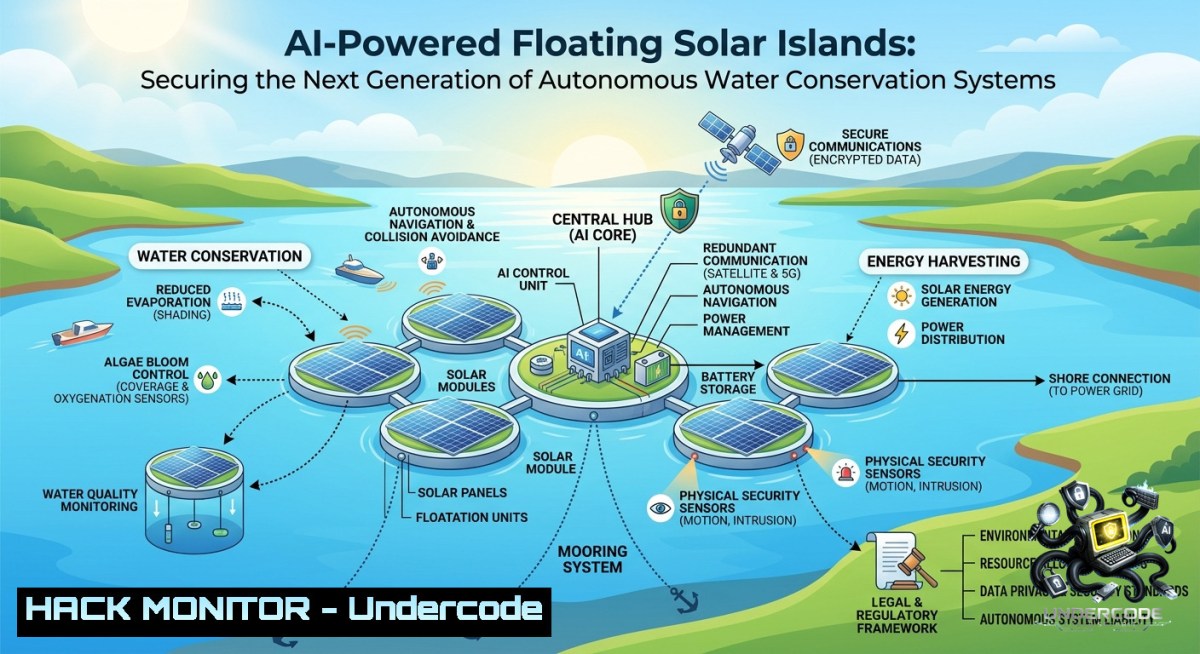
Introduction:
As climate change accelerates water evaporation from reservoirs and lakes, innovative solutions like autonomous floating solar islands are emerging to pump deep cold water to the surface, reducing evaporation while generating renewable energy. These AI-driven systems, however, introduce a complex attack surface—from edge-device vulnerabilities in remote aquatic environments to machine learning model tampering and real-time control hijacking. Securing such cyber-physical systems is no longer optional; it is foundational to ensuring sustainable water and energy infrastructure.
Learning Objectives:
- Identify attack vectors in autonomous floating solar platforms, including sensor spoofing, GPS manipulation, and AI model poisoning.
- Implement security hardening for edge Linux devices and Windows-based SCADA systems used in environmental monitoring.
- Apply API authentication, encrypted telemetry, and zero-trust architectures to protect real-time command and control channels.
You Should Know:
- Harden Edge Devices Against Physical and Network Threats
Autonomous floating platforms rely on Linux-based single-board computers (e.g., Raspberry Pi, NVIDIA Jetson) or industrial IoT gateways. These devices operate in exposed, unattended environments, making them prime targets for tampering, USB rubber ducky attacks, or network eavesdropping.
Step‑by‑step guide:
1. Disable unused interfaces and services
 On Linux (Debian/Ubuntu)
sudo systemctl disable bluetooth.service
sudo systemctl disable avahi-daemon
sudo nmcli radio wifi off
2. Implement USB guard to block unauthorized devices
sudo apt install usbguard
sudo usbguard generate-policy > /etc/usbguard/rules.conf
sudo systemctl enable --1ow usbguard
3. Set up encrypted filesystem for data at rest (e.g., LUKS for logs and models)
sudo apt install cryptsetup
sudo cryptsetup luksFormat /dev/sda1
sudo cryptsetup open /dev/sda1 secure_data
4. Use fail2ban to protect SSH (change default port as well)
sudo apt install fail2ban
sudo cp /etc/fail2ban/jail.conf /etc/fail2ban/jail.local
 Edit jail.local to set maxretry=3, bantime=3600, and enable sshd
sudo systemctl restart fail2ban
Windows-based control center hardening (if used for monitoring):
 Disable insecure protocols and restrict RDP
Set-ItemProperty -Path "HKLM:\System\CurrentControlSet\Control\Terminal Server\WinStations\RDP-Tcp" -1ame "UserAuthentication" -Value 1
Disable-WindowsOptionalFeature -Online -FeatureName "SMB1Protocol"
 Enable Windows Defender Application Guard for Edge
- Secure AI Model Pipelines from Poisoning and Evasion
The floating island uses AI for path planning, thermal layer detection, and energy management. Adversaries could inject poisoned training data (e.g., false temperature readings) or craft evasion attacks to make the platform misbehave.
Step‑by‑step guide to protect AI pipelines:
1. Validate all sensor inputs with anomaly detection
- Use statistical outlier detection (e.g., Z-score) on temperature, GPS, and current sensors.
import numpy as np
def detect_anomaly(data_point, window_mean, window_std, threshold=3):
return abs(data_point - window_mean) > threshold  window_std
2. Implement model signing and integrity checks
 Generate a signature for your PyTorch/TensorFlow model
openssl dgst -sha256 -sign private_key.pem -out model.sig model.pt
 On deployment, verify
openssl dgst -sha256 -verify public_key.pem -signature model.sig model.pt
3. Use federated learning with differential privacy (if multiple units share updates) to limit the impact of any single compromised node.
4. Containerize the inference engine using Docker + read‑only root filesystems
docker run -d --read-only --cap-drop=ALL --cap-add=NET_BIND_SERVICE my_ai_engine
3. Encrypt Telemetry and Command Channels
The platform communicates via cellular (4G/5G) or satellite to a central control server. Unencrypted telemetry allows attackers to spoof commands or replay captured data.
Step‑by‑step guide:
- Set up mutual TLS (mTLS) for all MQTT or HTTPS traffic
– Generate client and server certificates using OpenVPN’s easy-rsa or Let’s Encrypt.
 On the floating device (Linux)
sudo openssl req -1ew -1ewkey rsa:2048 -1odes -keyout device.key -out device.csr
 Sign with your CA, then configure mosquitto or nginx to require client certs
2. Use WireGuard for lightweight VPN tunnel from each platform to a cloud gateway
sudo apt install wireguard
wg genkey | tee privatekey | wg pubkey > publickey
 Configure /etc/wireguard/wg0.conf with allowed IPs and persistent keepalive
sudo systemctl enable wg-quick@wg0
3. Enforce frame-level encryption on LoRaWAN (if used for backup telemetry) with unique AppKey and NwkKey per device.
4. Implement command signing and nonce verification to prevent replay attacks:
import hmac, hashlib, time
command = f"pump_speed=70&nonce={int(time.time())}"
signature = hmac.new(secret_key, command.encode(), hashlib.sha256).hexdigest()
 Transmit both command and signature
4. Protect GPS and Navigation Systems from Spoofing
Autonomous movement across a reservoir requires precise GPS. Cheap software-defined radios can spoof GPS signals, causing the platform to drift into prohibited areas.
Step‑by‑step guide:
- Cross‑validate GPS with alternative sensors (e.g., IMU, accelerometer, and dead reckoning).
- Use a GPS anti‑spoofing library like gpsd with AGC monitoring
sudo apt install gpsd gpsd-clients
Monitor signal strength anomalies: if C/N0 > 50 dB consistently, suspect spoofing
cgps -s
- Implement a geofence with hysteresis on the edge device
On Linux using gpsd socket import gpsd gpsd.connect() while True: packet = gpsd.get_current() if not packet.valid: continue lat, lon = packet.lat, packet.lon if not (in_geofence(lat, lon)): execute_emergency_stop() cut motor power send_alert("Geofence breach - possible GPS spoofing") - For Windows‑based mission planners, use signed GPS drivers and disable automatic installation of raw HID devices.
5. Harden Cloud APIs for Remote Fleet Management
A central cloud API (REST/GraphQL) handles configuration updates, firmware OTA, and data aggregation. API vulnerabilities could allow mass takeover of all floating units.
Step‑by‑step guide:
- Implement OAuth2 with JWT and short-lived tokens (e.g., 15 min) – never use API keys alone.
- Rate limit per device ID and IP using Redis or a cloud WAF (AWS WAF, Cloudflare).
Example nginx rate‑limit:
limit_req_zone $binary_remote_addr zone=api:10m rate=5r/m;
server {
location /api/ {
limit_req zone=api burst=10 nodelay;
}
}
3. Validate all webhook endpoints with HMAC signatures to prevent forged status updates.
4. Use OWASP API Security Top 10 checks – especially broken object level authorization (BOLA).
Test with: `curl -X GET “https://api.example.com/device/1234/config” -H “Authorization: Bearer token_of_device_5678″`
5. Automate vulnerability scanning on API endpoints using ZAP or nuclei.
6. Conduct Red‑Team Exercises for Aquatic Cyber‑Physical Systems
Because these platforms are hard to physically access, attackers may use long‑range Wi-Fi (Yagi antennas) or drone‑mounted pineapple devices to intercept telemetry.
Step‑by‑step guide for testing:
- Simulate a rogue access point attack (Evil Twin) to capture credentials:
Using airgeddon (Linux)
git clone https://github.com/v1s1t0r1sh3r3/airgeddon.git
sudo ./airgeddon.sh
- Attempt replay attack by recording and resending LoRa packets with a HackRF One + GNU Radio.
- Inject false temperature readings into the MQTT broker (if authentication is weak) using mosquitto_pub:
mosquitto_pub -h broker_ip -p 1883 -t "sensor/water_temp" -m "35.5" unrealistic
- Use mitmproxy to intercept TLS traffic (if certificate pinning is missing) on the device’s update channel.
7. Implement Secure Over‑the‑Air (OTA) Update Mechanism
The AI model and firmware must be updatable remotely. Insecure OTA is a common entry for persistent backdoors.
Step‑by‑step guide:
- Sign each update binary with an offline GPG key
gpg --detach-sign --armor --local-user [email protected] firmware.bin
2. On the device, verify before applying
gpg --verify firmware.bin.asc firmware.bin
3. Use A/B partitioning (e.g., SWUpdate or RAUC) to allow rollback if verification fails.
4. Enforce update authentication via server‑signed nonces – the device requests a challenge, server signs it with a timestamp.
What Undercode Say:
- Key Takeaway 1: Autonomous environmental systems are not just mechanical challenges—they are cyber-physical attack surfaces requiring defense‑in‑depth from the edge sensor to the cloud API.
- Key Takeaway 2: Practical security measures (mTLS, GPS spoofing detection, AI model signing, and OTA verification) are immediately applicable to any floating solar, water conservation, or drone‑based monitoring project.
Analysis: The floating solar island concept elegantly combines renewable energy and water preservation, but its reliance on AI‑driven autonomy and remote telemetry creates a risk of environmental sabotage. An attacker who poisons the thermal layer detection model could cause the system to surface warm water instead of cold, accelerating evaporation—the opposite of its purpose. Worse, compromising the navigation system could steer the platform into dam infrastructure or shorelines, causing physical damage. The security community must treat such green tech as critical infrastructure. The commands and guides above provide a baseline; however, real‑world deployments should also incorporate hardware security modules (HSMs) for key storage and physical anti‑tamper switches. Given that many water authorities lack in‑house cybersecurity expertise, partnerships with industrial control system (ICS) security vendors are essential. The good news is that most mitigations (e.g., WireGuard, fail2ban, GPG signing) are open‑source and low‑cost, making this achievable even for pilot projects.
Prediction:
- +1 Adoption of AI‑powered floating solar will accelerate by 40% by 2028, driven by drought mitigation funding; security standards will be retrofitted as incidents emerge.
- -1 Without mandatory security audits, the first major attack—causing algae bloom due to false aeration commands or a collision with a dam spillway—will occur within 24 months of widespread deployment, leading to regulatory overcorrection that stifles innovation.
- +1 The intersection of water tech and cybersecurity will spawn a niche for “blue‑green penetration testing” (aquatic IoT red teams), creating new training courses and certifications.
- -1 Most current academic papers on floating solar ignore cybersecurity entirely, leaving a dangerous knowledge gap that hardware startups will only fill after breaches.
▶️ Related Video (82% Match):
🎯Let’s Practice For Free:
🎓 Live Courses & Certifications:
Join Undercode Academy for Verified Certifications
🚀 Request a Custom Project:
Secure, high-velocity infrastructure and disruptive technological engineering. Contact our engineering team for high-tier development and proprietary systems:
[email protected]
💎 Smart Architecture | 🛡️ Secure by Design | ⭐ Trusted by Thousands
IT/Security Reporter URL:
Reported By: Senolayvalilar Baraj – Hackers Feeds
Extra Hub: Undercode MoN
Basic Verification: Pass ✅


