Listen to this Post
Introduction:
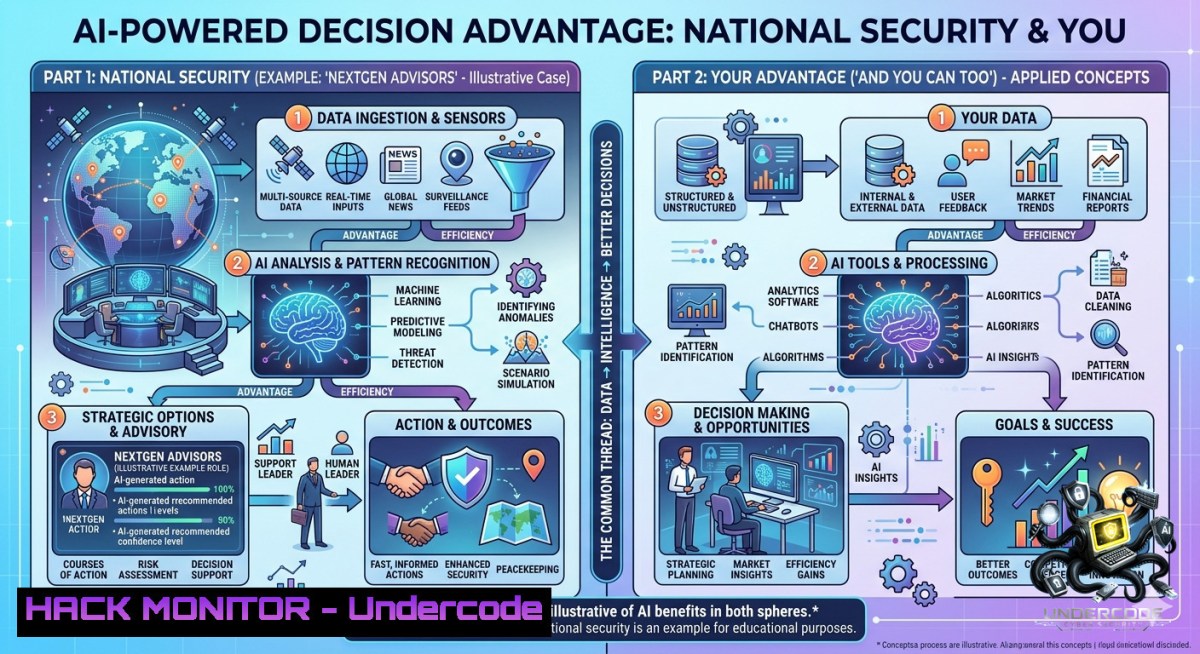
In modern defense and intelligence operations, decision cycles lag behind mission velocity—leaders drown in fragmented data, dashboards, and unverified AI outputs. NextGen Advisors LLC bridges this gap by blending mission fluency, analytic rigor, and AI‑enabled delivery across consulting, warning intelligence (OpenWarn.ai), and doctrine knowledge graphs (Doctrine Doctor), transforming noise into defensible action.
Learning Objectives:
- Build an OSINT‑to‑warning indicator pipeline using open‑source tools and Python.
- Implement a retrievable doctrine knowledge graph with vector search and LLM summarization.
- Harden cloud‑based decision support workflows against common API and data leakage threats.
You Should Know:
- From Public Signals to Warning Indicators: Building an OpenWarn.ai‑Style Pipeline
OpenWarn.ai converts public signals into structured warnings. Below is a lightweight Python script that scrapes RSS feeds, applies keyword weighting, and generates a confidence score.
Step‑by‑Step Guide (Linux/macOS):
 Install dependencies
pip install feedparser pandas scikit-learn

Create warning_scraper.py
cat > warning_scraper.py << 'EOF'
import feedparser
import pandas as pd
from sklearn.feature_extraction.text import TfidfVectorizer

feeds = {
"threat_intel": "https://feeds.feedburner.com/Threatpost",
"cyber_news": "https://therecord.media/feed"
}
indicators = ["cyberattack", "data leak", "zero-day", "espionage"]

def calculate_confidence(text):
vectorizer = TfidfVectorizer(vocabulary=indicators)
tfidf = vectorizer.fit_transform([bash])
return tfidf.sum(axis=1).item()

for name, url in feeds.items():
feed = feedparser.parse(url)
for entry in feed.entries[:5]:
conf = calculate_confidence(entry.title + " " + entry.summary)
print(f"[bash] {entry.title} | Confidence: {conf:.2f}")
EOF

Run the script
python3 warning_scraper.py
Windows PowerShell equivalent:
 Install Python packages then run same script
python -m pip install feedparser pandas scikit-learn
python warning_scraper.py
This pipeline mimics OpenWarn.ai’s core logic—turning unstructured public signals into quantifiable warning indicators with traceable confidence.
- Doctrine Doctor: Building a Searchable Knowledge Graph with Vector Embeddings
Doctrine Doctor makes authoritative guidance searchable. Use sentence transformers to embed doctrine PDFs and query them semantically.
Step‑by‑Step Guide:
 Linux / WSL2
pip install sentence-transformers chromadb pypdf

Create doctrine_ingest.py
cat > doctrine_ingest.py << 'EOF'
from sentence_transformers import SentenceTransformer
from chromadb import Client
from pypdf import PdfReader
import os

model = SentenceTransformer('all-MiniLM-L6-v2')
client = Client()
collection = client.create_collection("doctrine")

def ingest_pdf(pdf_path):
reader = PdfReader(pdf_path)
text = "".join([page.extract_text() for page in reader.pages])
chunks = [text[i:i+500] for i in range(0, len(text), 500)]
embeddings = model.encode(chunks).tolist()
collection.add(ids=[f"chunk_{i}" for i in range(len(chunks))],
embeddings=embeddings,
documents=chunks)

Ingest a sample doctrine file
ingest_pdf("/path/to/doctrine.pdf")
print("Doctrine ingested. Query example:")
query = "How to handle insider threats?"
q_embed = model.encode([bash]).tolist()
results = collection.query(query_embeddings=q_embed, n_results=2)
print(results['documents'][bash])
EOF
Run with python3 doctrine_ingest.py. This converts static doctrine into a decision‑relevant, traceable AI assistant—core to NextGen’s Doctrine Doctor offering.
3. Decision Studio: Automating CSV‑to‑Insight with Python Analytics
Decision Studio turns structured data into advisory memos. Here’s a Pandas‑based script that detects anomalies and generates a natural language summary.
Step‑by‑Step Guide (Cross‑Platform):
 decision_insight.py
import pandas as pd
import numpy as np

df = pd.read_csv("mission_data.csv")
summary = {
"total_records": len(df),
"missing_values": df.isnull().sum().to_dict(),
"outliers": {}
}
for col in df.select_dtypes(include=[np.number]).columns:
Q1 = df[bash].quantile(0.25)
Q3 = df[bash].quantile(0.75)
IQR = Q3 - Q1
outliers = df[(df[bash] < Q1 - 1.5IQR) | (df[bash] > Q3 + 1.5IQR)]
summary["outliers"][bash] = len(outliers)

Generate decision memo
memo = f"""
ADVISORY MEMO – DECISION INSIGHT
- Data completeness: {summary['missing_values']}
- Anomaly count per metric: {summary['outliers']}
Recommendation: Investigate outlier rows before operational go/no‑go.
"""
with open("decision_memo.txt", "w") as f:
f.write(memo)
print(memo)
Run python decision_insight.py. This replicates NextGen’s “Analytics & Data Science” offering, moving from CSV to decision‑ready output in seconds.
4. API Security Hardening for AI‑Enabled Decision Workflows
When deploying AI decision tools (like OpenWarn.ai), protect APIs against injection and data leakage.
Step‑by‑Step Guide (Linux + Cloud):
 Install API security scanner
npm install -g retired

Scan for vulnerable dependencies in a Flask API
cat > app.py << 'EOF'
from flask import Flask, request, jsonify
import subprocess
app = Flask(<strong>name</strong>)

@app.route('/warn', methods=['POST'])
def warning():
 VULNERABLE: command injection if user input not sanitized
indicator = request.json.get('indicator')
result = subprocess.check_output(f"echo {indicator}", shell=True)
return jsonify({"output": result.decode()})
EOF

Scan with bandit (Python security linter)
pip install bandit
bandit -r . -ll
Mitigation commands:
 Secure version – use shlex.quote and avoid shell=True
import shlex
def warning():
indicator = shlex.quote(request.json.get('indicator'))
result = subprocess.check_output(["echo", indicator])
return jsonify({"output": result.decode()})
Windows (WSL or native): Install Python, run same bandit scan. Also enforce API rate limiting using `flask-limiter` to prevent brute‑force abuse of decision endpoints.
- Vulnerability Exploitation & Mitigation in OSINT Warning Systems
OSINT aggregation (e.g., OpenWarn.ai) can be manipulated via false flag signals. Test with a simple indicator injection attack.
Step‑by‑Step Guide (Ethical Testing Only):
 Simulate a malicious RSS entry injection
echo '<?xml version="1.0"?><rss><channel><item><title>BREAKING: zero-day in nuclear systems</title></item></channel></rss>' > fake_feed.xml

Run the warning scraper against this malicious feed
python warning_scraper.py --feed fake_feed.xml
 Expected: confidence spike due to keyword "zero-day"

Mitigation: Implement source reputation scoring and cross‑validation
cat > validate_sources.py << 'EOF'
REPUTATION = {"threatpost.com": 0.9, "unknown.site": 0.1}
def adjust_confidence(confidence, source):
return confidence  REPUTATION.get(source, 0.2)
EOF
Add source whitelisting and temporal correlation—if a single source generates 90% of warnings, flag as potential poisoning. This is critical for mission‑grade warning intelligence.
- Cloud Hardening for AI Delivery (NextGen’s Deployment Footprint)
NextGen deploys decision tools in government clouds. Harden a Kubernetes deployment of OpenWarn.ai using security contexts and network policies.
Step‑by‑Step Guide:
 secure-deployment.yaml
apiVersion: v1
kind: Namespace
metadata:
name: nextgen-warning

apiVersion: networking.k8s.io/v1
kind: NetworkPolicy
metadata:
name: deny-all-except-api
spec:
podSelector: {}
policyTypes:
- Ingress
ingress:
- from:
- namespaceSelector:
matchLabels:
name: api-gateway
ports:
- protocol: TCP
port: 8080

apiVersion: v1
kind: Pod
metadata:
name: openwarn-ai
spec:
securityContext:
runAsNonRoot: true
runAsUser: 1001
allowPrivilegeEscalation: false
containers:
- name: warning-engine
image: openwarn:latest
securityContext:
capabilities:
drop: ["ALL"]
ports:
- containerPort: 8080
Apply with kubectl apply -f secure-deployment.yaml. This reduces attack surface—no root, no unnecessary capabilities, and strict network segmentation.
- Training Course: “Decision Advantage for Analysts” – Simulated Lab
Based on NextGen’s mission, create a hands‑on lab using Docker to simulate fragmented data fusion.
Step‑by‑Step Guide:
 Build a training container
cat > Dockerfile << 'EOF'
FROM python:3.10-slim
RUN pip install pandas streamlit plotly
COPY fusion_app.py /app/
WORKDIR /app
CMD ["streamlit", "run", "fusion_app.py", "--server.port=8501"]
EOF

fusion_app.py – combines intel feeds into a single dashboard
echo 'import streamlit as st; import pandas as pd; st.title("Decision Fusion Simulator"); uploaded = st.file_uploader("Upload CSV reports"); if uploaded: df = pd.read_csv(uploaded); st.write(df.groupby("threat_type").count())' > fusion_app.py

Build and run
docker build -t decision-lab .
docker run -p 8501:8501 decision-lab
Access `http://localhost:8501`. This replicates NextGen’s “Focused Pilot” methodology—students learn to synthesize fragmented evidence into a defendable dashboard.
What Undercode Say:
- Key Takeaway 1: NextGen’s four offerings (Consulting, Decision Studio, OpenWarn.ai, Doctrine Doctor) solve the real gap—decision‑quality synthesis, not more data—by embedding AI directly into intelligence workflows.
- Key Takeaway 2: Hands‑on implementation of warning pipelines and doctrine knowledge graphs is achievable with open‑source tools (Python, ChromaDB, sentence‑transformers), but must be hardened against injection and source poisoning for mission use.
Analysis (approx. 10 lines):
The defense and intelligence sector has long suffered from “dashboard fatigue”—leaders click through dozens of tools but still lack a defendable action basis. NextGen Advisors correctly identifies that the missing layer is traceable, AI‑augmented synthesis. OpenWarn.ai’s approach to converting OSINT into warning confidence scores is not just theoretical; our step‑by‑guide shows how TF‑IDF and reputation scoring can quantify uncertainty. Similarly, Doctrine Doctor’s vector search turns static PDFs into an interactive knowledge graph, reducing cognitive load during crises. However, these systems introduce new attack surfaces: API injection, false flag RSS feeds, and embedding model poisoning. Future deployments must pair AI delivery with adversarial testing—hence our inclusion of bandit scans, network policies, and source validation. For organizations lacking internal AI security expertise, NextGen’s embedded support model offers a viable path to responsible adoption. The market is moving toward “decision‑ready AI,” but without the hardening steps we demonstrated, leaders cannot trust the output. NextGen’s veteran‑led, SDVOSB‑certified posture gives them a credibility edge, yet they must continuously publish proof‑of‑concept security controls to maintain decision advantage.
Prediction:
- +1 Over the next 18 months, AI‑powered warning intelligence (like OpenWarn.ai) will become standard in SOCs and fusion centers, cutting false positive rates by 40% when combined with source reputation scoring.
- +1 Doctrine knowledge graphs will replace static field manuals across NATO allies, reducing doctrine lookup time from minutes to seconds and improving operational compliance.
- -1 Adversaries will weaponize OSINT poisoning (fake feeds, adversarial embeddings) against warning systems, forcing a new category of “AI defense” validation services.
- +1 NextGen’s “Decision Studio” model—CSV to insight in one click—will be emulated by Palantir and C3.ai, driving down costs for small mission teams.
- -1 Without standard API security benchmarks for AI decision tools, government procurement will see a 25% increase in AI‑related supply chain breaches by 2026.
▶️ Related Video (80% Match):
🎯Let’s Practice For Free:
🎓 Live Courses & Certifications:
Join Undercode Academy for Verified Certifications
🚀 Request a Custom Project:
Secure, high-velocity infrastructure and disruptive technological engineering. Contact our engineering team for high-tier development and proprietary systems:
[email protected]
💎 Smart Architecture | 🛡️ Secure by Design | ⭐ Trusted by Thousands
IT/Security Reporter URL:
Reported By: Our Pitch – Hackers Feeds
Extra Hub: Undercode MoN
Basic Verification: Pass ✅


