Listen to this Post
Introduction:
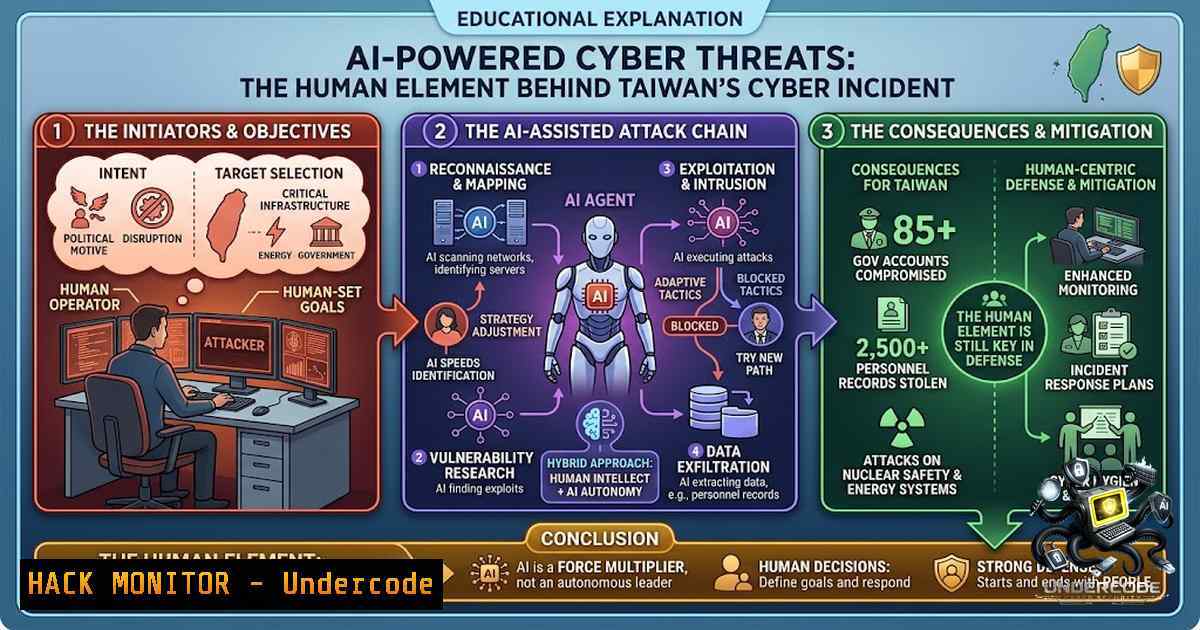
Recent reports from Taiwan have unveiled a sophisticated cyber incident where attackers leveraged open-source AI agents to construct autonomous hacking tools, operating with unprecedented precision and coordination. This event underscores a critical cybersecurity paradigm shift: while artificial intelligence amplifies offensive capabilities, the human element remains the ultimate driver of intent and strategy. For security professionals, this incident serves as a stark reminder that securing digital infrastructure requires addressing both technological vulnerabilities and the human adversaries who wield AI as a force multiplier.
Learning Objectives & Secrets:
- Objective 1: Understand the operational mechanics of AI-driven autonomous hacking tools and their integration into modern cyber kill chains.
Secret Tip: Focus on behavioral analysis of AI-generated attack patterns rather than signature-based detection, as these tools dynamically evolve their tactics. - Objective 2: Implement human-in-the-loop (HITL) threat modeling to anticipate adversarial decision-making processes.
Secret Tip: Use MITRE ATT&CK framework mappings to simulate human-directed AI attack scenarios and prioritize defensive controls accordingly. - Objective 3: Develop resilient identity verification and fraud prevention mechanisms that withstand AI-augmented social engineering.
Secret Tip: Deploy adaptive risk-based authentication that factors in behavioral biometrics and contextual anomalies to counter AI-generated synthetic identities.
You Should Know:
- Understanding the Taiwan Cyber Incident: AI Agents in Offensive Operations
The Taiwan incident reportedly involved attackers utilizing open-source large language models (LLMs) and reinforcement learning agents to automate vulnerability discovery, exploit development, and lateral movement. According to cybersecurity analysts, the attackers employed a multi-agent system where one agent handled reconnaissance, another generated exploit code, and a third coordinated payload delivery—all with minimal human intervention. This represents an evolution from script-kiddie automation to genuine AI-driven cyber warfare, where human operators only intervene at strategic decision points.
Step-by-step guide to analyzing AI attack patterns:
- Collect Threat Intelligence: Aggregates indicators of compromise (IoCs) from incident reports and open-source feeds (e.g., AlienVault OTX, MISP).
- Deploy Network Detection Tools: Use Wireshark or Zeek to capture network traffic, focusing on anomalous outbound connections and command-and-control (C2) patterns.
- Analyze Exploit Code: Reverse-engineer any captured malware using IDA Pro or Ghidra to identify AI-generated code signatures (e.g., repetitive function calls typical of LLM output).
- Correlate with Human Behavior: Map attack timelines against known threat actor TTPs to identify human decision points (e.g., choosing specific high-value targets).
2. Human-in-the-Loop: The Strategic Advantage
The human element in AI-driven attacks cannot be overstated. While AI can automate reconnaissance and exploit generation, it lacks the contextual awareness to select optimal targets or adjust strategies based on defense responses. In the Taiwan case, attackers reportedly used AI to generate spear-phishing emails in multiple languages with near-1ative fluency, but human operators curated the target list based on geopolitical intelligence. This hybrid approach suggests that defensive strategies must focus on both technical controls and human-centric threat intelligence.
Step-by-step guide to implementing HITL threat modeling:
- Conduct Red Team Exercises: Simulate AI-augmented attacks by incorporating LLM-generated attack vectors into penetration testing.
- Use Threat Intelligence Platforms (TIPs): Integrate TIPs like Recorded Future or ThreatConnect to correlate AI-generated alerts with human analyst verification.
- Implement Honeypots: Deploy decoy systems to observe AI agent behavior and collect data on attack patterns.
- Train Analysts on AI Outputs: Provide training on identifying false positives and AI-generated false flags, using tools like Splunk for log analysis: `index= “AI” | stats count by source` to monitor AI-related anomalies.
3. OSINT and Threat Actor Profiling
Open-source intelligence (OSINT) plays a crucial role in identifying the human operators behind AI-driven attacks. In the Taiwan incident, researchers traced the attack back to known threat groups using metadata from AI-generated code and infrastructure fingerprints. Tools like Shodan, Censys, and Maltego can reveal technical footprints, while social media monitoring uncovers operational chatter.
Step-by-step guide to OSINT profiling:
- Gather Infrastructure Data: Use `nmap -sV -O target_ip` to identify open ports and operating systems associated with C2 servers.
- Analyze Code Metadata: Extract comments, variable names, and coding styles from exploit samples using `strings malware.exe` or Python’s `re` module to detect AI-specific patterns.
- Monitor Dark Web Forums: Use automated scrapers (e.g., `scrapy` with Tor proxies) to track discussions about AI hacking tools and potential buyers.
- Geolocate C2 Traffic: Use `traceroute` and MaxMind GeoIP databases to map attack infrastructure to specific regions, correlating with known threat actor origins.
4. Securing Digital Identity Against AI Exploitation
The incident highlights vulnerabilities in identity verification and KYC/KYB processes, as AI can generate synthetic identities, deepfakes, and forged documents at scale. At WeVerify, the focus is on democratized verification—using cryptographic hashing and blockchain-based attestation to ensure document integrity. For organizations, implementing liveness detection, document forensic analysis, and AI-resistant biometrics is critical.
Step-by-step guide to hardening identity verification:
- Deploy Liveness Detection: Integrate tools like FaceTec or iProov that use 3D depth sensing and infrared scanning to counter deepfakes.
- Implement Document Verification: Use APIs from Onfido or Jumio with AI-resistant checks, such as microprint analysis and hologram verification.
- Enable Cryptographic Hashing: Generate SHA-256 hashes of user documents and store them on a private blockchain for tamper-proof audit trails:
`sha256sum document.pdf > document_hash.txt`
- Monitor for AI-Generated Forgeries: Train machine learning models on known forgery patterns using Python’s `TensorFlow` to detect synthetic document anomalies.
5. API Security and Cloud Hardening
AI-driven attacks often exploit misconfigured APIs and cloud services to gain initial access. The Taiwan incident likely involved reconnaissance of exposed endpoints, followed by AI-generated API abuse. Securing APIs requires stringent authentication, rate limiting, and anomaly detection.
Step-by-step guide to API hardening:
- Conduct API Discovery: Use `nmap -p 80,443,8080,8443 target_domain` to find exposed endpoints, then use tools like Postman to test for vulnerabilities.
- Implement Zero Trust Architecture: Enforce mutual TLS (mTLS) and OAuth 2.0 with short-lived access tokens.
- Enable Anomaly Detection: Use AWS GuardDuty or Azure Defender to monitor for abnormal API call patterns, such as high-frequency requests indicating bot activity.
- Deploy Web Application Firewalls: Configure WAF rules to block known AI-generated payloads, e.g., SQL injection patterns: `SQLi` regex in ModSecurity.
- Log and Audit: Centralize logs using ELK Stack (
filebeat,logstash,elasticsearch) and set up alerts for suspicious API traffic.
6. Vulnerability Exploitation and Mitigation
AI agents can rapidly scan for known vulnerabilities (CVEs) and exploit them within minutes. The Taiwan attack reportedly exploited unpatched IoT devices and legacy systems. Defenders must prioritize patch management, network segmentation, and vulnerability assessments.
Step-by-step guide to mitigation:
- Conduct Vulnerability Scans: Use Nessus or OpenVAS to identify exposed CVEs:
openvas -u admin -w password -h target_ip. - Segment Networks: Implement VLANs and firewalls to isolate critical assets from IoT and guest networks.
- Deploy Endpoint Detection and Response (EDR): Use CrowdStrike or SentinelOne to detect and block AI-driven exploits in real-time.
- Automate Patching: Use tools like Ansible or WSUS for automated patching, scheduling updates during low-traffic windows.
- Apply the Principle of Least Privilege: Restrict user permissions using Group Policy (Windows) or `sudo` configurations (Linux) to limit blast radius.
7. Training and Awareness for AI-Driven Threats
The human element in cybersecurity extends to defenders as well. Organizations must train SOC analysts to recognize AI-generated attacks, distinguish them from human-driven ones, and respond effectively. Continuous education on AI forensics, adversarial machine learning, and incident response is essential.
Step-by-step guide to training:
- Develop AI-Focused Modules: Create courses covering AI attack vectors, detection strategies, and ethical considerations.
- Use Simulators: Implement platforms like Cyberbit or RangeForce for hands-on AI attack simulation.
- Conduct Tabletop Exercises: Run scenarios where AI agents are part of the attack, forcing teams to coordinate with human intelligence sources.
- Promote Red Teaming: Encourage ethical hacking teams to use AI tools to test defenses, fostering a culture of continuous improvement.
What Undercode Say:
- Key Takeaway 1: The Taiwan incident reaffirms that AI is an amplifier, not an originator, of cyber threats; human intent remains the decisive factor. Defenders must shift focus from solely automating defenses to understanding the psychology and strategic objectives of human adversaries.
- Key Takeaway 2: Robust digital identity frameworks, combining cryptographic verification and behavioral analytics, are indispensable in combating AI-augmented fraud. The integration of AI-resistant checks into KYC processes is no longer optional but a necessity for regulated industries.
Analysis:
Volkan Kaya’s perspective resonates with the cybersecurity community’s growing consensus that the human element—both in attack and defense—is paramount. The Taiwan incident serves as a wake-up call that AI democratization lowers the barrier to advanced cyber operations, enabling smaller threat actors to launch sophisticated campaigns. However, this also presents an opportunity: by focusing on human-centric threat intelligence, security teams can anticipate not just what AI can do, but what its human operators are likely to target. The emphasis on building trust infrastructure, as highlighted by WeVerify, aligns with the principle that resilience comes from adaptive, multi-layered defenses that account for human fallibility and intent. Ultimately, the incident underscores the need for collaborative efforts—between AI researchers, security analysts, and policy makers—to develop ethical frameworks and technical safeguards that keep human accountability at the forefront of cybersecurity.
Prediction:
- +1 Increased Investment in Human-Centric AI Defense: Organizations will allocate more resources to training SOC analysts and developing threat intelligence that incorporates psychological profiling of threat actors, leading to more effective defense strategies.
- -1 Escalation of AI-Driven Cyber Warfare: As open-source AI agents become more accessible, state and non-state actors will increasingly deploy them in geopolitical conflicts, resulting in more frequent and devastating cyber incidents.
- +1 Advancements in AI-Resistant Verification: The incident will accelerate the development of cryptographic identity solutions, such as zero-knowledge proofs and decentralized identifiers, making digital trust more resilient to AI-generated fraud.
- -1 Regulatory Backlash: Governments may introduce stringent regulations on AI development and usage, potentially stifling innovation and leading to compliance burdens for legitimate organizations.
- +1 Collaborative Threat Sharing: The need to counter AI-driven threats will foster greater information sharing between private sector, governments, and academia, enhancing global cybersecurity posture.
- -1 Increased Exploitation of Legacy Systems: Many organizations will struggle to patch vulnerabilities fast enough, leaving critical infrastructure exposed to AI-powered attacks.
▶️ Related Video (88% Match):
🎯Let’s Practice For Free:
🎓 Live Courses & Certifications:
Join Undercode Academy for Verified Certifications
🚀 Request a Custom Project:
Secure, high-velocity infrastructure and disruptive technological engineering. Contact our engineering team for high-tier development and proprietary systems:
[email protected]
💎 Smart Architecture | 🛡️ Secure by Design | ⭐ Trusted by Thousands
IT/Security Reporter URL:
Reported By: https://lnkd.in/p/e-dNREPj – Hackers Feeds
Extra Hub: Undercode MoN
Basic Verification: Pass ✅


