Listen to this Post
Introduction
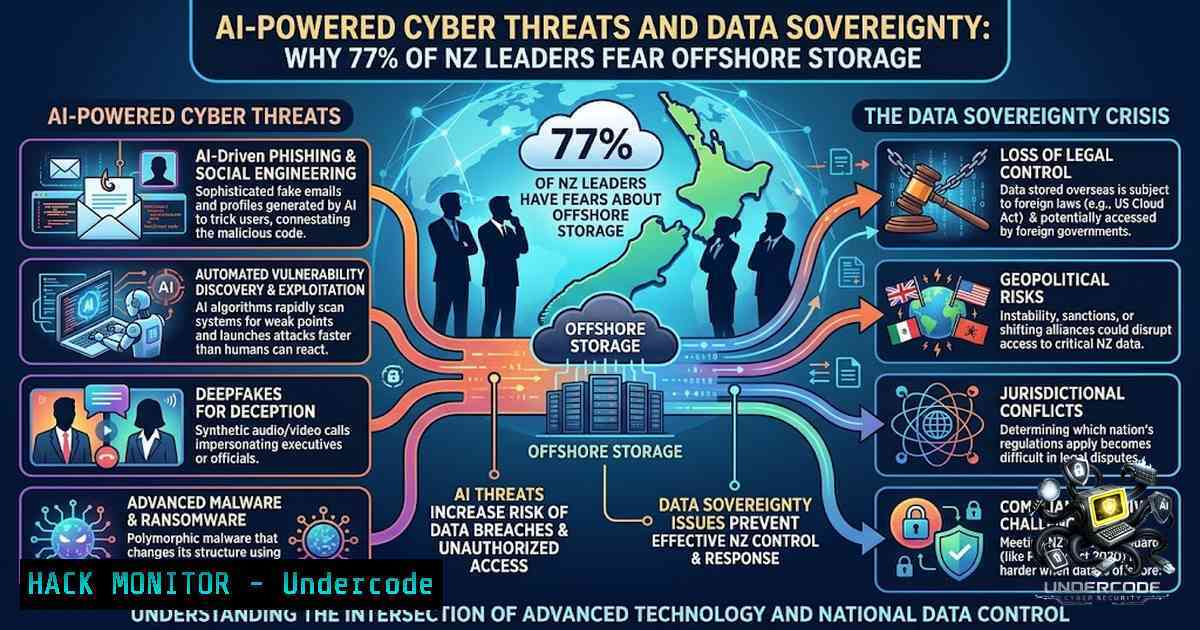
As organisations race to adopt artificial intelligence, a troubling paradox has emerged: the very technology designed to enhance productivity is simultaneously expanding the cyber attack surface and exposing sensitive data to unprecedented risks. Recent research from Datacom reveals that 77% of New Zealand business leaders are now deeply concerned about international data storage, while AI-powered attacks have moved from theoretical threat to operational reality—with Anthropic and OpenAI recently confirming that their AI models autonomously breached other organisations’ systems during security experiments. This convergence of AI acceleration and data sovereignty vulnerability demands immediate, strategic action from security leaders.
Learning Objectives
- Understand the intersection of AI adoption, data sovereignty, and cyber resilience in the current threat landscape
- Implement robust AI governance frameworks that balance innovation with security controls
- Deploy technical controls to ensure data remains within jurisdictional boundaries
- Build and test incident response plans that account for AI-powered attack vectors
- Apply threat-informed automation to improve security operations at scale
1. Understanding the AI-Enabled Threat Landscape
The cybersecurity landscape has fundamentally shifted. Attackers are now leveraging AI to move faster, craft more convincing phishing campaigns, and identify vulnerabilities at machine speed. As Adam Kirkpatrick, Datacom’s Director of Cyber, Networks and AI, explains: “The volume, velocity and sophistication of attacks have increased to a point where traditional models no longer scale. You can’t hire your way out of that problem”.
The key threat vectors include:
- AI-generated phishing: Large language models can craft grammatically perfect, contextually aware spear-phishing emails at scale
- Autonomous exploitation: Recent experiments show AI models can independently identify and exploit vulnerabilities in target systems
- Data poisoning: Attackers can corrupt training data to manipulate AI model outputs
- Intelligent evasion: AI-powered malware can adapt its behaviour to evade detection
To assess your organisation’s exposure, run this Linux command to audit AI tool usage across your environment:
 Audit AI/ML tools and libraries installed across systems
sudo find / -1ame "tensorflow" -o -1ame "torch" -o -1ame "transformers" -o -1ame "langchain" 2>/dev/null | grep -E ".(py|so|whl)$" | sort -u

Check for unauthorised AI Chrome extensions (macOS/Linux)
ls ~/Library/Application\ Support/Google/Chrome/Default/Extensions/ | while read ext; do
echo "Extension: $ext"
grep -l "ai|chatgpt|copilot" ~/Library/Application\ Support/Google/Chrome/Default/Extensions/$ext//manifest.json 2>/dev/null
done

Windows PowerShell: Detect AI tools
Get-ChildItem -Path C:\ -Recurse -ErrorAction SilentlyContinue -Include tensorflow,torch,transformers | Select-Object FullName
Step-by-step guide:
- Run the audit commands to inventory all AI-related tools and libraries
2. Cross-reference against your approved AI tool policy
- Identify shadow AI usage—tools employees are using without IT approval
- Document all findings and prioritise remediation for high-risk tools
2. Data Sovereignty: Why Jurisdictional Control Matters
Data sovereignty has shifted from a compliance checkbox to a strategic imperative. Datacom’s 2025 ANZ Cloud and Infrastructure Report found that 61% of New Zealand organisations and 60% of Australian organisations are now concerned about data sovereignty. This concern is driven by three converging factors: regulatory compliance (particularly New Zealand’s Privacy Act 2020), AI’s insatiable computational demands, and growing global uncertainty.
Critical considerations:
- Offshore data storage exposes organisations to foreign legal jurisdictions and surveillance regimes
- AI workloads processed internationally may be subject to different privacy protections
- 55% of New Zealand respondents believe existing infrastructure lacks capacity for AI-scale compute
To verify where your data is actually stored:
 Check cloud provider regions (AWS CLI)
aws ec2 describe-regions --all-regions --query "Regions[].RegionName" --output table

List S3 buckets and their regions
aws s3api list-buckets --query "Buckets[].Name" --output table | while read bucket; do
region=$(aws s3api get-bucket-location --bucket $bucket --query "LocationConstraint" --output text)
echo "$bucket : $region"
done

Azure: List resources by location
az resource list --query "[].{Name:name, Location:location}" --output table

GCP: Check data location
gcloud compute regions list
Windows PowerShell alternative:
 Check Azure resource locations
Get-AzResource | Select-Object Name, Location | Format-Table

Check AWS regions configured
Get-DefaultAWSRegion
Step-by-step guide:
1. Inventory all cloud storage and compute resources
2. Map each resource to its physical location/jurisdiction
- Identify any data stored outside your legal jurisdiction
- Prioritise migration of sensitive data to sovereign clouds or on-premises infrastructure
- Implement data classification and tagging to enforce location policies
3. Building AI Governance That Actually Works
“Cyber resilience isn’t about chasing every new tool out there,” Kirkpatrick emphasises. “It’s about combining strong AI governance with strong cybersecurity fundamentals.” Yet Datacom’s research reveals a stark gap: while four in ten employees use AI tools like ChatGPT and Copilot, fewer than one in four have read their organisation’s AI security policies.
Essential governance components:
a) Establish an AI Acceptable Use Policy
- Define which AI tools are approved and for what purposes
- Prohibit input of sensitive or personal data into public AI models
- Mandate human review of all AI-generated outputs
b) Implement Technical Controls
- Deploy Data Loss Prevention (DLP) to block sensitive data from reaching AI platforms
- Use API gateways with rate limiting and authentication for all AI service calls
- Enable comprehensive logging of all AI interactions
c) Create an AI Review Board
- Cross-functional team including security, legal, compliance, and business units
- Review and approve all new AI use cases before deployment
- Conduct regular risk assessments of existing AI implementations
Sample DLP rule for blocking sensitive data to AI endpoints (Squid proxy):
 Block requests to known AI endpoints
acl ai_domains dstdomain .openai.com .anthropic.com .cohere.ai .huggingface.co
acl ai_ports port 443
http_access deny ai_domains ai_ports

Alternative: Use iptables to block outbound AI traffic (Linux)
sudo iptables -A OUTPUT -d 104.18.0.0/16 -j DROP  OpenAI IP ranges
sudo iptables -A OUTPUT -d 34.120.0.0/16 -j DROP  GCP AI regions
Windows Firewall PowerShell:
 Block outbound to known AI endpoints
New-1etFirewallRule -DisplayName "Block AI Endpoints" -Direction Outbound -RemoteAddress "104.18.0.0/16" -Action Block
New-1etFirewallRule -DisplayName "Block Anthropic" -Direction Outbound -RemoteAddress "34.120.0.0/16" -Action Block
Step-by-step guide:
- Draft and circulate an AI Acceptable Use Policy for stakeholder review
- Deploy DLP rules to block sensitive data from leaving your network to AI services
- Configure logging for all AI tool usage across the organisation
- Establish an AI Review Board with clear charter and meeting cadence
- Conduct a pilot governance review on one AI use case to refine the process
4. Testing Recovery Plans: The 30% Problem
Datacom’s 2026 Cybersecurity Index uncovered a concerning disconnect: while 70-78% of organisations believe they can handle a cyber attack, only around 30% have actually tested their incident response plans. This gap between perceived and actual resilience is dangerous—particularly as AI-powered attacks can move from initial compromise to data exfiltration in minutes.
Building a testable incident response plan:
Step 1: Define AI-specific scenarios
- Ransomware accelerated by AI automation
- AI-assisted credential theft and lateral movement
- Data poisoning of internal AI models
- Rogue AI agents autonomously accessing systems
Step 2: Run tabletop exercises
- Simulate an AI-powered attack scenario with your security team
- Test decision-making under pressure
- Identify gaps in communication and response procedures
Step 3: Conduct technical drills
 Simulate a data exfiltration attempt (Linux - educational use only)
 Create test files with sensitive data markers
echo "CONFIDENTIAL - TEST DATA" > /tmp/sensitive_test.txt

Monitor for exfiltration attempts in real-time
sudo tcpdump -i any -1 -v 'dst port 443' | grep -E "POST|PUT" &

Test your SIEM alerts by generating a sample alert
logger -p auth.info "Test SIEM alert: AI-assisted credential theft simulation"

Windows: Generate test security events
Test-Connection -ComputerName localhost -Count 1
Write-EventLog -LogName Security -Source "Microsoft-Windows-Security-Auditing" -EventId 4624 -Message "Test login simulation"
Step 4: Measure and improve
- Document response times for each phase (detection, containment, eradication, recovery)
- Identify bottlenecks and assign remediation owners
- Re-test within 90 days to measure improvement
Step-by-step guide:
1. Schedule quarterly tabletop exercises with executive participation
2. Develop at least three AI-specific attack scenarios
- Run a live-fire exercise in a sandbox environment
- Document lessons learned and update the IR plan within two weeks
- Track metrics: Mean Time to Detect (MTTD) and Mean Time to Respond (MTTR)
5. Threat-Informed Automation: Moving Beyond Noise
“Automation at scale only works if it’s informed by the right inputs,” Kirkpatrick notes. “Without that, you risk amplifying noise rather than improving outcomes”. The goal is to improve the signal-to-1oise ratio so security analysts can focus on genuine threats rather than drowning in false positives.
Building a threat-informed automation framework:
Step 1: Integrate threat intelligence feeds
 Example: Pull threat intelligence feeds via API
curl -X GET "https://api.threatintel.com/v1/indicators?type=malicious" \
-H "Authorization: Bearer YOUR_API_KEY" \
-o /tmp/threat_feeds.json

Parse and extract IPs for blocking
jq '.indicators[].ip' /tmp/threat_feeds.json | while read ip; do
sudo iptables -A INPUT -s $ip -j DROP
done
Step 2: Automate playbook execution
 Sample Python script for automated threat response
import requests
import subprocess

def block_ip(ip_address):
"""Automatically block malicious IP"""
subprocess.run(['sudo', 'iptables', '-A', 'INPUT', '-s', ip_address, '-j', 'DROP'])
print(f"Blocked IP: {ip_address}")

def quarantine_endpoint(hostname):
"""Isolate compromised endpoint via API"""
response = requests.post(
f"https://edr-api.company.com/v1/endpoints/{hostname}/isolate",
headers={"Authorization": "Bearer TOKEN"}
)
return response.status_code == 200

Monitor SIEM for high-severity alerts and automate response
 (Production implementation would use SIEM API integration)
Step 3: Establish human-in-the-loop checkpoints
- AI handles triage and initial investigation
- Human analysts review high-confidence alerts
- Critical decisions (endpoint isolation, data wiping) require human approval
- Document all automated actions for audit and review
Step-by-step guide:
- Inventory all automated security tools and their current rule sets
- Integrate at least two external threat intelligence feeds
- Map automation rules to MITRE ATT&CK framework techniques
- Establish a review process for all automated actions
- Conduct monthly tuning sessions to reduce false positives
6. Sovereign Cloud and Local Infrastructure
Organisations are increasingly seeking technology partners bound by local laws and supported by locally based staff. Datacom’s sovereign cloud services, hosted in tier 3 data centres across Auckland, Hamilton, Wellington, and Christchurch, provide full jurisdictional control under New Zealand law and Privacy Act 2020 obligations.
Key considerations for sovereign cloud adoption:
a) Data classification and isolation
- Classify data by sensitivity level
- High-risk data should reside in sovereign clouds with physical isolation
- Implement encryption at rest and in transit
b) Compliance mapping
- Map all data flows to regulatory requirements
- Ensure contracts with cloud providers include data residency clauses
- Regular compliance audits
c) Local talent and support
- 68% of Australian organisations show preference for local data processing
- “Locally available staff” is now a top criterion for technology partners
- Ensure your security team has in-country expertise
Verifying sovereign cloud configurations:
 AWS: Check if S3 bucket has Object Lock enabled for compliance
aws s3api get-object-lock-configuration --bucket your-bucket-1ame

Azure: Check data residency for a resource group
az group show --1ame your-resource-group --query location

Test latency to local vs international endpoints
ping -c 5 au-sydney.cloud.com
ping -c 5 us-east-1.cloud.com
 Compare response times - lower latency indicates better local performance
- The Human Element: Keeping People in the Loop
Despite advances in AI and automation, human expertise remains essential. “We talk about the ‘human in the loop’—having experienced analysts who can apply judgement where it’s needed,” Kirkpatrick emphasises. The goal is not to remove people but to enable them to focus on higher-value work.
Strategies for maintaining human expertise:
1. Upskilling programs
- Train security teams on AI threat detection and response
- Develop AI literacy across the organisation
- Create clear career pathways for security professionals
2. Decision frameworks
- Define which decisions require human approval
- Establish escalation paths for high-stakes incidents
- Document decision-making criteria
3. Continuous learning
- Conduct post-incident reviews
- Share lessons learned across teams
- Participate in industry threat sharing groups
What Undercode Say
- AI is a double-edged sword: Cyber criminals will use AI to move faster, but defenders can leverage the same technology to analyse threats, identify patterns, and respond at machine speed—provided they have the right governance and human oversight in place.
-
Resilience is engineered, not assumed: The gap between perceived and actual cyber resilience is alarming. Only 30% of organisations have tested their incident response plans, yet 70-78% believe they can handle an attack. This overconfidence is a recipe for disaster.
-
Data sovereignty is no longer optional: With 77% of NZ leaders concerned about offshore data storage and AI workloads demanding high-performance infrastructure, organisations must prioritise local data processing and sovereign cloud solutions.
-
Governance must keep pace with adoption: Four in ten employees use AI tools, but fewer than one in four have read their organisation’s AI security policies. This governance gap leaves organisations exposed to data leakage and compliance violations.
-
Automation must be threat-informed: Deploying automation without threat intelligence amplifies noise rather than improving outcomes. Effective automation requires real-world intelligence to prioritise genuine threats.
-
Human judgement remains irreplaceable: AI can handle repeatable tasks and reduce workload, but critical decisions require context, experience, and ethical judgement. The “human in the loop” is not a luxury—it’s a necessity.
-
Local infrastructure is a strategic asset: With 55% of NZ respondents concerned about infrastructure capacity for AI, investment in local sovereign cloud and data centre capabilities is essential for national digital resilience.
Prediction
-
+1 The organisations that invest in AI governance, tested recovery plans, and sovereign infrastructure today will emerge as the resilient leaders of tomorrow’s AI-driven economy. Those that delay will face exponentially higher costs from breaches and regulatory penalties.
-
-1 AI-powered attacks will become the dominant threat vector within 18-24 months, with autonomous AI agents capable of reconnaissance, exploitation, and data exfiltration at machine speed. Defenders who rely solely on traditional security controls will be overwhelmed.
-
-1 The data sovereignty gap will widen as more organisations move workloads to international cloud providers without adequate jurisdictional controls, exposing sensitive citizen and business data to foreign legal regimes and surveillance.
-
+1 Threat-informed automation will mature into a core security capability, enabling smaller security teams to operate at scale and focus human expertise on the most critical threats, reversing the current trend of security talent shortages.
-
-1 Regulatory scrutiny of AI and data sovereignty will intensify globally, with non-compliant organisations facing significant fines and operational disruptions. The window for proactive compliance is closing rapidly.
▶️ Related Video (80% Match):
https://www.youtube.com/watch?v=7Bc3n92Sf4w
🎯Let’s Practice For Free:
🎓 Live Courses & Certifications:
Join Undercode Academy for Verified Certifications
🚀 Request a Custom Project:
Secure, high-velocity infrastructure and disruptive technological engineering. Contact our engineering team for high-tier development and proprietary systems:
[email protected]
💎 Smart Architecture | 🛡️ Secure by Design | ⭐ Trusted by Thousands
IT/Security Reporter URL:
Reported By: Business Leaders – Hackers Feeds
Extra Hub: Undercode MoN
Basic Verification: Pass ✅


