Listen to this Post
Introduction:
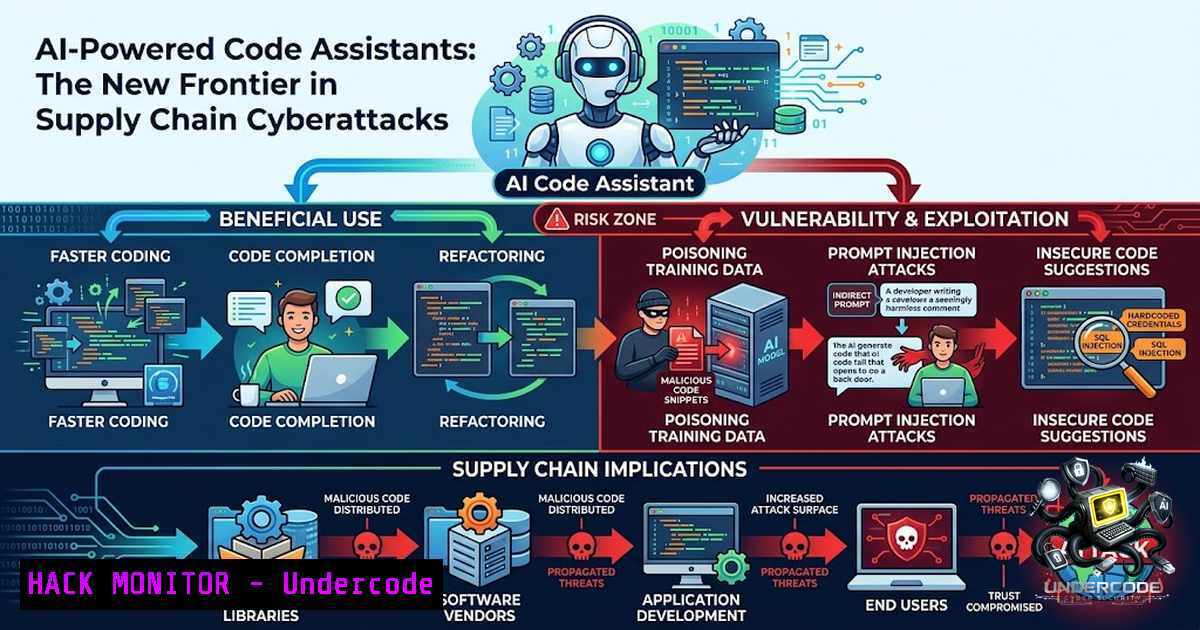
The integration of Artificial Intelligence (AI) into the software development lifecycle, particularly through code completion tools like GitHub Copilot, has revolutionized developer productivity. However, this convenience introduces a novel attack vector: the “AI Hacking” or prompt injection attack targeting the Large Language Models (LLMs) that power these assistants. As demonstrated by recent exploits, attackers can manipulate the training data or context provided to these models to generate vulnerable or malicious code, effectively weaponizing the very tools developers trust to write secure applications.
Learning Objectives:
- Understand the mechanism of prompt injection and data poisoning attacks against AI-powered code assistants.
- Learn how to detect and mitigate vulnerabilities introduced by AI-suggested code.
- Implement security controls and validation pipelines to protect your development environment from AI-driven supply chain threats.
You Should Know:
- The Anatomy of an AI Code Injection Attack
This section explains how attackers exploit the symbiotic relationship between developers and their AI tools. The attack typically begins with an attacker compromising a public repository or a popular package that the AI has been trained on. By injecting malicious code or comments containing “poisoned” patterns, the attacker can influence the AI’s future suggestions. When a developer queries the AI for a specific function, the model returns the poisoned code, which might include a hidden backdoor, an API key exfiltration routine, or a vulnerability like an SQL injection.
Step‑by‑step guide:
- Reconnaissance: Attackers identify popular libraries or frameworks used in conjunction with AI coding tools.
- Data Poisoning: They contribute to the project, adding benign-looking commits that contain the malicious pattern. Comments like `// TODO: Optimize this for high load` might instruct the AI to introduce a race condition.
- Targeting: The attacker waits for the AI to be retrained or for the context window to include their poisoned data.
- Execution: A developer uses the AI to generate a code snippet. The AI suggests the malicious code, the developer applies it, and the vulnerability is now in the production environment.
2. Detecting Malicious Suggestions with Static Analysis
To combat this, developers must integrate security scanners into their IDEs. Tools like Semgrep or CodeQL can be used to analyze AI-suggested code in real-time. The objective is to flag suspicious patterns—such as hardcoded credentials, known vulnerable functions (e.g., `eval()` in Python or `system()` in C), or insecure connection strings—before the code is committed.
Step‑by‑step guide:
- Install Semgrep: On Linux/macOS, run
pip install semgrep. On Windows, you can use `pip install semgrep` within a WSL environment or viachoco install semgrep. - Create a Rule: Create a YAML file named `security-rules.yml` with a rule to detect hardcoded secrets:
rules: - id: hardcoded-password pattern: - password = "..."; message: Hardcoded password detected. severity: ERROR. - Run the Scan: Execute `semgrep –config security-rules.yml .` in your terminal to scan the project directory.
- Integrate with IDE: Use the VS Code extension for Semgrep to highlight issues in AI-suggested code as you type.
3. Mitigating Prompt Injection Risks
Prompt injection is a technique where an attacker crafts a malicious input that causes the AI to ignore its system instructions and produce harmful output. In the context of a code assistant, a user might be lured into pasting a “poisoned” comment from an untrusted source into their codebase, which then tricks the AI into generating insecure code.
Step‑by‑step guide:
- Sanitize Inputs: Do not blindly copy and paste code or comments from unknown sources into your project.
- Context Isolation: Ensure that your AI assistant is not given access to proprietary or sensitive data in its context window. Use local LLM solutions or enterprise-tier services that offer data privacy.
- Output Validation: Treat AI output as untrusted data. Implement strict validation functions that verify the structure and security of the code. For example, use `ast` module in Python to parse the code and look for disallowed functions.
4. Securing the CI/CD Pipeline Against AI-Introduced Bugs
Once code is committed, the Continuous Integration/Continuous Deployment (CI/CD) pipeline is the last line of defense. It is crucial to run a comprehensive security scanning suite that includes Software Composition Analysis (SCA) and Dynamic Application Security Testing (DAST).
Step‑by‑step guide:
- Linux Command: `find . -1ame “.js” -exec node ./security-scanner.js {} \;` to run a custom scanner on all JavaScript files.
- Windows Command (PowerShell):
Get-ChildItem -Recurse -Filter .js | ForEach-Object { node ./security-scanner.js $_.FullName }. - Tool Configuration: Configure SonarQube to run on every pull request. In the `sonar-project.properties` file, add `sonar.qualitygate.wait=true` to block merges if vulnerabilities are found.
- Dependency Scanning: Use `npm audit` (Node.js) or `pip-audit` (Python) to check for known vulnerabilities in dependencies that the AI might have suggested.
-
Hardening Cloud Environments with the Principle of Least Privilege
Even if malicious code reaches production, cloud hardening can limit the blast radius. Ensure that the IAM roles assigned to the application have the minimum permissions necessary. If an AI-suggested code snippet contains an exploit attempting to access an S3 bucket, the policy should deny that action.
Step‑by‑step guide:
- AWS CLI Check:
aws iam list-policies --only-attached --query 'Policies[?AttachmentCount >0]'to review active policies. - Implement a Deny Policy: Create a policy that explicitly denies actions on sensitive resources unless from a specific VPC endpoint.
- Network Segmentation: Use Security Groups to restrict inbound traffic to only necessary ports. This will stop a reverse shell that might be part of a malicious AI suggestion from establishing an outbound connection.
6. Exploitation and Mitigation: The Code Example
A classic example involves the AI suggesting a snippet to read a configuration file. The malicious version might use the `os` module to execute a command if a specific environment variable is set.
– Vulnerable Code: `eval(sys.argv[bash])`
– Mitigation: Replace with `subprocess.run(sys.argv[bash], shell=False)` to prevent command injection, or better, use `argparse` to parse input safely.
7. Training and Awareness
The human element is critical. Developers must be trained to understand that AI is a tool, not a replacement for security expertise. They should be taught to review every AI-generated line of code with the same suspicion as code written by a junior developer.
What Undercode Say:
- Key Takeaway 1: The threat of AI-powered hacking is real and evolving. It shifts the attack surface from network vulnerabilities to the very algorithms we use to write code.
- Key Takeaway 2: Security cannot be an afterthought; it must be embedded into the development workflow through automated scanning, strict validation, and continuous education.
Analysis: The reliance on AI for code generation introduces a systemic risk to the global software supply chain. A single successful poisoning of a foundational model could impact millions of developers worldwide, leading to a wave of vulnerabilities that are extremely difficult to trace back to the source. The only way to combat this is to treat AI as an unverified external contributor, implementing robust security checks that can automatically detect and reject malicious patterns. This requires a shift in mindset from “accepted suggestion” to “strictly validated input,” fundamentally changing the trust model in software development.
Prediction:
- -1: We will likely see a surge in “AI-Originated” CVEs (Common Vulnerabilities and Exposures) in the next 2–3 years, as attackers become more sophisticated in their data poisoning and prompt injection techniques.
- +1: This will spur the development of a new class of security tools designed specifically for LLM validation and context sanitization, creating a new sub-industry in cybersecurity.
- -1: The democratization of coding through AI could lead to a generation of developers who lack the fundamental understanding of security principles, making them more susceptible to using malicious AI suggestions.
- +1: Enterprise adoption of AI code tools will drive the demand for private, self-hosted LLMs that can be fine-tuned on audited and secure codebases, significantly reducing the risk of public data poisoning.
▶️ Related Video (88% Match):
🎯Let’s Practice For Free:
🎓 Live Courses & Certifications:
Join Undercode Academy for Verified Certifications
🚀 Request a Custom Project:
Secure, high-velocity infrastructure and disruptive technological engineering. Contact our engineering team for high-tier development and proprietary systems:
[email protected]
💎 Smart Architecture | 🛡️ Secure by Design | ⭐ Trusted by Thousands
IT/Security Reporter URL:
Reported By: https://lnkd.in/p/eniSHnXy – Hackers Feeds
Extra Hub: Undercode MoN
Basic Verification: Pass ✅


