Listen to this Post
Introduction:
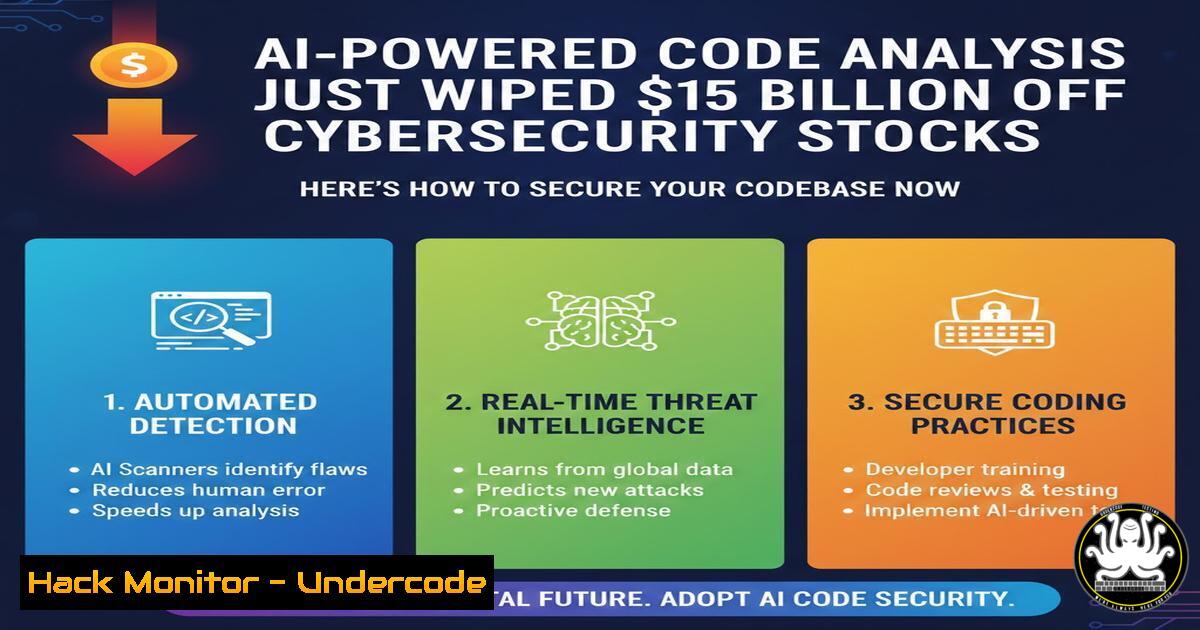
The cybersecurity landscape experienced a seismic shock when Anthropic unveiled an AI capability capable of autonomous codebase scanning, vulnerability detection, and fix suggestion. The market reaction was immediate and brutal, with major security vendors losing billions in valuation. This shift signals that AI is no longer just a tool for defenders but a direct competitor to traditional security stacks. This article explores how AI-driven code analysis works, how to implement similar security measures, and what commands and configurations you need to protect your infrastructure in this new era.
Learning Objectives:
- Understand the technical capabilities of AI-driven code vulnerability scanning
- Learn practical commands for implementing AI-assisted security testing
- Master configuration of open-source and enterprise tools for automated code auditing
- Identify mitigation strategies against AI-discovered vulnerabilities
- Analyze the future impact of generative AI on cybersecurity roles and tools
You Should Know:
1. Understanding AI-Powered Code Vulnerability Scanning
Anthropic’s new tool represents a leap in automated security testing. Unlike static analysis tools that rely on predefined rules, this AI understands code context, logic flaws, and complex vulnerability chains. It can scan entire repositories in minutes, identifying issues like SQL injection, buffer overflows, and insecure API calls while suggesting patches.
To understand how this works technically, we can simulate a basic vulnerability scan using open-source AI tools. Install and run CodeQL, a semantic code analysis engine now integrated with GitHub Advanced Security:
 Install CodeQL CLI on Linux
wget https://github.com/github/codeql-cli-binaries/releases/latest/download/codeql-linux64.zip
unzip codeql-linux64.zip -d ~/codeql
export PATH=~/codeql/codeql:$PATH

Download the CodeQL queries
git clone https://github.com/github/codeql.git ~/codeql-queries

Analyze a project (e.g., a vulnerable web app)
codeql database create ~/myproject-db --language=javascript --source-root=/path/to/your/project
codeql database analyze ~/myproject-db ~/codeql-queries/javascript/ql/src/codeql-suites/javascript-security-and-quality.qls --format=sarif-latest --output=results.sarif
This generates a SARIF report that AI can further interpret to suggest fixes, mirroring the core function that spooked investors.
2. Automating Vulnerability Discovery with AI-Assisted Tools
Beyond traditional SAST, integrating AI with runtime analysis yields powerful results. Tools like Semgrep now incorporate AI-driven rule suggestions. Use Semgrep to find secrets and vulnerabilities in code:
 Install Semgrep via pip
pip install semgrep

Run a scan on a codebase
semgrep --config "p/ci" /path/to/code

Generate an AI-powered fix using experimental features
semgrep --config "p/owasp-top-ten" --autofix /path/to/code
For Windows environments, use PowerShell to scan .NET applications with Security Code Scan:
 Install .NET tool
dotnet tool install --global SecurityCodeScan

Run analyzer on a solution
dotnet build MyApp.sln /p:RunSecurityCodeScan=true
These tools replicate the “scan and suggest fix” functionality that threatens traditional vendor models.
3. Hardening Cloud Infrastructure Against AI-Discovered Flaws
AI tools excel at identifying misconfigurations in cloud environments. Use Prowler, an open-source AWS security tool, to mimic AI-driven cloud auditing:
 Install Prowler
git clone https://github.com/prowler-cloud/prowler.git
cd prowler
pip install -r requirements.txt

Run a comprehensive AWS scan
./prowler -M json -o output/

Parse results with an AI script to prioritize fixes
cat output/output.$(date +%Y%m%d).json | jq '.[] | select(.status == "FAIL") | .control'
For Azure, use Scout Suite:
 Install and run Scout for Azure
pip install scoutsuite
scout azure --cli
These scans identify the exact vulnerabilities that AI tools would flag, allowing proactive hardening before attackers leverage the same AI.
4. Securing APIs with AI-Driven Testing
APIs are prime targets. Use OWASP ZAP with AI plugins or the GraphQL Cop tool for automated API security testing:
 Run ZAP in daemon mode for API scanning
docker run -u zap -p 8080:8080 -i owasp/zap2docker-stable zap.sh -daemon -host 0.0.0.0 -port 8080 -config api.disablekey=true

Execute an active scan against an OpenAPI spec
curl "http://localhost:8080/JSON/ascan/action/scan/?url=https://your-api.com&recurse=true"
For GraphQL endpoints, use InQL scanner:
 Install InQL
git clone https://github.com/doyensec/inql
cd inql
docker build -t inql .
docker run -it inql -t https://target.com/graphql -k
AI can now interpret the results and suggest specific mitigations like rate limiting or input sanitization.
5. Implementing AI-Generated Security Fixes
When AI suggests a fix, it’s critical to verify and apply it correctly. For a common vulnerability like SQL injection in Python (Flask), the AI might suggest:
 Vulnerable code
@app.route('/user/<username>')
def show_user(username):
query = "SELECT  FROM users WHERE username = '" + username + "'"
result = db.engine.execute(query)

AI-suggested fix using parameterized queries
@app.route('/user/<username>')
def show_user(username):
query = "SELECT  FROM users WHERE username = :username"
result = db.engine.execute(text(query), {'username': username})
Apply similar fixes systematically using Bandit for Python security linting:
 Install Bandit
pip install bandit

Run Bandit and output fix recommendations
bandit -r /path/to/code -f json | jq '.results[] | {filename: .filename, line: .line_number, issue: .issue_text}'
6. Continuous Integration Security with AI
Integrate AI-scanning into CI/CD pipelines. Here’s a GitHub Actions workflow snippet using SonarCloud with AI-enhanced analysis:
name: Security Scan
on: [bash]
jobs:
security:
runs-on: ubuntu-latest
steps:
- uses: actions/checkout@v3
- name: SonarCloud Scan
uses: sonarsource/sonarcloud-github-action@master
env:
GITHUB_TOKEN: ${{ secrets.GITHUB_TOKEN }}
SONAR_TOKEN: ${{ secrets.SONAR_TOKEN }}
SonarCloud now incorporates AI to detect hardcoded credentials and complex bugs. For Jenkins, use the OWASP Dependency-Check plugin:
stage('Security Scan') {
steps {
dependencyCheck additionalArguments: '--scan ./ --format XML --out ./dependency-check-report.xml'
dependencyCheckPublisher pattern: '/dependency-check-report.xml'
}
}
7. On-Premise AI Security Tool Deployment
For organizations unable to use cloud AI tools, deploy LocalAI with security models:
 Clone LocalAI
git clone https://github.com/mudler/LocalAI
cd LocalAI

Download a security-tuned model (e.g., CodeLlama)
wget https://huggingface.co/TheBloke/CodeLlama-7B-Instruct-GGUF/resolve/main/codellama-7b-instruct.Q4_K_M.gguf -O models/

Run LocalAI
docker-compose up -d

Query the model for code review
curl http://localhost:8080/v1/completions -H "Content-Type: application/json" -d '{
"model": "codellama-7b-instruct",
"prompt": "Review this Python code for security issues: [paste code here]"
}'
This replicates Anthropic’s capability entirely on-premises, avoiding data leaks while maintaining competitive security posture.
What Undercode Say:
- The market correction reflects a fundamental truth: AI is commoditizing core security functions. Traditional vendors must pivot from selling “vulnerability discovery” to offering “validated remediation and context-aware defense.”
- Security professionals must evolve from manual code review to AI-prompt engineering and fix verification. The skill shift is as significant as the cloud transition was a decade ago.
- The real winners will be organizations that integrate AI into their DevSecOps pipelines now, reducing mean-time-to-remediation from weeks to hours while cutting costs. However, over-reliance on AI without human oversight introduces new risks of automated false positives and missed logic flaws.
Prediction:
Within 18 months, AI-powered code analysis will become a standard feature in all major IDEs and CI/CD platforms, compressing the vulnerability lifecycle by 80%. Cybersecurity vendors will survive by pivoting to AI model security, prompt injection defense, and securing AI-generated code—a market that could exceed $10 billion by 2026. The “cybersecurity recession” triggered by this announcement is temporary; it’s actually the birth of a new, more efficient security paradigm where AI and human analysts form an unstoppable partnership.
▶️ Related Video (76% Match):
🎯Let’s Practice For Free:
IT/Security Reporter URL:
Reported By: Santhoshreddy39 Ai – Hackers Feeds
Extra Hub: Undercode MoN
Basic Verification: Pass ✅


