Listen to this Post
Introduction:
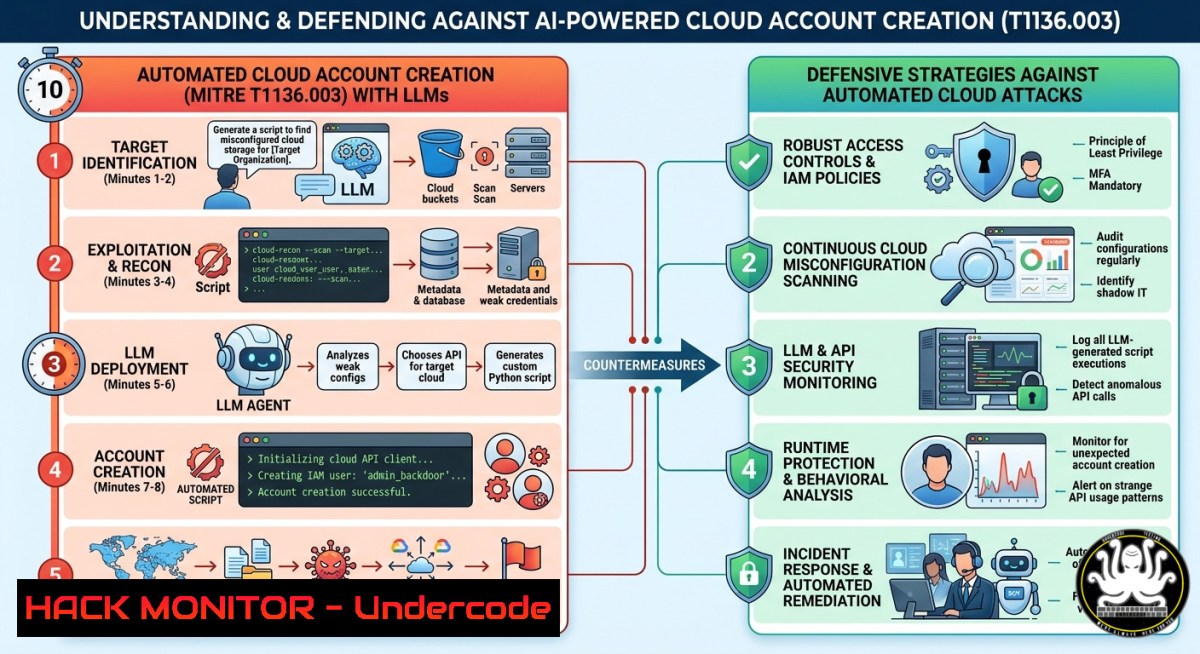
Threat actors now leverage large language models (LLMs) to compress entire cloud attack kill chains—from stolen credentials to full compromise—into less than 10 minutes. MITRE ATT&CK technique T1136.003 (Create Account: Cloud Account) has become a prime target for AI-driven automation, enabling rapid reconnaissance, privilege escalation, and lateral movement at a scale previously requiring hours of manual scripting.
Learning Objectives:
- Understand how LLMs automate cloud attack kill chains and the specific risks of T1136.003.
- Learn to detect and block unauthorized IAM user creation using AWS Service Control Policies (SCPs) and continuous validation.
- Build repeatable, deterministic attack emulations using YAML-based Cloud Attack Language (e.g., Mitigant Attack Builder) for proactive purple teaming.
You Should Know:
- Anatomy of an AI‑Accelerated Cloud Kill Chain (T1136.003 in Action)
Modern LLM‑powered attacks follow a streamlined flow: stolen credentials → identity enumeration → automated IAM user creation (T1136.003) → privilege escalation → lateral movement → data exfiltration or resource hijacking. The speed comes from AI agents that interpret cloud environment responses and adaptively choose next MITRE techniques.
Step‑by‑step example (emulation – do not run on production):
 Linux – simulate attacker reconnaissance using AWS CLI with stolen keys
aws sts get-caller-identity --profile stolen_creds
aws iam list-users --profile stolen_creds
 Attacker uses LLM to generate a script that creates a new IAM user
cat > create_rogue_user.sh <<EOF
aws iam create-user --user-name ai_backdoor --profile stolen_creds
aws iam create-access-key --user-name ai_backdoor --profile stolen_creds
aws iam attach-user-policy --user-name ai_backdoor --policy-arn arn:aws:iam::aws:policy/AdministratorAccess
EOF
chmod +x create_rogue_user.sh && ./create_rogue_user.sh
Windows (PowerShell) equivalent:
 Install AWS Tools for PowerShell first
Set-AWSCredential -AccessKey AKIA... -SecretKey ... -StoreAs stolen
New-IAMUser -UserName ai_backdoor -ProfileName stolen
New-IAMAccessKey -UserName ai_backdoor -ProfileName stolen
Register-IAMUserPolicy -UserName ai_backdoor -PolicyArn "arn:aws:iam::aws:policy/AdministratorAccess"
Defender action: Immediately restrict IAM user creation across all accounts using SCPs (see section 2). Also enable CloudTrail and GuardDuty with ML anomaly detection for rapid user creation events.
- Hardening with AWS Service Control Policies (SCPs) – And Bypass Awareness
SCPs are the most effective control against T1136.003, but misconfigured SCPs can be bypassed via privilege escalation from less restricted OUs or by exploiting delegated admin permissions.
Step‑by‑step to implement a restrictive SCP:
- Navigate to AWS Organizations → Policies → Service Control Policies.
- Create a new policy with the following JSON to deny all IAM user creation actions:
{ "Version": "2012-10-17", "Statement": [ { "Effect": "Deny", "Action": [ "iam:CreateUser", "iam:CreateAccessKey", "iam:AttachUserPolicy" ], "Resource": "" } ] } - Attach this SCP to the root OU or all target OUs.
- Validate using a test account: attempt to create a user – it should fail with
AccessDenied. - For ongoing validation, use tools like `aws iam simulate-custom-policy` or integrate into CI/CD:
aws iam simulate-principal-policy --policy-source-arn arn:aws:iam::123456789012:user/testuser --action-names iam:CreateUser
Bypass scenario to watch for: If an attacker compromises a role in an OU without the SCP (e.g., a sandbox OU), they can create users there and then assume roles in protected OUs via trust policies. Mitigation: apply SCPs everywhere and regularly audit trust policies.
- Purple Teaming with Cloud Attack Language (YAML) – No Custom Scripting
Tools like Mitigant Attack Builder allow defenders to define attack chains as YAML, execute them safely in isolated environments, and automatically clean up. This turns purple teaming into a repeatable, deterministic process.
Example YAML attack chain for T1136.003 + escalation:
name: "AI-Simulated Credential Compromise to Admin User"
techniques:
- id: T1078.004
name: "Valid Accounts: Cloud Accounts"
action: "use_stolen_keys"
parameters:
profile: "compromised_developer"
- id: T1136.003
name: "Create Account: Cloud Account"
action: "create_iam_user"
parameters:
username: "pentest_rogue"
attach_policy: "AdministratorAccess"
- id: T1098
name: "Account Manipulation"
action: "create_access_key"
depends_on: "T1136.003"
- id: T1530
name: "Data from Cloud Storage Object"
action: "list_and_download_s3"
depends_on: "T1098"
cleanup:
- delete_user: "pentest_rogue"
- delete_access_keys
How to use (Linux/macOS):
 Assuming Mitigant CLI installed
mitigant attack run --file cloud_killchain.yaml --env isolated-aws --region us-east-1
 Monitor logs for detection alerts
mitigant attack report --id <run_id> --format detections
Windows (PowerShell):
.\mitigant.exe attack run --file cloud_killchain.yaml --env isolated-aws
Get-MitigantRun -RunId <id> | Format-List Detections
This approach validates whether your SIEM, GuardDuty, or custom detections actually fire on T1136.003 – closing the gap between “we have alerts” and “alerts work.”
- Detecting AI‑Generated IAM Creation Attempts in Real Time
Traditional rule‑based detections (e.g., “one user created per minute”) fail against AI‑driven attacks that mimic human timing or use distributed sources. Focus on behavioral anomalies and sequence detection.
CloudTrail event pattern for T1136.003 (AWS EventBridge rule):
{
"source": ["aws.iam"],
"detail-type": ["AWS API Call via CloudTrail"],
"detail": {
"eventName": ["CreateUser", "CreateAccessKey", "AttachUserPolicy"],
"userIdentity": {
"type": ["IAMUser", "AssumedRole"]
}
}
}
Advanced detection with AWS Lambda (Python):
import boto3
def lambda_handler(event, context):
 Trigger on CreateUser, then check for rapid CreateAccessKey + AttachUserPolicy
user_name = event['detail']['requestParameters']['userName']
 Query CloudTrail for events from same source IP in last 5 min
 If sequence found, send high-severity alert to SNS
Linux command to simulate an attacker trying to bypass detection:
 Randomize delays between API calls
for i in {1..5}; do
aws iam create-user --user-name "test$RANDOM" --profile attacker
sleep $((RANDOM % 60 + 10))
aws iam create-access-key --user-name "test$RANDOM" --profile attacker
sleep $((RANDOM % 30))
done
Countermeasure: Deploy a GuardDuty custom rule that flags any IAM user creation followed by privilege escalation within a short window, regardless of timing jitter.
5. Continuous Validation: From Reactive to Proactive Defense
The key insight from AI‑scaled attacks is that static defenses expire. Purple teaming must become continuous – run attack chains weekly, after every infrastructure change, and whenever new MITRE techniques are published.
Step‑by‑step to integrate attack emulation into CI/CD (GitHub Actions example):
name: Weekly Purple Team - Cloud Attack Emulation
on:
schedule:
- cron: '0 2   0'  Every Sunday at 2 AM
workflow_dispatch:
jobs:
run-mitigant:
runs-on: ubuntu-latest
steps:
- uses: actions/checkout@v4
- name: Run Attack Chain
run: |
mitigant attack run --file weekly_t1136.yaml --env staging-aws
- name: Upload Detection Report
uses: actions/upload-artifact@v4
with:
name: purple-team-report
path: ./report.json
- name: Fail if critical detection missed
run: |
if jq '.detections.T1136_003.missed' report.json | grep -q true; then
echo "CRITICAL: T1136.003 not detected!" && exit 1
fi
Windows Task Scheduler for recurring validation:
$Action = New-ScheduledTaskAction -Execute "mitigant.exe" -Argument "attack run --file prod_like.yaml"
$Trigger = New-ScheduledTaskTrigger -Weekly -DaysOfWeek Sunday -At 2am
Register-ScheduledTask -TaskName "PurpleTeamWeekly" -Action $Action -Trigger $Trigger
This turns security validation into a measurable, automated process – the only way to keep pace with AI‑driven adversaries.
6. Mitigating Privilege Escalation from Compromised IAM Users
Even if you block T1136.003, attackers pivot via existing users. Use IAM Access Analyzer and least‑privilege reviews. Also implement per‑resource condition keys to restrict which users can create other users.
Example IAM policy to allow user creation only for specific naming patterns and require MFA:
{
"Effect": "Allow",
"Action": "iam:CreateUser",
"Resource": "arn:aws:iam:::user/authorized-",
"Condition": {
"Bool": {"aws:MultiFactorAuthPresent": "true"},
"StringLike": {"iam:PassedToService": "ec2.amazonaws.com"}
}
}
Linux command to test if a policy is too permissive:
 Use IAM Policy Simulator
aws iam simulate-principal-policy --policy-source-arn arn:aws:iam::123456789012:user/developer --action-names iam:CreateUser --context-entries ContextKeyName=aws:MultiFactorAuthPresent,ContextKeyValues=true,ContextKeyType=boolean
What Undercode Say:
- Key Takeaway 1: AI reduces cloud attack dwell time from hours to minutes – defenses must be validated continuously, not annually.
- Key Takeaway 2: SCPs are essential but not magic; regular bypass testing and organization‑wide enforcement are mandatory.
- Key Takeaway 3: YAML‑based purple teaming (like Mitigant Attack Builder) transforms security validation from ceremony into code – repeatable, deterministic, and scalable.
Analysis: The post highlights a critical shift: adversaries now use LLMs to automate decision‑making across MITRE techniques. Defenders still rely on static playbooks and periodic red team exercises – a mismatch. The solution is continuous, automated purple teaming embedded into CI/CD and cloud native controls. However, small teams may struggle with the learning curve of Cloud Attack Languages. The industry needs standardized YAML schemas and open‑source emulation libraries to democratize this capability. Until then, tools like Mitigant fill a vital gap.
Prediction:
Within 18 months, AI‑driven cloud attacks will target not just IAM user creation but also AI‑model poisoning and LLM‑augmented privilege escalation chains that bypass traditional SCPs by exploiting resource‑based policies. Defenders will adopt real‑time attack emulation as a standard compliance requirement (similar to vulnerability scanning). Organizations that fail to automate purple teaming will suffer silent breaches where attackers leverage AI to live off the land, creating and deleting accounts faster than any human‑operated SOC can respond. The future belongs to deterministic, machine‑speed validation – not annual penetration tests.
▶️ Related Video (74% Match):
🎯Let’s Practice For Free:
IT/Security Reporter URL:
Reported By: Aondona Cloudsecurity – Hackers Feeds
Extra Hub: Undercode MoN
Basic Verification: Pass ✅


