Listen to this Post
Introduction
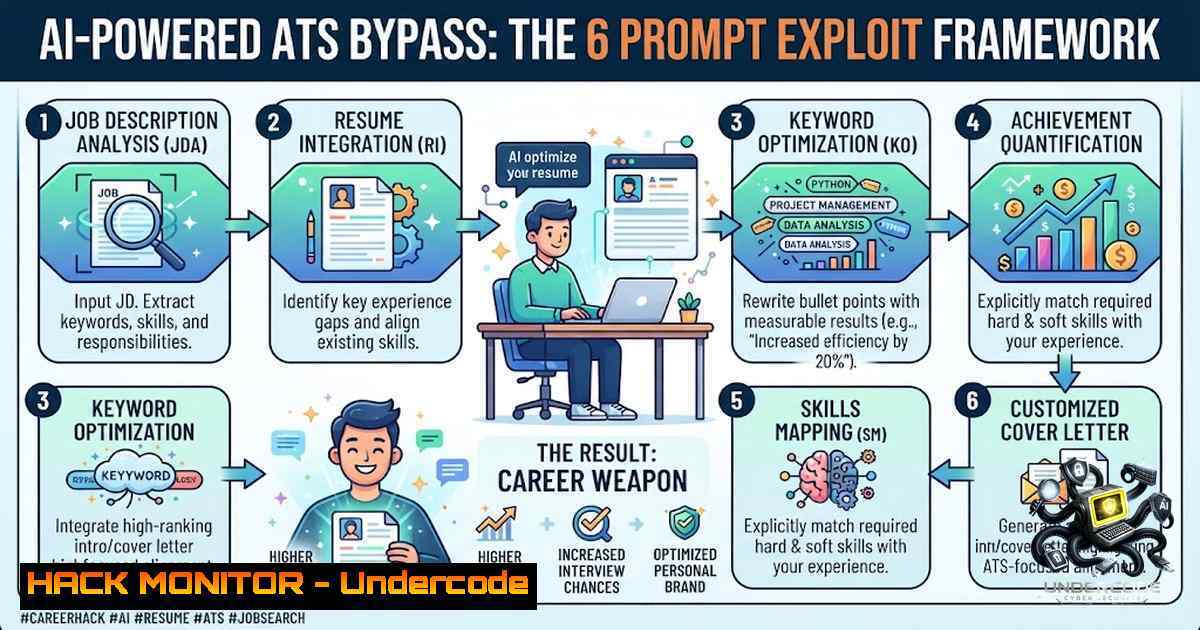
The modern job application process has evolved into a battle of algorithms, where Applicant Tracking Systems (ATS) serve as the first line of defense between candidates and their dream roles. Just as cybersecurity professionals use penetration testing to identify vulnerabilities in systems, job seekers must now leverage AI to uncover weaknesses in their application materials. The six prompts outlined below represent a comprehensive offensive strategy for CV optimization, transforming ChatGPT from a generic text generator into a sophisticated career warfare tool that exploits ATS logic and recruiter psychology.
Learning Objectives
- Master six AI-driven prompts to systematically identify and eliminate CV vulnerabilities that trigger ATS rejection
- Understand how to reverse-engineer job descriptions to extract hidden requirements and must-have keywords
- Learn to transform duty-based bullet points into achievement-driven narratives with measurable business impact
You Should Know
- The ATS Resilience Assessment: Simulating the Machine Gatekeeper
The first prompt acts as your penetration testing tool against the ATS firewall. By commanding ChatGPT to role-play as a senior HR professional with specific industry expertise, you force the AI to analyze your CV through the lens of algorithmic screening and human bias. This approach reveals critical vulnerabilities that would otherwise remain hidden until after submission.
Step-by-Step Guide:
This prompt functions like a vulnerability scanner, assessing your CV against both ATS parsing engines and recruiter cognitive biases. Here’s how to implement it effectively:
- Environment Setup: Create a new ChatGPT session and paste the exact prompt: “You are a senior HR professional with 10 years of recruiting experience in [your target industry]. Analyze my CV like you’re screening a real candidate. Tell me: (1) which sections make you skip immediately, (2) achievements that are too weak and need strengthening, (3) the one thing that would get me rejected in the first 10 seconds. Be brutal. Don’t be nice.”
-
Data Collection: Paste your entire CV text after the prompt. Ensure you include all sections, including contact information, professional summary, work experience, education, skills, and certifications.
-
Vulnerability Interpretation: Analyze the AI’s response for specific patterns:
– Section skipping flags: These indicate areas where ATS parsing fails or recruiters lose interest
– Weak achievement indicators: Look for phrases like “responsible for,” “assisted with,” or “participated in” – these trigger rejection
– First 10-second rejection items: These are typically formatting issues, missing contact information, or irrelevant experience
- Remediation Planning: Create a prioritization matrix based on the AI’s feedback. Address first 10-second rejection items immediately, then section-skipping issues, followed by achievement strengthening.
Technical Implementation Example:
 Pseudo-code for CV vulnerability assessment
def assess_cv_vulnerabilities(cv_text, industry):
vulnerability_scanner = {
'formatting_issues': check_contact_info(cv_text),
'keyword_density': calculate_industry_keywords(cv_text, industry),
'achievement_impact': analyze_accomplishment_verbs(cv_text),
'ats_compatibility': test_parsing_errors(cv_text)
}
return vulnerability_scanner
2. The Job Description Reverse Engineering Protocol
This prompt transforms ChatGPT into a threat intelligence analyst, breaking down job descriptions to identify hidden requirements and unspoken expectations. Understanding the JD’s underlying structure is crucial for crafting a CV that passes both algorithmic and human screening.
Step-by-Step Guide:
- JD Analysis: Use the prompt: “Here is the job description: [paste JD]. Break it down section by section and give me: (1) hidden skills not written but definitely expected, (2) red flags if a candidate is missing them, (3) the 3 must-have keywords that must appear in my CV, (4) what the hiring manager actually cares about that the JD never says directly.”
-
Keyword Extraction: The AI will identify both explicit and implicit keywords. For cybersecurity roles, look for:
– Explicit keywords: SIEM, SOAR, vulnerability assessment, NIST framework
– Implicit skills: Incident response, team leadership, communication with executive stakeholders
– Red flag indicators: Missing compliance certifications, lack of specific tool experience
- Hidden Requirements Analysis: Focus on the hidden skills identified by the AI. These often include:
– Soft skills: Problem-solving ability, crisis management
– Technical nuances: Understanding of specific attack vectors or compliance frameworks
– Cultural fit indicators: Experience with agile teams or DevSecOps environments
- Keyword Integration: Create a keyword matrix mapping JD requirements to your CV content, ensuring natural language inclusion without keyword stuffing.
-
The ATS Parser Exploit: Crafting a 90+ Score Attack Vector
This prompt functions as an advanced ATS bypass tool, specifically engineered to optimize your CV for algorithm scoring while maintaining human readability. The key difference between this and simple keyword stuffing is the strategic placement and natural integration of critical terms.
Step-by-Step Guide:
- Gap Analysis: Use the prompt: “My CV keeps failing initial screening. Act as an ATS specialist. Here is my CV:
. Here is the job description: [bash]. Identify every gap between the two. Then rewrite my Experience and Skills sections using the exact keywords from the JD naturally, not stuffed. Target score: 90+ on ATS. Show me before and after for every change."</p></li>
<li><p>Before/After Comparison: The AI will generate side-by-side comparisons showing:</p></li>
</ol>

<p>- Original content: Generic descriptions without metrics
- Optimized content: Keyword-rich, metric-driven narratives that maintain natural flow

<ol>
<li>Keyword Placement Strategy: Ensure critical keywords appear in:</li>
</ol>

- Professional summary: First 50 words (highest weight)
- Each job's bullet points: Distribute keywords naturally
- Skills section: Exact matches from JD requirements

<ol>
<li>ATS Scoring Optimization: Focus on the AI's scoring methodology:</li>
</ol>

- Exact match keywords: Highest weight
- Synonym variations: Moderate weight
- Contextual relevance: Ensuring keywords appear in correct sentence structures

<h2 style="color: yellow;">Windows Command Reference for Document Processing:</h2>

[bash]
 Convert CV to plain text for ATS testing
type cv.docx > cv.txt
 Use findstr to count keyword occurrences
findstr /C:"security" /C:"vulnerability" /C:"compliance" cv.txt
Linux Command Reference for Keyword Analysis:
 Extract keywords from JD
grep -o -E '(security|vulnerability|incident response|compliance)' job_description.txt | sort | uniq -c
 Check keyword density in optimized CV
awk '{total += length($0)} END {print "Total characters:", total}' optimized_cv.txt
4. The Achievement Injection Framework
This prompt transforms ChatGPT into an achievement architect, converting duty-based bullet points into powerful, metric-driven accomplishments that stop recruiters mid-scroll. The formula (Strong action verb + what I did + measurable result + business impact) creates a narrative structure that algorithms and humans find equally compelling.
Step-by-Step Guide:
- Duty Extraction: Use the prompt: “Here are my current job descriptions on my CV: [paste bullet points]. Every single one describes a duty not a result. Rewrite each one using this formula: Strong action verb + what I did + measurable result + business impact. If I haven’t given you numbers, suggest realistic placeholders I can verify. Make a recruiter stop scrolling.”
2. Metric Identification: The AI will:
- Identify potential metrics: Numbers, percentages, timeframes
- Suggest realistic placeholders: If no metrics exist, the AI creates verifiable ranges
- Verify metric plausibility: Ensures suggested metrics are industry-appropriate
- Verb Optimization: Replace weak verbs with powerful alternatives:
– Weak verbs: “Responsible for,” “Assisted with,” “Participated in”
– Strong verbs: “Implemented,” “Architected,” “Orchestrated,” “Spearheaded”- Business Impact Articulation: Connect individual achievements to broader organizational outcomes:
– Cost savings: “Reduced security incidents by 40%”
– Revenue generation: “Enabled $2M in compliant cloud migration revenue”
– Efficiency improvements: “Decreased response time from 48 hours to 6 hours”Implementation Example:
// JavaScript template for achievement transformation
const achievementTemplate = (action, metric, impact) => {
return <code>(${action}) that ${metric}, resulting in ${impact}</code>;
};

// Example usage for cybersecurity role
const transformed = achievementTemplate(
'Architected a zero-trust network segmentation framework',
'reduced lateral movement attempts by 67%',
'preventing an estimated $1.2M in potential breach costs'
);
5. The Recruiter Simulation Engine
This prompt creates a behavioral model of a recruiter processing 200 CVs in 6 seconds each, providing candid feedback on what works and what kills your chances. It’s the equivalent of a user experience test that reveals the immediate visual and content-based triggers recruiters respond to.
Step-by-Step Guide:
- Recruiter Persona Setup: Use the prompt: “You are a recruiter who just received 200 CVs for this role: [paste JD]. You have 6 seconds per CV. Here is mine: [paste CV]. Tell me: (1) do you shortlist me or skip me in those 6 seconds and why, (2) what is the first thing that catches your eye, (3) what is the first thing that kills my chances, (4) what would make you call me immediately.”
2. Shortlist Analysis: The AI will provide:
- Pass/fail decision: Based on initial 6-second scan
- First impression factors: What immediately caught attention
- Kill factors: What led to immediate rejection
- Desirable elements: What would trigger an immediate call
3. Visual Hierarchy Optimization: Based on recruiter behavior:
- Top third: Most critical information (professional summary, current role, key achievements)
- Middle section: Supporting evidence (technical skills, certifications)
- Bottom section: Secondary information (education, optional details)
- First Impression Engineering: Ensure the first 3 bullet points under each role contain:
– Most impactful achievements
– Highest relevance to the JD
– Strongest metrics6. The Comprehensive Security Audit
This final prompt functions as a system-wide vulnerability assessment, evaluating every section of your CV against multiple criteria including ATS compatibility, keyword strength, achievement quality, formatting clarity, summary impact, skills relevance, and length appropriateness.
Step-by-Step Guide:
- Full Audit Execution: Use the prompt: “Perform a complete audit of my final CV: [bash]. Check every section: ATS compatibility, keyword strength, achievement quality, formatting clarity, summary impact, skills relevance, length appropriateness. Score each section out of 10. Tell me exactly what is still weak and the precise fix for each. I want this CV to score 90+ before I send it anywhere.”
2. Section Scoring: The AI will provide:
- Score breakdown: Each section gets a detailed score with justification
- Weakness identification: Specific areas requiring improvement
- Precise fix recommendations: Actionable changes for each weakness
- Final Optimization: Execute the recommended changes in the following order:
– Critical fixes: Items preventing 90+ scoring
– Medium priority: Items that would improve but aren’t blocking
– Optional enhancements: Nice-to-have improvements- Validation: Re-run the audit to verify improvements and ensure all identified issues have been properly addressed.
What Undercode Say
Key Takeaway 1: Generic prompts generate generic results. These six structured prompts represent a systematic approach to CV optimization, leveraging AI’s analytical capabilities to uncover and address vulnerabilities that would otherwise remain hidden until after application submission.
Key Takeaway 2: The approach combines technical ATS optimization with human psychological triggers, creating a dual-purpose strategy that satisfies both algorithmic screening and recruiter decision-making processes.
Analysis: This framework mirrors established cybersecurity best practices, including vulnerability assessment, threat modeling, risk mitigation, and security auditing. The methodology demonstrates that career advancement in the modern job market requires the same systematic approach that organizations use to protect their digital assets. By treating CV optimization as a security challenge, professionals can significantly increase their chances of passing initial screening and advancing to human review stages. The emphasis on measurable results, keyword optimization, and recruiter psychology creates a comprehensive defense-in-depth strategy that addresses all points of failure in the application process.
Prediction
+1 The integration of AI-powered CV optimization will become as standard as spell-checking in professional applications, with candidates using these techniques to level the playing field against increasingly sophisticated ATS systems
+1 Organizations will begin adopting AI-powered application screening that leverages the same prompting techniques to identify candidates who understand and implement these optimization strategies, creating a self-reinforcing arms race
-1 The proliferation of these techniques may lead to a homogenization of CV content as candidates optimize for the same keywords and formulas, potentially reducing the distinctiveness of individual applications
+1 Career coaches and HR professionals will incorporate these prompting frameworks into their standard advisory practices, democratizing access to high-quality CV optimization
+1 The development of specialized AI tools trained specifically on ATS patterns and recruiter behavior will emerge, offering even more sophisticated optimization capabilities beyond general-purpose LLMs
▶️ Related Video (78% Match):
🎯Let’s Practice For Free:
🎓 Live Courses & Certifications:
Join Undercode Academy for Verified Certifications
🚀 Request a Custom Project:
Secure, high-velocity infrastructure and disruptive technological engineering. Contact our engineering team for high-tier development and proprietary systems:
[email protected]
💎 Smart Architecture | 🛡️ Secure by Design | ⭐ Trusted by ThousandsIT/Security Reporter URL:
Reported By: Harishkumar Sh – Hackers Feeds
Extra Hub: Undercode MoN
Basic Verification: Pass ✅🔐JOIN OUR CYBER WORLD [ CVE News • HackMonitor • UndercodeNews ]
📢 Follow UndercodeTesting & Stay Tuned:


