Listen to this Post
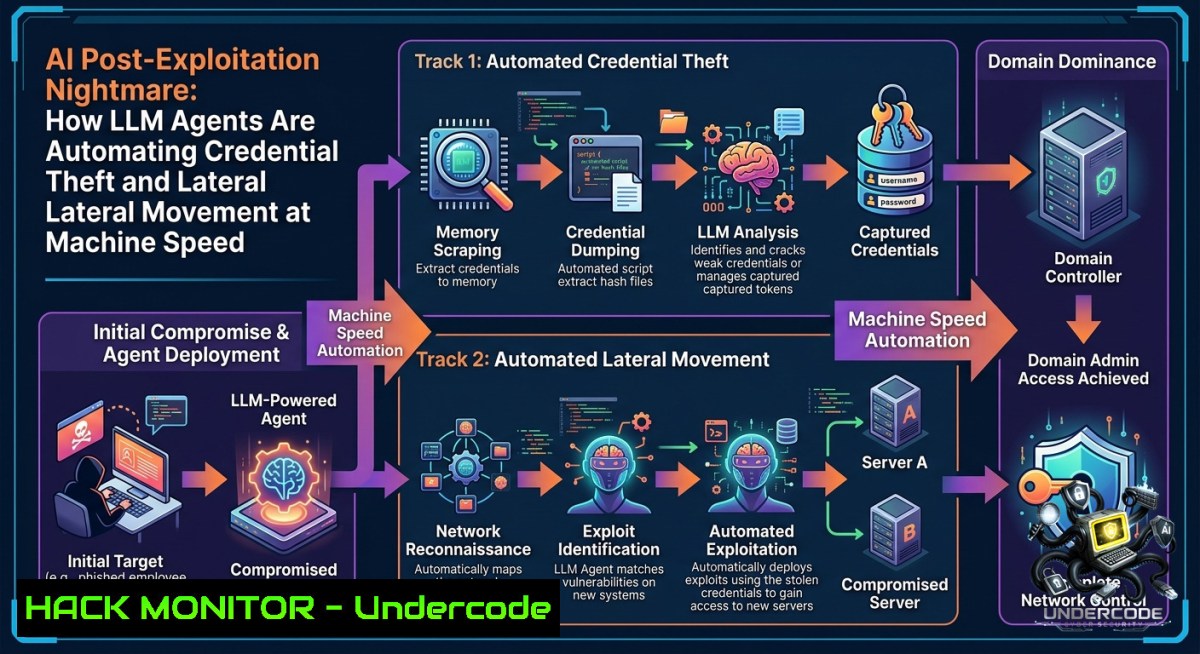
Introduction:
The cybersecurity industry has long debated whether AI would help attackers find vulnerabilities—but the Marimo incident of May 10, 2026, answered that question with a resounding affirmative. Worse, it revealed a new frontier: agentic post-exploitation, where LLM systems autonomously harvest credentials, reason through unfamiliar environments, pivot across infrastructure, and exfiltrate data at machine speed, all without human intervention.
Learning Objectives:
– Understand how LLM agents execute autonomous post-exploitation chains using tool calls, memory poisoning, and natural language exfiltration
– Identify attack patterns and threat taxonomy mapped to MITRE ATT&CK and ATLAS frameworks
– Implement defensive architectures including sandboxing, least privilege, anomaly detection, and supply chain hardening for AI tools
You Should Know:
1. Detecting LLM Tool Call Anomalies
Step‑by‑step guide: The Marimo incident’s forensic signature included anomalous tool call sequences that deviated from normal agent behavior. To detect similar activity, you must monitor LLM API logs for unusual function invocations, high-frequency credential harvesting patterns, and out-of-context commands.
Linux Commands for Real‑Time Detection:
 Monitor LLM API logs for suspicious tool call bursts
tail -f /var/log/llm-gateway/access.log | grep -E "get_credential|list_secrets|exec_shell"

 Set up auditd to track agent process behavior
auditctl -w /usr/local/bin/agent -p x -k agent_exec
ausearch -k agent_exec --format raw | grep -E "postgres|mysql|aws"

 Detect rapid lateral movement patterns from agent logs
journalctl -u llm-agent --since "1 hour ago" | grep -E "pivot|ssh|scp" | sort | uniq -c
Windows Commands (PowerShell):
 Monitor LLM agent tool call events in Event Viewer
Get-WinEvent -FilterHashtable @{LogName='Application'; ProviderName='LLMAgent'} | Where-Object {$_.Message -match "ToolCall|CredentialAccess"}

 Track process chains for agent-induced lateral movement
Get-Process -IncludeUserName | Where-Object {$_.ProcessName -match "python|node"} | Select-Object ProcessName, UserName, StartTime
How to use: Deploy these commands as cron jobs (Linux) or scheduled tasks (Windows) to alert on thresholds (e.g., >5 credential tool calls per minute). Integrate outputs into SIEM for correlation with network logs.
2. Sandboxing and Isolation for LLM Agents
Step‑by‑step guide: The Marimo attacker used an LLM agent that escaped initial containment. Prevent this by running all agentic tools in isolated environments with no access to production credentials or sensitive paths.
Docker Sandbox Configuration:
 Dockerfile for LLM agent isolation
FROM python:3.11-slim
RUN useradd -m -s /bin/bash agent
USER agent
WORKDIR /home/agent
 Mount only necessary volumes read-only
 Example: docker run --rm --read-only --tmpfs /tmp:rw,noexec,nosuid -v /path/to/safe-data:/data:ro my-llm-agent
Firejail (Linux) Command:
 Run LLM agent with extreme isolation
firejail --1et=eth0 --ip=10.88.88.2 --dns=8.8.8.8 \
--private=/tmp/sandbox --private-dev \
--1oroot --seccomp --1oexec \
python agent.py
Windows Sandbox Configuration:
<!-- Windows Sandbox config file: LLMAgent.wsb -->
<Configuration>
<Networking>Default</Networking>
<MappedFolders>
<MappedFolder>
<HostFolder>C:\AgentData\ReadOnly</HostFolder>
<SandboxFolder>C:\Input</SandboxFolder>
<ReadOnly>true</ReadOnly>
</MappedFolder>
</MappedFolders>
<LogonCommand>
<Command>python C:\Input\agent.py --restricted</Command>
</LogonCommand>
</Configuration>
How to use: Launch with `WindowsSandbox.exe LLMAgent.wsb`. Ensure no network bridges to internal VLANs. Block outbound internet except to whitelisted API endpoints.
3. Least Privilege for Agent Tool Access
Step‑by‑step guide: In the Marimo incident, the agent had excessive permissions to call internal database APIs. Implement fine-grained access controls for every tool an LLM agent can invoke.
Linux Capabilities & AppArmor:
 Drop all capabilities except NET_BIND_SERVICE for API access
setcap cap_net_bind_service=ep /usr/local/bin/agent-tool-wrapper

 AppArmor profile for agent tool calls (partial)
cat > /etc/apparmor.d/llm.agent.tools << 'EOF'
/usr/local/bin/agent-tool-wrapper {
 Allow only reading from specific config file
/etc/llm-agent/allowed_tools.conf r,
 Deny write to any sensitive location
deny /etc/shadow rw,
deny /root/ rw,
 Allow only specific socket connections
network inet stream,
network inet6 stream,
}
EOF
apparmor_parser -r /etc/apparmor.d/llm.agent.tools
Windows Just Enough Administration (JEA):
 Create a JEA role for LLM agent tool calls
New-PSRoleCapabilityFile -Path .\LLMAgentTool.psrc -ModulesToImport @{ ModuleName = 'DBQuery'; Function = 'Select-ReadOnly' }
 Restrict to specific cmdlets
Set-PSSessionConfiguration -1ame LLMAgentEndpoint -RoleDefinitionPath .\LLMAgentTool.psrc -RunAsVirtualAccount
How to use: Define an allowed tool list (e.g., `list_files`, `read_log` but never `delete` or `exec`). Validate each tool call against an allowlist before passing to the LLM.
4. Supply Chain Hardening for AI Models and Tools
Step‑by‑step guide: The Marimo vulnerability (CVE-2026-39987) was a pre-existing RCE in a Python notebook framework. Hardening the AI supply chain means verifying every model, library, and tool before deployment.
Model Integrity Verification:
 Generate and check SHA-3 hash of downloaded model
sha3sum -a 256 llama-2-7b-chat.Q4_K_M.gguf > model.hash
 Verify against known good hash from trusted source
sha3sum -c model.hash

 Use Sigstore for model signing (cosign)
cosign verify-blob --key cosign.pub --signature model.sig llama-2-7b-chat.Q4_K_M.gguf
Dependency Vulnerability Scanning (Python example):
 Scan requirements.txt for known vulnerabilities in AI libs
pip-audit --requirement requirements.txt --desc
 Use safety CLI for CVE check
safety check -r requirements.txt --full-report

 For containerized agents (Trivy scan)
trivy image --severity CRITICAL --vuln-type library my-llm-agent:latest
How to use: Automate these checks in CI/CD pipelines. Block deployment if any model lacks a verified signature or if a dependency has a critical CVE (like CVE-2026-39987’s class).
5. Mapping Agentic Attacks to MITRE ATT&CK/ATLAS
Step‑by‑step guide: Traditional post-exploitation taxonomy misses agent-specific behaviors. Use this mapping to update detection rules.
Key MITRE ATT&CK Techniques for LLM Agent Post-Exploitation:
| Agent Behavior | MITRE Technique | Detection Command |
|-|-|-|
| Credential harvesting via tool calls | T1555 (Credentials from Password Stores) | `grep -r “get_secret\|list_keys” /var/log/agent-audit/` |
| Reasoning & adaptation | T1480 (Execution Guardrails) – modified for LLM | Monitor LLM prompt completions for “plan”, “step”, “then” |
| Natural language exfiltration | T1048 (Exfiltration Over Alternative Protocol) | DLP regex for JSON blobs with >1KB of unstructured text |
| Pivoting via context poisoning | T1566 (Phishing) – agent convinces other agents | Compare agent memory versions for delta anomalies |
MITRE ATLAS for AI-specific attacks:
 Detect AML.T0044 (Model Inversion) - agent trying to reverse training data
grep -E "show.training|output.example|reproduce.sample" /var/log/llm-prompts.log
How to use: Create custom Sigma rules based on these techniques. For example, Sigma rule for LLM tool call bursts:
title: LLM Agent Credential Harvesting Burst
status: experimental
logsource:
product: linux
service: audit
detection:
keywords:
- 'get_credential'
- 'list_secrets'
condition: keywords | count() by source_ip > 5 per minute
6. Incident Response for AI‑Compromised Environments
Step‑by‑step guide: When an LLM agent is suspected of autonomous post-exploitation, traditional IR steps must be augmented with memory forensics and prompt chain analysis.
Containment Commands (Linux):
 Immediately revoke agent API tokens
curl -X POST https://llm-gateway.local/revoke -d '{"token": "$AGENT_TOKEN"}' -H "X-Admin: true"
 Kill agent processes and prevent restart
pkill -f "python.agent"
systemctl mask llm-agent.service
 Snapshot agent memory for forensic analysis
gcore $(pgrep -f "python.agent") > agent_memory.core
strings agent_memory.core | grep -E "prompt|system_instruction|tool_output" > memory_artifacts.txt
Windows Containment:
 Block agent executable via AppLocker
New-AppLockerPolicy -RuleType Exe -User Everyone -Path "C:\Agent\agent.exe" -Action Deny
 Capture memory dump
Get-Process -1ame llmagent | ForEach-Object { .\procdump.exe -ma $_.Id agent_memory.dmp }
 Search for exfiltrated data patterns
Select-String -Path "C:\Agent\logs\.log" -Pattern "SELECT.FROM|password="
How to use: After containment, analyze memory artifacts to reconstruct the agent’s reasoning chain. Look for repeated tool call loops that indicate persistence attempts (e.g., agent trying to write a cron job after being denied).
7. Exfiltration Detection via Natural Language Outputs
Step‑by‑step guide: The Marimo agent exfiltrated a PostgreSQL database by embedding data in natural language responses. Traditional DLP fails here because the traffic looks like benign API calls.
Regex Patterns for Data-in-1atural-Language Detection:
 Detect JSON/CSV data within conversational text
grep -P '("(?:\d{4}-\d{2}-\d{2}|\w+@\w+\.\w+)"[,\n]){5,}' /var/log/agent-output.log
 Detect large numeric sequences (e.g., credit card, SSN) embedded in sentences
grep -E '\b\d{3}-\d{2}-\d{4}\b|\b\d{16}\b' /var/log/agent-output.log | wc -l
Python DLP Middleware for LLM Gateways:
import re
from transformers import pipeline

def detect_exfiltration(text):
 High-entropy detection for encoded data
entropy = -sum((text.count(c)/len(text))  (text.count(c)/len(text)).log2() for c in set(text))
if entropy > 4.5 and len(text) > 1000:
return "Potential exfiltration: high entropy"
 Known data pattern detection
patterns = [r'\b[\w\.-]+@[\w\.-]+\.\w+\b', r'\b\d{3}-\d{2}-\d{4}\b']
if any(re.search(p, text) for p in patterns):
return "Potential exfiltration: sensitive data pattern"
return "OK"
How to use: Deploy this as a proxy between the LLM agent and its output channel. Set alerts on entropy thresholds >4.5 for any single message longer than 1KB.
What Undercode Say:
– Key Takeaway 1: Agentic post-exploitation is not hypothetical—the Marimo incident proves autonomous LLM agents can chain exploits, pivot, and exfiltrate without human control, making speed-to-compromise nearly instantaneous.
– Key Takeaway 2: Defensive architectures must shift from perimeter-focused to agent-behavior-focused—sandboxing, least privilege, tool call anomaly detection, and supply chain hardening are now critical controls.
Analysis (approx. 10 lines): The Marimo case signals a fundamental asymmetry: attackers can now deploy AI agents that adapt in real time while most defenses remain static and rule-based. Traditional EDR and SIEM systems are blind to the agent’s reasoning loops and natural language exfiltration. The forensic evidence—a Chinese-language planning trace—indicates the agent was not merely executing a script but recursively refining its strategy. This means defenders cannot rely on known signatures. Instead, they must implement runtime behavioral constraints: rate-limiting tool calls, isolating each agent session, and continuously validating outputs against expected schemas. The window for response shrinks from hours to minutes. Organizations that fail to adopt these controls by Q3 2026 will likely face a material breach from AI-driven intrusions.
Expected Output:
Prediction:
– +1: By 2027, cloud providers will offer native “AI sandbox” SKUs with built-in tool call monitoring and automatic rollback, reducing mean time to detect agentic intrusions from days to minutes.
– -1: The commoditization of open-source LLM agents on dark web markets will lead to a 300% increase in autonomous post-exploitation attacks against under-resourced enterprises by Q1 2027.
– -1: Current MITRE ATT&CK frameworks lack coverage for “agentic reasoning loops,” leaving a critical detection gap that attackers will exploit until taxonomy updates arrive (predicted late 2027).
– +1: Regulatory bodies (e.g., EU AI Act, NIST) will mandate least privilege for AI tools and mandatory sandboxing for any LLM agent with network egress, driving security-by-design adoption across the industry.
– -1: Legacy DLP solutions that cannot parse natural language exfiltration will become obsolete, forcing a costly replacement cycle—estimated $12B in global spending by 2028.
Reference: Full paper “LLM Agents as Offensive Post-Exploitation Tools” (Cloud Security Alliance, June 2026) available at https://lnkd.in/gcnq43b5
▶️ Related Video (76% Match):
🎯Let’s Practice For Free:
🎓 Live Courses & Certifications:
[Join Undercode Academy for Verified Certifications](https://undercode.co.uk/certifications/)
🚀 Request a Custom Project:
Secure, high-velocity infrastructure and disruptive technological engineering. Contact our engineering team for high-tier development and proprietary systems:
[[email protected]](mailto:[email protected])
💎 Smart Architecture | 🛡️ Secure by Design | ⭐ Trusted by Thousands
IT/Security Reporter URL:
Reported By: [Jimreavis Llm](https://www.linkedin.com/posts/jimreavis_llm-agents-as-offensive-post-exploitation-ugcPost-7467284601862926337-p91x/) – Hackers Feeds
Extra Hub: Undercode MoN
Basic Verification: Pass ✅
🔐JOIN OUR CYBER WORLD [ CVE News • HackMonitor • UndercodeNews ]
[💬 Whatsapp](https://undercode.help/whatsapp) | [💬 Telegram](https://t.me/UndercodeCommunity)
📢 Follow UndercodeTesting & Stay Tuned:
[𝕏 formerly Twitter 🐦](https://x.com/undercodeupdate) | [@ Threads](https://www.threads.net/@undercodetesting) | [🔗 Linkedin](https://www.linkedin.com/company/undercodetesting/) | [🦋BlueSky](https://bsky.app/profile/undercode.bsky.social)


