Listen to this Post
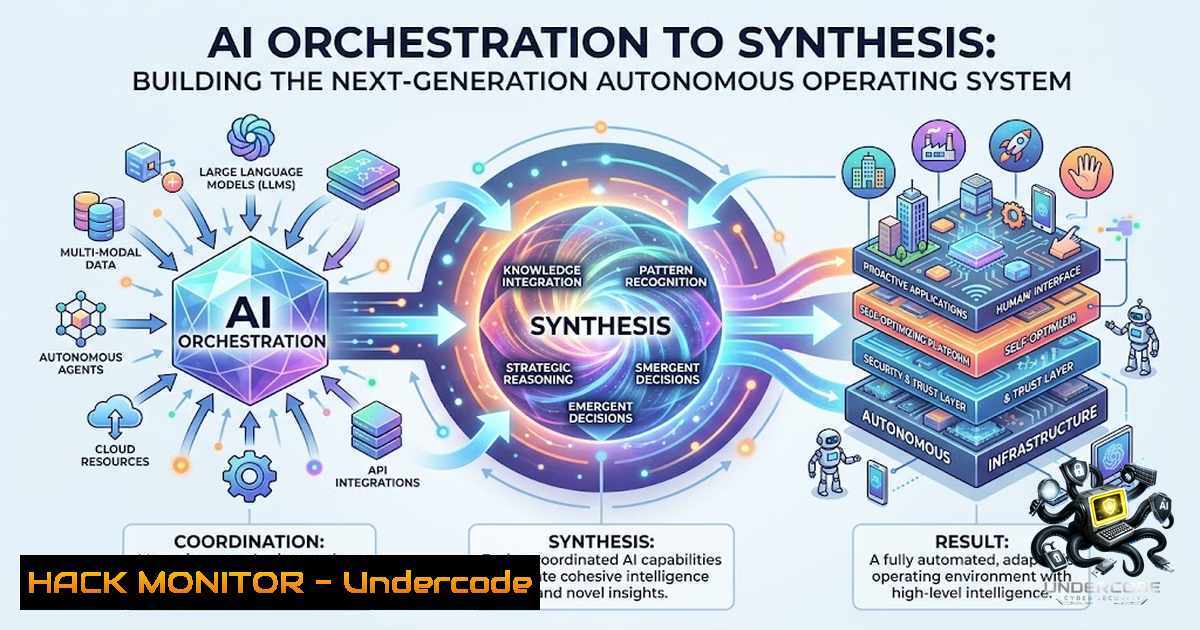
Introduction:
The current wave of AI integration has moved beyond simple model invocation and API chaining; we are entering the era of “synthesis.” This paradigm shift involves weaving Large Language Models (LLMs), autonomous agents, real-time data pipelines, and human workflows into a cohesive, self-optimizing operating system. For cybersecurity and IT professionals, this synthesis represents a double-edged sword: it enables unprecedented automation of defense mechanisms while introducing complex attack surfaces where system-wide vulnerabilities can cascade across integrated components.
Learning Objectives & Secrets:
- Objective 1: Architecting a Synthesized Control Plane. Learn to move from linear orchestration (Do A, then B) to a dynamic, event-driven mesh where AI agents negotiate tasks and allocate resources based on real-time telemetry.
- Objective 2 Secret Tips: Implement “feedback injection” loops where the output of one agent (e.g., a vulnerability scanner) directly modifies the system prompt of another agent (e.g., a patch management AI) without human intervention, creating a closed-loop remediation system.
- Objective 3 Secret Tips: Secure the “synthesis glue” by enforcing mutual TLS (mTLS) and short-lived JWT tokens between every agent and API endpoint. Treat the orchestrator as a zero-trust broker, not a trusted insider.
You Should Know:
- Designing the Synthesized Agent Mesh with LangChain and AutoGen
The core of synthesis lies in moving from Directed Acyclic Graphs (DAGs) of tasks to a dynamic mesh of conversational agents. Unlike simple orchestration where a central coordinator dictates steps, a synthesized system allows agents to “talk” to each other to solve problems.
Step‑by‑step guide:
- Setup: Install the required Python libraries:
pip install langchain autogen pyyaml requests. - Define Agent Roles: Create a “Manager” agent, a “Security Analyst” agent, and a “Remediation” agent. The Manager interprets high-level goals.
- Implement Group Chat: Use AutoGen’s `GroupChat` to allow agents to converse. The Manager must be set to `speaker_selection_method=”round_robin”` for structured debates or `”auto”` for dynamic flow.
- Tool Binding: Equip the Security Analyst with a tool to query the NVD (National Vulnerability Database) API.
- Command Example (Linux): To simulate the environment variable setup for API keys:
export NVD_API_KEY="your_key_here". - Command Example (Windows PowerShell):
$env:NVD_API_KEY="your_key_here". - Code Snippet (Tool Definition):
from langchain.tools import tool
import requests</li>
</ul>

@tool
def query_nvd(cpe: str) -> str:
"""Fetches CVEs for a given CPE string."""
response = requests.get(f"https://services.nvd.nist.gov/rest/json/cves/2.0?cpeName={cpe}")
return response.text
This setup transforms a static API call into a dynamic capability that agents can “discover” and use based on context.
- Implementing API Security and Gateway Hardening for Agent Communication
In a synthesized OS, APIs are the nervous system. Securing these endpoints against prompt injection and data leakage is critical, especially when agents have access to internal databases.
Step‑by‑step guide:
- Gateway Setup: Deploy Kong or KrakenD as an API gateway in front of all internal AI services.
- Plugin Configuration: Enable the “Rate Limiting” and “JWT” plugins. Ensure the JWT plugin is configured to reject tokens without the `aud` (audience) claim to prevent token reuse across different agent roles.
- Input Validation: Implement a middleware that scans incoming agent prompts for SQL injection or command injection patterns before they reach the LLM. While LLMs understand context, parsing them through a regex firewall for system commands is a defensive layer.
- Windows Configuration (IIS URL Rewrite): If hosting on Windows, add a rule to block requests containing `{` or `}` in query strings to prevent basic prompt injection attempts.
- Linux Command (Nginx Rate Limit): Add to the Nginx config: `limit_req_zone $binary_remote_addr zone=mylimit:10m rate=10r/s;` to prevent DDoS via agent flooding.
- Tutorial: Use `openssl` to generate a strong secret for JWT:
openssl rand -base64 32. Store this in a secure vault (e.g., HashiCorp Vault) and inject it into the gateway container via environment variables.
- Cloud Hardening: Securing the Data Lake and Vector Databases
Synthesis relies heavily on Retrieval-Augmented Generation (RAG). The vector database storing sensitive company data is a prime target. Hardening this involves network segmentation and encryption.
Step‑by‑step guide:
- Network Policies: In Kubernetes, apply a NetworkPolicy that denies ingress/egress to the vector database (e.g., Pinecone, Milvus) except from the specific agent service account.
- Encryption: Enable client-side encryption for vector embeddings before they leave the application server.
- Audit Logging: Enable full audit trails on the database. Use `gcloud logging` or `aws cloudtrail` to monitor for anomalous `SELECT` queries that retrieve massive chunks of data.
- Command (AWS CLI): `aws rds describe-db-instances –query ‘DBInstances[].DBInstanceIdentifier’` to list databases and ensure they are encrypted via the `–storage-encrypted` flag.
- Linux Command: Monitor network connections to the DB using `netstat -antp | grep 5432` (for PostgreSQL) to identify unauthorized IPs attempting to access the vector storage.
- Vulnerability Exploitation & Mitigation: The “Agent Sprawl” Risk
As we deploy more agents, we increase the “blast radius” of a compromised agent. If a user exploits a prompt injection to make a “Remediation Agent” execute malicious code, the entire OS is compromised.
Step‑by‑step guide (Penetration Testing Focus):
- Exploitation Simulation: Use a tool like `metasploit` (specifically the `auxiliary/scanner/http/open_proxy` module) to test if the orchestrator endpoint allows arbitrary command forwarding.
- Mitigation – Sandboxing: Run each agent in a Docker container with a read-only root filesystem. Command:
docker run --read-only --tmpfs /tmp my-agent-image. - Mitigation – Principle of Least Privilege: Ensure the Service Account for the “Remediation Agent” only has permissions to write to a specific S3 bucket, not delete EC2 instances. Use AWS IAM policy checks:
aws iam simulate-principal-policy --policy-source-arn arn:aws:iam::account-id:role/remediation-role. - Monitoring: Set up alerts in your SIEM for any agent-to-agent communication that occurs outside the defined “whitelisted” peer channels.
- Integrating Human-in-the-Loop (HITL) as a Security Circuit Breaker
Synthesis is not total automation. The human role shifts to a “supervisor” reviewing high-risk decisions. This interface must be secure to prevent bypass attacks.
Step‑by‑step guide:
- Webhook Setup: Configure the Orchestrator to call a webhook endpoint that is guarded by a UI requiring human MFA approval (e.g., Okta Verified Push) before a high-severity command is executed.
- Timeout Logic: If the human does not approve within 5 minutes, the system should automatically rollback the proposed changes to a known-good state.
- Command (Linux – Cron Job for Rollback): Schedule a cron job that checks for pending approvals and triggers a Git repository rollback script if the approval timestamp is older than 5 minutes.
- Code Snippet (Approval Check):
if time.time() - approval_timestamp > 300:
os.system("bash rollback_terraform.sh")
This ensures that even if the human is under a DoS attack, the infrastructure self-heals.
- Real-Time Monitoring and Log Aggregation with ELK and OpenTelemetry
To understand a synthesized system, you need to trace the “thought” process of the agents.
Step‑by‑step guide:
- Instrumentation: Use OpenTelemetry to add spans to each agent’s function call. Propagate a `trace_id` through the HTTP headers of all API calls.
- Centralization: Set up an ELK stack (Elasticsearch, Logstash, Kibana) to ingest these traces.
- Kibana Dashboard: Create a dashboard showing the latency of the “Reasoning” vs. “Tool Calling” phases.
- Linux Command (Logstash config test):
/usr/share/logstash/bin/logstash -t -f /etc/logstash/conf.d/agents.conf. - Windows Command: If using Windows Event Viewer, use `wevtutil qe System /c:3 /rd:true /f:Text` to check system logs, but redirect agent logs to a dedicated drive to avoid filling the OS disk.
- Disaster Recovery for AI State (Model Drift and Hallucination)
A synthesized system can “drift” if the underlying models change or if the context window fills with corrupt data.
Step‑by‑step guide:
- Pinning Models: Use specific model versions (e.g.,
gpt-4-0613) instead of `gpt-4-latest` in your orchestration YAML files. - Context Cleaning: Implement a function that clears the agent memory (clears the
agent.memory.chat_history) every 24 hours or after a specific number of tokens to prevent context poisoning. - Database Backup: Regularly backup the Vector Database using the `aws s3 sync` command to a cold storage bucket for recovery in case of a “rogue agent” deleting entries.
- Docker Compose Rollback: Store your `docker-compose.yml` in a Git repo. If the system fails, run `git checkout
` and `docker-compose up -d` to revert the entire architecture to a stable version.
What Undercode Say:
- Key Takeaway 1: The transition from AI orchestration to synthesis requires a “Zero Trust” architecture for the agents themselves. Treat every API call between agents as an external request, even if they run on the same cluster.
- Key Takeaway 2: The “Secret Tip” of feedback loops is powerful but dangerous. A bug in the feedback mechanism can amplify a security hole exponentially. Always decouple the feedback channel and monitor it with anomaly detection algorithms to spot weird spikes in requests.
Prediction:
- +1: The synthesis model will lead to the rise of “Autonomous Security Champions” that can predict attacker movements based on integrated threat intelligence, allowing systems to self-patch before the CVE is publicly announced.
- -1: The complexity will lead to “Black Box” operations where human admins have no idea why an agent made a specific network change, leading to catastrophic misconfigurations and supply chain attacks.
- -1: Legacy security tools are not equipped to handle the GraphQL-like queries generated by agent-to-agent synthesis. We will see a spike in API-related breaches before “Secure by Design” synthesizers become the norm.
▶️ Related Video (88% Match):
🎯Let’s Practice For Free:
🎓 Live Courses & Certifications:
Join Undercode Academy for Verified Certifications
🚀 Request a Custom Project:
Secure, high-velocity infrastructure and disruptive technological engineering. Contact our engineering team for high-tier development and proprietary systems:
[email protected]
💎 Smart Architecture | 🛡️ Secure by Design | ⭐ Trusted by ThousandsIT/Security Reporter URL:
Reported By: https://lnkd.in/p/eDshkN4F – Hackers Feeds
Extra Hub: Undercode MoN
Basic Verification: Pass ✅🔐JOIN OUR CYBER WORLD [ CVE News • HackMonitor • UndercodeNews ]
📢 Follow UndercodeTesting & Stay Tuned:


