Listen to this Post
Introduction:
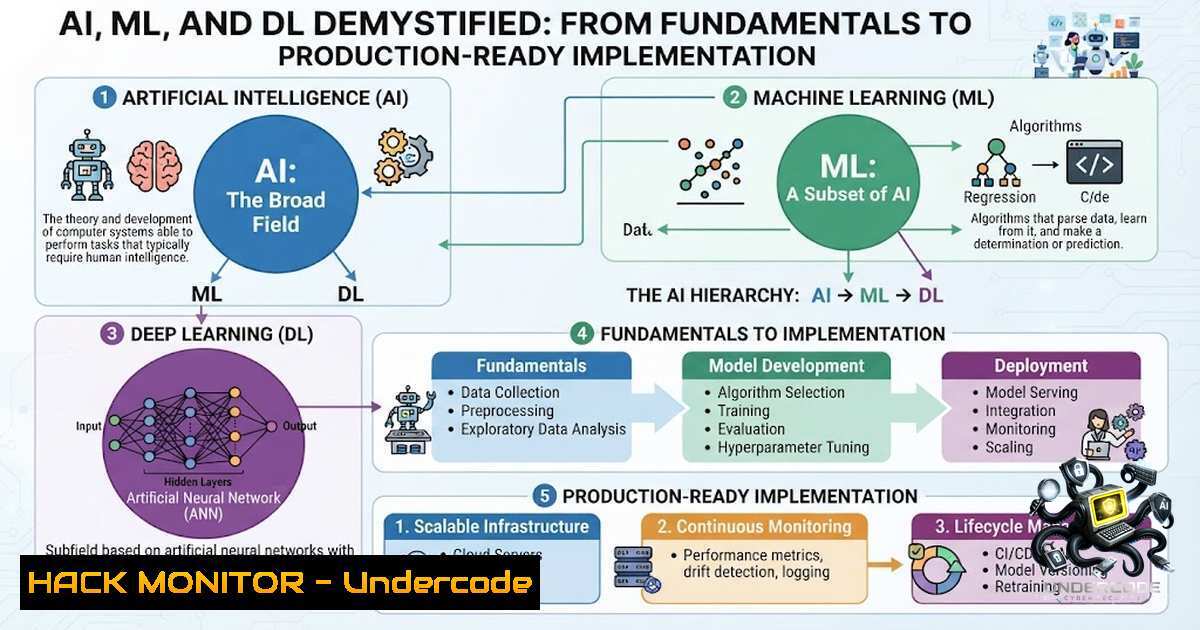
The terms Artificial Intelligence (AI), Machine Learning (ML), and Deep Learning (DL) are frequently used interchangeably in casual conversation, yet they represent a distinct hierarchy of technological sophistication. AI is the overarching science of mimicking human cognition, ML is the data-driven engine that enables systems to learn without explicit programming, and DL is the neural-1etwork-powered subset that autonomously extracts complex features from raw data. Understanding this taxonomy is not merely academic—it is foundational for any professional aiming to build, deploy, or secure intelligent systems in today’s cybersecurity and IT landscape.
Learning Objectives:
- Differentiate between AI, ML, and DL with clear real-world examples and understand their hierarchical relationship.
- Set up a production-ready Python environment for machine learning and deep learning on Linux and Windows.
- Install and validate core frameworks like TensorFlow and PyTorch, including GPU-accelerated configurations.
- Implement a basic neural network and understand the operational commands required for training and inference.
You Should Know:
- The Intelligence Hierarchy: AI → ML → DL
Artificial Intelligence is the broadest category, encompassing any technique that enables machines to mimic human intelligence, from simple rule-based chatbots to advanced autonomous systems. Machine Learning is a subset of AI where algorithms learn patterns from data rather than following explicitly programmed rules. Deep Learning, in turn, is a specialized subset of ML that uses artificial neural networks with multiple layers (hence “deep”) to automatically discover intricate structures in large datasets.
For example, a rule-based chatbot that responds to specific keywords is AI but not ML. Netflix’s recommendation engine, which learns from your viewing history, is ML. ChatGPT, Gemini, and Claude are powered by Large Language Models (LLMs) built on Deep Learning architectures. This hierarchy is critical for cybersecurity professionals: rule-based AI is easier to audit but brittle, while DL models offer superior pattern recognition (e.g., in malware detection) but introduce opaque decision-making that complicates threat hunting and compliance.
- Setting Up Your Machine Learning Environment (Linux & Windows)
Before diving into model development, you need a clean, isolated Python environment. This prevents dependency conflicts between projects—a common headache in data science.
Step-by-Step Guide:
Step 1: Verify Python Installation
Open your terminal (Linux/macOS) or Command Prompt/PowerShell (Windows). Check if Python 3.8+ is installed:
python --version
or
python3 --version
If not installed, download it from python.org or use your package manager (e.g., `sudo apt install python3-pip` on Ubuntu).
Step 2: Create a Virtual Environment
Navigate to your project directory and create a virtual environment:
python3 -m venv ml-env
This command creates a folder named `ml-env` containing an isolated Python installation.
Step 3: Activate the Virtual Environment
- Linux/macOS:
source ml-env/bin/activate
- Windows (Command Prompt):
ml-env\Scripts\activate
- Windows (PowerShell):
.\ml-env\Scripts\Activate.ps1
Your terminal prompt should now show `(ml-env)` indicating the environment is active.
Step 4: Upgrade pip and Install Core Libraries
With the virtual environment active, upgrade pip and install foundational libraries:
pip install --upgrade pip
pip install numpy pandas matplotlib scikit-learn jupyter
These libraries provide the building blocks for data manipulation, visualization, and classical ML algorithms.
3. Installing Deep Learning Frameworks: TensorFlow and PyTorch
Deep learning requires specialized frameworks that can leverage GPUs for accelerated computation. Below are verified installation commands for both CPU and GPU configurations.
TensorFlow Installation:
- CPU-only version (works on any system):
pip install tensorflow
- GPU-enabled version (requires NVIDIA drivers and CUDA):
pip install tensorflow[and-cuda]
Note: Ensure your CUDA version matches the TensorFlow version requirements.
PyTorch Installation:
Visit pytorch.org to get the correct command for your system. For a CPU-only installation:
pip install torch torchvision torchaudio --index-url https://download.pytorch.org/whl/cpu
For CUDA 11.8 (GPU):
pip install torch torchvision torchaudio --index-url https://download.pytorch.org/whl/cu118
For CUDA 12.1:
pip install torch torchvision torchaudio --index-url https://download.pytorch.org/whl/cu121
Verifying Installation:
Run the following Python commands to confirm each framework is working:
import tensorflow as tf
print("TensorFlow version:", tf.<strong>version</strong>)
print("GPU Available:", tf.config.list_physical_devices('GPU'))

import torch
print("PyTorch version:", torch.<strong>version</strong>)
print("CUDA Available:", torch.cuda.is_available())
4. Building Your First Neural Network (Command-Line Approach)
You can train a simple neural network without a Jupyter notebook by using a Python script. Create a file named `train.py` with the following content:
import numpy as np
import tensorflow as tf
from tensorflow import keras

Generate synthetic data
X = np.random.random((1000, 20))
y = np.random.randint(2, size=(1000, 1))

Build a simple model
model = keras.Sequential([
keras.layers.Dense(64, activation='relu', input_shape=(20,)),
keras.layers.Dense(64, activation='relu'),
keras.layers.Dense(1, activation='sigmoid')
])

model.compile(optimizer='adam', loss='binary_crossentropy', metrics=['accuracy'])
model.fit(X, y, epochs=10, batch_size=32)
model.save('my_first_model.h5')
print("Model training complete and saved as my_first_model.h5")
Run the script from the terminal:
python train.py
This command will train a binary classifier and save the trained model.
5. Essential Linux Commands for AI/ML Workflows
Beyond Python, several Linux commands are indispensable for managing datasets, monitoring system resources, and automating training pipelines:
- Check GPU status (NVIDIA):
nvidia-smi
Displays GPU utilization, memory usage, and running processes.
- Monitor system resources in real-time:
htop
(Install with `sudo apt install htop` on Ubuntu)
- Compress and archive large datasets:
tar -czvf dataset.tar.gz ./data_folder
-
Download datasets from the command line:
wget https://example.com/dataset.zip
unzip dataset.zip -d ./data
-
Run a Jupyter notebook server on a specific port:
jupyter notebook --port=8888 --1o-browser --ip=0.0.0.0
This is useful for remote development on cloud instances.
6. Windows-Specific Commands and Tools
For Windows users, the Windows Subsystem for Linux (WSL) is highly recommended for AI/ML development as it provides a native Linux environment. However, native Windows commands are also available:
- Check Python version:
python --version
-
List installed packages:
pip list
-
Create a requirements file:
pip freeze > requirements.txt
-
Install all dependencies from a requirements file:
pip install -r requirements.txt
-
Set environment variables (useful for configuring TensorFlow):
set TF_CPP_MIN_LOG_LEVEL=2
This suppresses verbose logging messages.
7. Security Considerations in AI/ML Pipelines
From a cybersecurity perspective, AI/ML pipelines introduce unique attack surfaces:
– Model Poisoning: Adversaries can inject malicious data during training to corrupt model behavior. Always validate and sanitize training data.
– Model Inversion: Attackers can reconstruct training data from model outputs. Implement differential privacy techniques.
– Adversarial Attacks: Small perturbations to input data can cause misclassification. Use adversarial training and input validation.
– Supply Chain Risks: Third-party libraries (e.g., TensorFlow, PyTorch) can contain vulnerabilities. Regularly update dependencies and scan for known CVEs using tools like `safety` or bandit.
– API Security: When deploying models as REST APIs, enforce authentication, rate limiting, and input size restrictions to prevent denial-of-service attacks.
What Undercode Say:
- Key Takeaway 1: The AI-ML-DL hierarchy is not just semantic—it dictates the complexity of implementation, the volume of data required, and the interpretability of the resulting system. Rule-based AI is transparent but inflexible; ML offers data-driven adaptability; DL provides state-of-the-art performance at the cost of opacity and computational expense.
- Key Takeaway 2: A solid understanding of environment setup, framework installation, and basic model training is the minimum viable skill set for any aspiring AI engineer. Mastery of these fundamentals enables professionals to move beyond theoretical knowledge and build production-grade systems that can be integrated into real-world cybersecurity and IT infrastructures.
Analysis: The LinkedIn post by sravani Dommeti serves as an excellent primer for beginners, but the real value lies in translating that conceptual knowledge into actionable technical skills. The distinction between AI, ML, and DL is often glossed over in introductory materials, yet it has profound implications for system design, resource allocation, and security posture. For instance, choosing DL over traditional ML for a threat detection system means committing to large-scale GPU infrastructure, extensive labeled datasets, and a more complex validation pipeline—trade-offs that must be justified by the performance gains. Furthermore, the rise of Generative AI and LLMs, built on DL architectures, is reshaping the cybersecurity landscape, enabling both sophisticated defense mechanisms and novel attack vectors. Professionals who can navigate this hierarchy—from conceptual understanding to hands-on implementation—will be uniquely positioned to lead in this evolving field.
Prediction:
- +1 The democratization of AI/ML tools and cloud-based GPU instances will continue to lower the barrier to entry, enabling a new wave of cybersecurity innovations in automated threat hunting, anomaly detection, and incident response.
- +1 As LLMs and Generative AI mature, we will see a convergence of NLP and cybersecurity, with AI-powered assistants becoming standard tools for security analysts, drastically reducing mean time to detection (MTTD) and response (MTTR).
- -1 The increasing complexity and opacity of DL models will exacerbate the “black box” problem in security, making it harder to audit AI-driven decisions and comply with emerging regulations around algorithmic accountability and data privacy.
- -1 Adversarial AI will evolve into a primary attack vector, with threat actors using generative models to craft highly convincing phishing campaigns, bypass biometric authentication, and manipulate ML-based security controls. Defensive AI must continuously adapt to counter these threats.
- +1 The integration of AI/ML into DevSecOps pipelines will become standard practice, with automated model retraining and continuous monitoring ensuring that security models remain effective against evolving threats.
- -1 The skills gap in AI/ML security will widen, creating a critical shortage of professionals who understand both the technical implementation and the security implications of intelligent systems.
- +1 Open-source frameworks and community-driven repositories (e.g., GitHub, Hugging Face) will continue to accelerate innovation, but they will also introduce supply chain risks that require vigilant dependency management and security auditing.
▶️ Related Video (88% Match):
🎯Let’s Practice For Free:
🎓 Live Courses & Certifications:
Join Undercode Academy for Verified Certifications
🚀 Request a Custom Project:
Secure, high-velocity infrastructure and disruptive technological engineering. Contact our engineering team for high-tier development and proprietary systems:
[email protected]
💎 Smart Architecture | 🛡️ Secure by Design | ⭐ Trusted by Thousands
IT/Security Reporter URL:
Reported By: Sravani Dommeti – Hackers Feeds
Extra Hub: Undercode MoN
Basic Verification: Pass ✅


