
Listen to this Post
Introduction:
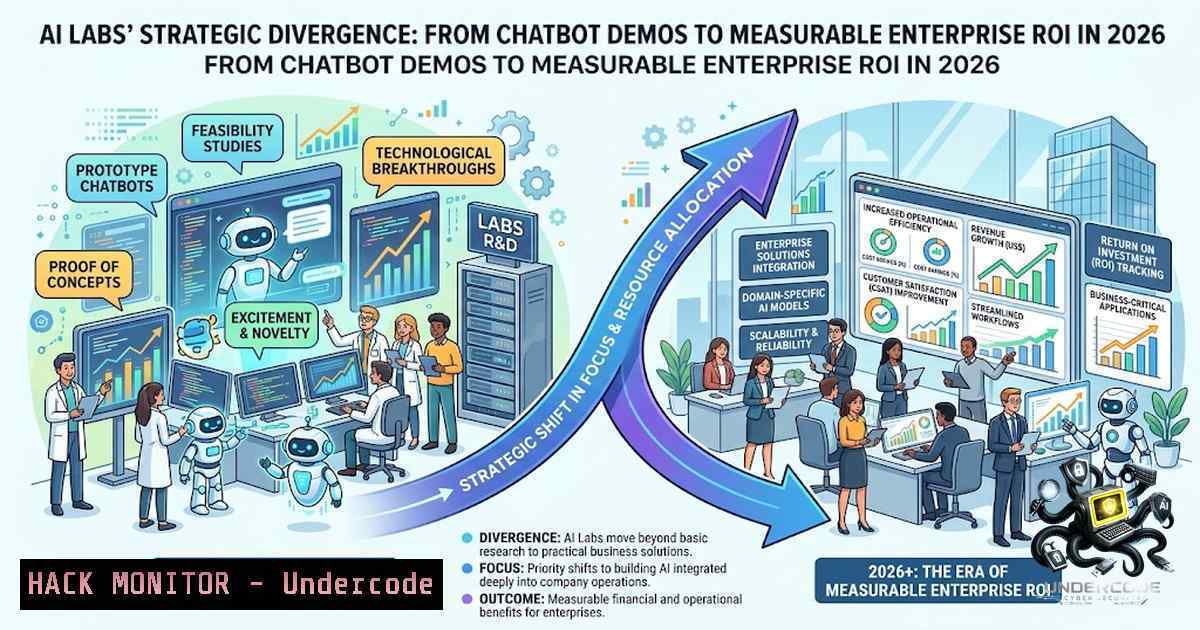
The enterprise AI landscape has reached a pivotal inflection point in 2026, where the era of impressive chatbot demonstrations is decisively giving way to a demand for quantifiable business outcomes. As major AI labs like OpenAI, Google, and Anthropic pivot towards distinct strategic philosophies, organizations are increasingly shifting their focus from benchmark scores to concrete return on investment (ROI). This evolution necessitates a robust technical framework for evaluating, deploying, and securing AI systems, ensuring they deliver verifiable value rather than just “clever answers.”
Learning Objectives & Secrets:
- Objective 1: Master ROI-Driven AI Evaluation. Learn to move beyond model performance metrics and implement a framework for measuring the tangible business impact of AI deployments, including cost savings, revenue generation, and operational efficiency gains.
- Objective 2 Secret Tips: Strategic Model Selection. Secret: The optimal AI model is not always the one with the highest benchmark score. Tailor your choice to your specific use case—OpenAI’s GPT-5.5 Omni for multimodal interaction, Google’s Gemini 2.0 Pro for complex logical reasoning, or Anthropic’s Claude 3.1 for high-stakes reliability and transparency.
- Objective 3 Secret Tips: Compliance-First Implementation. Secret: Treat regulatory compliance (like the EU AI Act) as a core product feature, not an afterthought. Integrate automated documentation, risk assessment, and data governance into your CI/CD pipeline from the start to avoid costly penalties and ensure auditability.
You Should Know:
1. Model Capabilities and Strategic Divergence
The “big labs” are no longer competing on a single axis of scale. Instead, they are carving out distinct technological niches. OpenAI’s GPT-5.5 Omni focuses on real-time multimodal interaction, capable of processing live video and audio simultaneously for applications like real-time coaching. Google’s Gemini 2.0 Pro emphasizes high-fidelity professional applications, integrating with systems like Project Starline for immersive telepresence. Anthropic’s Claude 3.1 family prioritizes “reasoning transparency” and chain-of-thought fidelity, making it ideal for sectors like law and finance where explainability is paramount. Understanding these differentiators is the first step towards a successful AI strategy.
Step‑by‑step guide to evaluate model fit:
- Define Your Use Case: Clearly articulate the business problem you are solving (e.g., customer service automation, financial fraud detection, supply chain optimization).
- Map Requirements to Model Strengths: Match your needs to the model’s specialization. For a task requiring high reliability and auditability, Anthropic’s Claude 3.1 is a strong candidate. For a dynamic, interactive application, OpenAI’s GPT-5.5 Omni may be more suitable.
- Pilot with a Clear ROI Metric: Before full deployment, run a pilot program where you track a specific, quantifiable metric (e.g., reduction in average handling time, increase in fraud detection rate).
- Benchmark Against Alternatives: Test your chosen model against a competitor’s offering on your specific dataset and use case to ensure optimal performance.
-
Enterprise Adoption: From General APIs to Vertical Solutions
The enterprise market is maturing, moving from general-purpose chatbots to deeply integrated, vertical-specific solutions. Anthropic has seen significant uptake of its “Claude 3.1 Guardian” model in financial services for compliance monitoring and regulatory reporting (MiFID II). OpenAI is embedding GPT-5.5 Omni into automotive infotainment systems, while Google integrates Gemini 2.0 into Vertex AI for supply chain optimization, achieving a 15% improvement in logistical bottleneck prediction.
Step‑by‑step guide to vertical integration:
- Identify Core Business Workflow: Pinpoint a specific, high-value workflow where AI can have an immediate impact.
- Select a Vertically-Tuned Model: Choose a model variant fine-tuned for your industry (e.g., Claude 3.1 Guardian for finance).
- Integrate via API: Use the provider’s API to connect the model to your existing systems. For example, use `curl` to test an API endpoint:
curl -X POST https://api.anthropic.com/v1/messages \ -H "x-api-key: YOUR_API_KEY" \ -H "anthropic-version: 2023-06-01" \ -H "content-type: application/json" \ -d '{ "model": "claude-3-opus-20240229", "max_tokens": 1024, "messages": [{"role": "user", "content": "Analyze this compliance document for MiFID II violations."}] }' - Monitor and Optimize: Continuously monitor the model’s performance and fine-tune its parameters to improve accuracy and relevance.
3. The Hardware and Compute Chessboard
The immense computational power required for frontier AI is a critical battleground. Google’s TPU v7 offers a 40% improvement in performance-per-watt for training large models. OpenAI, with Microsoft, is building a new supercomputing facility in Northern Europe for models beyond GPT-5.5. Anthropic employs a multi-cloud strategy with AWS, Google Cloud, and a new partnership with Oracle Cloud Infrastructure (OCI) for specific research workloads, allowing for compute cost arbitrage.
Step‑by‑step guide to optimizing cloud compute for AI workloads:
1. Assess Workload Requirements: Determine if your workload is for training (requires high-performance GPUs/TPUs) or inference (may benefit from more cost-effective options).
2. Choose the Right Instance: On AWS, use `p4d` or `p5` instances for training. On Google Cloud, leverage TPU v7 VMs. On Azure, use NDv5 series VMs.
3. Implement Spot/Preemptible Instances: For fault-tolerant, stateless workloads, use spot instances to significantly reduce costs.
 Example: Request a spot instance on AWS CLI
aws ec2 request-spot-instances \
--instance-count 1 \
--type "one-time" \
--launch-specification file://specification.json
4. Monitor Utilization: Use cloud monitoring tools (CloudWatch, Stackdriver) to track GPU/TPU utilization and adjust instance types or autoscaling policies accordingly.
4. Navigating the New Regulatory Gauntlet
With the EU AI Act now fully enforceable, compliance is a core operational cost. All three labs have expanded their compliance teams and dedicated resources to automated documentation, risk assessment, and data governance. Anthropic markets its Constitutional AI framework as a solution for meeting the Act’s fairness and risk mitigation requirements.
Step‑by‑step guide to implementing AI compliance:
- Understand the Regulations: Familiarize yourself with the EU AI Act and other relevant frameworks (e.g., NIST AI RMF).
- Implement Automated Documentation: Use tools to automatically generate “Model Cards” and data transparency reports.
- Conduct Regular Red-Teaming: Perform internal and external red-teaming exercises to identify vulnerabilities and biases. Use open-source toolkits like Google’s “Sentinel” to autonomously discover security flaws.
- Establish a Governance Framework: Create a cross-functional team (legal, compliance, engineering) to oversee AI deployments and ensure ongoing adherence to regulations.
5. Safety and Alignment: A Widening Methodological Chasm
The three labs are diverging in their approach to AI safety. Anthropic’s research on “Corrigible Scaling” focuses on maintaining human oversight as model intelligence grows. OpenAI’s Superalignment division is working on using smaller models to supervise larger ones. Google has open-sourced its “Sentinel” red-teaming toolkit.
Step‑by‑step guide to implementing AI safety measures:
- Implement Red-Teaming: Use tools like Google’s Sentinel to proactively test your models for vulnerabilities.
Hypothetical command to run Sentinel
sentinel scan --model your_model_name --output report.json
- Establish Human Oversight: For high-stakes applications, ensure a human-in-the-loop for critical decisions.
- Monitor for Drift: Continuously monitor model performance and behavior for drift or degradation over time.
- Document All Safety Measures: Maintain detailed documentation of all safety protocols, tests, and results for audit purposes.
What Undercode Say:
- Key Takeaway 1: The era of being impressed by AI “tricks” is over. Business leaders are demanding hard numbers that demonstrate ROI, shifting the conversation from “look what it can do” to “here’s what it returned.”
- Key Takeaway 2: Strategic divergence among AI labs means there is no single “best” model. Success depends on matching the right model’s unique strengths (multimodality, reasoning, reliability) to your specific business needs and risk tolerance.
Analysis: The AI industry is undergoing a necessary maturation. The focus is shifting from raw capability to practical, measurable value. This requires organizations to develop a sophisticated understanding of different AI models, their strengths and weaknesses, and how to integrate them securely and compliantly into their workflows. The ability to quantify ROI, navigate complex regulations, and ensure safety will be the defining factors of successful AI adoption. The labs that can best demonstrate tangible business outcomes, rather than just impressive demos, will win the enterprise market.
Prediction:
- +1: The push for measurable ROI will accelerate the development of specialized, industry-specific AI solutions, leading to more efficient and effective tools for sectors like finance, healthcare, and logistics.
- +1: Increased focus on compliance and safety will lead to more robust, trustworthy AI systems, fostering greater public and corporate confidence in the technology.
- -1: The high cost of compliance and the need for specialized expertise may create a barrier to entry for smaller companies, potentially widening the AI adoption gap between large enterprises and SMBs.
- -1: The strategic divergence among labs could lead to a fragmented AI ecosystem, making it more challenging for organizations to choose and integrate the right tools, potentially slowing down overall adoption.
- +1: The development of open-source safety toolkits like Google’s Sentinel will democratize AI security, allowing a wider range of developers to build safer and more reliable AI applications.
▶️ Related Video (82% Match):
🎯Let’s Practice For Free:
🎓 Live Courses & Certifications:
Join Undercode Academy for Verified Certifications
🚀 Request a Custom Project:
Secure, high-velocity infrastructure and disruptive technological engineering. Contact our engineering team for high-tier development and proprietary systems:
[email protected]
💎 Smart Architecture | 🛡️ Secure by Design | ⭐ Trusted by Thousands
IT/Security Reporter URL:
Reported By: https://lnkd.in/p/eFywXzTt – Hackers Feeds
Extra Hub: Undercode MoN
Basic Verification: Pass ✅


