Listen to this Post
Introduction:
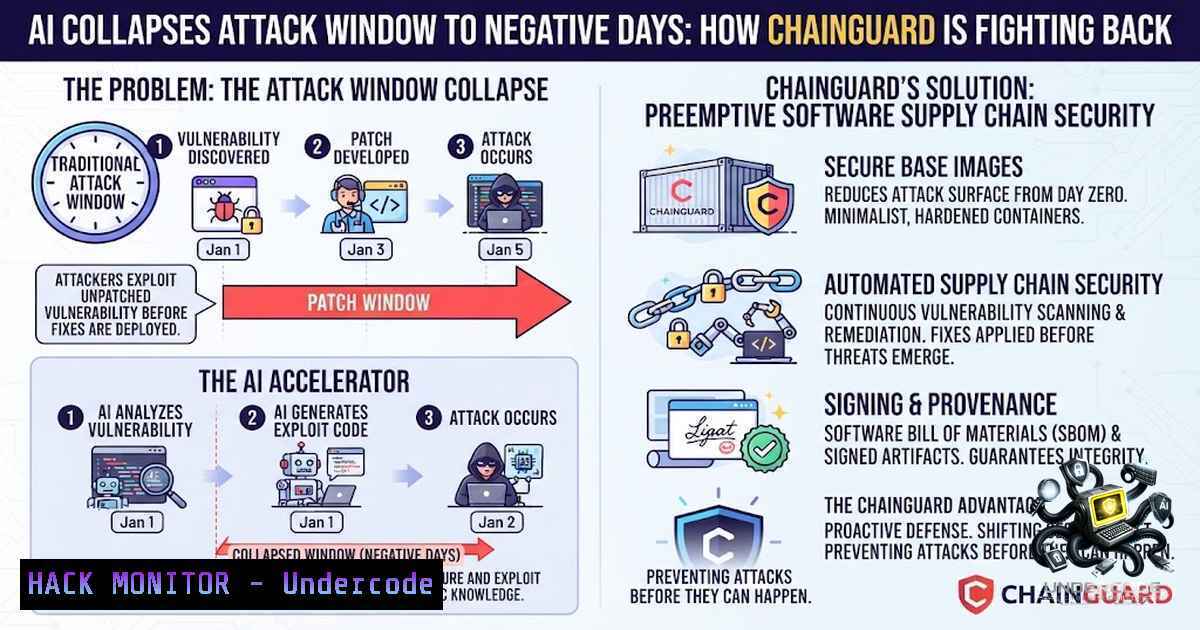
The software supply chain has entered a new era of risk. Frontier AI models can now discover novel, chained zero-day vulnerabilities in open source software at machine speed — flaws that survived decades of expert review and evaded automated fuzzers run over five million times. The mean time to exploit a CVE has gone from 63 days in 2018 to -7 days in 2025, meaning active exploits now arrive before patches are even available. In response, Chainguard’s AI Readiness Innovation Week delivered a comprehensive suite of tools across containers, libraries, CI/CD pipelines, AI agent skills, and a new industry coalition designed to secure the entire software development lifecycle against AI-powered threats.
Learning Objectives:
- Understand how AI-driven vulnerability discovery has collapsed traditional disclosure timelines and what that means for your organization
- Learn to implement hardened GitHub Actions, container images, and language libraries as drop-in replacements for vulnerable dependencies
- Master the configuration of Chainguard’s security tools across Linux and Windows environments to automate CVE remediation and supply chain protection
- Chainguard Actions: Hardening CI/CD Pipelines Against Supply Chain Attacks
GitHub Actions have become the backbone of modern CI/CD — and the most privileged attack surface in your infrastructure. They have access to source code, tokens, cloud credentials, and release infrastructure, making them ideal targets in an AI age where the cost of scaled malicious attacks has fallen dramatically. Recent attacks like the tj-actions/changed-files compromise exposed CI/CD secrets in workflow logs across 23,000+ repositories, while the Trivy action attack pulled credential-stealing malware from tags developers already trusted.
Chainguard Actions, now in open beta, provide the largest catalog of hardened, verified GitHub Actions with self-serve access to 500+ Actions, a one-day SLA for new requests, and an automated migration skill.
Step‑by‑step guide to implementing Chainguard Actions:
- Inventory your current Actions usage: Use the Chainguard Actions migration skill to scan your repositories and identify vulnerable Actions. Run:
Install the Chainguard CLI tool
curl -o chainctl https://dl.chainguard.dev/chainctl/latest/chainctl_linux_amd64
chmod +x chainctl
sudo mv chainctl /usr/local/bin/

Authenticate with your Chainguard account
chainctl auth login

Scan your GitHub organization for Actions usage
chainctl actions scan --org your-org-1ame --output inventory.json
-
Replace vulnerable Actions with hardened versions: In your workflow files (
.github/workflows/.yml), replace standard Actions with Chainguard’s hardened versions. For example:Before (vulnerable)</p></li> </ol> <p>- uses: actions/checkout@v3 After (hardened) - uses: chainguard/actions/checkout@v3
- Request new Actions with the one-day SLA: If a required Action isn’t in the catalog, submit a request through the Chainguard Console. The team will harden and verify it within one business day.
-
Verify and audit each Action: Each Chainguard Action comes with an auditable record of what vulnerabilities were found and removed, enabling your security team to prove compliance to auditors.
2. Chainguard Agent Skills: Securing AI Coding Assistants
With developers directing AI agents like Claude Code, Cursor, and GitHub Copilot to build, test, and deploy code at machine speed, every dependency an agent reaches for becomes a trust decision made with no human in the loop. Chainguard Agent Skills provide 1,000+ hardened agent skills that teach AI coding assistants to use secure practices — from scanning for secrets to walking developers through remediation.
Step‑by‑step guide to deploying Agent Skills:
- Access the Agent Skills registry: Navigate to the Chainguard Console and select “Agent Skills” from the navigation menu. Browse the catalog of 1,000+ pre-hardened skills.
-
Install skills for your AI assistant: For Claude Code, add skills to your project:
Clone the agent skills repository
git clone https://github.com/chainguard/agent-skills.git
cd agent-skills

Install a specific skill (e.g., secrets scanning)
./install-skill.sh secrets-scanner
-
Configure your IDE integration: For Cursor or VS Code with Copilot, install the Chainguard plugin available in the Cursor Marketplace:
// .cursor/settings.json { "chainguard.enabled": true, "chainguard.registry": "https://skills.chainguard.dev", "chainguard.auto_remediate": true } -
Create private skills for your team: Use the private registry to upload and manage your team’s own hardened agent skills, ensuring organization-specific security policies are enforced.
-
Chainguard Libraries for Java: CVE Remediation Without Major Upgrades
Ninety percent of the Fortune 500 rely on Java for core systems, yet the last release of Spring Boot 2.7 reached end of life in November 2023 with 143 CVEs across 79 projects — none of which have received patches. Teams are caught between accepting risk, spending hours backporting fixes themselves, or undertaking months-long major version upgrades.
Chainguard Libraries for Java, now generally available, introduces a fourth option: swap your vulnerable Java library for one that Chainguard has remediated via backported fixes. They’ve already backported remediations for dozens of CVEs across spring-boot, spring-framework, spring-security, and h2database.
Step‑by‑step guide to remediating Java CVEs:
- Add the Chainguard repository to your Maven
pom.xml:<repositories> <repository> <id>chainguard</id> <url>https://libraries.chainguard.dev/maven</url> </repository> </repositories>
-
Replace vulnerable dependencies with remediated versions: Instead of upgrading to a breaking new major version, simply reference the Chainguard-remediated version:
<dependency>
<groupId>org.springframework.boot</groupId>
<artifactId>spring-boot-starter-web</artifactId>
<!-- Chainguard-remediated version with backported CVE fixes -->
<version>2.7.18-chainguard.1</version>
</dependency>
-
Verify remediation in the Chainguard Console: Navigate to Libraries → Java → Remediated tab to see which versions have remediated CVEs.
-
Generate SBOM and provenance for compliance: Each remediated package comes with a signed SBOM and provenance, giving your team verifiable proof of the artifact’s integrity to auditors.
4. Chainguard Libraries for JavaScript: Malware‑Resistant Dependencies
The JavaScript ecosystem has been devastated by supply chain attacks. The Shai-Hulud self-replicating worm compromised at least 187 npm packages, including widely used libraries like debug, chalk, and ansi-styles — totaling over 2 billion weekly downloads. Malicious code is inserted during the build and distribution process, and detection is reactive, with remediation happening after the damage is done.
Chainguard Libraries for JavaScript provides malware-resistant dependencies built entirely from source on hardened SLSA L2 infrastructure, with full provenance and no change to existing developer workflows.
Step‑by‑step guide to securing JavaScript dependencies:
1. Configure npm to use the Chainguard registry:
 Set the Chainguard registry as the default
npm config set registry https://libraries.chainguard.dev/npm/

Or configure per-project in .npmrc
echo "registry=https://libraries.chainguard.dev/npm/" >> .npmrc
- Install packages with the Chainguard prefix: Chainguard Libraries are drop-in replacements that maintain the same API and version semantics:
Instead of npm install express
npm install @chainguard/express

Or use the chainguard-lib CLI tool for bulk migration
npx chainguard-lib migrate --package-lock package-lock.json
-
Integrate with existing artifact managers: Chainguard Libraries integrates with JFrog Artifactory and Sonatype Nexus, allowing your security team to enforce which packages are allowed to build.
-
Verify SBOMs and signatures: Each package comes with a complete SBOM and signed artifacts, enabling you to confirm that what you’re consuming is exactly what was built from verified source.
-
Chainguard Containers: Hardened Images That Fit Your Enterprise Stack
Chainguard Containers have been updated with new capabilities that make it easier to run hardened images in existing enterprise environments — from RHEL-based pipelines to FIPS requirements to compliance tooling. New features include first-party RPM support for RHEL 9 and RHEL 10 (in preview), a CMVP-validated Go Geomys FIPS image, Dependabot support for private cgr.dev registries, and flattened CycloneDX SBOMs.
Step‑by‑step guide to deploying hardened containers:
1. Pull a Chainguard container image:
 Standard image (minimal, zero CVEs)
docker pull cgr.dev/chainguard/nginx:latest

FIPS-compliant image for regulated workloads
docker pull cgr.dev/chainguard/go-geomys:latest-fips

RHEL-compatible image with RPM metadata
docker pull cgr.dev/chainguard/rhel-compat:9
2. Scan for vulnerabilities before deployment:
 Use Grype to verify zero CVEs
grype cgr.dev/chainguard/nginx:latest

Generate a CycloneDX SBOM
chainctl images sbom cgr.dev/chainguard/nginx:latest --format cyclonedx
- Configure Dependabot for private registries: Add your Chainguard registry to Dependabot configuration:
.github/dependabot.yml version: 2 registries: chainguard: type: docker-registry url: https://cgr.dev username: ${{secrets.CHAINGUARD_USERNAME}} password: ${{secrets.CHAINGUARD_TOKEN}} updates:</li> </ol> - package-ecosystem: docker directory: / registries: - chainguard- Enforce policy controls: Block images that have reached end of life, restrict pulls to images with long-term support, and set cool-downs that delay access to new versions.
6. Athena: The Industry Coalition for AI‑Discovered Vulnerabilities
When frontier AI models can find critical vulnerabilities in hours, the traditional coordinated disclosure model — built for a world where finding a serious flaw took weeks — is no longer sufficient. Athena is an industry coalition that pools vulnerability findings from across the industry and takes each one through its full lifecycle: clearinghouse functions, pre-embargo remediation, continuous reconciliation, platform and network mitigations, and upstream disclosure.
Athena already includes more than two dozen members, has processed over 20,000 security findings, generated more than 2,000 patches, and contributed to over 500 open source projects. Members gain access to private hardened builds through Chainguard Libraries before vulnerabilities are publicly disclosed.
Step‑by‑step guide to participating in Athena:
- Submit findings through the encrypted portal: Organizations submit pre-disclosure vulnerability findings. Each submitter decides what is shared, with whom, and on what embargo timeline.
-
Access private hardened builds: As an Athena member, you gain early access to Chainguard Libraries with backported fixes before public disclosure.
-
Deploy network and platform mitigations: Partners push non-patch mitigations ahead of disclosure — detection signatures, traffic-level rules, and platform-side blocks that blunt exploitation where a patch isn’t yet available.
-
Contribute to the maintainer-of-last-resort program: Chainguard is working with the Linux Foundation on a coordinated Security Incident Response Team (SIRT) for open source and a maintainer-of-last-resort program that keeps critical projects supported even when upstream teams can’t move fast enough.
What Undercode Say:
-
Key Takeaway 1: The AI-driven acceleration of vulnerability discovery has fundamentally broken the traditional disclosure model. Organizations can no longer wait for patches — they need proactive, hardened artifacts that are secure by default from the moment they’re consumed.
-
Key Takeaway 2: Chainguard’s Innovation Week represents a paradigm shift from reactive security to preventive, provenance-centric supply chain protection. By hardening every layer — from CI/CD pipelines to AI agents to containers to language libraries — they’re building a comprehensive defense-in-depth strategy for the AI era.
Analysis: The collapse of the mean time to exploit from 63 days to -7 days is the most critical data point in modern cybersecurity. It means traditional patch management is dead. Organizations that continue to rely on reactive patching will be exploited before they can respond. Chainguard’s approach — providing pre-hardened, continuously rebuilt artifacts with full provenance — is the only viable strategy for keeping pace with AI-powered attackers. The Athena coalition addresses the coordination problem head-on, recognizing that fragmented, siloed security efforts are slower and more dangerous for everyone. With Gartner naming Chainguard a Leader in its inaugural Magic Quadrant for Software Supply Chain Security — positioned furthest right for Completeness of Vision — the market is signaling that this preventive, supply chain-centric approach is the future of enterprise security.
Prediction:
- +1 The Athena coalition will become the de facto standard for coordinated vulnerability disclosure in the AI era, with membership growing to over 100 organizations within 18 months and reducing the average exploit window for critical CVEs from hours to days through pre-embargo remediation.
-
+1 Chainguard’s model of “hardened by default” artifacts will become the industry standard, with major cloud providers and DevOps platforms integrating similar capabilities, fundamentally transforming how software is built and consumed.
-
-1 Organizations that fail to adopt supply chain security measures within the next 12-24 months will experience a significant increase in AI-driven supply chain attacks, as threat actors increasingly weaponize frontier models to discover and exploit vulnerabilities at scale.
-
-1 The fragmentation problem Athena aims to solve will worsen before it improves, as more organizations quietly fork and patch critical libraries independently, creating a patchwork of incompatible fixes that increases overall systemic risk.
-
+1 The integration of Chainguard tools into Cursor Marketplace, GitHub, and major CI/CD platforms will accelerate adoption, making secure-by-default development the path of least resistance for engineering teams.
▶️ Related Video (76% Match):
https://www.youtube.com/watch?v=1QWGsd-tc80
🎯Let’s Practice For Free:
🎓 Live Courses & Certifications:
Join Undercode Academy for Verified Certifications
🚀 Request a Custom Project:
Secure, high-velocity infrastructure and disruptive technological engineering. Contact our engineering team for high-tier development and proprietary systems:
[email protected]
💎 Smart Architecture | 🛡️ Secure by Design | ⭐ Trusted by ThousandsIT/Security Reporter URL:
Reported By: Jhaddix Huge – Hackers Feeds
Extra Hub: Undercode MoN
Basic Verification: Pass ✅🔐JOIN OUR CYBER WORLD [ CVE News • HackMonitor • UndercodeNews ]
📢 Follow UndercodeTesting & Stay Tuned:


