
Listen to this Post
Introduction
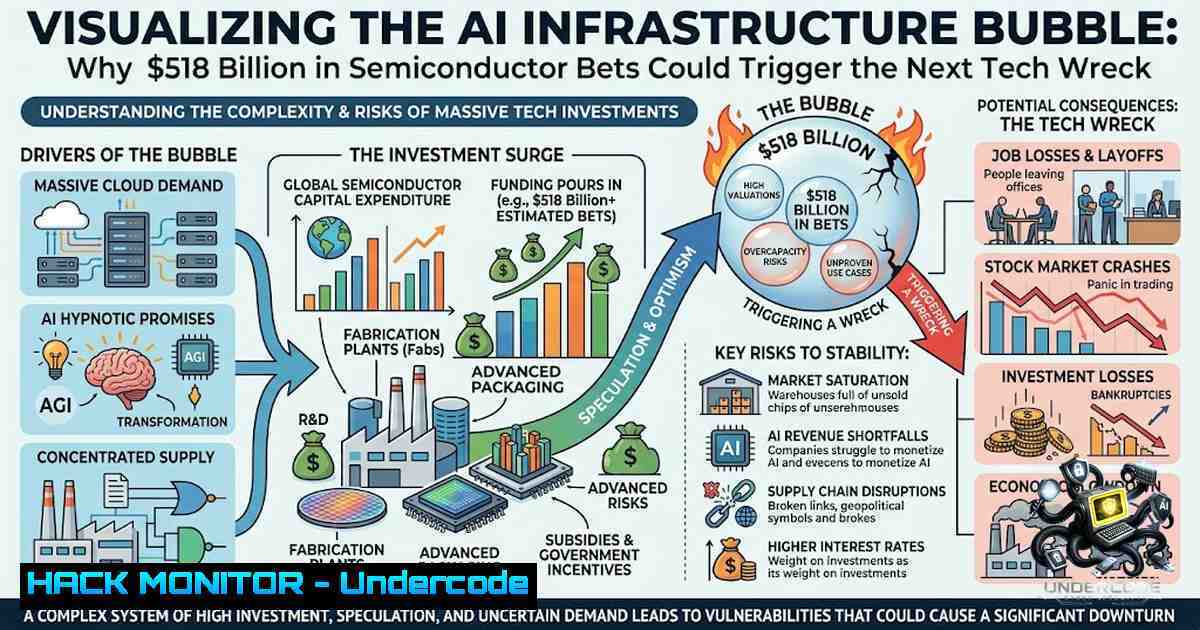
The global AI gold rush has triggered an unprecedented spending spree on semiconductor manufacturing, with South Korean giants Samsung and SK Hynix committing a staggering $518 billion (800 trillion won) to build four new memory fabrication plants. While industry leaders project these investments will double DRAM production by 2031, the Bank for International Settlements (BIS) has issued a stark warning: the current AI capex boom bears an alarming resemblance to historical manias—from 1830s canals to the dot-com bubble—and could trigger a protracted investment bust if expected returns fail to materialize. This article examines the cybersecurity, technical, and financial implications of this massive infrastructure build-out, providing actionable guidance for IT professionals navigating the AI-driven semiconductor landscape.
Learning Objectives
- Understand the scale and scope of current AI-driven semiconductor investments and their potential bubble dynamics
- Identify cybersecurity and operational risks associated with large-scale memory infrastructure deployment
- Master practical commands and configurations for securing AI workloads and memory-intensive environments
- Evaluate ROI and cost-reduction strategies for AI infrastructure investments
- Implement hardening measures for HBM-enabled systems and data center architectures
- The $518 Billion Bet: Understanding the Memory Megaproject
On June 29, 2026, Samsung Electronics Chairman Lee Jae-yong and SK Group Chairman Chey Tae-won, alongside South Korean President Lee Jae Myung, announced a historic investment: 800 trillion won (approximately $518 billion or €455 billion) to construct four new semiconductor fabrication plants in South Korea’s southwest region. The initiative aims to double the country’s DRAM production by 2031, with a specific focus on High-Bandwidth Memory (HBM)—the specialized memory stacks powering AI accelerators and server processors.
Each fabrication facility carries an estimated cost exceeding €100 billion—five to ten times the cost of a typical modern semiconductor plant. Construction timelines span at least two years for the building phase, followed by another year for cleanroom equipment installation, and additional months before production lines reach full capacity. Notably, the project excludes NAND flash for SSDs, concentrating exclusively on DRAM and HBM technologies.
Beyond the fabs themselves, 81 trillion won (€46 billion) is allocated for a packaging hub to process HBM, while additional funds flow into AI data centers and further processing facilities. The South Korean government promises expedited approvals, though subsidy details remain undisclosed.
Step-by-Step Guide: Monitoring Memory Infrastructure Investment Impact
For IT professionals tracking infrastructure investments, here are practical commands to assess memory demand and capacity planning:
Linux – Monitor Memory Bandwidth and Utilization:
 Install bandwidth monitoring tools
sudo apt-get install linux-tools-common linux-tools-$(uname -r)

Monitor memory bandwidth in real-time
sudo perf stat -e cpu-clock,cycles,instructions,cache-references,cache-misses,LLC-loads,LLC-load-misses -a -- sleep 10

Check HBM-specific performance (AMD systems)
sudo cat /sys/kernel/debug/dri/0/amdgpu_mem_info

Monitor memory latency
sudo bpftrace -e 'kprobe:handle_mm_fault { @[bash] = count(); }'

Track memory allocation patterns
sudo perf record -e kmem:mm_page_alloc -a -- sleep 30
sudo perf script
Windows – Memory Performance Analysis:
 Monitor system memory performance
Get-Counter "\Memory\" | Format-Table

Track memory pool usage
Get-Counter "\Memory\Pool Paged Bytes" -Continuous

Analyze memory allocation for AI workloads
Get-Process | Sort-Object -Property WorkingSet -Descending | Select-Object -First 20

Monitor page file usage
wmic os get FreePhysicalMemory,TotalVisibleMemorySize,FreeVirtualMemory
- The Bubble Warning: BIS Sounds the Alarm on AI Overinvestment
The Bank for International Settlements, often called the “central bank of central banks,” has issued a sobering assessment in its Annual Economic Report 2026. The report warns that the five largest hyperscalers—Alphabet, Amazon, Meta, Microsoft, and Oracle—are projected to spend over $1 trillion on AI-related capital expenditure across 2025–2026. These commitments are already outpacing earnings and free cash flow, forcing some firms to issue debt for additional financing.
The BIS identifies a “risk of firms over-committing resources to investment projects with still uncertain returns, leaving all firms vulnerable to disappointments in AI payoffs”. Their predictive models indicate that as current AI exuberance drives capital expenditures higher, the total payoff minus investment costs could turn negative. A disappointment in returns “could trigger a sudden pullback in financing and turn the capex boom into a protracted investment bust, with potential knock-on effects on financial conditions”.
The report draws explicit parallels to historical investment manias: canals in the 1830s, British railways in the 1840s, electrification in the late 1920s, and the dot-com boom of the late 1990s. Each episode involved genuine technological breakthroughs yet attracted more capital than commercial returns could justify.
Step-by-Step Guide: Assessing AI Investment Risk and ROI
Linux – Financial and Infrastructure Risk Assessment:
 Monitor cloud spending and resource utilization
aws ce get-cost-and-usage --time-period Start=2026-06-01,End=2026-06-30 --granularity=DAILY --metrics "BlendedCost" "UnblendedCost" "UsageQuantity"

Track GPU utilization for AI workloads (NVIDIA)
nvidia-smi --query-gpu=utilization.gpu,utilization.memory,memory.total,memory.free --format=csv

Monitor data center power consumption
sudo ipmiutil sensor -1 | grep -i power

Calculate infrastructure ROI (estimate)
echo "Total Investment: $518,000,000,000"
echo "Projected Annual Revenue Increase: [Enter estimate]"
echo "ROI = (Revenue - Investment) / Investment  100"
Python – Simple ROI Calculator for AI Infrastructure:
 ai_infrastructure_roi.py
def calculate_roi(total_investment, annual_revenue_increase, years=5):
total_revenue = annual_revenue_increase  years
net_profit = total_revenue - total_investment
roi = (net_profit / total_investment)  100
return roi

investment = 518e9  $518 billion
annual_revenue = 50e9  Estimated annual revenue increase
roi = calculate_roi(investment, annual_revenue)
print(f"5-Year ROI: {roi:.2f}%")
print(f"Break-even required: {investment / annual_revenue:.1f} years")
- The Security Gap: When Billions Go to Bricks, Not Cybersecurity
Bernhard Biedermann’s critical observation—”Leider bleibt dafür aber kein Geld über für mehr Sicherheit” (Unfortunately, there’s no money left for more security)—strikes at the heart of a growing concern. As semiconductor manufacturers pour hundreds of billions into physical infrastructure, cybersecurity budgets risk being deprioritized. This creates a dangerous vulnerability surface across the AI supply chain.
Memory chips, particularly HBM used in AI accelerators, present unique security challenges. Rowhammer attacks, side-channel vulnerabilities, and firmware exploits can compromise entire data center operations. The massive scale of new fabs also introduces physical security risks, supply chain integrity concerns, and intellectual property theft vectors.
Step-by-Step Guide: Securing Memory-Intensive AI Infrastructure
Linux – Memory Security Hardening:
 Enable kernel address space layout randomization (KASLR)
echo 1 > /proc/sys/kernel/randomize_va_space

Disable unnecessary kernel modules
echo "blacklist nouveau" >> /etc/modprobe.d/blacklist.conf
echo "blacklist bluetooth" >> /etc/modprobe.d/blacklist.conf

Harden memory management
sysctl -w vm.mmap_min_addr=65536
sysctl -w vm.overcommit_memory=2
sysctl -w kernel.kptr_restrict=2

Enable auditing for memory access
auditctl -a always,exit -S mmap -S mprotect -S munmap -k memory_access

Monitor for Rowhammer-like patterns
watch -1 1 'cat /proc/meminfo | grep -E "^(MemTotal|MemFree|MemAvailable|Buffers|Cached)"'
Windows – Memory Security Configuration:
 Enable Windows Defender Credential Guard
bcdedit /set {0cb3b571-2f2e-4343-a879-d86a476d7215} loadoptions DISABLE-LSA-ISO
bcdedit /set {0cb3b571-2f2e-4343-a879-d86a476d7215} device path \EFI\Microsoft\Boot\SecConfig.efi
bcdedit /set vm {0cb3b571-2f2e-4343-a879-d86a476d7215} enforce

Enable memory integrity (HVCI)
Set-ItemProperty -Path "HKLM:\SYSTEM\CurrentControlSet\Control\DeviceGuard\Scenarios\HypervisorEnforcedCodeIntegrity" -1ame "Enabled" -Value 1

Configure page file encryption
Set-ItemProperty -Path "HKLM:\SYSTEM\CurrentControlSet\Control\FileSystem" -1ame "NtfsEncryptPageFile" -Value 1

Monitor memory-related security events
Get-WinEvent -FilterHashtable @{LogName='Security'; ID=4656,4658,4660,4663} -MaxEvents 50
4. Power and Infrastructure: The 18.4 Gigawatt Reality
South Korea’s ambitious plan includes nationwide AI computing capacity reaching 8.4 gigawatts by 2029 and 18.4 gigawatts by 2035. These figures represent immense power demands that will strain existing electrical grids and raise significant operational security concerns. Data centers at this scale become prime targets for physical attacks, power grid manipulation, and environmental threats.
The BIS report explicitly warns that “the related demand for computing resources and electricity are causing overinvestment in electricity and data centers”. This overinvestment creates cascading risks: supply chain bottlenecks, rising electricity prices, and inflationary pressures.
Step-by-Step Guide: Data Center Power and Infrastructure Hardening
Linux – Power Monitoring and Optimization:
 Install power monitoring tools
sudo apt-get install powertop linux-tools-common

Run power consumption analysis
sudo powertop --csv=power_report.csv

Monitor CPU power states
sudo turbostat --quiet --show Busy%,Bzy_MHz,PkgTmp,PkgWatt,GFXWatt,IRQ,Pkg%pc2,Pkg%pc3,Pkg%pc6,Pkg%pc7,Pkg%pc8,Pkg%pc9,Pkg%pc10

Optimize power settings for data center
sudo cpupower frequency-set -g powersave

Monitor temperature and thermal throttling
sensors
watch -1 2 'sensors | grep -E "Core|Package"'
Network – Infrastructure Monitoring:
 Monitor data center network health
iftop -i eth0 -t -s 60

Track bandwidth usage patterns
vnstat -d -i eth0

Monitor for anomalous traffic (potential security incidents)
sudo tcpdump -i any -1n -c 1000 'port not 22 and port not 80 and port not 443'
- The Human Factor: Experienced Specialists vs. The Casino
Bernhard Biedermann’s concluding observation—”Erfahrene Spezialisten sind sicher die besser Wahl wenn Sie eine stabile Zukunft erleben wollen, andernfalls ist das Kasino der richtige Platz” (Experienced specialists are certainly the better choice if you want a stable future; otherwise, the casino is the right place)—underscores a critical tension in the AI infrastructure boom.
The industry’s “Größenwahn” (megalomania) and “Süchtige” (addictive) behavior toward AI investment mirrors patterns seen in previous tech bubbles. Experienced IT professionals recognize that sustainable growth requires measured investment, robust security practices, and realistic ROI calculations—not speculative bets on infinite AI-driven demand.
Step-by-Step Guide: Building a Skilled AI Security Team
Linux – Skills Assessment and Training Automation:
 Create a skills inventory script
cat > skills_inventory.sh << 'EOF'
!/bin/bash
echo "=== AI Infrastructure Skills Assessment ==="
echo "1. Kubernetes Experience:"
kubectl version --client 2>/dev/null || echo "Not installed"
echo "2. Container Security:"
docker --version 2>/dev/null || echo "Not installed"
echo "3. Cloud Platform Knowledge:"
aws --version 2>/dev/null || echo "AWS CLI not found"
gcloud --version 2>/dev/null || echo "GCloud not found"
echo "4. AI Framework Familiarity:"
python3 -c "import tensorflow; print('TensorFlow:', tensorflow.<strong>version</strong>)" 2>/dev/null || echo "TensorFlow not found"
python3 -c "import torch; print('PyTorch:', torch.<strong>version</strong>)" 2>/dev/null || echo "PyTorch not found"
echo "5. Security Tools:"
nmap --version 2>/dev/null || echo "Nmap not found"
openssl version 2>/dev/null || echo "OpenSSL not found"
EOF

chmod +x skills_inventory.sh
./skills_inventory.sh
Training Pipeline Setup:
 Set up automated security training environment
 Install vulnerable-by-design AI environment for practice
git clone https://github.com/OWASP/ai-security.git
cd ai-security
docker-compose up -d

Run vulnerability scans on AI infrastructure
sudo apt-get install nikto
nikto -h http://localhost:8501

Configure continuous security training
crontab -e
 Add: 0 9   1 /usr/local/bin/ai_security_training.sh
6. Mitigating the Bubble: Practical Risk Management
As the BIS warns, “the current AI investment boom is more fragile than it looks”. Complex financing arrangements between hyperscalers, chipmakers, private capital, and non-bank lenders create interconnected risks where “companies are simultaneously investors, customers and counterparties to each other”. Capital circulating within the same ecosystem makes risk “harder to see and harder to measure”.
Step-by-Step Guide: AI Infrastructure Risk Mitigation
Linux – Risk Assessment and Monitoring:
 Implement comprehensive logging
sudo journalctl --vacuum-size=500M
sudo systemctl enable systemd-journald

Set up fail2ban for AI service protection
sudo apt-get install fail2ban
sudo systemctl enable fail2ban
sudo systemctl start fail2ban

Monitor for resource exhaustion (potential DoS)
watch -1 5 'ps aux --sort=-%mem | head -10'
watch -1 5 'ps aux --sort=-%cpu | head -10'

Create early warning system for performance degradation
cat > performance_baseline.sh << 'EOF'
!/bin/bash
while true; do
CPU=$(top -bn1 | grep "Cpu(s)" | awk '{print $2}' | cut -d. -f1)
MEM=$(free -m | awk '/Mem:/ {print int($3/$2  100)}')
DISK=$(df -h / | awk 'NR==2 {print $5}' | cut -d% -f1)
echo "$(date): CPU=${CPU}%, MEM=${MEM}%, DISK=${DISK}%"
if [ $CPU -gt 80 ] || [ $MEM -gt 85 ] || [ $DISK -gt 90 ]; then
echo "WARNING: Resource threshold exceeded!"
 Trigger alert
fi
sleep 60
done
EOF
chmod +x performance_baseline.sh
Windows – Risk Monitoring:
 Create performance baseline script
$baseline = @{}
$counters = @("\Processor(_Total)\% Processor Time", "\Memory\Available MBytes", "\PhysicalDisk(_Total)\% Disk Time")

foreach ($counter in $counters) {
$value = (Get-Counter $counter).CounterSamples.CookedValue
$baseline[$counter] = $value
}

Monitor deviations
while ($true) {
foreach ($counter in $counters) {
$current = (Get-Counter $counter).CounterSamples.CookedValue
$baseline_value = $baseline[$counter]
$deviation = [bash]::Abs(($current - $baseline_value) / $baseline_value  100)
if ($deviation -gt 20) {
Write-Warning "Significant deviation detected for $counter"
}
}
Start-Sleep -Seconds 60
}
What Undercode Say:
- Key Takeaway 1: The $518 billion semiconductor investment represents an unprecedented bet on AI-driven memory demand, but historical patterns suggest that such infrastructure bubbles often burst when projected returns fail to materialize. IT professionals must maintain realistic expectations and implement robust risk management strategies.
-
Key Takeaway 2: Cybersecurity is being dangerously deprioritized in the rush to build physical infrastructure. Organizations must allocate adequate budgets for memory security, supply chain integrity, and data center protection—or risk catastrophic breaches that could dwarf the initial investment losses.
Analysis:
The current AI infrastructure boom presents a paradox: genuine technological advancement coexists with speculative excess that echoes previous financial manias. The BIS warning is not a dismissal of AI’s potential—the report acknowledges AI could raise productivity by 20% to 50% in task-level studies—but rather a caution against overcommitment to projects with uncertain returns.
For cybersecurity professionals, this environment creates both opportunities and threats. The massive scale of new memory production will enable more powerful AI systems, but also expand the attack surface for memory-based exploits, side-channel attacks, and supply chain compromises. Organizations that prioritize security alongside infrastructure investment will be better positioned to weather potential market corrections.
The human element remains critical: experienced specialists who understand both the technical and financial dimensions of AI infrastructure will be invaluable as the industry navigates this period of unprecedented investment and uncertainty. The casino mentality that Biedermann critiques is precisely what the BIS warns against—a speculative approach that ignores fundamental ROI calculations and risk management principles.
Prediction:
- +1 The massive increase in HBM and DRAM production will eventually drive down memory costs, making advanced AI capabilities more accessible to smaller organizations and democratizing AI development.
-
-1 If AI returns disappoint—as the BIS models suggest is possible—the resulting investment pullback could trigger a semiconductor industry consolidation, with smaller players facing insolvency and long-term supply agreements becoming liabilities rather than assets.
-
-1 Cybersecurity gaps created by infrastructure-focused spending will likely result in major breaches targeting memory supply chains, potentially disrupting global AI operations and eroding public trust in AI technologies.
-
+1 The South Korean semiconductor hub will accelerate technological innovation and create a concentrated ecosystem of expertise that could rival Silicon Valley, driving advances in memory architecture and AI hardware design.
-
-1 Power infrastructure constraints (18.4 GW by 2035) may force data center operators to make difficult trade-offs between computational capacity and environmental sustainability, potentially slowing AI adoption in regions with inadequate grid infrastructure.
-
+1 The BIS warning may prompt more disciplined investment approaches, encouraging organizations to conduct thorough ROI analyses and implement robust risk management frameworks—ultimately creating a more sustainable AI industry.
-
-1 Interconnected financing arrangements between hyperscalers, chipmakers, and non-bank lenders create systemic risk that could transmit financial stress across the broader economy if AI investment cycles turn.
-
+1 The focus on HBM technology will drive innovation in memory security, leading to new hardware-level protections against side-channel attacks and memory corruption vulnerabilities.
-
-1 The five-to-ten year construction timeline for new fabs means production capacity may come online precisely when AI demand plateaus, creating oversupply and pricing collapse reminiscent of previous semiconductor cycles.
-
+1 Organizations that prioritize experienced cybersecurity specialists over speculative infrastructure bets will gain competitive advantage through resilient, secure AI operations that can withstand both technical and financial turbulence.
▶️ Related Video (76% Match):
https://www.youtube.com/watch?v=3qo9bganOpQ
🎯Let’s Practice For Free:
🎓 Live Courses & Certifications:
Join Undercode Academy for Verified Certifications
🚀 Request a Custom Project:
Secure, high-velocity infrastructure and disruptive technological engineering. Contact our engineering team for high-tier development and proprietary systems:
[email protected]
💎 Smart Architecture | 🛡️ Secure by Design | ⭐ Trusted by Thousands
IT/Security Reporter URL:
Reported By: Bernhard Biedermann – Hackers Feeds
Extra Hub: Undercode MoN
Basic Verification: Pass ✅


