Listen to this Post
Introduction:
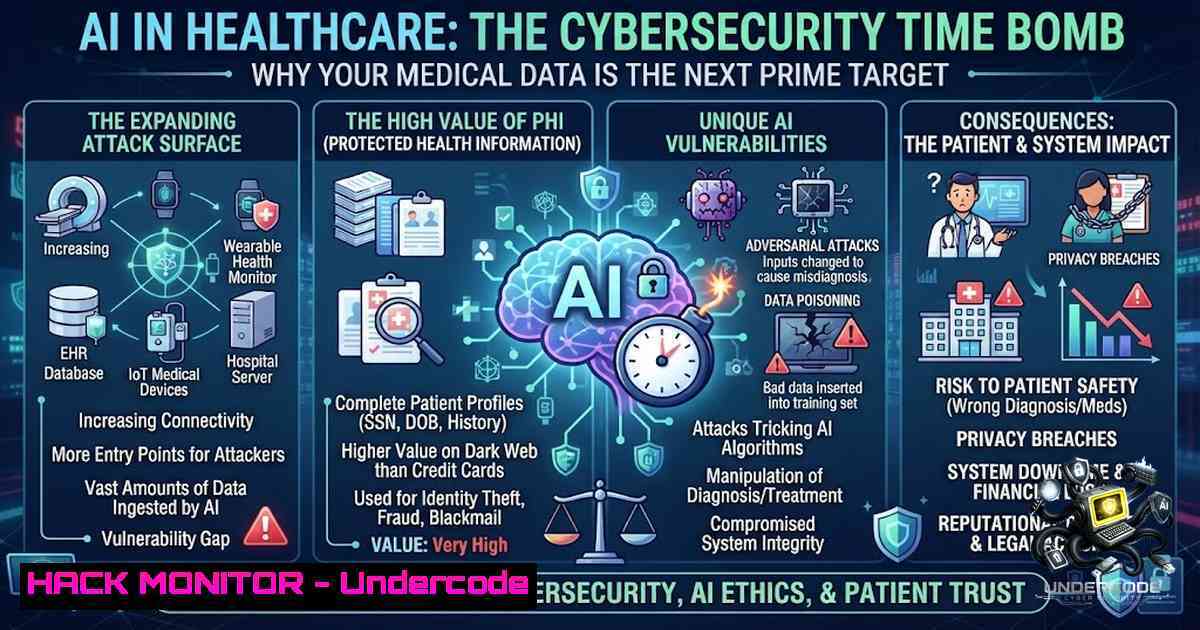
Artificial Intelligence is revolutionizing healthcare at an unprecedented pace—from early disease detection and medical imaging analysis to drug discovery and hospital management. However, the same connectivity and data-driven intelligence that make AI-powered healthcare transformative also create an expanded attack surface that cybercriminals are rapidly exploiting. With the global AI in healthcare market projected to rise from roughly $36 billion in 2025 to over $500 billion by 2033, the urgency to secure AI-driven medical systems has never been greater. Healthcare organizations must now navigate a complex landscape where data poisoning, adversarial attacks, ransomware, and regulatory compliance intersect—and where a single vulnerability can compromise patient safety.
Learning Objectives:
- Understand the unique cybersecurity threats facing AI-enabled healthcare systems, including data poisoning, adversarial attacks, and supply chain vulnerabilities
- Master the regulatory compliance landscape including HIPAA Security Rule updates (2025), FDA guidance, NIST AI RMF, and AAMI CR515:2025
- Learn practical security implementation techniques including PHI redaction, prompt injection defense, encryption, and AI-specific penetration testing
- Deploy verified Linux and Windows commands for securing healthcare AI infrastructure
- Develop an incident response framework tailored to AI-enabled medical environments
- Data Poisoning: The Invisible Threat to Healthcare AI
Healthcare AI systems face major vulnerabilities to data poisoning that current defenses and regulations cannot adequately address. Attackers with access to as few as 100–500 samples can compromise healthcare AI regardless of dataset size, often achieving over 60 percent success, with detection taking an estimated 6 to 12 months or sometimes not occurring at all. The distributed nature of healthcare infrastructure creates many entry points where insiders with routine access can launch attacks with limited technical skill. Privacy laws such as HIPAA and GDPR can unintentionally shield attackers by restricting the analyses needed for detection. Supply chain weaknesses allow a single compromised vendor to poison models across 50 to 200 institutions.
Real-World Attack Scenario: The Medical Scribe Sybil scenario demonstrates how coordinated fake patient visits can poison data through legitimate clinical workflows without requiring a system breach. A 2025 study found that replacement of just 0.001% of training tokens with medical misinformation results in harmful models more likely to propagate medical errors.
Step-by-Step Defense Implementation:
Step 1: Implement Ensemble Disagreement Monitoring
 Linux - Monitor model output variance across ensemble members
 Install required packages
pip install scikit-learn numpy pandas

Python script to detect data poisoning via prediction disagreement
python -c "
import numpy as np
from sklearn.ensemble import RandomForestClassifier
 Load your ensemble models and compare predictions
 Flag instances where ensemble members disagree beyond threshold
"
Step 2: Deploy Privacy-Preserving yet Auditable Mechanisms
 Linux - Set up audit logging for all data ingestion pipelines
sudo mkdir -p /var/log/ai_security
sudo chmod 750 /var/log/ai_security
 Configure rsyslog to capture all model training data access
echo "authpriv. /var/log/ai_security/data_access.log" >> /etc/rsyslog.conf
sudo systemctl restart rsyslog
Step 3: Implement Mandatory Adversarial Robustness Testing
 Linux - Install and run Adversarial Robustness Toolbox (ART)
pip install adversarial-robustness-toolbox
 Test model against FGSM and PGD attacks
python -c "
from art.attacks.evasion import FastGradientMethod
from art.estimators.classification import SklearnClassifier
 Evaluate robustness and generate report
"
- PHI Protection and HIPAA Compliance for AI Systems
In January 2025, the Department of Health and Human Services (HHS) published a proposed rule to revise HIPAA’s Security Rule, establishing that electronic protected health information (ePHI) used in AI training data, prediction models, and algorithm data is protected by HIPAA. The rule requires heightened risk analysis, written inventories of technology assets including AI software, and regular monitoring of authoritative sources for known vulnerabilities.
Compliance Requirements:
- AI tools can only access, use, and disclose PHI as permitted by HIPAA
- AI companies are considered business associates if they have access to protected health information
- Public server AI tools such as ChatGPT do not comply with HIPAA’s Privacy and Security Rules
- Civil penalties include fines up to $50,000 per violation; criminal penalties range from imprisonment for one to 10 years and fines from $50,000–$250,000
Step-by-Step PHI Redaction Implementation:
Step 1: Deploy Clinical AI Gateway with PHI Protection
 Linux - Clone and deploy security-hardened clinical AI gateway
git clone https://github.com/MohsenBah/clinical-ai-gateway.git
cd clinical-ai-gateway
docker compose up -d
 Health check
curl -s http://localhost:8000/health | jq
Step 2: Implement Microsoft Presidio for PHI Redaction
 Linux - Install Presidio
pip install presidio-analyzer presidio-anonymizer
 Download spaCy model
python -m spacy download en_core_web_lg
Step 3: Encrypt Patient Data at Rest
 Linux - LUKS encryption for sensitive data directories
sudo cryptsetup luksFormat /dev/sdX1
sudo cryptsetup luksOpen /dev/sdX1 encrypted_phi
sudo mkfs.ext4 /dev/mapper/encrypted_phi
sudo mount /dev/mapper/encrypted_phi /mnt/phi_data
 Generate AES-256 key for model encryption
dd if=/dev/urandom bs=1 count=32 of=aes256.bin
Step 4: Windows – BitLocker for PHI Protection
 Windows PowerShell - Enable BitLocker on data drives
Enable-BitLocker -MountPoint "D:" -EncryptionMethod XtsAes256
 Configure recovery password protector
Add-BitLockerKeyProtector -MountPoint "D:" -RecoveryPasswordProtector
3. Adversarial Attacks on Medical Imaging and LLMs
Vision language models (VLMs) are increasingly integrated into medical workflows for diagnostic support and clinical decision-making. However, these systems are vulnerable to both prompt injection and adversarial perturbation attacks. Research across multiple modalities (CT, MRI, ultrasound, pathology, endoscopy, and dermatology) reveals complex vulnerability patterns with no single model providing universal robustness.
Attack Vectors:
- White-box attacks on medical VLMs exceed 80% attack success rate
- Black-box transfer attacks show varying vulnerability: GPT-5 (44%), MedGemma (37%), Claude 4.1 Opus (17%)
- Universal black-box adversarial attacks pose substantial risk even when attackers lack access to the target model or its training data
- Stealth black-box attacks specifically designed for medical imaging applications
Step-by-Step Adversarial Defense Implementation:
Step 1: Deploy Multimodal LLM Security Gateway
 Linux - Clone HealthGuard for healthcare LLM security
git clone https://github.com/KrishV2003/HealthGuard-LLM-Security.git
cd HealthGuard-LLM-Security
 Install dependencies
pip install -r requirements.txt
 Run security gateway
python healthguard.py --model groq --port 8080
Step 2: Implement Prompt Injection Protection
 Linux - Deploy guardrailing-llms for healthcare AI assistant
git clone https://github.com/rh-ai-quickstart/guardrailing-llms.git
cd guardrailing-llms/
 Create OpenShift project
oc new-project guardrails-demo
 Install with Helm
helm install guardrails-demo helm/ --1amespace guardrails-demo
 Verify pods are running
oc get pod -1 guardrails-demo
Step 3: Monitor for Adversarial Input Patterns
 Linux - Set up real-time monitoring for prompt injection attempts
sudo journalctl -u your-ai-service -f | grep -i "injection|adversarial|malicious"
 Windows PowerShell - Monitor event logs for suspicious activity
Get-WinEvent -LogName Security | Where-Object {$_.Message -match "AI|prompt|injection"}
- Medical Device AI Security: IoMT and ML-Enabled Devices
The Internet of Medical Things (IoMT) has the potential to radically improve healthcare by enabling real-time monitoring, remote diagnostics, and AI-driven decision making. However, the connectivity, embedded intelligence, and inclusion of novel sensors expose medical devices to severe cybersecurity threats, compromising patient safety and data privacy.
AAMI CR515:2025 addresses unique cybersecurity threats associated with developing and deploying machine learning–enabled medical device software (MLMD), covering threats that arise during data collection, product design, deployment, use, and maintenance. The FDA’s January 2025 draft guidance on AI-Enabled Device Software Functions provides comprehensive recommendations for AI-enabled devices, emphasizing cybersecurity as a critical criteria for premarket submissions.
Recent Vulnerabilities:
- CVE-2025-24836: Python script could send continuous commands over unencrypted Bluetooth, causing denial-of-service
- CVE-2025-4393: Medtronic MyCareLink Patient Monitor deserialization vulnerability allowing privilege escalation
- CVE-2025-2230: Philips Intelligence Cardiovascular replay attacks and authentication bypass
Step-by-Step Medical Device Security Hardening:
Step 1: Implement SBOM and MDS2 Analysis
 Linux - Generate Software Bill of Materials for medical device software
pip install cyclonedx-bom
cyclonedx-bom -o sbom.json
 Analyze vulnerabilities using LLM-assisted tools
python -c "
 Leverage MDS2 and SBOM data for vulnerability analysis
 Combine with CVE, CPE, KEV sources
"
Step 2: Network Segmentation for IoMT Devices
 Linux - Create isolated VLAN for medical devices using iptables
sudo iptables -A FORWARD -i eth0 -o eth1 -j DROP
sudo iptables -A FORWARD -i eth1 -o eth0 -m state --state ESTABLISHED,RELATED -j ACCEPT
 Windows - Configure Windows Firewall for device isolation
New-1etFirewallRule -DisplayName "Block IoMT Outbound" -Direction Outbound -Action Block
Step 3: Deploy Intrusion Detection for Medical Networks
 Linux - Install and configure Snort for medical device traffic monitoring
sudo apt-get install snort
sudo snort -i eth0 -c /etc/snort/snort.conf -l /var/log/snort
 Monitor for anomalous device behavior
tail -f /var/log/snort/alert
5. AI-Powered Ransomware and Offensive AI in Healthcare
Cybercriminals are weaponizing AI agents to attack industries including healthcare. Hackers are using agentic AI to carry out sophisticated cyberattacks, such as ransomware, that would have previously required years of training. In Q2 2025, security firms blocked a million attacks tied to AI-powered pharmaceutical fraud schemes.
Notable Incidents:
- Serviceaide breach (2025): An AI-linked platform exposed sensitive health data from Catholic Health, affecting 483,000 patients due to a misconfigured Elasticsearch database
- HCIactive breach (2025): An “AI-powered” services firm hack affected nearly 3.1 million individuals nationwide
- Kettering Health attack (2025): Interlock ransomware group infiltrated hospital networks, encrypting electronic health records, billing platforms, and critical messaging tools
Step-by-Step AI Security Assessment Implementation:
Step 1: Deploy AI-Powered Penetration Testing
 Linux - Install Nebula AI-powered penetration testing platform
python -m pip install nebula-ai --upgrade
 Pull local LLM for offline testing
ollama pull mistral
 Configure and run assessment
nebula scan --target healthcare-ai-endpoint.com --model mistral
Step 2: Implement Black-Box Security Scanning for LLM Applications
 Linux - Install AICU scanner for LLM security assessment
pip install aicu-scanner
 Point at chat endpoint and detect leaks
aicu scan https://your-healthcare-ai-endpoint.com/chat
Step 3: Kali Linux AI-Assisted Penetration Testing
 Linux - Kali with Claude AI integration via MCP
 Install mcp-kali-server
sudo apt install mcp-kali-server
 Configure Claude Desktop MCP client
 Edit ~/Library/Application Support/Claude/claude_desktop_config.json
 Execute natural language security commands
 Example: "Port scan scanme.nmap.org and check for vulnerabilities"
Step 4: Windows – Deploy Security Information and Event Management
 Windows PowerShell - Configure audit policies for AI systems
auditpol /set /subcategory:"System Integrity" /success:enable /failure:enable
 Enable advanced audit logging
wevtutil set-log Microsoft-Windows-Sysmon/Operational /enabled:true /retention:false /maxsize:1073741824
6. NIST AI RMF and Regulatory Frameworks
The NIST AI Risk Management Framework (AI RMF) provides non-regulatory guidance to help organizations identify, assess, and mitigate AI-related risks. The Generative AI Profile extends this framework to address risks specific to large language models and deep learning systems. In healthcare, frameworks like the NIST AI RMF and IEEE UL 2933 standard help organizations create trustworthy and transparent AI applications.
Key Regulatory Updates (2025):
- FDA final guidance (August 2025): Streamlining approval for AI-enabled device software functions requiring repeated adjustments
- FDA draft guidance (January 2025): Total product lifecycle approach for AI-enabled devices
- NIST Cyber AI Profile draft: Practical guidance on managing cybersecurity risks introduced by and affecting AI systems
- AAMI CR515:2025: Added to FDA’s recognized consensus standards database
Step-by-Step Compliance Implementation:
Step 1: Conduct AI Asset Inventory
 Linux - Create and maintain AI asset inventory
echo "AI_Asset_Inventory_$(date +%Y%m%d).csv" > /var/log/ai_assets.log
 Document: datasets, models, APIs, training data sources
 Map PHI data flows and identify trust boundaries
Step 2: Implement Continuous Monitoring
 Linux - Set up Prometheus and Grafana for AI system monitoring
docker run -d -p 9090:9090 prom/prometheus
docker run -d -p 3000:3000 grafana/grafana
 Configure alerts for anomalous model behavior
Step 3: Establish Incident Response Plan
 Linux - Create incident response playbook directory
mkdir -p /opt/security/incident_response
 Document procedures for:
 - Data poisoning detection
 - Model compromise
 - PHI breach
 - Ransomware response
What Undercode Say:
- Key Takeaway 1: Healthcare AI is uniquely vulnerable to data poisoning attacks that can be executed with minimal resources (100–500 samples) and may go undetected for 6–12 months, making traditional security monitoring insufficient. Organizations must implement ensemble disagreement monitoring and mandatory adversarial robustness testing.
-
Key Takeaway 2: The 2025 regulatory landscape has fundamentally changed HIPAA compliance for AI systems. ePHI used in AI training data and prediction models is now explicitly protected, and organizations face penalties up to $50,000 per violation plus criminal liability. Public AI tools like ChatGPT are categorically non-compliant.
-
Key Takeaway 3: Adversarial attacks on medical imaging and LLMs are not theoretical—white-box attacks achieve over 80% success rate, and black-box transfer attacks can compromise proprietary models without access to training data. Organizations must deploy multimodal security gateways with prompt injection, PHI redaction, and gibberish detection layers.
-
Key Takeaway 4: Cybercriminals are now weaponizing AI for ransomware and phishing attacks against healthcare. The Serviceaide breach affecting 483,000 patients and HCIactive breach affecting 3.1 million individuals demonstrate that AI infrastructure misconfigurations have catastrophic consequences. Proactive AI-powered penetration testing tools like Nebula and Kali’s Claude integration are becoming essential defensive measures.
-
Key Takeaway 5: The convergence of medical devices with AI creates new attack surfaces that traditional cybersecurity frameworks cannot address. AAMI CR515:2025 and FDA guidance now require end-to-end security consideration from data collection through deployment. Organizations must implement SBOM analysis, network segmentation, and continuous monitoring for IoMT environments.
Prediction:
-
-1: The weaponization of AI by cybercriminals will accelerate dramatically in 2026–2027, with agentic AI ransomware attacks becoming the norm rather than the exception. Healthcare organizations that have not implemented AI-specific security measures will face catastrophic breaches affecting millions of patients.
-
-1: Data poisoning attacks will become the primary vector for compromising healthcare AI systems. With detection taking 6–12 months, many organizations will unknowingly deploy compromised models, leading to misdiagnoses, treatment errors, and widespread patient harm before the attacks are discovered.
-
+1: The regulatory push from HHS, FDA, and NIST will drive standardization of AI security practices across healthcare. Organizations that proactively adopt frameworks like NIST AI RMF and AAMI CR515:2025 will gain competitive advantage and patient trust.
-
+1: AI-powered security tools—including Nebula, Kali’s MCP integration, and clinical AI gateways—will democratize advanced penetration testing, enabling smaller healthcare organizations to implement enterprise-grade security without massive security teams.
-
-1: The complexity of AI supply chains will create systemic vulnerabilities where a single compromised vendor can poison models across 50–200 institutions. This will lead to industry-wide incidents that transcend individual organizational security postures.
-
+1: Fully homomorphic encryption and local-only AI processing will enable privacy-preserving healthcare AI that can analyze patient data without ever decrypting it—fundamentally changing the risk calculus for AI in healthcare and potentially eliminating many current security concerns.
▶️ Related Video (78% Match):
https://www.youtube.com/watch?v=2GnSyBLTyQY
🎯Let’s Practice For Free:
🎓 Live Courses & Certifications:
Join Undercode Academy for Verified Certifications
🚀 Request a Custom Project:
Secure, high-velocity infrastructure and disruptive technological engineering. Contact our engineering team for high-tier development and proprietary systems:
[email protected]
💎 Smart Architecture | 🛡️ Secure by Design | ⭐ Trusted by Thousands
IT/Security Reporter URL:
Reported By: Meredith Palmer – Hackers Feeds
Extra Hub: Undercode MoN
Basic Verification: Pass ✅


