Listen to this Post
Introduction:
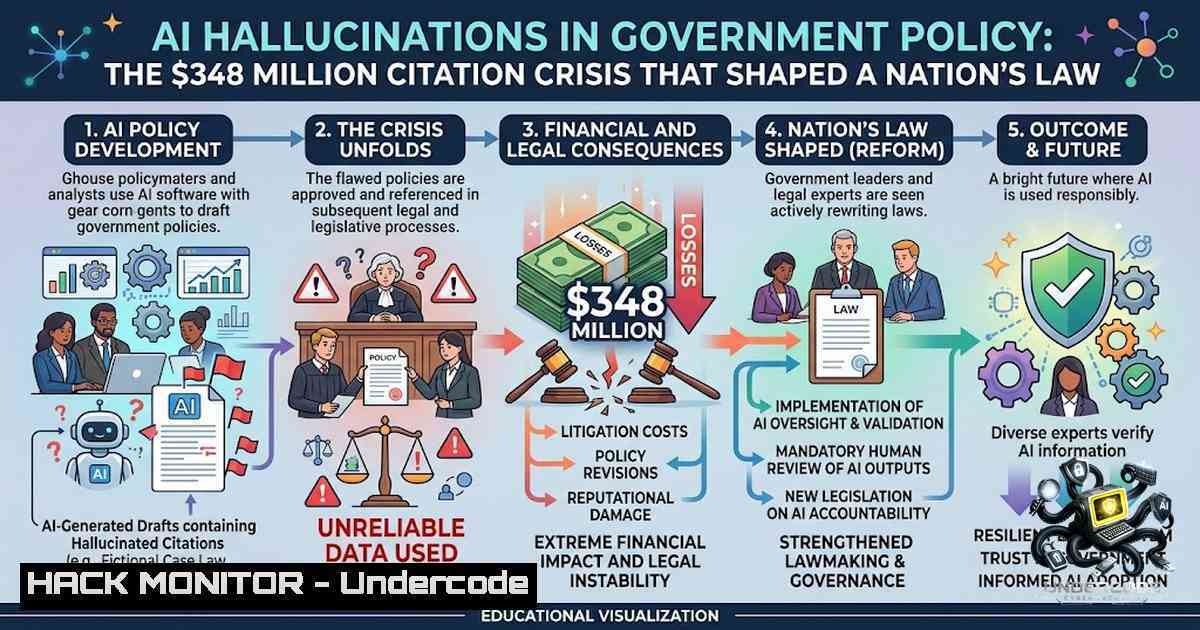
The integration of artificial intelligence into policy-making and regulatory frameworks has accelerated globally, but with it comes a critical vulnerability: AI hallucinations. When generative AI produces plausible-sounding but entirely fabricated citations, the consequences can ripple through legal systems, corporate compliance, and public trust. The recent revelation that Australia’s Age Assurance Technology Trial—a $3.48 million government-commissioned report that directly informed the world’s first nationwide social media ban for children under 16—contained multiple AI-fabricated citations serves as a stark warning. This incident exposes the dangerous gap between “manual verification” as a procedural checkbox and genuine source validation, raising urgent questions about how governments, enterprises, and security professionals must adapt their verification workflows in an AI-augmented world.
Learning Objectives & Secrets:
- Objective 1: Understand AI Hallucination Mechanics in Technical Documentation — Learn to identify the telltale signs of AI-generated citations, including DOIs that resolve to non-existent papers, author-journal-year combinations that cannot be verified, and sources that exist but do not support the claims attributed to them.
-
Objective 2 Secret Tip: Metadata Forensics — The ACCS report contained embedded ChatGPT metadata in four links across two sections. Security analysts should routinely inspect document metadata for AI tool signatures, including specific model identifiers, token patterns, and generation timestamps that may indicate AI involvement.
-
Objective 3 Secret Tip: Temporal Verification — One ACCS source claimed a paper was accessed in March 2025, yet the paper was not published until June 2025. Cross-referencing access dates against publication dates is a simple but powerful hallucination detection technique often overlooked in manual reviews.
You Should Know:
1. The Anatomy of an AI-Hallucinated Citation
AI hallucinations in academic and technical references manifest in distinct patterns that security professionals and analysts must recognize. The Australian case revealed three primary categories of fabricated citations:
- Non-existent DOIs: Digital Object Identifiers that resolve to nothing—the papers simply do not exist in any academic database.
- Composite Fabrications: References where the author name, journal title, publication year, and DOI appear correctly formatted but the combination exists nowhere in legitimate academic literature.
- Misattributed Sources: DOIs that resolve to real papers, but the content of those papers does not support the claim made in the citing document.
Verification Protocol:
 Linux - Batch DOI verification using crossref API
!/bin/bash
 Verify DOIs against CrossRef API
while read doi; do
response=$(curl -s "https://api.crossref.org/works/$doi")
if echo "$response" | grep -q '"status":"ok"'; then
echo "VALID: $doi"
else
echo "HALLUCINATION: $doi"
fi
done < dois.txt

Windows PowerShell - DOI validation
$dois = Get-Content .\dois.txt
foreach ($doi in $dois) {
try {
$response = Invoke-RestMethod -Uri "https://api.crossref.org/works/$doi" -ErrorAction Stop
Write-Host "VALID: $doi"
} catch {
Write-Host "HALLUCINATION: $doi" -ForegroundColor Red
}
}
What This Does: These scripts query the CrossRef API to verify whether a DOI resolves to a real academic publication. Any DOI that fails to return a valid metadata response should be flagged for immediate human review. For government or enterprise reports, this check should be mandatory before any document containing academic citations is published.
2. Metadata Forensics: Detecting AI Involvement in Documents
The ACCS initially denied using AI altogether, then conceded that ChatGPT metadata was embedded in four links across two sections of the report. This pattern of denial-then-admission is itself a red flag. Security teams should implement metadata inspection as a standard step in document review workflows.
Step-by-Step Metadata Extraction:
Linux/macOS:
 Extract all metadata from PDF
exiftool -all report.pdf

Search specifically for AI-related metadata
pdfinfo report.pdf | grep -i "chatgpt|openai|gpt|ai"

Extract hidden text and metadata from DOCX
unzip -p report.docx word/document.xml | grep -i "chatgpt|generated|ai"

For comprehensive analysis
strings report.pdf | grep -i "chatgpt|openai|gpt-4|claude|anthropic"
Windows (PowerShell):
 Extract PDF metadata
Get-PdfMetadata -Path .\report.pdf

Search DOCX for AI signatures
Get-ChildItem -Path .\report.docx | Expand-Archive -DestinationPath .\docx_extract
Select-String -Path .\docx_extract\word.xml -Pattern "chatgpt|openai|gpt-4|claude"

Check file properties for AI tool signatures
Get-ItemProperty -Path .\report.pdf | Select-Object
Tool Configuration:
 Example CI/CD pipeline step for document verification
document-verification:
stage: validate
script:
- python verify_citations.py --input report.pdf --output validation_report.json
- python detect_ai_metadata.py --input report.pdf --threshold 0.7
rules:
- if: $CI_MERGE_REQUEST_TARGET_BRANCH_NAME == "main"
What This Does: These commands extract hidden metadata that may reveal whether AI tools were used to generate or modify document content. Metadata fields like Producer, Creator, Generator, and embedded XML comments often contain identifying information about the software used. The presence of AI tool signatures does not automatically invalidate a document, but it should trigger enhanced scrutiny of all citations and factual claims.
3. Source-Validated Writing: Building Verification Into the Workflow
The fundamental failure in the Australian case was treating verification as a post-hoc step rather than an integrated property of the document creation process. As the Foragentis team articulated, “every claim resolves to a real, checkable source row before a report can publish, or it doesn’t publish”.
Implementation Strategy:
Step 1: Citation Management Integration
 Python - Citation verification before document generation
import requests
import json
from datetime import datetime

class CitationValidator:
def <strong>init</strong>(self):
self.crossref_api = "https://api.crossref.org/works/"
self.pubmed_api = "https://eutils.ncbi.nlm.nih.gov/entrez/eutils/esummary.fcgi"

def validate_doi(self, doi):
response = requests.get(f"{self.crossref_api}{doi}")
if response.status_code == 200:
data = response.json()
if data.get('message', {}).get('status') == 'ok':
return {'valid': True, 'metadata': data['message']}
return {'valid': False, 'error': 'DOI does not resolve'}

def validate_claim(self, claim_text, source_doi):
 Extract key claims and verify against source abstract
 This is where semantic verification would occur
pass

Usage
validator = CitationValidator()
for citation in document_citations:
result = validator.validate_doi(citation.doi)
if not result['valid']:
raise ValueError(f"Hallucinated citation detected: {citation.doi}")
Step 2: CI/CD Pipeline Integration for Document Verification
 .github/workflows/document-verify.yml
name: Document Citation Verification

on:
pull_request:
paths:
- 'reports//.md'
- 'reports//.docx'

jobs:
verify-citations:
runs-on: ubuntu-latest
steps:
- uses: actions/checkout@v4
- name: Extract citations
run: python extract_citations.py --input ${{ github.event.pull_request.head.sha }}
- name: Verify DOIs
run: python verify_dois.py --citations citations.json --output verification_report.json
- name: Check for AI metadata
run: python detect_ai_metadata.py --input reports/
- name: Block if hallucinations found
if: failure()
run: exit 1
What This Does: This approach bakes verification into the document lifecycle—citations are validated before they can be merged into the final report. The CI/CD pipeline blocks publication if any DOI fails validation or if AI metadata signatures exceed configured thresholds.
- API Security and Hallucination Detection in AI-Generated Content
As organizations increasingly rely on AI APIs for content generation, the risk of hallucinated citations extends beyond internal documents to API responses, chatbots, and automated reporting systems.
API Security Hardening for AI Outputs:
 Python - Wrapper for LLM API calls with citation validation
import openai
import requests
import json

class SecureLLMClient:
def <strong>init</strong>(self, api_key):
self.client = openai.OpenAI(api_key=api_key)
self.citation_validator = CitationValidator()

def generate_with_validation(self, prompt, require_citations=True):
response = self.client.chat.completions.create(
model="gpt-4",
messages=[{"role": "user", "content": prompt}],
temperature=0.3  Lower temperature reduces hallucination risk
)

content = response.choices[bash].message.content

if require_citations:
 Extract potential DOIs and validate
import re
dois = re.findall(r'10.\d{4,9}/[-._;()/:A-Z0-9]+', content, re.IGNORECASE)
for doi in dois:
result = self.citation_validator.validate_doi(doi)
if not result['valid']:
 Flag for human review or regenerate
return self._regenerate_with_correction(prompt, doi)

return content

def _regenerate_with_correction(self, prompt, invalid_doi):
 Request regeneration with explicit instruction to verify citations
corrected_prompt = f"{prompt}\n\nIMPORTANT: Do not cite {invalid_doi} as it does not exist. Verify all citations against real academic sources."
return self.generate_with_validation(corrected_prompt, require_citations=True)
API Gateway Configuration (NGINX):
 Rate limiting and validation for AI API endpoints
location /api/ai/generate {
limit_req zone=ai_api burst=10 nodelay;
proxy_pass http://llm-backend;
proxy_set_header X-Request-ID $request_id;

Log all requests for audit
access_log /var/log/nginx/ai_api.log combined;

Enable response buffering for content inspection
proxy_buffering on;
proxy_buffer_size 128k;
proxy_buffers 4 256k;
proxy_busy_buffers_size 256k;
}
What This Does: This secure client wrapper validates all citations in AI-generated content before returning it to the user. Invalid citations trigger automatic regeneration with explicit instructions to avoid hallucination. The NGINX configuration provides rate limiting, logging, and buffering to enable content inspection at the gateway level.
5. Cloud Hardening for AI Workloads
Organizations deploying AI for document generation must harden their cloud environments to prevent data leakage and ensure auditability of AI-generated content.
AWS Security Configuration:
 Terraform - Secure AI workload configuration
resource "aws_kms_key" "ai_documents" {
description = "KMS key for AI-generated document encryption"
deletion_window_in_days = 7
enable_key_rotation = true
}

resource "aws_s3_bucket" "ai_document_storage" {
bucket = "ai-document-storage-${var.account_id}"

versioning {
enabled = true
}

server_side_encryption_configuration {
rule {
apply_server_side_encryption_by_default {
kms_master_key_id = aws_kms_key.ai_documents.arn
sse_algorithm = "aws:kms"
}
}
}
}

resource "aws_cloudtrail" "ai_api_trail" {
name = "ai-api-trail"
s3_bucket_name = aws_s3_bucket.ai_document_storage.id
include_global_service_events = true
is_multi_region_trail = true

event_selector {
read_write_type = "All"
include_management_events = true

data_resource {
type = "AWS::S3::Object"
values = ["arn:aws:s3:::ai-document-storage-${var.account_id}/"]
}
}
}
Azure Configuration:
 Azure PowerShell - Secure AI workspace
$resourceGroup = "ai-document-rg"
$workspaceName = "ai-document-workspace"

Deploy Azure OpenAI with content filtering
$openai = New-AzOpenAIAccount `
-ResourceGroupName $resourceGroup `
-1ame $workspaceName `
-Location "eastus" `
-SkuName "S0"

Enable diagnostic settings for audit logging
Set-AzDiagnosticSetting `
-ResourceId $openai.Id `
-Enabled $true `
-StorageAccountId $storageAccount.Id `
-Category @("AuditEvent", "RequestResponse")
What This Does: These cloud configurations ensure that all AI-generated documents are encrypted at rest, versioned for audit trails, and logged for compliance. CloudTrail and diagnostic settings capture all API calls to AI services, enabling forensic analysis if hallucinations or data leaks are detected.
6. Vulnerability Exploitation and Mitigation in AI-Generated Reports
The Australian case demonstrates a systemic vulnerability: when AI-generated content containing hallucinations is used to justify legislation or policy, the attack surface extends from the document itself to the legal and regulatory frameworks it supports.
Automated Hallucination Detection Script:
 Comprehensive hallucination detection pipeline
import re
import requests
from concurrent.futures import ThreadPoolExecutor
import json

class HallucinationDetector:
def <strong>init</strong>(self):
self.sources = {
'crossref': 'https://api.crossref.org/works/',
'pubmed': 'https://eutils.ncbi.nlm.nih.gov/entrez/eutils/esummary.fcgi',
'arxiv': 'https://export.arxiv.org/api/query'
}

def extract_citations(self, text):
 Extract DOIs, arXiv IDs, and formatted citations
doi_pattern = r'10.\d{4,9}/[-._;()/:A-Z0-9]+'
arxiv_pattern = r'arxiv:\d{4}.\d{4,5}'

dois = re.findall(doi_pattern, text, re.IGNORECASE)
arxivs = re.findall(arxiv_pattern, text, re.IGNORECASE)

return {'dois': dois, 'arxivs': arxivs}

def verify_batch(self, citations):
results = {}
with ThreadPoolExecutor(max_workers=10) as executor:
futures = {}
for doi in citations['dois']:
futures[executor.submit(self.verify_doi, doi)] = doi
for arxiv in citations['arxivs']:
futures[executor.submit(self.verify_arxiv, arxiv)] = arxiv

for future in futures:
result = future.result()
results[result['id']] = result['valid']

return results

def verify_doi(self, doi):
try:
response = requests.get(f"{self.sources['crossref']}{doi}", timeout=5)
if response.status_code == 200:
data = response.json()
if data.get('message', {}).get('status') == 'ok':
return {'id': doi, 'valid': True}
except:
pass
return {'id': doi, 'valid': False}

def verify_arxiv(self, arxiv_id):
 Validate arXiv ID
arxiv_id = arxiv_id.replace('arxiv:', '')
try:
response = requests.get(
f"{self.sources['arxiv']}?id_list={arxiv_id}",
timeout=5
)
if 'opensearch:totalResults' in response.text:
import xml.etree.ElementTree as ET
root = ET.fromstring(response.text)
ns = {'opensearch': 'http://a9.com/-/spec/opensearch/1.1/'}
total = root.find('.//opensearch:totalResults', ns)
if total is not None and int(total.text) > 0:
return {'id': arxiv_id, 'valid': True}
except:
pass
return {'id': arxiv_id, 'valid': False}

def generate_report(self, text):
citations = self.extract_citations(text)
results = self.verify_batch(citations)

invalid = [k for k, v in results.items() if not v]
report = {
'total_citations': len(results),
'valid_citations': len(results) - len(invalid),
'hallucinated_citations': invalid,
'hallucination_rate': len(invalid) / len(results) if results else 0
}
return report

Usage
detector = HallucinationDetector()
with open('report.txt', 'r') as f:
text = f.read()
report = detector.generate_report(text)
print(json.dumps(report, indent=2))
Mitigation Strategy:
- Pre-publication validation: Run hallucination detection on all documents before publication
- Human-in-the-loop: Flag all potentially hallucinated citations for human review
- Audit trail: Maintain a record of all validation attempts and outcomes
- Retraction protocol: Establish clear procedures for correcting documents if hallucinations are discovered post-publication
7. Building an Organizational Verification Culture
The Australian case reveals that “manual verification” as practiced by ACCS was inadequate. The fix for the initial fabrication introduced another fabrication, demonstrating that verification cannot be a one-time step performed by a tired person after the fact. Instead, organizations must build verification into their culture and workflows.
Recommended Controls:
| Control | Description | Implementation Priority |
||-||
| Source Validation Gate | No citation can be included without DOI verification | Critical |
| Metadata Scanning | Automated detection of AI tool signatures | High |
| Temporal Verification | Cross-reference access dates against publication dates | High |
| Independent Review | Second analyst verifies all citations before publication | Medium |
| Audit Logging | All verification attempts logged with timestamps | Medium |
| Retraction Protocol | Clear process for correcting errors post-publication | Medium |
Policy Template:
document_verification_policy:
version: "1.0"
scope: "All internal and external reports containing citations"

pre_publication_checks:
- name: "DOI Validation"
description: "All DOIs must resolve to real publications"
tool: "CrossRef API"
action_on_failure: "Block publication"

<ul>
<li>name: "Metadata Scan"
description: "Scan for AI tool signatures in document metadata"
tool: "ExifTool + custom detectors"
action_on_failure: "Flag for enhanced review"</p></li>
<li><p>name: "Claim Verification"
description: "Verify that cited sources actually support the claims"
tool: "Manual review by subject matter expert"
action_on_failure: "Rewrite or remove claim"</p></li>
</ul>

<p>post_publication:
- name: "Monitoring"
description: "Continuous monitoring for newly discovered hallucinations"
frequency: "Quarterly"
- name: "Correction"
description: "Issuance of corrigendum or retraction within 72 hours"
responsible: "Compliance Officer"
What Undercode Say:
- Key Takeaway 1: Manual verification is not a control—it is a process. The ACCS claimed its citations were “manually verified,” yet six fabricated references made it into the final report. Manual verification checks whether someone looked, not whether the source is real. Organizations must implement systematic, tool-assisted verification that validates each citation against authoritative databases before publication.
-
Key Takeaway 2: The fix for a fabrication should not introduce another fabrication. When ACCS went back to correct the citations, the correction introduced a new error: a paper claimed to have been accessed in March 2025, months before it was actually published in June 2025. This demonstrates that verification cannot be a reactive, one-time step. It must be built into the document creation workflow from the outset.
Analysis: The Australian age assurance report incident is not an isolated failure—it is the fourth major AI-hallucination story to surface since mid-June, spanning a Big Four consulting retraction, a UK Home Office asylum refusal, Apple’s bug bounty program rationing, and now this. Each case shares a common thread: organizations relying on post-hoc manual review to catch AI-generated errors, rather than building verification into the content creation process itself. The financial and reputational cost of these failures is mounting, and regulators are increasingly scrutinizing AI-assisted documentation. The solution is not to ban AI from documentation—AI offers genuine productivity gains—but to implement source-validated writing workflows where every claim resolves to a verifiable source before publication. As Foragentis articulated, “Honest systems scale. Manipulative ones collapse”.
Prediction:
- -1: Regulatory scrutiny of AI-assisted government and corporate reporting will intensify significantly in 2026-2027. Organizations that fail to implement robust citation validation will face fines, retractions, and reputational damage comparable to financial misreporting scandals.
-
-1: The “manual verification” defense will become legally untenable. Courts and regulators will expect organizations to demonstrate systematic, tool-assisted verification processes, not merely claims that someone “looked at” the citations.
-
+1: The demand for AI hallucination detection tools will surge, creating a new cybersecurity sub-sector focused on content validation. Startups and established vendors will compete to provide API-based citation verification, metadata analysis, and forensic auditing capabilities.
-
+1: Organizations that adopt source-validated writing workflows early will gain a competitive advantage in trust and compliance, particularly in regulated industries such as government contracting, financial services, and healthcare.
-
-1: The Australian case will not be the last major policy failure driven by AI hallucinations. As AI tools become more integrated into policy research, legal drafting, and regulatory impact assessments, the risk of similar failures will scale with adoption unless verification infrastructure matures in parallel.
-
+1: The incident will accelerate the development of open-source citation verification tools and standards, similar to how the SolarWinds breach accelerated software supply chain security. Expect to see ISO standards for AI-assisted documentation emerge within 18-24 months.
▶️ Related Video (78% Match):
https://www.youtube.com/watch?v=0ABqpWyqXXU
🎯Let’s Practice For Free:
🎓 Live Courses & Certifications:
Join Undercode Academy for Verified Certifications
🚀 Request a Custom Project:
Secure, high-velocity infrastructure and disruptive technological engineering. Contact our engineering team for high-tier development and proprietary systems:
[email protected]
💎 Smart Architecture | 🛡️ Secure by Design | ⭐ Trusted by Thousands
IT/Security Reporter URL:
Reported By: https://lnkd.in/p/ddTi6PXC – Hackers Feeds
Extra Hub: Undercode MoN
Basic Verification: Pass ✅


