Listen to this Post
Introduction:
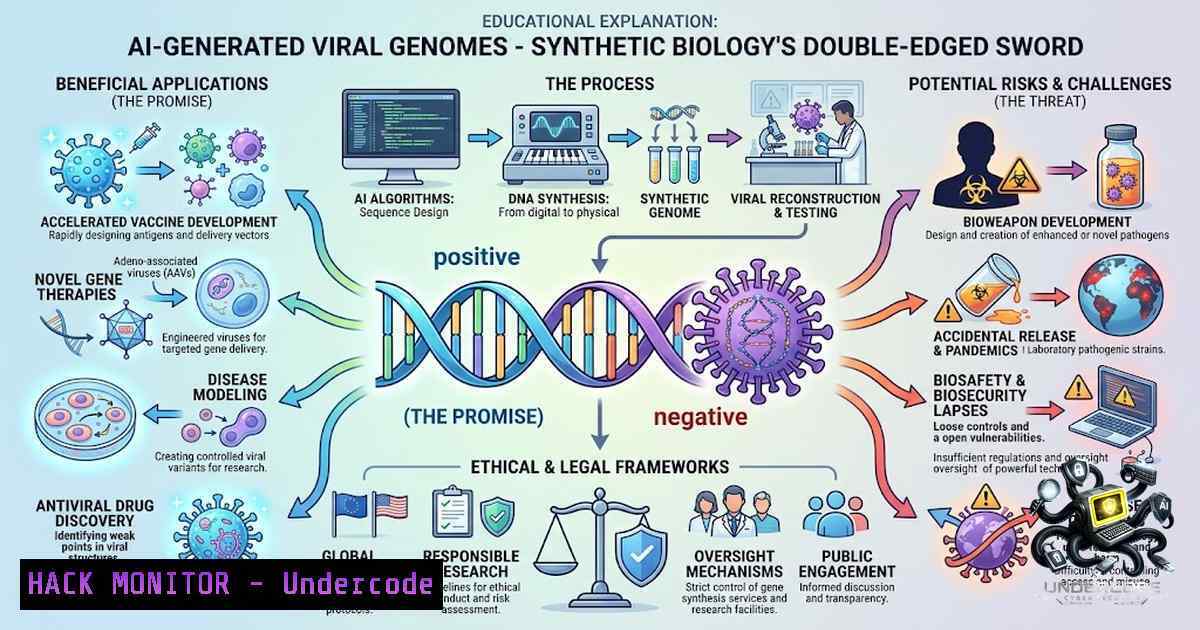
For the first time, artificial intelligence has successfully written the complete genome of a functional virus—a bacteriophage capable of infecting and inhibiting bacterial growth. In an unprecedented experiment, researchers demonstrated that Evo 1 and Evo 2, genomic language models trained on DNA sequences, could generate viable viral genomes that, when synthesized in the laboratory, produced infectious particles. This breakthrough marks a paradigm shift in synthetic biology, but simultaneously raises urgent cybersecurity and biosafety concerns: if AI can design functional pathogens, what prevents malicious actors from weaponizing this capability against human or animal hosts?
Learning Objectives:
- Understand the architecture and training methodology of genomic language models (Evo 1 and Evo 2) and their application in viral genome design.
- Analyze the experimental pipeline—from sequence generation to laboratory synthesis and viability screening—and identify critical control points.
- Evaluate the biosafety, biosecurity, and dual-use implications of AI-driven synthetic biology, with actionable risk mitigation strategies.
- Acquire hands-on skills in DNA sequence analysis, bioinformatics filtering, and security auditing of AI-generated biological data.
You Should Know:
1. Genomic Language Models: How AI “Writes” DNA
Evo 1 and Evo 2 operate on the same foundational principle as large language models (LLMs) like GPT, but instead of processing human text, they process genomic sequences composed of four nucleotide bases: adenine (A), thymine (T), cytosine (C), and guanine (G). The models learn to predict the next base in a DNA chain based on preceding context, effectively understanding which extensions are permissible in specific genomic regions, which sequences form functional genes, and which modifications remain compatible. Prior to the experiment, Evo models were additionally trained on over two million bases from bacteriophage genomes and further fine-tuned on Microviridae sequences—the viral family to which the target bacteriophage ΦX174 belongs.
Step-by-Step Guide: What This Does and How to Use It
For security researchers and bioinformaticians seeking to audit or replicate such AI-driven genomic design, the following pipeline outlines the core workflow:
- Model Selection and Fine-Tuning: Choose a pre-trained genomic model (e.g., Evo, DNABERT, or Nucleotide Transformer). Fine-tune it on a curated dataset of target viral families to improve domain-specific generation accuracy.
- Prompt Engineering: Provide the model with seed fragments of the target genome. Optimal fragment length is critical—too long, and the model merely copies the known sequence; too short, and it generates extraneous, non-functional variants. In the ΦX174 experiment, fragments of 4–9 bases yielded the best results.
- Sequence Generation: Run the model to generate thousands of candidate genomes. Set parameters to control diversity and mutation rates.
- Computational Filtering: Apply automated filters to eliminate non-viable candidates:
– Host attachment protein similarity: Reject sequences where the key viral attachment protein shows <60% similarity to the natural protein.
– Genome length: Retain only sequences within a defined range (e.g., 4,000–6,000 base pairs for ΦX174).
– Homopolymer runs: Exclude sequences with the same nucleotide repeated more than 10 times consecutively.
– GC/AT ratio: Filter out genomes with atypical nucleotide composition ratios.
5. Laboratory Synthesis: Synthesize the filtered DNA candidates and introduce them into host cells (e.g., E. coli) to test for functional viral replication.
Linux/Windows Commands for DNA Sequence Analysis:
 Linux: Install bioinformatics tools
sudo apt-get install ncbi-blast+ biopython seqtk

Calculate GC content of a FASTA file
seqtk comp viral_genome.fasta | awk '{print ($3+$4)/$2}'

Filter sequences by length (between 4000 and 6000 bp)
seqtk seq -A -L 4000 -U 6000 input.fasta > filtered.fasta

Windows (PowerShell with Biopython installed)
python -c "from Bio import SeqIO; records = [r for r in SeqIO.parse('input.fasta','fasta') if 4000 <= len(r.seq) <= 6000]; SeqIO.write(records, 'filtered.fasta', 'fasta')"
- The Experimental Pipeline: From In Silico Design to Functional Virus
The research team deliberately avoided animal or human viruses during training, excluding sequences from viruses that infect complex cells to reduce the risk of generating dangerous constructs with unpredictable properties. The test focused on bacteriophage ΦX174—a well-studied virus with a ~5,400-base genome containing only 11 genes, each with a known function. Of the 285 sequences synthesized in the laboratory, 16 produced viable viruses capable of inhibiting E. coli growth. Some variants survived dozens of protein modifications, though random mutations typically prove fatal to the original virus.
Step-by-Step Guide: Security Auditing of AI-Generated Viral Sequences
For cybersecurity professionals tasked with assessing the safety of AI-generated biological data, implement the following audit protocol:
- Source Verification: Confirm the model’s training data excludes high-risk pathogens (e.g., Ebola, SARS-CoV-2, influenza). Request model cards and training dataset manifests.
- Sequence Annotation: Use tools like Prokka or RAST to annotate generated sequences and identify all open reading frames (ORFs).
- Homology Search: Run BLAST against NCBI’s nt database to detect any unintended similarity to human or animal pathogens.
- Pathogenicity Prediction: Employ virulence factor databases (VFDB) and pathogenicity prediction tools (e.g., PathogenFinder) to assess risk.
- Regulatory Compliance Check: Verify that all generated sequences are screened against the U.S. Department of Health and Human Services (HHS) Screening Framework for Synthetic Nucleic Acids or equivalent regional regulations.
- Access Control: Implement strict role-based access control (RBAC) for genomic data repositories, with audit logging of all sequence exports.
API Security Configuration for Genomic Data Repositories:
 Example: Secure API gateway configuration (NGINX)
location /api/genomes/ {
auth_request /auth;
auth_request_set $user $upstream_http_x_forwarded_user;
proxy_set_header X-User $user;
limit_req zone=genome_api burst=10 nodelay;
 Encrypt data in transit
proxy_ssl_certificate /etc/nginx/ssl/api.crt;
proxy_ssl_certificate_key /etc/nginx/ssl/api.key;
}
3. Biosafety and Dual-Use Implications: The Cybersecurity Angle
The experiment’s success demonstrates that AI can now design functional pathogens, albeit bacteriophages. However, the underlying technology is rapidly generalizing. Genomic models trained on broader datasets could, in theory, generate sequences for human-infecting viruses. This creates a new class of dual-use risk: AI models that were developed for beneficial synthetic biology can be repurposed for bioweapon design. The researchers mitigated this risk by excluding complex-cell viruses from training and applying stringent filters. Yet, as these models become open-source, malicious actors could fine-tune them on publicly available pathogen genomes.
Cloud Hardening for AI Training Pipelines:
To secure AI training environments handling sensitive genomic data, implement the following measures:
- Data Encryption: Encrypt all training datasets at rest (AES-256) and in transit (TLS 1.3). Use hardware security modules (HSMs) for key management.
- Network Segmentation: Isolate training clusters in private subnets with no direct internet access. Use bastion hosts for administrative access.
- Container Security: Scan Docker images for vulnerabilities using Trivy or Clair before deployment. Run containers with non-root users and read-only root filesystems.
- Model Access Controls: Implement model versioning and access logging. Use model signing to prevent tampering.
- Adversarial Robustness: Test models against adversarial inputs designed to generate harmful sequences. Implement output filtering as a security control.
Linux Commands for Container Security Scanning:
 Scan Docker image for vulnerabilities
trivy image myregistry/genomic-model:latest --severity HIGH,CRITICAL

Run container with security constraints
docker run --read-only --cap-drop=ALL --cap-add=NET_BIND_SERVICE \
--security-opt=no-1ew-privileges:true myregistry/genomic-model:latest
- Vulnerability Exploitation and Mitigation in AI-Generated Biological Data
The primary vulnerability lies not in the AI model itself, but in the supply chain: training data poisoning, model theft, and unauthorized fine-tuning. An attacker could poison the training dataset with sequences designed to generate more virulent or antibiotic-resistant pathogens. Alternatively, a compromised model checkpoint could be exfiltrated and fine-tuned on malicious datasets.
Mitigation Strategies:
- Data Provenance: Maintain cryptographic hashes of all training datasets. Verify integrity before each training run.
- Model Watermarking: Embed imperceptible watermarks in model weights to enable forensic tracing of exfiltrated models.
- Federated Learning: Where possible, use federated learning to keep sensitive training data localized.
- Output Sanitization: Deploy automated screening of all generated sequences against pathogen databases before any synthesis order is placed.
Windows PowerShell Script for Sequence Sanitization:
 PowerShell: Batch screening of FASTA files against a local pathogen database
$pathogens = Get-Content -Path "C:\db\pathogen_signatures.txt"
Get-ChildItem -Path "C:\generated_sequences.fasta" | ForEach-Object {
$content = Get-Content $<em>.FullName -Raw
foreach ($sig in $pathogens) {
if ($content -match $sig) {
Write-Warning "Pathogen signature detected in $($</em>.Name)"
Move-Item $_.FullName -Destination "C:\quarantine\"
break
}
}
}
- Training and Awareness: Building a Cyber-Bio Security Workforce
The convergence of AI, synthetic biology, and cybersecurity demands a new interdisciplinary skill set. Security professionals must now understand genomic data formats, bioinformatics pipelines, and the regulatory landscape surrounding synthetic nucleic acids.
Recommended Training Modules:
- Module 1: Fundamentals of Genomics for Cybersecurity Professionals (DNA structure, sequencing technologies, FASTA/GenBank formats).
- Module 2: AI Model Security in Life Sciences (adversarial attacks, data poisoning, model extraction).
- Module 3: Biosecurity Risk Assessment Frameworks (HHS Screening Framework, WHO Laboratory Biosafety Manual).
- Module 4: Secure DevOps for Bioinformatics Pipelines (containerization, CI/CD security, secret management).
- Module 5: Incident Response for Biological Data Breaches (forensic analysis, regulatory reporting, public communication).
Linux Commands for Genomic Data Forensics:
 Calculate SHA-256 hash of a genomic dataset for integrity verification
sha256sum training_data.fasta > training_data.fasta.sha256

Monitor unauthorized access to genomic files
auditctl -w /data/genomes/ -p rwxa -k genome_access
ausearch -k genome_access --format raw | aureport -f -i
What Undercode Say:
- Key Takeaway 1: The Evo experiment proves that AI can now design functional viral genomes from scratch—a capability that shifts synthetic biology from a human-driven discipline to an AI-accelerated one. The 16 viable sequences out of 285 synthesized candidates demonstrate a 5.6% success rate, which, while modest, is a proof-of-concept that will only improve with larger models and richer training data.
-
Key Takeaway 2: Biosafety controls are currently the primary defense. The researchers’ decision to exclude animal/human viruses from training and apply multiple computational filters (protein similarity, length, homopolymer runs, GC/AT ratio) is commendable. However, these are not hard cryptographic guarantees—they are policy choices. As open-source genomic models proliferate, the barrier to generating functional pathogens will plummet, necessitating new regulatory frameworks and technical controls.
-
Analysis: This experiment is a watershed moment for both synthetic biology and cybersecurity. For the first time, the “write” capability for functional genetic material has been democratized by AI. The cybersecurity community must now treat genomic data as critical infrastructure. Traditional security models (CIA triad) must expand to include “safety” as a core pillar—not just confidentiality, integrity, and availability, but also the prevention of harm. This requires collaboration between bioinformaticians, AI researchers, and security engineers to develop robust guardrails: model watermarking, output sanitization, secure training pipelines, and real-time sequence screening. The race is on between those who would use this technology for good (phage therapy, drug discovery) and those who would weaponize it. The window for proactive defense is narrow—and closing fast.
Prediction:
-
-1 Over the next 12–24 months, open-source genomic language models will be fine-tuned on human pathogen datasets by malicious actors, leading to the first documented case of AI-generated pathogen sequence being used in a bioterrorism plot or state-sponsored biological warfare program. The barrier to entry will drop from a multi-million-dollar wet lab to a skilled programmer with cloud computing credits.
-
-1 Regulatory frameworks will struggle to keep pace. Existing screening frameworks (e.g., HHS) are designed for human-designed sequences, not AI-generated millions of candidates per hour. Expect a 18–24 month gap between the technology’s maturation and the implementation of effective oversight, during which undetected synthesis of harmful sequences will occur.
-
+1 Conversely, the same technology will accelerate phage therapy development, enabling personalized bacteriophage cocktails for antibiotic-resistant infections within 3–5 years. AI-designed phages could become a standard tool in infectious disease treatment, saving hundreds of thousands of lives annually.
-
+1 The cybersecurity industry will respond with a new product category: AI-powered biosecurity screening platforms. These will integrate with laboratory synthesis ordering systems to automatically screen all requested sequences against pathogen databases, applying machine learning to detect novel harmful patterns not in existing databases.
-
-1 The convergence of AI and synthetic biology will trigger a new wave of cyber-bio attacks, where ransomware groups encrypt genomic datasets and demand payment not just for decryption, but to prevent the public release of engineered pathogen sequences. This will create a new class of extortion with life-threatening consequences.
▶️ Related Video (88% Match):
https://www.youtube.com/watch?v=1Q-FuQ0isMs
🎯Let’s Practice For Free:
🎓 Live Courses & Certifications:
Join Undercode Academy for Verified Certifications
🚀 Request a Custom Project:
Secure, high-velocity infrastructure and disruptive technological engineering. Contact our engineering team for high-tier development and proprietary systems:
[email protected]
💎 Smart Architecture | 🛡️ Secure by Design | ⭐ Trusted by Thousands
IT/Security Reporter URL:
Reported By: https://lnkd.in/p/evhvtCxs – Hackers Feeds
Extra Hub: Undercode MoN
Basic Verification: Pass ✅


