
Listen to this Post
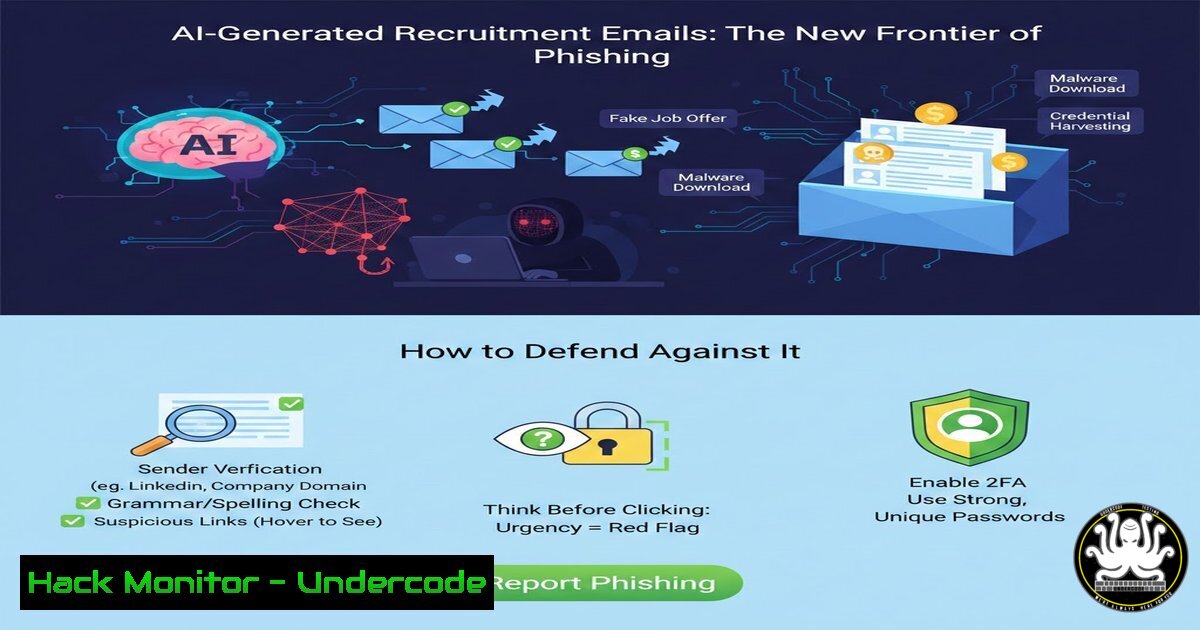
Introduction:
The proliferation of AI-generated content has infiltrated recruitment, producing highly convincing—yet often irrelevant—job opportunity emails. While some are merely spam, many now serve as sophisticated phishing lures, weaponizing Large Language Models (LLMs) to craft personalized, error-free messages that bypass traditional spam filters. Cybersecurity professionals must dissect these digital wolves in sheep’s clothing, leveraging email forensics, authentication protocols, and AI detection tools to safeguard their organizations.
Learning Objectives:
- Identify structural and semantic red flags unique to AI-generated recruitment phishing.
- Perform in-depth email header analysis and validate sender authentication records.
- Deploy command-line tools and AI-based detectors to automate threat assessment.
You Should Know:
1. Email Header Forensics: Unmasking the Origin
Email headers contain a wealth of forensic data—sender IP, return-path, authentication results, and routing history. Modern AI-generated emails often spoof legitimate domains; headers rarely lie.
Step‑by‑step guide (Linux / Windows):
- Extract full headers – In Gmail: open email → three dots → “Show original”. In Outlook: double‑click email → File → Properties → Internet headers.
2. Analyze with command line (Linux):
 Save headers to file and inspect
cat email_headers.txt | grep -E "Received: from|SPF|DKIM|DMARC|Reply-To|Return-Path"
 Trace the originating IP
dig -x <IP_address> +short
whois <IP_address>
3. Windows PowerShell alternative:
 If you have the .eml file
Get-Content .\email.eml | Select-String -Pattern "Received: from|SPF|DKIM|DMARC"
 DNS lookup for IP
Resolve-DnsName <IP_address> -Type PTR
4. Look for anomalies: Mismatched `Reply-To` domains, `Received` chains that don’t align with claimed sender, or missing authentication headers.
2. Sender Authentication: SPF, DKIM, and DMARC Auditing
AI‑generated phishing often originates from domains with weak or missing email authentication. Verify records manually:
Linux:
 SPF record
dig TXT example.com | grep "v=spf1"
 DKIM selector (commonly "default" or "google")
dig TXT default._domainkey.example.com
 DMARC policy
dig TXT _dmarc.example.com
Windows PowerShell:
Resolve-DnsName -Type TXT example.com | ? Strings -match "v=spf1"
Resolve-DnsName -Type TXT default._domainkey.example.com
Resolve-DnsName -Type TXT _dmarc.example.com
Interpretation:
– `v=spf1` missing → domain can be spoofed.
– No DKIM record → email integrity not assured.
– DMARC `p=none` → no enforcement; `p=quarantine` or `p=reject` indicates mature security posture.
3. AI-Generated Text Fingerprinting with Open‑Source Tools
LLMs leave subtle statistical fingerprints. Tools like GPTZero and HuggingFace’s Roberta‑Large‑OpenAI‑Detector can be scripted.
Linux / Python setup:
 Install required libraries
pip install transformers torch

Create detection script: ai_detect.py
from transformers import pipeline
detector = pipeline("text-classification", model="roberta-large-openai-detector")
text = "I came across your profile and thought you'd be a great fit..."
result = detector(text[:512])
print(result)  'fake' probability indicates AI generation
Usage:
Pipe email bodies directly into the script for bulk analysis. Note: these detectors are not infallible but add a valuable layer.
- Sandboxing Attachments and Links in a Controlled Environment
Even AI‑crafted emails may carry malicious payloads. Never trust attachments; test them in isolation.
Linux (Cuckoo Sandbox / Hybrid Analysis CLI):
 Submit file to Hybrid Analysis (requires API key)
curl -F "[email protected]" -H "api-key: YOUR_KEY" https://www.hybrid-analysis.com/api/v2/submit/file
 Quick static analysis
file suspicious.doc
strings suspicious.doc | grep -E "http|powershell|cmd|wscript"
Windows (Sysinternals):
 Download and run Process Monitor on a sandbox VM
.\Procmon.exe /AcceptEula
 Use sigcheck to verify digital signatures
sigcheck -a suspicious.doc
5. Hardening Email Gateways with DMARC Rejection Policies
Move beyond monitoring—enforce DMARC rejection to block spoofed AI‑recruitment emails.
Configuration example (generic MTA):
1. Publish a DMARC record with `p=reject`:
`v=DMARC1; p=reject; rua=mailto:[email protected]; pct=100`
- Test with `dig` as shown in section 2.
- Monitor aggregate reports to identify legitimate senders that fail alignment.
6. Building a Human Firewall: Tailored Training Modules
Automation cannot replace a trained eye. Develop in‑house labs:
- Phishing simulation using AI‑generated templates (tools: GoPhish, SET).
- Hands‑on exercises:
- Compare real vs. AI‑generated recruitment emails side by side.
- Use email header analysis in a live lab (Linux/Windows VMs).
- Recommended courses: SANS SEC401 (defense), Cybrary’s “Phishing Awareness”, LinkedIn Learning’s “Cybersecurity with AI”.
7. Incident Response: Containing AI‑Phishing Breaches
If an employee falls victim, rapid containment is critical.
SIEM query example (Splunk):
index=email sourcetype=phishing_alert [email protected]
| table _time, sender, subject, link_clicked
| eval verdict=if(match(sender, "external_untrusted"), "malicious", "unknown")
Linux host compromise triage:
 Check for unauthorized processes
ps aux --sort=-%mem | head -20
 Review auth logs
grep "Accepted" /var/log/auth.log | tail -50
 Network connections
ss -tunap
What Undercode Say:
- Key Takeaway 1: AI‑generated recruitment emails are no longer just annoyances—they are precision phishing weapons that exploit trust in professional networks.
- Key Takeaway 2: Defending against them requires a layered stack: DNS‑level authentication, email header forensics, AI content detection, and continuous user education.
- Analysis: The LinkedIn post highlights a systemic flaw—recruitment platforms monetize low‑effort AI outreach while ignoring security implications. Cybersecurity teams must now treat “job opportunity” emails with the same suspicion as Nigerian prince scams. Automated header analysis and DMARC enforcement are immediate, high‑impact mitigations. Over‑reliance on LLM detectors is risky; they should supplement, not replace, traditional email security. The human element remains the weakest link—and the best defense when properly trained. Investing in blue‑team automation to parse and flag AI‑generated language will become a standard SOC capability within two years.
Prediction:
As generative AI evolves, recruitment phishing will merge with deepfake voice and video calls (“vishing”), creating fully synthetic multi‑channel impersonation attacks. Email authentication alone will be insufficient. Future defense will pivot to zero‑trust email architecture—no implicit trust for any inbound message, mandatory out‑of‑band verification for financial or credential‑related requests, and AI‑vs‑AI arms races at the transport layer. Organizations that fail to adapt will suffer credential leaks and ransomware deployments initiated by a single automated “job inquiry.”
▶️ Related Video (80% Match):
🎯Let’s Practice For Free:
IT/Security Reporter URL:
Reported By: Daspinks Here – Hackers Feeds
Extra Hub: Undercode MoN
Basic Verification: Pass ✅


