
Listen to this Post
Introduction:
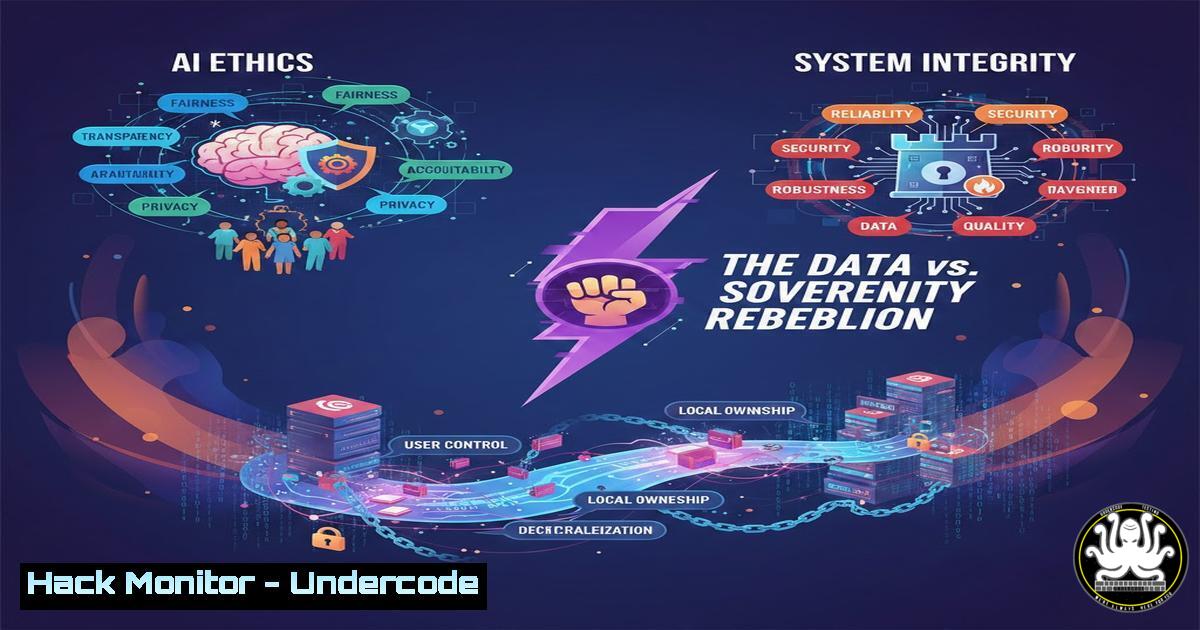
The modern digital ecosystem is a battlefield of narratives. While the philosophical struggle for personal sovereignty often plays out in boardrooms and social media, its technical equivalent is fought in server logs, API endpoints, and access control lists (ACLs). When a system—whether a social media algorithm or a corporate firewall—attempts to “flip the script” on a user, it often manifests as unauthorized data harvesting, gaslighting via UI/UX, or the manipulation of behavioral data. This article dissects the technical anatomy of “systemic gaslighting,” moving beyond the psychological to explore how integrity in tech is maintained through data sovereignty, immutable logs, and AI ethics hardening. We will explore how to verify that your digital “mirror” is not cracked by analyzing the infrastructure of trust, specifically focusing on the tools and protocols that prevent systems from defining you against your will.
Learning Objectives:
- Analyze the correlation between personal data sovereignty and system integrity verification.
- Implement Linux/Windows commands to audit system logs for unauthorized access patterns.
- Configure AI ethics guardrails to prevent algorithmic bias and misrepresentation.
- Execute API security hardening to prevent data manipulation by third-party services.
- Apply cryptographic verification methods to ensure data immutability.
You Should Know:
1. Auditing the System Logs: The Technical “Confession”
In the context of the post, the “broken mirror” represents a system that reflects a distorted reality—often due to compromised data integrity. The first step in reclaiming your narrative is to audit the system logs for unauthorized access or changes. If a system is trying to “punish you for noticing,” it is likely doing so by manipulating data points.
Step‑by‑step guide: Checking for Integrity Violations
- Linux (Syslog/Journald): Use `journalctl` to query system logs for authentication failures or unauthorized sudo attempts. This reveals if someone (or a process) has been trying to alter system states.
Check for failed SSH login attempts (potential reconnaissance)
sudo journalctl _SYSTEMD_UNIT=ssh.service | grep "Failed password"

List all sudo commands executed to see if anyone is escalating privileges illegitimately
sudo grep "sudo:" /var/log/auth.log
- Windows (Event Viewer via PowerShell): Use PowerShell to query security logs for Account Manipulation (Event ID 4738) or User Account Changes.
Get events related to user account changes in the last 7 days
Get-EventLog -LogName Security -InstanceId 4738 -After (Get-Date).AddDays(-7) | Format-List
This process allows you to verify if the “confession” the system demands exists in the form of log entries that prove your innocence (or its corruption).
2. AI Ethics Guardrails: Preventing Algorithmic Gaslighting
Jess T. mentions building “psychologically safe systems for neurodiverse users” with projects like “Bully Buddy.” In AI, the “villain narrative” occurs when a model is trained on biased data, leading to misclassification of user intent or identity. To prevent this, you must implement fairness constraints.
Step‑by‑step guide: Implementing a Fairness Constraint in ML Models
Using a hypothetical Python script with an AI fairness library (like AIF360), you can check for disparate impact.
 Example: Checking for bias in a hiring algorithm (simplified)
from aif360.datasets import BinaryLabelDataset
from aif360.metrics import BinaryLabelDatasetMetric

Assume 'dataset' contains privileged and unprivileged groups
metric = BinaryLabelDatasetMetric(dataset,
unprivileged_groups=[{'race': 1}],
privileged_groups=[{'race': 0}])
print("Disparate Impact:", metric.disparate_impact())
 A value < 0.8 indicates potential bias that could "misrepresent" an individual.
This technical step ensures the system reflects reality (the user’s data) accurately, rather than a broken, biased mirror.
- API Security and Data Sovereignty: Controlling the Narrative
The post highlights links to various platforms (GoStudio.AI, Instagram, etc.). Every time your data is sent to an external API, you risk it being crunched into “other people’s fantasies.” Hardening API calls and ensuring data sovereignty means controlling the egress of sensitive information.
Step‑by‑step guide: Hardening an API Request with mTLS and Payload Encryption
To prevent man-in-the-middle attacks or data manipulation during transmission, implement mutual TLS (mTLS) and encrypt sensitive payload fields.
 Using curl with client certificate authentication (mTLS)
curl --cert client.crt --key client.key --cacert ca.crt \
-X POST https://api.secureplatform.com/v1/user/data \
-H "Content-Type: application/json" \
-d '{"user": "encrypted_payload_here"}'
Additionally, implement strict rate limiting on the server side (e.g., using Nginx) to prevent data scraping attempts that could be used to build a false profile of you.
 Nginx config to limit requests per IP
limit_req_zone $binary_remote_addr zone=mylimit:10m rate=10r/s;
server {
location /api/ {
limit_req zone=mylimit burst=20 nodelay;
}
}
4. Blockchain for Immutable Integrity: The Unbreakable Mirror
If you want to ensure that your actions cannot be misrepresented later (“they take your silence and call it a confession”), you can anchor your digital proof to a blockchain. This creates a timestamped, immutable record.
Step‑by‑step guide: Creating a Verifiable Hash of a Document
Use OpenSSL to create a hash of a file, then record that hash on a public ledger (conceptually).
 Generate SHA-256 hash of a document (e.g., a contract or log file)
openssl dgst -sha256 -binary important_document.pdf | xxd -p
 Output: 5e884898da28047151d0e56f8dc6292773603d0d6aabbdd62a11ef721d1542d8
You would then submit this hash via a service that writes to a blockchain (like Ethereum). Later, if someone claims you altered the document, you can regenerate the hash and prove the data hasn’t changed since the timestamp, effectively “letting your own life be the evidence.”
5. Cloud Hardening: Securing Your Community Roots
The post mentions “community roots” and links to various foundations (Marine Foundation, GGAF). For organizations managing community data, cloud misconfigurations are the fastest way to lose sovereignty. An open S3 bucket is a “broken mirror” that exposes everyone’s reflection.
Step‑by‑step guide: Auditing AWS S3 for Public Access
Using the AWS CLI, you can check for buckets that allow public access, which would violate the psychological safety of users.
 List all buckets and check their public access block status
aws s3api list-buckets --query 'Buckets[].Name' --output text | xargs -I {} aws s3api get-public-access-block --bucket {} 2>&1
 If the command returns an error, the bucket might be publicly accessible.
To remediate, block public access immediately:
aws s3api put-public-access-block --bucket your-bucket-name --public-access-block-configuration BlockPublicAcls=true,IgnorePublicAcls=true,BlockPublicPolicy=true,RestrictPublicBuckets=true
What Undercode Say:
- Key Takeaway 1: Digital sovereignty is not a philosophical concept but a technical configuration. By auditing logs, encrypting data in transit, and verifying API endpoints, you reclaim the narrative from systems designed to categorize you.
- Key Takeaway 2: AI ethics are a form of system integrity. Implementing bias detection algorithms is the technical equivalent of refusing to look into a “broken mirror”; it ensures the output reflects the input truthfully, without distortion.
The psychological concept of being the “villain” in someone else’s story translates directly to the technical world where a compromised system flags a benign user as a threat. The defense lies in proactive hardening: using immutable ledgers to timestamp truth, applying strict ACLs to prevent unauthorized data manipulation, and deploying fairness metrics to prevent algorithmic prejudice. The architects of the future are not just those who build AI, but those who build in the checks and balances that prevent the system from “eating us alive” with its fantasies. By treating every data point as a piece of evidence in your own story, you move from a reactive victim to a sovereign node in the network.
Prediction:
Within the next 18 months, we will see the rise of “Personal Integrity Protocols” (PIPs)—standardized cryptographic frameworks that allow individuals to prove the authenticity of their digital footprint without relying on the platforms that seek to control them. As AI agents become more autonomous, the conflict will shift from human vs. system to AI vs. AI, where one agent attempts to gaslight another. The ultimate battleground will be the verifiability of the training data itself, making data provenance and integrity the most valuable assets in the digital economy.
▶️ Related Video (90% Match):
🎯Let’s Practice For Free:
IT/Security Reporter URL:
Reported By: Jesstoft Sovereignty – Hackers Feeds
Extra Hub: Undercode MoN
Basic Verification: Pass ✅


