
Listen to this Post
Introduction:
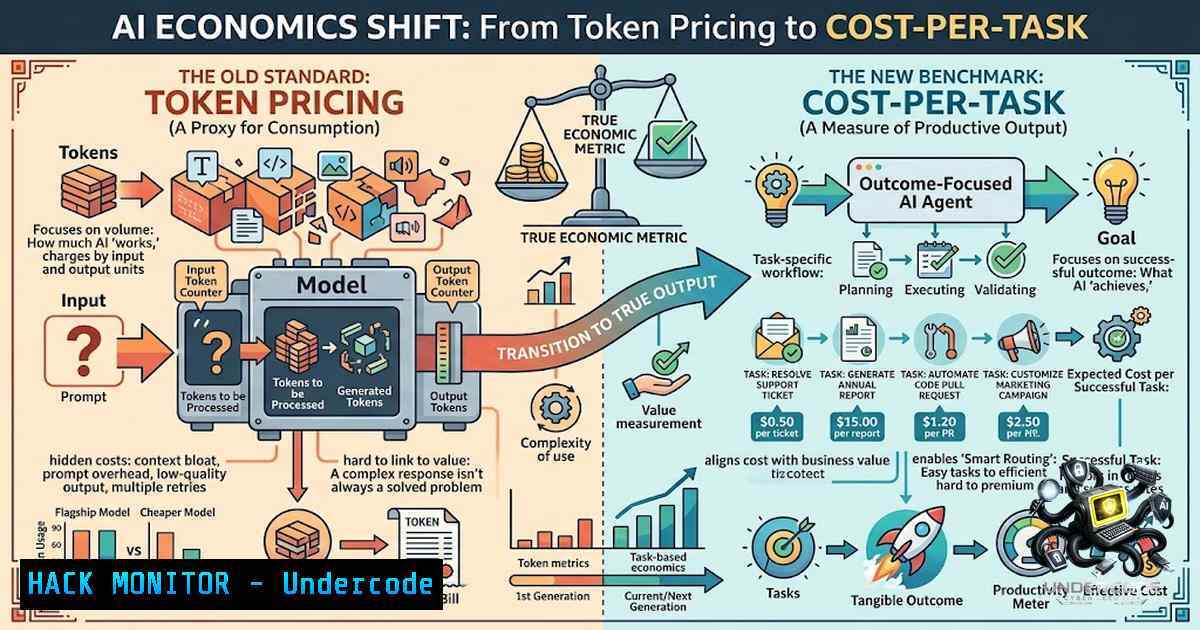
The artificial intelligence industry has long relied on token-based pricing models to quantify the cost of generative AI services, but this metric fundamentally misaligns with actual business value creation. As organizations increasingly integrate AI into mission-critical workflows, the traditional focus on input and output token costs obscures the true economic equation. A paradigm shift is emerging where successful task completion—accounting for retries, fallback mechanisms, and human validation overhead—becomes the definitive measure of AI operational efficiency, challenging vendors to reconsider how they price and benchmark their models.
Learning Objectives & Secrets:
- Objective 1: Evaluate AI Models Based on Task Success Rate
Learn to measure model effectiveness through completion accuracy, error recovery patterns, and consistency across diverse query types.
Secret Tip: Implement a weighted scoring system that penalizes models requiring excessive retries, as each failed attempt compounds infrastructure costs and latency overhead. -
Objective 2: Calculate Total Cost of Ownership for AI-Powered Features
Develop frameworks that incorporate token usage, compute resources, retry logic, fallback orchestration, and human-in-the-loop validation expenses.
Secret Tip: Use serverless architectures with granular billing alerts to isolate cost-per-task metrics in production environments, enabling real-time budget optimization. -
Objective 3: Optimize Prompt Engineering and Model Selection for Cost Efficiency
Master techniques to reduce token consumption without sacrificing output quality, including chain-of-thought pruning, dynamic context windows, and hybrid model routing.
Secret Tip: Deploy a multi-model gateway that routes simple queries to lighter models (e.g., GPT-5.6 Luna) and complex tasks to frontier models (GPT-5.6 Sol), balancing cost and capability dynamically.
You Should Know:
1. Implementing Cost-Aware API Gateways for AI Workloads
Modern AI applications require intelligent routing to minimize per-task expenses while maintaining performance standards. This section provides practical steps to build a cost-aware gateway that evaluates model performance and cost in real time.
Step-by-Step Guide:
- Set Up a Model Registry with Cost Metadata
Create a database table storing model identifiers, cost per 1K tokens (input/output), average task completion rate, and latency percentiles. Example PostgreSQL schema:CREATE TABLE model_registry ( id SERIAL PRIMARY KEY, model_name VARCHAR(50), input_cost_per_1k DECIMAL(10,6), output_cost_per_1k DECIMAL(10,6), avg_completion_rate DECIMAL(5,2), p95_latency_ms INTEGER );
-
Deploy a Router Service Using Python and FastAPI
Implement a scoring function that calculates a weighted cost score based on historical performance:async def select_model(query_complexity: float, required_accuracy: float): candidates = await db.fetch_all("SELECT FROM model_registry") for model in candidates: score = (model.avg_completion_rate 0.6) - (model.p95_latency_ms 0.2) - (model.input_cost_per_1k 0.2) return sorted(candidates, key=lambda x: x['score'], reverse=True)[bash]
3. Integrate Retry and Fallback Logic
Configure exponential backoff with jitter for retries, and designate a fallback model (e.g., GPT-5.6 Sol) when the primary model fails twice:
from tenacity import retry, stop_after_attempt, wait_exponential

@retry(stop=stop_after_attempt(2), wait=wait_exponential(multiplier=1, min=2, max=10))
async def call_model_with_retry(model, prompt):
try:
return await openai_client.chat.completions.create(model=model, messages=prompt)
except Exception as e:
logger.warning(f"Model {model} failed, switching to fallback")
return await openai_client.chat.completions.create(model='gpt-5.6-sol', messages=prompt)
4. Monitor Costs with CloudWatch or Prometheus
Create custom metrics for cost per successful task and alert when thresholds exceed 120% of baseline. For AWS, use:
aws cloudwatch put-metric-data --1amespace "AI/Cost" --metric-1ame "CostPerTask" --value 0.0042 --unit Count
5. Test with A/B Traffic Splitting
Route 10% of traffic to a new model variant and compare cost-per-task against the incumbent over 24 hours:
curl -X POST https://api.gateway.ai/v1/route -H "x-traffic-group: test" -d '{"query": "Summarize this contract"}'
2. Optimizing Token Efficiency Through Dynamic Context Management
Token consumption directly impacts cost, but intelligent context pruning can reduce usage by 30-50% without degrading output quality.
Step-by-Step Guide:
1. Implement Sliding Context Windows
For chat applications, retain only the last N turns plus a summarized history. Use a summarization model like GPT-5.6 Luna to compress older turns:
def trim_context(history, max_tokens=4000):
while count_tokens(history) > max_tokens:
 Summarize the oldest 20% of messages
oldest = history[:len(history)//5]
summary = summarize(oldest)
history = [bash] + history[len(history)//5:]
return history
2. Apply Semantic Chunking for Document Processing
Split long documents into semantic chunks using sentence embeddings, then retrieve only relevant chunks via vector search:
from sentence_transformers import SentenceTransformer
model = SentenceTransformer('all-MiniLM-L6-v2')
chunks = split_into_paragraphs(document)
embeddings = model.encode(chunks)
query_embedding = model.encode(query)
relevant_indices = cosine_similarity(query_embedding, embeddings).argsort()[-3:]
reduced_prompt = "\n".join([chunks[bash] for i in relevant_indices])
3. Use System Prompts to Constrain Output Length
Explicitly instruct the model to generate concise responses with character or word limits:
System: You are a technical assistant. Provide answers in exactly 3 bullet points, each under 15 words.
4. Cache Frequent Queries with Redis
Store responses for repetitive tasks with a TTL based on data freshness requirements:
redis-cli SET "task:summarize:report_2024" "summary_text" EX 86400
redis-cli GET "task:summarize:report_2024"
5. Log and Analyze Token Usage Metrics
Use OpenTelemetry to trace token consumption per request and visualize trends in Grafana:
from opentelemetry import metrics
meter = metrics.get_meter(<strong>name</strong>)
token_counter = meter.create_counter("prompt_tokens", description="Prompt tokens per task")
token_counter.add(prompt_tokens, {"model": "gpt-5.6-luna"})
- Security Hardening for AI Gateways and API Keys
As AI services become cost-sensitive, attackers may attempt to exploit endpoints through token bombing or prompt injection to inflate costs.
Step-by-Step Guide:
1. Rate Limit Based on Token Consumption
Implement a rate limiter that caps total tokens per minute per API key, not just request count:
from fastapi import Request
from slowapi import Limiter
from slowapi.util import get_remote_address

limiter = Limiter(key_func=get_remote_address)
@app.post("/v1/chat")
@limiter.limit("10000 tokens per minute")
async def chat(request: Request):
pass
2. Validate and Sanitize Inputs
Use regex patterns to block excessively long inputs and detect injection patterns:
import re
def validate_prompt(prompt):
if len(prompt) > 8000:
raise ValueError("Prompt exceeds safe limit")
if re.search(r"(?i)(ignore|override|system)", prompt):
raise SecurityError("Potential prompt injection detected")
- Encrypt API Keys at Rest and in Transit
Use AWS KMS or HashiCorp Vault to manage secrets, and enforce TLS 1.3 for all connections:aws kms encrypt --key-id alias/ai-api-key --plaintext file://api_key.txt --output text --query CiphertextBlob
4. Enable Audit Logging for Cost Anomalies
Configure CloudTrail and CloudWatch to trigger alerts when a single API key exceeds 200% of its average daily usage:
aws cloudwatch put-metric-alarm --alarm-1ame "HighTokenUsage" --metric-1ame "TokenCount" --1amespace "AI" --statistic Sum --period 300 --evaluation-periods 2 --threshold 5000000 --comparison-operator GreaterThanThreshold
5. Implement a Web Application Firewall (WAF) Rule
Block suspicious IPs and user-agent strings that show scraping patterns:
aws wafv2 create-web-acl --1ame ai-gateway-acl --scope REGIONAL --default-action Allow
aws wafv2 update-web-acl --1ame ai-gateway-acl --scope REGIONAL --rules file://waf-rules.json
4. Measuring Human Review Costs and Orchestration Overhead
Human validation often represents the largest hidden cost in AI pipelines. Automating quality checks can significantly reduce this burden.
Step-by-Step Guide:
1. Deploy Confidence Scoring for Automatic Filtering
Use model log-probabilities to flag low-confidence outputs for human review:
response = openai_client.chat.completions.create(..., logprobs=True)
avg_logprob = np.mean([token.logprob for token in response.choices[bash].logprobs.content])
if avg_logprob < -2.5:
send_for_human_review(response.choices[bash].message.content)
2. Implement a Feedback Loop with Reinforcement Learning
Collect human corrections and fine-tune a smaller model to replicate review patterns, reducing manual effort:
openai fine_tunes.create -t corrections.jsonl -m gpt-3.5-turbo --suffix "review-specialist"
3. Use Rule-Based Post-Processing
Apply regex and NLP heuristics to catch common errors (e.g., hallucinated dates, inconsistent numbers):
import re
def validate_output(text):
date_pattern = r'\d{4}-\d{2}-\d{2}'
if not re.search(date_pattern, text):
return False, "Missing date"
return True, text
4. Track Review Time with Analytics
Instrument the review UI to measure average time per task and identify bottlenecks:
performance.mark('review_start');
// ... user reviews ...
performance.mark('review_end');
performance.measure('review_duration', 'review_start', 'review_end');
5. Budget Review Effort Based on Task Criticality
Assign a “review priority” score to each task and allocate resources accordingly:
priority = calculate_priority(prompt_tokens, user_importance, cost_so_far)
if priority > 0.8: escalate_to_senior_reviewer()
5. Cloud Cost Optimization for AI Infrastructure
Beyond API costs, compute and storage expenses can dominate AI budgets. Applying cloud-1ative optimizations can yield significant savings.
Step-by-Step Guide:
1. Right-Size GPU Instances
Use AWS Compute Optimizer or Azure Advisor to recommend instance types based on utilization:
aws compute-optimizer get-ec2-instance-recommendations --instance-arns arn:aws:ec2:us-east-1:123456789012:instance/i-12345
2. Use Spot Instances for Non-Critical Batch Jobs
Launch Spark or Ray clusters on spot instances with a fallback to on-demand if interrupted:
aws ec2 request-spot-instances --instance-count 2 --launch-specification file://spec.json
3. Enable Auto-Scaling Based on Queue Depth
Configure KEDA or AWS Auto Scaling to scale pods based on SQS queue length:
apiVersion: keda.sh/v1alpha1
kind: ScaledObject
metadata: name: ai-worker
spec:
scaleTargetRef: { name: ai-deployment }
triggers:
- type: aws-sqs-queue
metadata: { queueURL: https://sqs.region.amazonaws.com/12345/ai-queue, queueLength: "10" }
4. Implement Storage Tiering for Model Artifacts
Move older model versions to S3 Glacier or Azure Archive to reduce storage costs:
aws s3 cp s3://models/gpt-5.6-luna-v1/ s3://models-archive/ --recursive --storage-class GLACIER
5. Monitor and Shut Down Idle Environments
Use CloudWatch Events to stop instances during off-hours:
aws events put-rule --1ame StopInstancesAtNight --schedule-expression "cron(0 22 ? )"
6. Continuous Evaluation and Model Rotation
The AI landscape evolves rapidly; regularly reassessing model performance ensures cost efficiency over time.
Step-by-Step Guide:
1. Set Up Daily Benchmark Runs
Use a fixed test set of 1000 tasks to compare new model versions against the baseline:
async def daily_benchmark():
for model in ['gpt-5.6-luna', 'gpt-5.6-sol', 'gpt-4-turbo']:
total_cost, total_success = 0, 0
for task in test_set:
result = await call_model(model, task.prompt)
total_cost += result.cost; total_success += 1 if task.validate(result) else 0
log_metrics(model, total_cost / len(test_set), total_success / len(test_set))
2. A/B Test New Models in Production
Deploy canary releases with 5% traffic and compare cost-per-task over 7 days:
istioctl create -f virtual-service-canary.yaml
3. Automate Model Rollback on Cost Spikes
Configure Prometheus alerts to revert to the previous model if cost-per-task exceeds threshold:
groups:
- name: ai.rules
rules:
- alert: HighCostPerTask
expr: ai_cost_per_task > 0.005
annotations: { summary: "Reverting to stable model" }
4. Maintain a Model Performance Dashboard
Visualize trends with Grafana, including cost, accuracy, and latency:
{ "panels": [ { "targets": [ { "expr": "avg(ai_cost_per_task) by (model)" } ] } ] }
5. Document Model Retirement Process
Create a runbook for deprecating underperforming models, including data migration and client notifications.
What Undercode Say:
- Key Takeaway 1: Token pricing is a vendor-centric metric that fails to capture the real cost of AI integration; success-based costing aligns incentives between providers and enterprises, encouraging models that deliver reliable outputs with minimal friction.
- Key Takeaway 2: The GPT-5.6 family demonstrates that frontier intelligence does not necessarily command premium pricing—models like Sol offer competitive performance at lower per-task costs, democratizing access for startups and reducing the barrier to entry for AI-1ative products.
- Analysis: The industry is transitioning from “pay-as-you-token” to “pay-for-value” models, driven by the realization that task completion encompasses retries, context engineering, and human oversight. This shift will force vendors to publish not just token prices but also benchmarked cost-per-task metrics, potentially leading to tiered SLAs based on task complexity. Startups should adopt cost-aware architectures early, leveraging model routers, caching layers, and automated quality checks to maintain profitability as AI adoption scales. The competitive advantage will increasingly lie in orchestration intelligence rather than raw model capability, rewarding teams that can extract maximum value from each API call. This evolution parallels the cloud computing journey, where early cost metrics (CPU hours) gave way to outcome-based billing (serverless function invocations). As AI commoditizes, the winners will be those who optimize the entire pipeline, from prompt design to human review, creating a virtuous cycle of cost reduction and capability expansion. Expect to see new entrants offering “outcome guarantees” and insurance products against task failure, further reshaping the economic landscape. For now, prudent engineers will treat every token as a scarce resource and every model as a variable in a larger optimization problem.
Prediction:
- +1 The cost-per-task benchmark will become a standard industry metric within 18 months, with major cloud providers integrating it into their AI service dashboards.
- +1 Open-source model hubs will adopt “efficiency scores” that rank models based on cost-per-task across diverse workloads, accelerating the commoditization of AI.
- -1 Smaller AI startups may face margin pressure as enterprises demand outcome-based pricing, potentially leading to consolidation in the inference-as-a-service market.
- +1 Advances in model distillation and quantization will reduce per-task costs by 40-60%, making AI viable for previously uneconomical use cases like real-time fraud detection.
- -1 The focus on cost efficiency may incentivize vendors to over-optimize for benchmarks, potentially sacrificing robustness or fairness in edge cases.
- +1 Hybrid routing systems that dynamically select models based on task complexity will become a standard architectural pattern, similar to CDN caching for content delivery.
- +1 Regulatory bodies may adopt cost-per-task as a metric for assessing AI affordability in public sector deployments, influencing procurement standards.
- -1 As costs decrease, the barrier to entry for malicious actors also lowers, potentially increasing the risk of automated attacks and disinformation campaigns.
- +1 The evolution will drive innovation in prompt compression and few-shot learning, further reducing token dependencies and enabling longer context windows without prohibitive costs.
- +1 Organizations that adopt cost-aware AI strategies today will achieve a 3-5x ROI advantage over competitors relying solely on token-based pricing models by 2027.
▶️ Related Video (80% Match):
🎯Let’s Practice For Free:
🎓 Live Courses & Certifications:
Join Undercode Academy for Verified Certifications
🚀 Request a Custom Project:
Secure, high-velocity infrastructure and disruptive technological engineering. Contact our engineering team for high-tier development and proprietary systems:
[email protected]
💎 Smart Architecture | 🛡️ Secure by Design | ⭐ Trusted by Thousands
IT/Security Reporter URL:
Reported By: https://lnkd.in/p/eHBDmUdH – Hackers Feeds
Extra Hub: Undercode MoN
Basic Verification: Pass ✅


