Listen to this Post
Introduction:
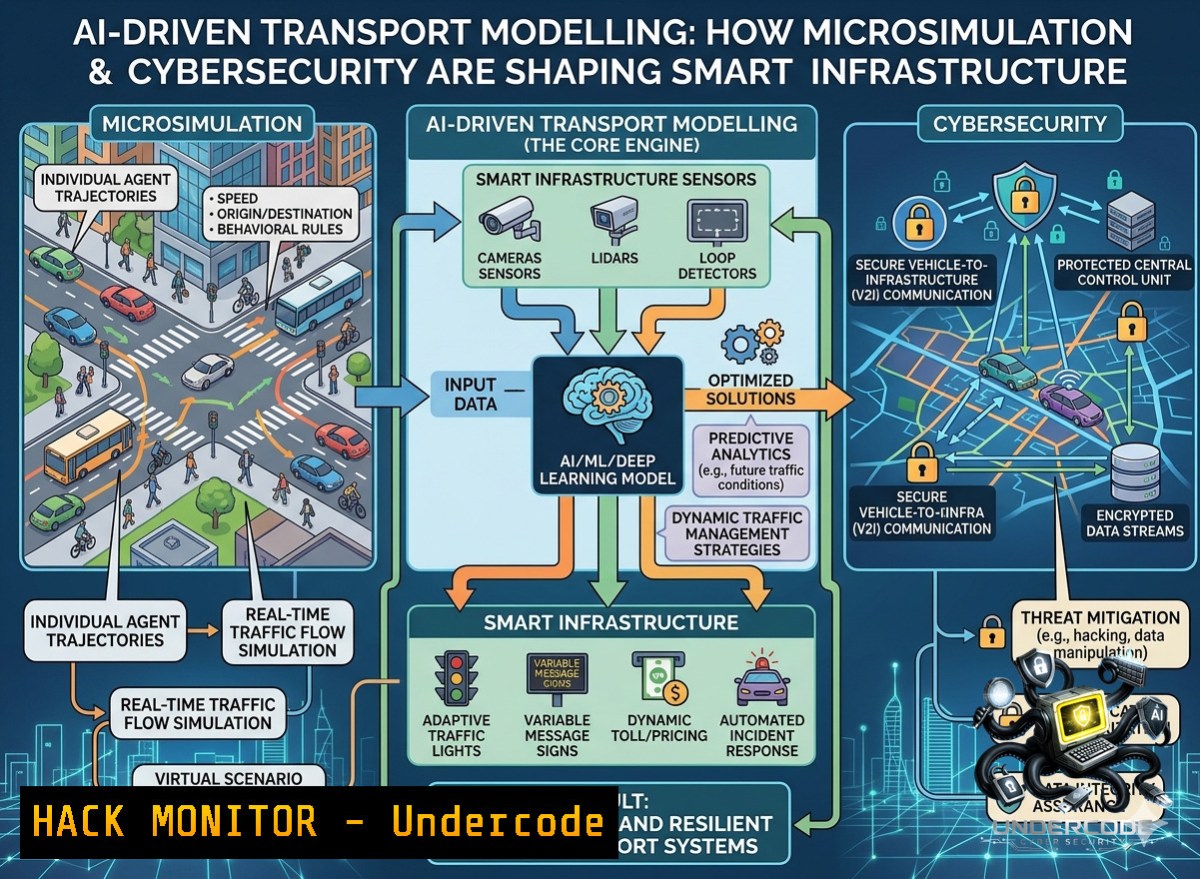
Transport microsimulation models are critical for urban planning, but their reliance on real-time data feeds, IoT sensors, and cloud-based analytics introduces significant cybersecurity risks. As North Yorkshire Council seeks Senior and Transport Modellers (salaries £35k–£48k) to maintain these models, professionals must now blend data science, AI, and infrastructure security to protect against tampering, data poisoning, and ransomware attacks that could paralyse traffic networks.
Learning Objectives:
- Understand how transport microsimulation models integrate with AI and real‑world data pipelines.
- Identify cybersecurity vulnerabilities in smart transport infrastructure (traffic sensors, V2X, cloud APIs).
- Apply Linux/Windows commands and hardening techniques to secure modelling environments and data flows.
You Should Know:
- Extending the Post: Real‑World Transport Modelling and Its Tech Stack
North Yorkshire Council’s transport modelling team uses microsimulation tools (e.g., AIMSUN, VISSIM, SUMO) to predict traffic behaviour, evaluate infrastructure projects, and inform decarbonisation strategies. These models ingest live data from CCTV, loop detectors, and GPS trackers. To replicate this environment, you can install the open‑source SUMO (Simulation of Urban MObility) on Linux or Windows.
Step‑by‑step guide – Installing SUMO on Ubuntu (Linux):
 Update system and install dependencies
sudo apt update && sudo apt upgrade -y
sudo apt install sumo sumo-tools sumo-doc -y

Verify installation
sumo --version

Set environment variable for SUMO_HOME (optional)
echo 'export SUMO_HOME=/usr/share/sumo' >> ~/.bashrc
source ~/.bashrc

Run a simple example simulation
sumo -c /usr/share/sumo/tests/sumo/netedit/import/plain/simple.netc.cfg
Windows equivalent: Download the SUMO installer from https://sumo.dlr.de, add `C:\Program Files\SUMO\bin` to PATH, and run `sumo –version` in Command Prompt.
Cybersecurity angle: Transport models are prime targets for adversarial ML (e.g., injecting fake traffic data to cause model mispredictions). Always validate sensor inputs using cryptographic signatures.
2. Hardening Data Pipelines for Transport Modelling
Raw data from traffic sensors often flows through MQTT or REST APIs. Without TLS or authentication, attackers can inject false congestion reports, leading to poor planning decisions. Below are commands to set up a secure MQTT broker (Mosquitto) on Linux.
Step‑by‑step – Secure MQTT with TLS:
 Install Mosquitto
sudo apt install mosquitto mosquitto-clients -y

Generate self‑signed certificates (for testing)
openssl req -1ew -x509 -days 365 -1odes -out cert.pem -keyout key.pem -subj "/CN=transport-broker"

Configure Mosquitto to use TLS
sudo nano /etc/mosquitto/conf.d/tls.conf
Add:
listener 8883
cafile /etc/mosquitto/ca_certificates/cert.pem
certfile /etc/mosquitto/certs/cert.pem
keyfile /etc/mosquitto/certs/key.pem
require_certificate false
 Restart broker
sudo systemctl restart mosquitto
sudo systemctl enable mosquitto

Test with a secure subscription (replace IP)
mosquitto_sub -h 192.168.1.10 -p 8883 --cafile cert.pem -t "traffic/sensors/"
Windows alternative: Use `mosquitto` from Chocolatey or the official Windows binary, then edit `mosquitto.conf` similarly.
3. AI‑Based Anomaly Detection for Transport Model Inputs
Transport modellers now use unsupervised learning (e.g., autoencoders, Isolation Forest) to detect data poisoning. The following Python script (run on Linux or Windows with Python 3.8+) identifies anomalous traffic count readings.
Step‑by‑step – Deploy an Anomaly Detector:
 requirements: pip install pandas scikit-learn numpy
import pandas as pd
from sklearn.ensemble import IsolationForest
import numpy as np

Simulate sensor data: [timestamp, traffic_volume, avg_speed_kmh]
data = np.random.rand(1000, 3)
data[bash] = [0, 9999, 0]  inject anomalous spike

model = IsolationForest(contamination=0.05, random_state=42)
preds = model.fit_predict(data)

anomalies = np.where(preds == -1)[bash]
print(f"Detected {len(anomalies)} anomalies at indices: {anomalies[:10]}")
To operationalise: Schedule this script as a cron job (Linux) or Task Scheduler (Windows) to flag suspicious data before it enters the microsimulation model. For production, add API authentication and logging.
4. Cloud Hardening for Collaborative Modelling Platforms
North Yorkshire Council’s team works collaboratively, likely using cloud storage (Azure, AWS) for model files. Misconfigured S3 buckets or Azure Blobs can leak sensitive infrastructure plans. Use these CLI commands to audit cloud permissions.
Step‑by‑step – Audit Azure Blob Permissions (Linux/Windows with Azure CLI):
 Login
az login

List storage accounts
az storage account list --output table

Check public access level for each container
az storage container list --account-1ame YOUR_ACCOUNT --query "[].[name,publicAccess]" --output table

Set all private (recommended)
az storage container set-permission --1ame CONTAINER_NAME --public-access off --account-1ame YOUR_ACCOUNT
For AWS S3 (Linux):
aws s3 ls
aws s3api get-bucket-acl --bucket YOUR_BUCKET
aws s3api put-bucket-acl --bucket YOUR_BUCKET --acl private
5. Vulnerability Exploitation & Mitigation: Traffic Control Spoofing
Attackers can replay recorded GPS traces to spoof a traffic jam. Mitigation requires timestamping and sequence validation. Below is a Linux command to monitor network traffic to/from a simulation server (example using tcpdump).
Step‑by‑step – Detect Replay Attacks on Modeller’s Network:
 Capture packets on port 443 (encrypted) but look for repeated sequences on plaintext ports
sudo tcpdump -i eth0 -1 -c 1000 -w capture.pcap

Analyse with tshark for duplicate sequence numbers (if using UDP)
tshark -r capture.pcap -T fields -e udp.seq -e ip.src -e udp.payload | sort | uniq -d
Mitigation: Implement nonce values and HMAC in sensor APIs. Example Python snippet for HMAC verification:
import hmac, hashlib
secret = b"shared_key"
sensor_msg = b"volume:42"
digest = hmac.new(secret, sensor_msg, hashlib.sha256).hexdigest()
 Receiver recomputes and compares
What Undercode Say:
- Key Takeaway 1: Transport modelling is no longer just civil engineering – it’s a data‑intensive, AI‑driven discipline that demands cybersecurity hygiene. The job post’s “technical development” and “data‑driven work” implicitly require skills in secure coding, anomaly detection, and cloud hardening.
- Key Takeaway 2: Real‑world impact (influencing infrastructure) carries real risk. A compromised model can lead to misallocated millions, traffic chaos, or even safety incidents. Professionals who master both simulation tools (SUMO, VISSIM) and defensive security (TLS, HMAC, Isolation Forest) will lead the next wave of smart city jobs.
Analysis (approx. 10 lines): The North Yorkshire Council post reveals a silent shift in public‑sector roles – “Transport Modeller” now implies a hybrid of data scientist, systems engineer, and security analyst. The salary bands (£35k–£48k) are competitive for the UK public sector, but private smart‑city startups often pay 30% more for candidates with cybersecurity certifications (e.g., CISSP, CEH). The mention of “15+ years’ expertise” suggests legacy systems that may lack modern security patches – a ripe attack surface. Candidates should ask about incident response plans for traffic data breaches. Furthermore, the collaborative team includes “data specialists” who likely manage SQL or NoSQL databases; ensuring those databases are encrypted at rest and in transit is non‑negotiable. Transport models are increasingly trained with reinforcement learning (RL) – RL policies are vulnerable to reward poisoning. Thus, model version control and rollback mechanisms (e.g., Git LFS with signed commits) are essential. Overall, this job is a stepping stone to higher‑paying roles in smart infrastructure security.
Prediction:
- -1 By 2027, unsecured transport microsimulation models will be a primary vector for ransomware attacks on metropolitan governments, causing multi‑day traffic shutdowns and demanding Bitcoin payouts.
- +1 The integration of blockchain‑based data provenance for traffic sensors (e.g., IOTA or Hyperledger) will emerge as a standard mitigation, creating a niche for modellers with distributed ledger skills.
- -1 Open‑source simulation tools (SUMO, MATSim) will face supply chain attacks, as seen with `colors` and `event-stream` npm packages, leading to backdoored traffic predictions.
- +1 AI‑powered defensive tools (e.g., adversarial training for transport models) will become a core module in postgraduate data science courses, with dedicated certifications by 2028.
- -1 Public job postings like this one rarely mention cybersecurity requirements, leaving councils underprepared. Expect at least one major UK transport authority to suffer a model‑tampering incident before 2026.
▶️ Related Video (86% Match):
🎯Let’s Practice For Free:
🎓 Live Courses & Certifications:
Join Undercode Academy for Verified Certifications
🚀 Request a Custom Project:
Secure, high-velocity infrastructure and disruptive technological engineering. Contact our engineering team for high-tier development and proprietary systems:
[email protected]
💎 Smart Architecture | 🛡️ Secure by Design | ⭐ Trusted by Thousands
IT/Security Reporter URL:
Reported By: Transportmodeller Datacareers – Hackers Feeds
Extra Hub: Undercode MoN
Basic Verification: Pass ✅


