Listen to this Post
Introduction
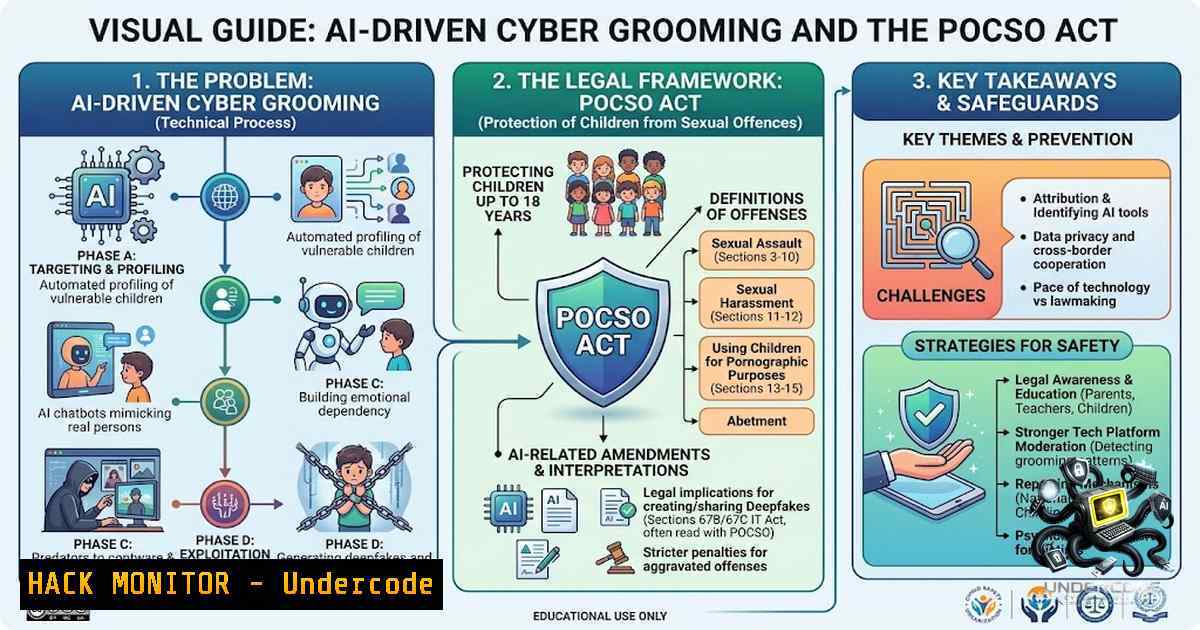
The digital age has fundamentally reshaped the landscape of child safety, introducing sophisticated threats that exploit the very technologies designed to connect us. The webinar “Child Safety in the Digital Age: Cyber Grooming, AI & the POCSO Act,” organized by Yours In Law on 8 August 2026, highlighted the critical intersection of emerging AI capabilities and existing legal frameworks. The session underscored that while the Protection of Children from Sexual Offences (POCSO) Act, 2012, provides a robust foundation, the rapid evolution of generative AI and its use in predatory behavior presents a significant and growing challenge. This article expands on those discussions, offering a technical examination of cyber grooming, the role of AI, and a practical guide for digital forensics, legal compliance, and proactive defense.
Learning Objectives
- Understand the technical modus operandi of AI-enhanced cyber grooming and its distinction from traditional methods.
- Identify and utilize open-source and commercial tools for detecting grooming patterns in digital communications.
- Learn the specific provisions of the POCSO Act and the Information Technology (IT) Act that apply to AI-generated and AI-facilitated child exploitation.
- Acquire practical digital forensics and incident response skills for preserving evidence and building a legal case.
- Develop a proactive security mindset for parents, educators, and IT professionals to safeguard children in online spaces.
You Should Know
1. The Technical Anatomy of AI-Enhanced Cyber Grooming
Traditional online grooming is a manipulative process where an offender builds trust with a minor to exploit them sexually. The integration of AI has transformed this into a scalable, sophisticated operation. Predators now leverage AI-augmented personas to manage relationships with dozens of children simultaneously, maintaining perfect memory of past conversations and generating convincing fake personas (e.g., fake age, interests aligned with the child). This is not just about individual messages; it’s a behavioral process that unfolds over time.
The technical vectors are diverse. A forensic analysis of URLs used by active online groomers revealed that they are used to engage in social engineering, distribute malware, solicit Child Sexual Abuse Material (CSAM), and share images. In 2024 and 2025, deepfake and AI voice-clone content emerged as dominant offence vectors in Indian caseloads. This includes AI-generated CSAM, where material is created without involving a real child, and deepfake bullying, where face-swapped explicit images are circulated.
Step‑by‑step guide: Detecting Grooming Patterns with Open-Source Intelligence (OSINT)
To proactively identify potential grooming, you can use behavioral analysis tools.
- Deploy SENTINEL (Open-Source): This tool detects grooming by watching how behavior evolves over time, not just individual keywords. It builds a behavioral profile across linguistic, graph (who talks to whom), and temporal (when they talk) layers.
Clone and run with Docker Compose
git clone https://github.com/sentinel-safety/SENTINEL
cd SENTINEL
cp .env.example .env
docker compose up -d
You can then ingest an event to get a risk score:
from sentinel import SentinelClient client = SentinelClient(api_key="your_key", base_url="http://localhost:8080") result = client.events.ingest({ "platform_user_id": "user_84721", "recipient_id": "user_10392", "channel_type": "direct_message", "timestamp": "2026-04-24T09:41:00Z", "message_length": 142 }) print(result.risk_score) → 87 (critical) -
Analyze Conversations with Tuteliq CLI: This AI-powered command-line tool can detect grooming patterns in conversations.
Install via npm npm install -g @tuteliq/cli Login with your API key (get from tuteliq.ai) tuteliq login <your-api-key> Detect grooming in a conversation tuteliq detect-grooming -m '[{"role":"adult","content":"Hey, you're really mature for your age."},{"role":"child","content":"Thanks!"}]' --age 12 -
The Legal Framework: POCSO, IT Act, and the AI Gap
The legal response to these evolving threats is multifaceted. The POCSO Act, 2012, criminalizes a wide range of cybercrimes against children, including child pornography, cyber stalking, cyber bullying, and grooming. Specifically, Section 11(iv) addresses cyberstalking, stating that a person commits sexual harassment when, with sexual intent, they repeatedly follow, watch, or contact a child through electronic means.
Crucially, the law has adapted to address AI-generated content. The POCSO Act covers “any visual depiction,” which includes artificially generated material (Sections 13/14). Section 67B of the IT Act specifically addresses the publishing or transmitting of material depicting children in sexually explicit conduct in electronic form, with penalties of up to 7 years for a first offence and 10 years for subsequent ones. The IT Rules, 2025, further mandate that intermediaries must remove CSAM (real or AI-generated) within 24 hours of notice.
However, significant gaps remain. Existing legal frameworks are often inadequately equipped to address AI-driven cyberbullying, particularly in relation to synthetic content and anonymity. A significant gap arises at the intersection of AI-driven exploitation and young adults between eighteen and twenty-five years of age, who fall outside the POCSO Act’s protection.
Step‑by‑step guide: Incident Response for a Deepfake Incident
If a deepfake of a minor is circulating, immediate and structured action is critical.
- Preserve Evidence: Take screenshots of every place the deepfake appears, ensuring you capture URLs and timestamps. Do NOT save the image files themselves to avoid possessing illegal material.
- Report to Platforms: Immediately report the content to the platforms where it appears (Instagram, Snapchat, WhatsApp, YouTube). All have priority reporting channels for CSAM.
- File an FIR: File a First Information Report (FIR) under the POCSO Act + IT Act 67B + BNS 79. This should be done within 24 hours.
- Coordinate with School: Contact the child’s school to coordinate efforts to stop the circulation among classmates.
- Send Legal Notice: Send a legal notice to identified perpetrators demanding deletion and damages.
- Apply for Injunction: If platforms delay, apply for a High Court injunction under 226 to compel a takedown.
3. AI-Powered Defense and Digital Forensics
Law enforcement and digital forensics are increasingly leveraging AI to counter these threats. In a landmark initiative, the Telangana Police deployed India’s first sovereign AI platform, C-SIGHT, to identify child sexual abuse offenders and analyze massive volumes of digital evidence. This AI-enabled, self-hosted platform processes CyberTipline reports in 20 minutes or less with 98% accuracy in identifying CSAM content, all while ensuring sensitive data never leaves police systems.
From an investigation standpoint, the forensic examiner’s core task is statutory matching: identifying which IT Act and BNS provisions apply and qualifying platform-side records as electronic evidence under BSA Section 63. The Intermediary Guidelines 2021 impose compliance obligations on platforms, and those records themselves are forensic evidence.
Step‑by‑step guide: Digital Forensics for Social Media Evidence
When investigating a potential cyber grooming case, follow these steps for evidence collection.
- Acquire Content (Victim-Supplied): Victims typically arrive with screenshots. These are a starting point but are not sufficient as sole evidence.
- Identify Applicable Laws: Determine which offences apply. This requires mapping the conduct to specific provisions of the IT Act 2000, BNS 2023, and the POCSO Act.
– Cyberbullying/Grooming: IT Act Section 67, POCSO Section 11/12.
– Deepfake/AI Voice-Clone: IT Act Section 66D (impersonation), BNS Section 79.
3. Qualify Electronic Evidence: Under BSA Section 63, platform-side records must be formally requested via subpoena to be qualified as admissible electronic evidence.
4. Analyze Communication Patterns: Use tools like SENTINEL or Tuteliq to analyze the behavioral trajectory of the conversation, not just individual messages. Look for patterns of trust-building, secrecy, and gradual sexualization.
- Cloud Hardening and API Security for Child-Facing Platforms
Platforms that host user-generated content or facilitate communication must implement robust security measures to prevent abuse. This involves hardening cloud infrastructure and securing APIs against malicious actors.
Linux Commands for Server Hardening:
 Harden SSH configuration
sudo sed -i 's/PermitRootLogin prohibit-password/PermitRootLogin no/' /etc/ssh/sshd_config
sudo sed -i 's/PasswordAuthentication yes/PasswordAuthentication no/' /etc/ssh/sshd_config
sudo systemctl restart sshd

Set up a basic firewall with UFW
sudo ufw default deny incoming
sudo ufw default allow outgoing
sudo ufw allow ssh
sudo ufw enable

Install and configure Fail2ban for brute-force protection
sudo apt-get install fail2ban -y
sudo systemctl enable fail2ban
sudo systemctl start fail2ban
API Security Best Practices:
- Rate Limiting: Implement strict rate limiting to prevent automated scraping and abuse.
- Input Validation: Sanitize all user inputs to prevent injection attacks.
- Authentication: Use OAuth 2.0 or similar strong authentication mechanisms. The Tuteliq MCP Server, for instance, brings AI-powered safety tools into AI assistants like Claude, allowing for detection of grooming patterns via API calls.
- Content Moderation: Integrate AI-powered content moderation APIs to automatically flag and review unsafe content.
5. Training Courses and Professional Development
The complexity of these threats necessitates continuous learning. Several professional courses are available to build expertise in digital safeguarding:
– Advanced Online Child Protection Laws Certification (LSBA): Equips professionals with expertise in legal frameworks, cybercrime prevention, and online grooming identification.
– Digital Safeguarding in Practice (University of Strathclyde): A fully online course covering indicators of online sexual abuse and grooming.
– UNMC516 – Safeguarding Children 6: Risk Management and Digital Environments: Focuses on identifying and evaluating risks in digital environments.
What Undercode Say
- Key Takeaway 1: The Evolution of the Threat is Exponential. The integration of AI is not just an incremental change; it is a paradigm shift. Predators are using AI to scale their operations, create hyper-realistic synthetic content, and evade traditional detection methods. The technical community, legal professionals, and parents must all adapt to this new reality.
- Key Takeaway 2: Technology is a Double-Edged Sword. While AI empowers predators, it also equips defenders with unprecedented capabilities. Tools like SENTINEL and C-SIGHT demonstrate that AI can be used to detect behavioral patterns at scale, analyze vast amounts of data, and accelerate investigations. The challenge lies in deploying these tools ethically and effectively.
The webinar provided a crucial, high-level overview of the intersection of AI, child safety, and the law. This article has sought to drill down into the technical and procedural details, providing actionable commands, legal citations, and forensic methodologies. The fight against cyber grooming is a technical, legal, and societal challenge. By understanding the technology, knowing the law, and utilizing the right tools, we can build a safer digital world for children.
Prediction
- +1 The deployment of sovereign AI platforms like C-SIGHT will significantly increase the efficiency and success rate of cybercrime investigations, leading to more predator identifications and child rescues.
- -1 The legal gap in protecting young adults (18-25) from AI-driven exploitation will become a critical issue, leading to increased advocacy for amending the POCSO Act or introducing new legislation.
- -1 The proliferation of open-source AI models will make it easier for bad actors to create AI-generated CSAM, overwhelming current moderation and legal frameworks.
- +1 The integration of behavioral intelligence tools like SENTINEL into mainstream platforms will become standard practice, creating a proactive defense mechanism that stops grooming before it escalates.
- -1 The sophistication of AI-driven social engineering and voice cloning will lead to a surge in “virtual kidnapping” and extortion scams, creating new forms of trauma for families.
▶️ Related Video (68% Match):
🎯Let’s Practice For Free:
🎓 Live Courses & Certifications:
Join Undercode Academy for Verified Certifications
🚀 Request a Custom Project:
Secure, high-velocity infrastructure and disruptive technological engineering. Contact our engineering team for high-tier development and proprietary systems:
[email protected]
💎 Smart Architecture | 🛡️ Secure by Design | ⭐ Trusted by Thousands
IT/Security Reporter URL:
Reported By: Nikita Patidar – Hackers Feeds
Extra Hub: Undercode MoN
Basic Verification: Pass ✅


