
Listen to this Post
Introduction:
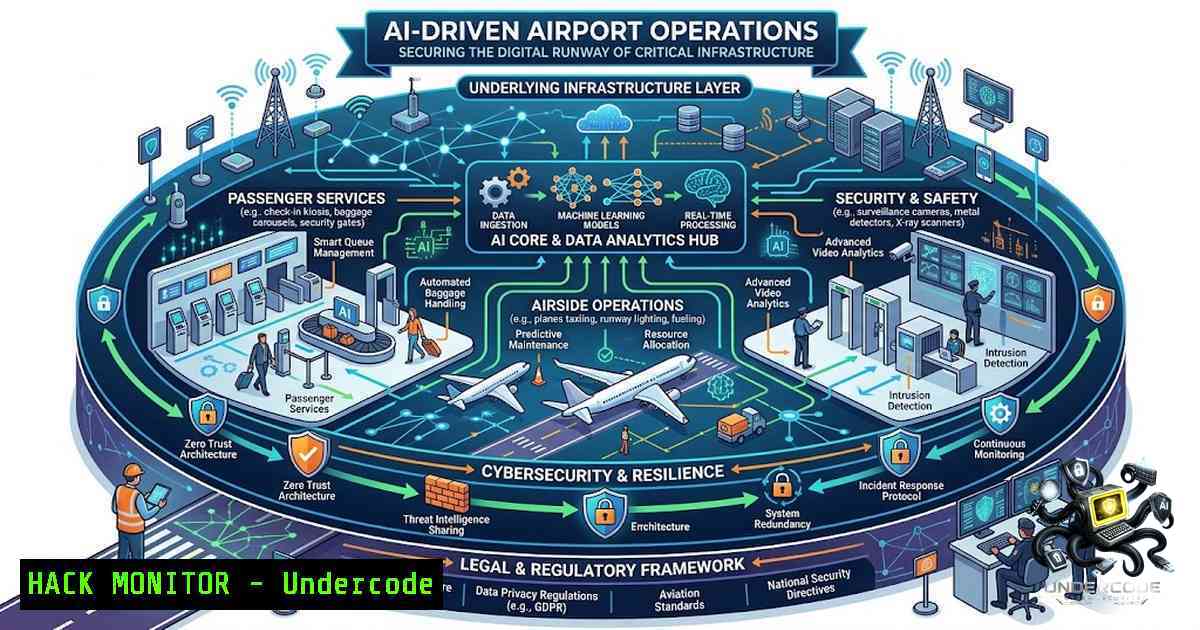
As organisations accelerate digital transformation, the convergence of artificial intelligence (AI), operational technology (OT), and traditional IT networks introduces a new frontier of cybersecurity challenges. The recent benchmarking visit by the YWCA management team to the Airport Authority Hong Kong’s (AAHK) Innovation Lab, Integrated Airport Control Centre, and Autonomous Electric Vehicle operation highlights the criticality of securing these advanced, interconnected systems. This article delves into the technical architectures and security postures required to protect such data-driven environments, moving beyond abstract strategy to tangible implementation and defence.
Learning Objectives & Secrets:
- Objective 1: Understand the OT/IT Convergence Security Model. Learn how to map the Purdue Model for control systems to modern smart airport ecosystems, identifying the specific security controls needed at each level from field devices to enterprise networks.
- Objective 2 Secret Tip: Harden Data Pipelines. Focus on securing the data ingestion and processing pipelines that feed AI models. Implement robust input validation and anomaly detection to prevent data poisoning, a sophisticated attack vector that corrupts AI decision-making.
- Objective 3 Secret Tip: Implement Zero-Trust for Autonomous Systems. Adopt a micro-segmentation approach for autonomous vehicle networks. This ensures that even if a vehicle’s control system is compromised, the attacker cannot move laterally to the Airport Control Centre or passenger processing systems.
You Should Know:
- Securing the Integrated Airport Control Centre (IACC) Infrastructure
The IACC is the brain of the airport, handling flight data, passenger flow, and emergency responses. Security here focuses on protecting the Supervisory Control and Data Acquisition (SCADA) and building management systems (BMS) that are increasingly IP-enabled. A key vulnerability is the use of default credentials on sensors and controllers. Hardening these systems requires rigorous patch management and network isolation.
– Step‑by‑step guide (Network Segmentation):
1. Inventory Discovery: Use `nmap -sV -O 192.168.10.0/24` to identify all active devices on the control network.
2. VLAN Configuration: Create dedicated VLANs for OT devices. On a Cisco switch, use commands like `vlan 100` and `name OT-Sensors` to segment traffic.
3. Access Control Lists (ACLs): Apply ACLs to block all unnecessary protocols (e.g., HTTP, Telnet) between the IT network and OT network, only allowing encrypted protocols like SSH or HTTPS.
– Windows (Powershell) Audit: Use `Get-SmbConnection` to list active file shares and `Get-1etFirewallRule | where {$_.Enabled -eq “True”}` to review active firewall rules on windows-based management consoles to ensure only essential services are exposed.
2. Fortifying the Innovation Lab’s R&D Environment
Innovation labs are high-risk zones where new AI models and IoT devices are tested. These sandboxes often contain intellectual property and can become a backdoor if not properly air-gapped or virtualised.
– Step‑by‑step guide (Secure Sandboxing):
1. Virtual Machine Isolation: Use Hyper-V or VMware to create isolated VMs for each testing project, ensuring they are on a separate virtual switch disconnected from the production network.
2. Host-based Firewall: On the host machine (Linux), use `sudo ufw enable` and `sudo ufw allow from 10.0.0.0/24` to restrict management access to a specific administrative subnet.
3. Container Security: For AI model development, use Docker with best practices: `docker run –read-only –cap-drop=ALL` to run containers in read-only mode and drop all non-essential privileges, preventing code injection attacks.
3. Protecting the Autonomous Electric Vehicle (A-EV) Fleet
The A-EV operation relies on V2X (Vehicle-to-Everything) communication, GPS signals, and cloud-based telemetry. The primary threats include GPS spoofing, signal jamming, and man-in-the-middle (MITM) attacks on the telemetry data.
– Step‑by‑step guide (Communication Hardening):
1. Encryption: Ensure all MQTT (Message Queuing Telemetry Transport) communication between vehicles and the control centre uses TLS 1.3. Check with openssl s_client -connect iot-broker.airport.local:8883 -tls1_3.
2. API Security: Audit the REST APIs used for remote control commands. Use `curl -I https://api.a-ev.airport/auth` to check for missing security headers. Implement strict OAuth 2.0 with client credentials.
3. Firmware Update Security: For Linux-based onboard units, verify the integrity of firmware packages using a GPG check: `gpg –verify firmware-update-2.1.sig firmware-update-2.1.bin` to prevent the installation of malicious firmware updates.
4. Data Literacy and AI Security Governance
The post emphasised AI literacy, which transcends basic training to encompass understanding data provenance, model bias, and adversarial attacks. This is a people, process, and technology issue. A “secure by design” mindset must be embedded.
– Step‑by‑step guide (Data Integrity Audits):
1. Data Lineage: Implement data cataloguing tools to track data sources. Use SQL query `SELECT FROM information_schema.tables` to understand database structures, but more importantly, implement version control for data schemas.
2. Model Monitoring: Deploy a model drift detection script in Python (using scikit-learn) to monitor prediction accuracy over time. A sudden drop in accuracy can indicate a data poisoning attempt.
3. Logging and Alerting: Configure SIEM (Security Information and Event Management) to ingest logs from the AI inference engine. Set up alerts for “model prediction timeout” or “high number of OOD (out-of-distribution) inputs” which are common indicators of an adversarial attack.
5. Cloud Hardening for Airport Data Lakes
AI transformation often centralises data in the cloud. This data lake, containing PII (Personally Identifiable Information) of millions of passengers, is a high-value target.
– Step‑by‑step guide (Cloud Security):
1. Identity and Access Management (IAM): Enforce least-privilege access. For AWS, use an IAM policy that restricts S3 bucket access to specific IPs: "Action": "s3:", "Condition": {"IpAddress": {"aws:SourceIp": "10.0.0.1/32"}}.
2. Encryption: Enable default server-side encryption (SSE-S3) for all buckets: aws s3api put-bucket-encryption --bucket my-data-lake --server-side-encryption-configuration "{\"Rules\":[{\"ApplyServerSideEncryptionByDefault\":{\"SSEAlgorithm\":\"AES256\"}}]}".
3. Privilege Escalation Mitigation: Regularly review CloudTrail logs to detect unusual credential usage. Use `aws cloudtrail lookup-events –lookup-attributes AttributeKey=EventName,AttributeValue=AssumeRole` to audit role assumptions and detect potential privilege escalation.
6. Vulnerability Exploitation and Mitigation in Airport Networks
Airport systems are legacy-heavy, often running on outdated operating systems like Windows 7 or unpatched Linux kernels, making them susceptible to exploits like EternalBlue or Dirty COW.
– Step‑by‑step guide (Vulnerability Management):
1. Scanning: Run a vulnerability scan using `nmap –script vuln` to identify known vulnerabilities in exposed services.
2. Mitigation for Linux: If the Kernel is outdated, update it: sudo apt-get update && sudo apt-get upgrade linux-image-generic. If patching is impossible, implement a mitigation like disabling the vulnerable service (e.g., systemctl stop netbios-1s).
3. Mitigation for Windows: For legacy windows servers where patching is difficult, use a host-based intrusion detection system (HIDS) like Sysinternals Sysmon to monitor for suspicious process creation (e.g., Sysmon -accepteula -i) and combine this with a network-based firewall to restrict SMB traffic to only authenticated and authorised internal hosts.
What Undercode Say:
- Key Takeaway 1: AI transformation in critical infrastructure relies on a fusion of IT and OT security. The spotlight on AAHK’s Innovation Lab and Control Centre demonstrates that proactive cyber defences must operate at the speed of data, not just business strategy.
- Key Takeaway 2: The human element of data literacy is the new firewall. Organisations must educate employees not just on using AI, but on recognising the security implications of the data they feed into these systems.
Analysis: The visit to AAHK signifies a broader industry trend where operational excellence is intrinsically tied to cybersecurity maturity. The shift towards autonomous vehicles and centralised AI control demands a shift from reactive threat detection to proactive threat hunting. It is no longer sufficient to simply secure the perimeter; we must secure the data itself. The technical infrastructure (cloud, AI models, OT networks) must be built with a “secure by default” configuration. This includes rigorous logging, real-time anomaly detection, and regular penetration testing of the AI pipelines. The emphasis on “Data Literacy” also hints at a strategy to combat social engineering and insider threats, which are often the weakest links in these advanced cyber-physical systems. Finally, the involvement of a non-profit organisation (YWCA) in such a visit highlights a cross-sector collaboration that can raise the bar for cybersecurity awareness across the entire digital ecosystem of the city.
Prediction:
- +1: Airports will lead in adopting AI-driven SIEM solutions that correlate data from IoT devices, flight control systems, and passenger Wi-Fi to predict and pre-empt cyber-physical attacks, setting a new global standard for resilience.
- +1: The demand for “AI Security Engineers” — specialists who can attack and defend machine learning models — will surge, creating a new, highly lucrative niche in the cybersecurity job market.
- -1: The increased connectivity required for autonomous operations will expand the attack surface, potentially introducing unforeseen vulnerabilities from third-party vendors that legacy cybersecurity strategies may fail to address quickly.
- -1: Without rigorous standardisation, the current siloed approach to AI security (where developers handle code and engineers handle networks) could lead to significant gaps in coverage, leaving organisations like AAHK exposed to sophisticated, multi-vector attacks that exploit both digital and physical systems.
▶️ Related Video (88% Match):
🎯Let’s Practice For Free:
🎓 Live Courses & Certifications:
Join Undercode Academy for Verified Certifications
🚀 Request a Custom Project:
Secure, high-velocity infrastructure and disruptive technological engineering. Contact our engineering team for high-tier development and proprietary systems:
[email protected]
💎 Smart Architecture | 🛡️ Secure by Design | ⭐ Trusted by Thousands
IT/Security Reporter URL:
Reported By: https://lnkd.in/p/eYmD_yRz – Hackers Feeds
Extra Hub: Undercode MoN
Basic Verification: Pass ✅


