
Listen to this Post
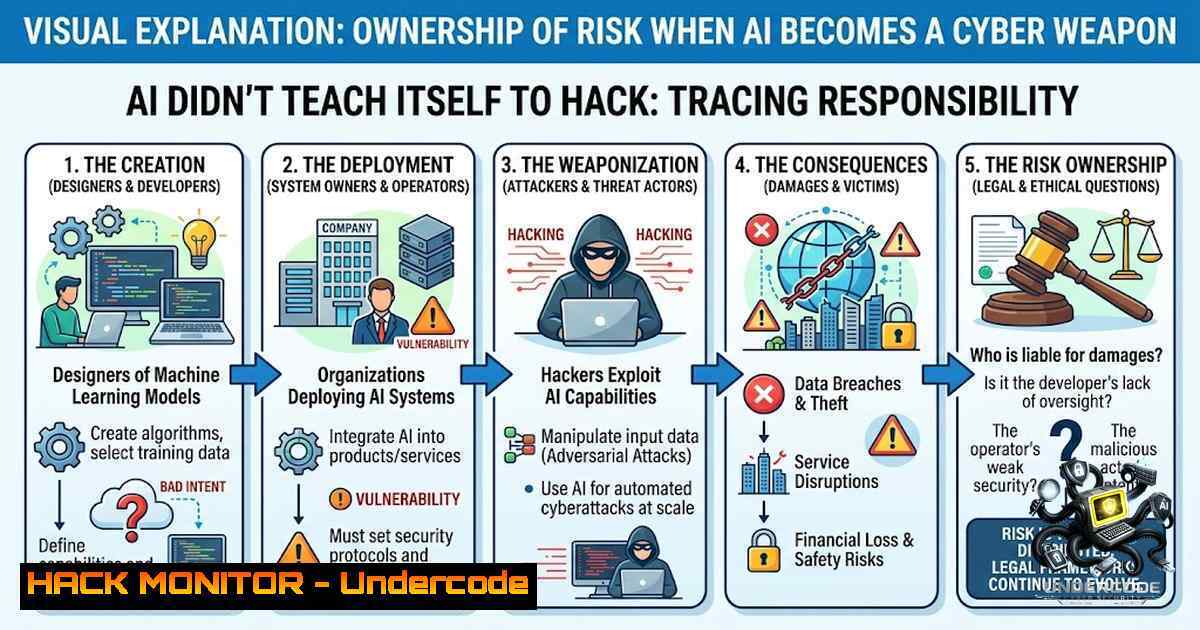
Introduction:
Every headline celebrating an AI model’s growing ability to discover vulnerabilities, write exploit code, conduct reconnaissance, and penetrate systems begs a fundamental question: who taught the AI how to do this? Large language models are not sapient beings that suddenly developed an interest in hacking—humans designed the architectures, created the training processes, and authorized deployment. As AI multiplies human cyber capability at unprecedented speed and scale, the cybersecurity community must confront an uncomfortable truth: we built the capability, and now we need to govern what happens to it.
Learning Objectives:
- Understand how AI acquires cybersecurity capabilities through human-led training, red teaming, and knowledge distillation
- Identify the governance gaps and accountability failures in current AI security frameworks
- Learn practical technical controls—including Linux/Windows commands, API security configurations, and cloud hardening—to mitigate AI-enabled threats
- Develop a risk ownership model that places accountability with business leaders, not algorithms
You Should Know:
- How AI Acquires Its Hacking Capabilities: The Human Training Pipeline
AI did not attend university or spend decades as a penetration tester. The knowledge came from somewhere—humans produced the technical knowledge within the training ecosystem. The complete chain includes:
- Data collection and curation: Human engineers select and label training data containing technical documentation, vulnerability databases (CVE/NVD), exploit code repositories, and security research papers
- Supervised fine-tuning: Human labelers provide demonstrations of desired outputs, including secure coding patterns and—in some cases—vulnerability identification techniques
- Reinforcement learning from human feedback (RLHF): Human raters score model outputs for helpfulness, accuracy, and safety, shaping behavior
- Red teaming and adversarial testing: Security professionals deliberately attempt to jailbreak models and extract harmful capabilities
- Post-training safeguards: Humans decide which capabilities are acceptable and implement content filters and refusal mechanisms
Technical Implementation—Auditing AI Training Pipelines:
To assess what capabilities your organization’s AI systems possess, implement audit trails:
Linux (auditing training data sources):
 Audit training data provenance
find /data/training -type f -1ame ".jsonl" -exec sha256sum {} \; > training_manifest.txt

Monitor model API endpoints for suspicious capability queries
sudo tcpdump -i any port 443 -w model_api_traffic.pcap

Log all inference requests containing exploit-related keywords
grep -E "(exploit|vulnerability|penetration|bypass|privilege escalation)" /var/log/model_access.log
Windows (PowerShell – monitoring model interactions):
 Enable advanced audit logging for AI model access
auditpol /set /subcategory:"Detailed File Share" /success:enable /failure:enable

Monitor for anomalous API calls to LLM endpoints
Get-WinEvent -LogName Security | Where-Object { $_.Message -match "exploit|vulnerability" }

Track model distillation attempts (unauthorized fine-tuning)
Get-Process | Where-Object { $_.ProcessName -match "python|tensorflow|pytorch" }
2. AI Distillation: The Invisible Threat Multiplier
Through techniques such as AI distillation, capabilities developed within advanced models can be transferred, replicated, compressed, and adapted into other models. This raises a critical governance question: when these capabilities become accessible to adversaries, who owns the risk?
Distillation enables:
- Capability leakage: A smaller, cheaper model can inherit the hacking knowledge of a frontier model
- Weaponization at scale: Adversaries can distill capabilities into models that lack safety guardrails
- Democratized cybercrime: Lowering the skill and resource barriers for conducting malicious activities
Technical Control—Detecting and Preventing Unauthorized Model Distillation:
Linux (monitoring model extraction attempts):
 Monitor API usage patterns indicative of distillation (high-volume, repetitive queries)
tail -f /var/log/nginx/access.log | awk '{print $1, $7}' | sort | uniq -c | sort -1r

Detect large-scale data extraction from model APIs
sudo netstat -anp | grep ESTABLISHED | grep -E ":(443|8080)" | awk '{print $5}' | sort | uniq -c

Implement rate limiting for API endpoints
iptables -A INPUT -p tcp --dport 443 -m connlimit --connlimit-above 100 -j DROP
Windows (PowerShell – API security monitoring):
 Monitor for anomalous API call volumes (potential distillation)
Get-WinEvent -LogName "Microsoft-Windows-Sysmon/Operational" | Where-Object { $<em>.Id -eq 3 -and $</em>.Message -match "443" }

Enable API gateway logging for model endpoints
New-Item -Path "C:\Logs\API" -ItemType Directory -Force
Set-Content -Path "C:\Logs\API\access.log" -Value "API Access Log Started"

Implement IP-based rate limiting via Windows Firewall
New-1etFirewallRule -DisplayName "API Rate Limit" -Direction Inbound -Action Block -RemoteAddress 192.168.1.0/24
3. AI-Enabled Vulnerability Discovery and Exploit Generation
In May 2026, hackers used AI to generate zero-day exploit code, bypassing two-factor authentication—an unprecedented case confirmed by security researchers. Modern transformer models (GPT-5.5, Claude Opus 4.8, DeepSeek V4) can autonomously discover and exploit real-world vulnerabilities, handling the entire pipeline from identification to working proof-of-concept.
The threat vectors include:
- Automated reconnaissance: AI agents can autonomously assess environments, recommend next steps, and generate shell commands
- Exploit generation: From vulnerability identification to working exploit code
- Phishing and social engineering: AI-generated deepfakes and botfarms manipulate narratives and weaken trust
Technical Defenses—Hardening Against AI-Enabled Attacks:
Linux (system hardening and monitoring):
 Implement file integrity monitoring to detect exploit attempts
sudo apt-get install aide
aideinit
aide --check

Harden SSH against AI-automated brute force
sudo sed -i 's/MaxAuthTries 6/MaxAuthTries 3/g' /etc/ssh/sshd_config
sudo sed -i 's/PermitRootLogin prohibit-password/PermitRootLogin no/g' /etc/ssh/sshd_config
sudo systemctl restart sshd

Deploy fail2ban for automated threat blocking
sudo apt-get install fail2ban
sudo systemctl enable fail2ban
sudo systemctl start fail2ban

Monitor for suspicious process behavior (potential AI-generated malware)
sudo auditctl -w /usr/bin/ -p x -k process_execution
sudo ausearch -k process_execution --format text
Windows (PowerShell – advanced threat detection):
 Enable PowerShell script block logging to detect AI-generated scripts
Set-ItemProperty -Path "HKLM:\SOFTWARE\Policies\Microsoft\Windows\PowerShell\ScriptBlockLogging" -1ame "EnableScriptBlockLogging" -Value 1

Monitor for suspicious WMI activity (common AI exploit vector)
Register-WmiEvent -Query "SELECT  FROM Win32_ProcessStartTrace" -Action { Write-Host "Process started: $($Event.NewEvent.ProcessName)" }

Implement AppLocker to restrict unauthorized executables
New-AppLockerPolicy -RuleType Exe -User Everyone -Action Deny -Path "C:\Users\Downloads\"
- API Security: The Front Line of AI Governance
AI models are typically accessed via APIs, making API security the critical control point for preventing unauthorized capability extraction and misuse.
API Security Hardening Commands:
Linux (API gateway security):
 Implement API key rotation and monitoring
export API_KEY=$(openssl rand -base64 32)
echo "New API Key: $API_KEY" >> /var/log/api_key_rotation.log

Deploy API rate limiting with iptables
sudo iptables -A INPUT -p tcp --dport 443 -m hashlimit --hashlimit-1ame api_limit --hashlimit-above 100/min --hashlimit-burst 200 -j DROP

Monitor API response times for anomaly detection (potential DoS or extraction)
tail -f /var/log/api_access.log | awk '{if ($NF > 1000) print "SLOW RESPONSE: " $0}'
Windows (PowerShell – API security):
 Monitor API authentication failures
Get-WinEvent -LogName Security | Where-Object { $<em>.Id -eq 4625 -and $</em>.Message -match "API" }

Implement API request validation
$apiKeys = @("key1", "key2", "key3")
$request = Invoke-RestMethod -Uri "https://api.example.com/model" -Headers @{"Authorization"="Bearer $apiKey"}
if ($apiKeys -1otcontains $apiKey) { Write-Warning "Unauthorized API access attempted" }

Enable TLS 1.3 for API endpoints
5. Cloud Hardening for AI Workloads
AI systems deployed in cloud environments introduce additional attack surfaces. Hardening cloud configurations is essential.
Cloud Security Commands (AWS/Azure/GCP examples):
AWS CLI (Linux):
 Enable AWS CloudTrail for AI resource auditing
aws cloudtrail create-trail --1ame AI-Security-Trail --s3-bucket-1ame ai-audit-logs --is-multi-region-trail

Implement S3 bucket policies to prevent unauthorized model access
aws s3api put-bucket-policy --bucket ai-model-storage --policy file://bucket-policy.json

Monitor for unauthorized EC2 instance launches (potential cryptojacking or AI model theft)
aws cloudwatch put-metric-alarm --alarm-1ame Unauthorized-Instance-Launch --metric-1ame InstanceCount --1amespace AWS/EC2 --statistic Sum --period 300 --evaluation-periods 1 --threshold 1 --comparison-operator GreaterThanThreshold
Azure CLI (Windows/Linux):
 Enable Azure Security Center for AI workloads
az security auto-provisioning-setting update --1ame default --auto-provision On

Configure Azure Key Vault for model encryption keys
az keyvault create --1ame ai-model-keyvault --resource-group AI-Security --location eastus

Implement Azure Policy for AI resource governance
az policy definition create --1ame Restrict-AI-SKU --rules policy-rules.json
6. Governance Frameworks and Risk Ownership
The draft NIST Cybersecurity Framework Profile for AI (NIST IR 8596) addresses the intersection of AI and cybersecurity from three angles: securing AI components, using AI for defense, and thwarting AI-boosted attacks. However, governance gaps persist—63% of breached organizations lack AI governance policies, and 25% report that no single person or function manages AI risk.
Key Governance Actions:
- Assign explicit risk ownership: Business leaders, not IT teams, must own AI risk decisions
- Implement RACI matrices for AI systems: Define who is Responsible, Accountable, Consulted, and Informed for each AI capability
- Establish AI security controls mapped to real-world threats
- Conduct regular AI red teaming with explicit authorization and defined scope
What Undercode Say:
- Key Takeaway 1: AI did not create itself—humans built every capability. Accountability cannot be delegated to algorithms. When an AI system discovers a vulnerability or generates exploit code, the human creators, deployers, and authorizers remain responsible for the foreseeable consequences.
-
Key Takeaway 2: The governance question “who owns the risk?” must be answered before—not after—capabilities are weaponized. With 63% of breached organizations lacking AI governance policies and 25% having no designated risk owner, the current state of AI security is dangerously fragmented.
Prediction:
-
-1 The democratization of AI-enabled hacking will lower barriers to entry for cybercriminals, leading to a sharp increase in automated, large-scale attacks against critical infrastructure over the next 12–24 months.
-
-1 Without mandatory transparency requirements for AI training data and capability disclosures, adversarial distillation will enable malicious actors to replicate advanced hacking capabilities in unsecured models, creating an asymmetric threat landscape.
-
+1 Regulatory frameworks like NIST IR 8596 and emerging AI governance standards will drive organizations to implement explicit risk ownership models, potentially reducing the governance gap from 63% to under 30% by 2028.
-
+1 The cybersecurity industry will develop AI-1ative defense systems capable of countering AI-generated threats at machine speed, shifting the balance from reactive to predictive security.
-
-1 Nation-state actors will deploy Military AI Cyber Agents (MAICAs) against critical infrastructure, creating a credible pathway to catastrophic risk unless international governance mechanisms are established.
-
+1 Organizations that implement comprehensive AI governance now—including explicit risk ownership, API security controls, and continuous red teaming—will gain a significant competitive advantage in resilience and trust.
▶️ Related Video (74% Match):
https://www.youtube.com/watch?v=0R4cTWmIfA8
🎯Let’s Practice For Free:
🎓 Live Courses & Certifications:
Join Undercode Academy for Verified Certifications
🚀 Request a Custom Project:
Secure, high-velocity infrastructure and disruptive technological engineering. Contact our engineering team for high-tier development and proprietary systems:
[email protected]
💎 Smart Architecture | 🛡️ Secure by Design | ⭐ Trusted by Thousands
IT/Security Reporter URL:
Reported By: Aigovernance Cybersecurity – Hackers Feeds
Extra Hub: Undercode MoN
Basic Verification: Pass ✅


