Listen to this Post
Introduction:
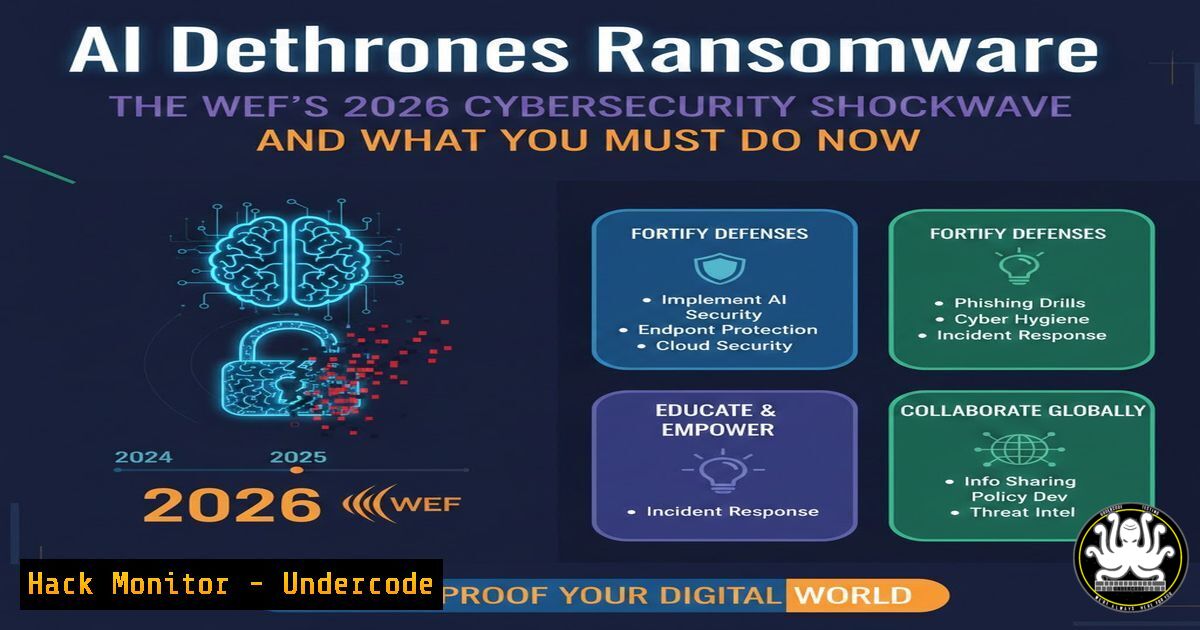
The World Economic Forum’s Global Cybersecurity Outlook 2026 signals a tectonic shift in the threat landscape, where AI-powered vulnerabilities and systemic fraud have surpassed ransomware as the paramount boardroom concern. This evolution demands a fundamental recalibration of defense strategies, moving from fragmented, reactive tools to integrated, intelligent, and sovereign-resilient platforms. The report underscores an urgent divide: organizations achieving cyber maturity are proactively grappling with AI risks, while others remain mired in yesterday’s battles.
Learning Objectives:
- Understand the technical implications of AI adversarial exploits and data leaks, and learn immediate hardening techniques.
- Implement actionable measures to combat AI-enhanced phishing and identity theft, the drivers of cyber-enabled fraud.
- Architect a move towards integrated security platforms, unifying IT/OT detection and aligning with geopolitical and sovereignty requirements.
You Should Know:
1. Hardening Systems Against AI-Powered Data Exfiltration
The report highlights that 87% of executives witnessed rising AI risks, particularly data leaks. AI can automate the discovery of misconfigured services and sensitive data stores at an unprecedented scale. Defenders must preemptively lock down their environments.
Step‑by‑step guide:
Step 1: Discover Sensitive Data with AI-Powered Tools. Use open-source tools like `truffleHog` or `git-secrets` to proactively find secrets and credentials in your code repositories, mimicking what an adversarial AI would do.
 Install and run truffleHog to scan a git repo for secrets
docker run -it -v "$PWD:/pwd" trufflesecurity/trufflehog:latest git https://github.com/yourcompany/yourrepo --only-verified
Step 2: Enforce Strict Access Controls and Encryption. On Linux, use `auditd` to monitor access to sensitive files. On Windows, leverage PowerShell to inventory and encrypt sensitive data stores.
 Windows PowerShell: Get list of files containing potential sensitive info
Get-ChildItem -Path C:\Projects -Recurse -Include .config, .env, .pem, .key | Select-Object FullName
 Then, apply BitLocker or file-level encryption using <code>cipher.exe</code>.
Step 3: Deploy Deception Technology. Plant canary tokens and honey pots that appear as attractive data leaks to AI-driven scanners. When interacted with, they trigger immediate alerts, revealing the attack campaign.
2. Mitigating AI-Enhanced Phishing & Identity Fraud
With 73% impacted by cyber-enabled fraud, phishing has evolved beyond generic emails. AI generates highly personalized lures and deepfake audio/video for credential theft.
Step‑by‑step guide:
Step 1: Implement DMARC, DKIM, and SPF. This is your first technical barrier. Configure these DNS records to prevent email spoofing, a foundational tactic for phishing.
Example DNS TXT record for SPF:
v=spf1 include:_spf.yourmailprovider.com ~all
Step 2: Mandate Phishing-Resistant MFA. Move beyond SMS-based codes. Enforce FIDO2/WebAuthn security keys or certificate-based authentication, which are resistant to real-time phishing and MITM attacks.
Step 3: Train with AI-Generated Phishing Simulations. Use tools like GoPhish or commercial platforms that leverage AI to create dynamic, convincing phishing campaigns for internal training, preparing your workforce for the new reality.
3. Geopolitical Fragmentation & Secure Vendor Management
Supply chain disruptions and vendor choices are now strategic risks. This necessitates technical vetting and secure integration protocols.
Step‑by‑step guide:
Step 1: Software Bill of Materials (SBOM) Enforcement. Require an SBOM in standard formats (SPDX, CycloneDX) from all software vendors. Use tools to analyze them for known vulnerabilities and unwanted dependencies.
 Use Syft to generate an SBOM for your own container image
syft your-application:latest -o spdx-json > sbom.json
Step 2: Zero-Trust Network Access (ZTNA) for Vendors. Replace vulnerable VPNs for third-party access. Implement ZTNA solutions that grant vendors least-privilege access only to specific applications, not your entire network.
Step 3: Sovereign Cloud Configuration. If operating under sovereignty requirements, configure your cloud environments (AWS, Azure, GCP) to enforce data residency and restrict metadata flows to non-compliant regions using policy tools like Azure Policy or AWS SCPs.
4. Building the AI-Augmented SOC
The manual SOC is obsolete. The report advocates for AI-enhanced platforms that can react at machine speed.
Step‑by‑step guide:
Step 1: Integrate SIEM with AI Threat Intelligence. Configure your SIEM (e.g., Splunk, Elastic SIEM) to ingest feeds from AI-curated threat intelligence platforms. Automate alert correlation using ML-driven analytics rules.
Step 2: Automate Incident Response with Playbooks. Use SOAR platforms to create playbooks for common AI-driven attacks. For example, automate the containment of a compromised user account:
1. Query SIEM for anomalous login locations.
2. Disable account via LDAP/Active Directory API.
3. Isolate affected endpoint using EDR API.
4. Open a ticket in ITSM system.
Step 3: Deploy User and Entity Behavior Analytics (UEBA). Implement tools that baseline normal behavior for users and devices, using AI to flag subtle anomalies indicative of account takeover or insider threats.
5. Migrating to an Integrated Security Platform
Fragmented point solutions create blind spots. The shift is towards unified platforms covering IT, OT, and cloud.
Step‑by‑step guide:
Step 1: Conduct a Security Tool Sprawl Audit. Inventory all security tools using automated discovery and manual interviews. Map their functions (EDR, FW, IDS, etc.) and data outputs.
Step 2: Establish a Centralized Data Lake. Create a secure, scalable data repository (e.g., in a cloud environment) where logs from all security and infrastructure tools are ingested in a normalized format (like OCSF).
Step 3: Build or Adopt a Unified Platform Layer. Choose a platform (like an XDR) or build a custom integration layer using APIs that unifies visibility, correlates alerts from the data lake, and provides a single pane of glass for detection and response across all environments.
What Undercode Say:
- The Adversary’s Toolbox Has Fundamentally Changed. Defending against ransomware with better backups is no longer sufficient. The primary attack vectors are now AI-driven reconnaissance, exploitation, and social engineering, requiring a corresponding shift in defensive AI and automation.
- Resilience is Now Defined by Anticipation and Integration. Cyber resilience, per the WEF, is less about surviving an attack and more about architecting systems that anticipate novel AI threats and enable seamless, rapid response across a unified environment. Sovereign interoperability—being secure locally while collaborating globally—is the new benchmark.
Prediction:
The WEF 2026 findings foreshadow a near-term future where cybersecurity becomes a dominant factor in geopolitical stability and economic competitiveness. Organizations that fail to integrate AI defensively and consolidate their security stacks will face untenable risks, leading to a wave of consolidation and regulatory mandates. We will see the rise of “Cyber Sovereignty” as a service and the formal regulation of offensive AI in cyber operations. The boardroom conversation will permanently shift from “if we get hacked” to “how fast can we adapt and counter,” with investment pouring into autonomous response systems and privacy-preserving collaborative defense networks.
▶️ Related Video (80% Match):
🎯Let’s Practice For Free:
IT/Security Reporter URL:
Reported By: UgcPost 7416789753141907456 – Hackers Feeds
Extra Hub: Undercode MoN
Basic Verification: Pass ✅


