Listen to this Post
Introduction:
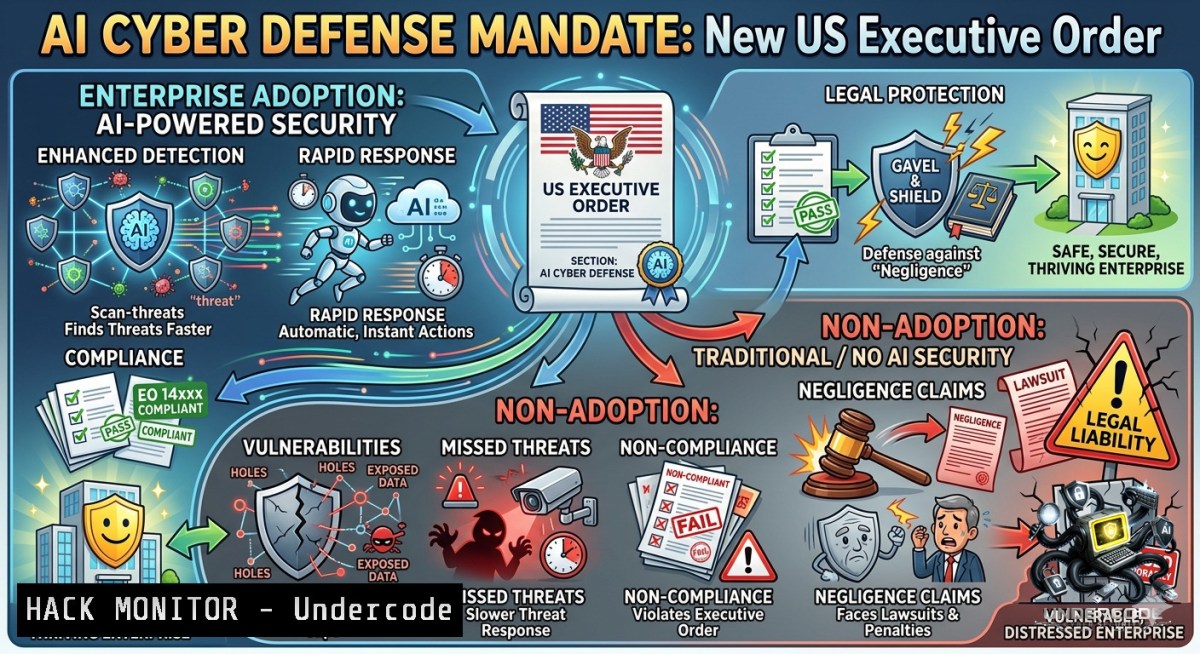
On June 2nd, the White House signed an executive order mandating a federal AI cybersecurity overhaul, pushing AI-enabled defenses into military networks, civilian agencies, and critical infrastructure within 30 days. While the order promotes voluntary industry collaboration through a new AI vulnerability clearinghouse and frontier model benchmarking, it also sets an implicit legal floor—enterprises that fail to deploy AI-powered defenses may soon face negligence claims in court.
Learning Objectives:
– Implement AI-driven intrusion detection and vulnerability scanning to meet emerging federal security baselines
– Configure coordinated disclosure workflows with CISA, NSA, and Treasury for AI-related vulnerabilities
– Deploy pre-release security benchmarking on frontier AI models using open-source vulnerability scanners
You Should Know:
1. Federal AI Cyber Overhaul: 30-Day Implementation Guide
The EO requires DHS and CISA to push AI-enabled defense capabilities to federal civilian agencies, state governments, and critical infrastructure operators within 30 days. This section covers how to replicate that baseline in your own environment using open-source AI threat detection.
What the post says: The EO puts military and national‑security networks on a fast track for AI defense, with civilian agencies following immediately after.
Step‑by‑step guide:
1. Deploy an AI‑powered IDS/IPS using Zeek + machine learning. On Ubuntu/Debian:
sudo apt update && sudo apt install zeek python3-pip
pip3 install tensorflow pandas scikit-learn
zeekctl deploy
2. Train a basic anomaly detector on network logs:
import pandas as pd
from sklearn.ensemble import IsolationForest
logs = pd.read_csv('/var/log/zeek/conn.log')
model = IsolationForest(contamination=0.01)
model.fit(logs[['duration','orig_bytes','resp_bytes']])
3. Schedule automated retraining via cron (Linux) or Task Scheduler (Windows):
0 2 /usr/bin/python3 /opt/ai_detector/retrain.py
4. Integrate with CISA’s automated indicator sharing (AIS) – register at `https://www.cisa.gov/ais` and push alerts via STIX/TAXII.
2. Voluntary AI Cybersecurity Clearinghouse: Coordinated Vulnerability Disclosure
Treasury, NSA, and CISA will jointly run a voluntary clearinghouse for AI‑related vulnerabilities, sharing scanning and patching intelligence with industry. To benefit, you must adopt coordinated disclosure workflows.
Step‑by‑step guide:
1. Set up vulnerability scanning for AI/ML dependencies (e.g., PyTorch, TensorFlow, Hugging Face):
 Using OWASP Dependency-Check with ML library signatures
dependency-check --scan ./requirements.txt --format HTML
2. Automate CVE correlation using the National Vulnerability Database API:
curl -X GET "https://services.nvd.nist.gov/rest/json/cves/2.0?keywordSearch=tensorflow" -o ai_cves.json
3. Submit findings to CISA’s coordinated disclosure portal (`https://www.cisa.gov/report`). Include:
– Affected AI model version
– Proof‑of‑concept code
– Suggested patch or mitigation
4. On Windows, use PowerShell to parse NVD feeds and trigger email alerts:
$cves = Invoke-RestMethod -Uri "https://services.nvd.nist.gov/rest/json/cves/2.0?keywordSearch=pytorch"
if ($cves.totalResults -gt 0) { Send-MailMessage -To "[email protected]" -Subject "AI CVE Alert" }
3. Frontier Model Framework: Pre-Release Security Benchmarking
Within 60 days, frontier labs must voluntarily hand over models for classified cyber benchmarking 30 days before public release. Enterprises can adopt similar pre‑release testing using open‑source adversarial toolkits.
Step‑by‑step guide:
1. Install Garak (LLM vulnerability scanner) to probe model behavior:
pip install garak
garak --model_type huggingface --model_name meta-llama/Llama-2-7b --probes continuity
2. Run prompt injection tests using Counterfit (Microsoft’s AI red team tool):
git clone https://github.com/Azure/counterfit
cd counterfit && pip install -r requirements.txt
python counterfit.py -t your_model_endpoint
3. Benchmark against classified‑style criteria (e.g., data extraction, jailbreak resistance). Export results:
garak --report_prefix pre_release_benchmark_ --output_format html
4. For closed‑source models, implement API‑side filtering with a reverse proxy. Example Nginx rule to block malicious prompts:
location /v1/completions {
if ($request_body ~ "ignore previous instructions") { return 403; }
proxy_pass http://model_api;
}
4. Deregulation Guardrail: What the “No Licensing” Ban Means for Compliance
The EO explicitly prohibits federal agencies from imposing mandatory licensing, pre‑clearance, or permitting on AI technologies. However, this does not exempt enterprises from existing liability frameworks. Using unvetted AI security tools may still open you to negligence claims.
Step‑by‑step guide to stay compliant without federal permits:
1. Maintain a Software Bill of Materials (SBOM) for all AI components:
syft python:latest -o spdx-json > ai_sbom.json
2. Generate evidence of due diligence – e.g., audit logs from your AI‑powered IDS:
sudo ausearch -m USER_CMD -ts today > ai_defense_audit.log
3. On Windows, use PowerShell’s Get-WinEvent to export AI security events:
Get-WinEvent -LogName "Windows PowerShell" | Where-Object {$_.Message -match "AI"} | Export-Csv ai_audit.csv
4. Retain these logs for at least 18 months (the emerging legal statute of concern).
5. AI Vulnerability Detection R&D: Hands‑on with Federally Funded Techniques
OMB funds AI vulnerability‑detection R&D. Replicate cutting‑edge methods using adversarial machine learning (AML) libraries.
Step‑by‑step guide to build a detection lab:
1. Deploy an ML‑based rootkit detector using Linux eBPF + TensorFlow:
sudo apt install bpftrace python3-tensorflow
bpftrace -e 'kprobe:sys_call_table { printf("syscall %d\n", arg1); }' | python3 train_detector.py
2. Use adversarial perturbations to test your own models’ robustness (Foolbox library):
import foolbox as fb
model = fb.Model(model, bounds=(0,1))
attack = fb.attacks.LinfPGD()
adversarial = attack(model, images, labels, epsilons=0.03)
3. Scan for data poisoning in training pipelines with Alibi Detect:
pip install alibi-detect
python -c "from alibi_detect.od import IForest; od = IForest(threshold=0.1)"
4. Automate container scanning for AI dependencies (Trivy):
trivy image pytorch/pytorch:latest --severity HIGH,CRITICAL --format table
6. Prosecution of AI‑Enabled Intrusions: Defensive Countermeasures
The Attorney General will prosecute AI‑enabled data theft and intrusions. Prepare your environment to both detect and mitigate AI‑powered attacks (e.g., automated phishing, credential stuffing at scale).
Step‑by‑step guide:
1. Deploy Windows Defender with cloud‑delivered AI protection (requires Defender for Endpoint):
Set-MpPreference -CloudBlockLevel High -CloudTimeout 50
2. Block AI‑generated phishing domains using DNS filtering with threat intelligence feeds:
 Linux: add to /etc/hosts or use dnsmasq
echo "0.0.0.0 suspicious-ai-domain.com" | sudo tee -a /etc/hosts
3. Implement rate‑limiting on authentication endpoints to foil AI‑driven brute‑force:
 Using fail2ban for SSH
sudo apt install fail2ban
echo -e "[bash]\nenabled = true\nmaxretry = 3\nfindtime = 60" | sudo tee -a /etc/fail2ban/jail.local
4. Monitor for AI‑generated code injections via static analysis tools (Semgrep):
semgrep --config auto --lang python --pattern 'exec($X)' .
What Undercode Say:
– Key Takeaway 1: The EO gives the federal government a “free seat” at the vulnerability‑discovery table – agencies learn of critical AI flaws before public disclosure. This creates a two‑tier system where loyal labs get priority access to federal spending.
– Key Takeaway 2: Enterprises that fail to deploy AI‑powered defenses will likely face negligence claims, because the EO’s baseline becomes the de facto standard of care in cybersecurity lawsuits.
Analysis (10 lines):
The order’s deregulation guardrail is clever: by banning mandatory licensing, the administration avoids burdening AI startups while still driving adoption through spending and liability. The 30‑day clock for federal AI defense is aggressive – most agencies lack the data science talent to deploy models securely. Expect a surge in contracts for AI security vendors (CrowdStrike, Darktrace, SentinelOne). The voluntary clearinghouse risks being toothless unless the government shares real‑time threat intel, not just after‑the‑fact reports. Including NSA in the loop suggests vulnerability weaponization is on the table – a double‑edged sword for national security. For CISOs, the biggest immediate risk is legal: plaintiffs’ lawyers will point to this EO as the minimum acceptable defense. That means budget approvals for AI security tools just became easier to justify. The frontier model pre‑release benchmark is likely to leak into global standards (ISO/IEC 42001, NIST AI RMF). Finally, the prosecution mandate for AI‑enabled intrusions will drive demand for forensic tools that can attribute attacks to generative AI.
Prediction:
– +1 The EO will accelerate the creation of a $10B+ AI cybersecurity market by 2027, with Fortune 500 companies racing to implement AI‑powered SIEM and SOAR platforms.
– -1 Smaller enterprises and local governments without AI expertise will face a wave of negligence lawsuits after preventable AI‑driven breaches, forcing many to consolidate into regional security cooperatives.
– +1 Open‑source AI defense tools (e.g., Garak, Counterfit) will see 500% adoption growth as federal grants fund their integration into CISA’s free services.
– -1 The NSA’s role in the clearinghouse will erode international trust in US‑led vulnerability disclosure, prompting the EU and China to create rival AI security frameworks.
▶️ Related Video (68% Match):
🎯Let’s Practice For Free:
🎓 Live Courses & Certifications:
[Join Undercode Academy for Verified Certifications](https://undercode.co.uk/certifications/)
🚀 Request a Custom Project:
Secure, high-velocity infrastructure and disruptive technological engineering. Contact our engineering team for high-tier development and proprietary systems:
[[email protected]](mailto:[email protected])
💎 Smart Architecture | 🛡️ Secure by Design | ⭐ Trusted by Thousands
IT/Security Reporter URL:
Reported By: [Ilyakabanov The](https://www.linkedin.com/posts/ilyakabanov_the-ai-innovation-and-security-executive-share-7467943786350886912-YeGV/) – Hackers Feeds
Extra Hub: Undercode MoN
Basic Verification: Pass ✅
🔐JOIN OUR CYBER WORLD [ CVE News • HackMonitor • UndercodeNews ]
[💬 Whatsapp](https://undercode.help/whatsapp) | [💬 Telegram](https://t.me/UndercodeCommunity)
📢 Follow UndercodeTesting & Stay Tuned:
[𝕏 formerly Twitter 🐦](https://x.com/undercodeupdate) | [@ Threads](https://www.threads.net/@undercodetesting) | [🔗 Linkedin](https://www.linkedin.com/company/undercodetesting/) | [🦋BlueSky](https://bsky.app/profile/undercode.bsky.social)


