Listen to this Post
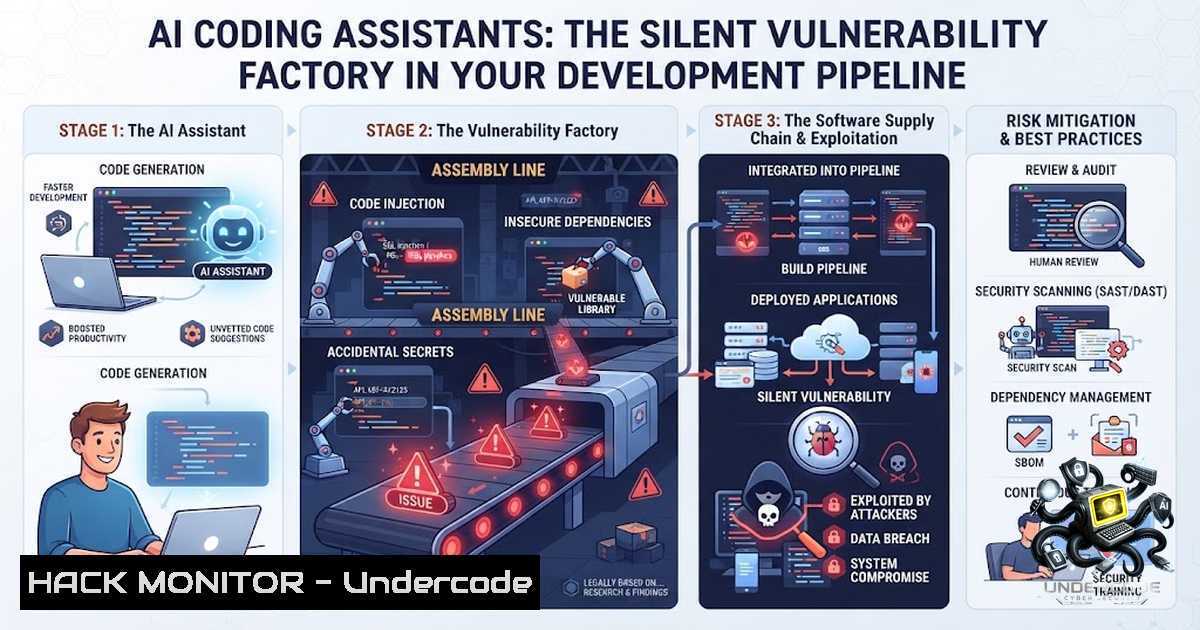
Introduction:
AI coding assistants like GitHub Copilot and Amazon CodeWhisperer have become indispensable tools for modern development teams, promising unprecedented productivity gains. However, these models generate code based on pattern matching from training data—not contextual security awareness—meaning they routinely introduce SQL injection vulnerabilities, hardcoded credentials, weak cryptographic implementations, and insecure API calls directly into production environments. The threat is not theoretical: empirical studies reveal that 29.5% of Python and 24.2% of JavaScript snippets generated by AI coding tools contain security weaknesses, with AI-assisted developers producing SQL injection vulnerabilities at 5.1 times the rate of unassisted developers.
Learning Objectives:
- Understand the specific security vulnerabilities introduced by AI coding assistants and their root causes
- Master practical scanning and detection techniques for identifying AI-generated vulnerabilities in existing codebases
- Implement a comprehensive security framework—including tooling, policy controls, and human review processes—to safely integrate AI coding tools into development workflows
You Should Know:
- The Vulnerability Landscape: What AI Coding Tools Actually Get Wrong
AI coding assistants excel at pattern completion but fundamentally lack security context. They don’t understand your business logic, compliance requirements, or existing security architecture. This limitation manifests in several predictable vulnerability categories that research has consistently identified across multiple tools including GitHub Copilot, Amazon CodeWhisperer, and ChatGPT.
Most Common AI-Generated Vulnerabilities:
- Hardcoded Credentials and Secrets: AI models are trained on public code that frequently contains embedded API keys, passwords, and tokens. The models reproduce this pattern, generating realistic-looking but exposed credentials directly in source files. Research shows hard-coded credentials appear in 79.1% of vulnerable AI-generated code samples.
-
SQL Injection: AI assistants routinely build SQL queries using string concatenation rather than parameterized statements—a classic vulnerability that enables attackers to manipulate database queries.
-
Command Injection: GitHub Copilot CLI itself has demonstrated critical command injection vulnerabilities (CVE-2026-29783) where the shell tool fails to properly sanitize user inputs before executing commands, allowing malicious actors to exploit bash parameter expansion operators.
-
Insecure Cryptographic Implementations: Models generate weak encryption, outdated algorithms, or improper key management practices without understanding cryptographic best practices.
-
Server-Side Request Forgery (SSRF): Often underrated, SSRF vulnerabilities are frequently introduced when AI generates code that makes external requests without proper validation.
-
Prompt Injection and Agent Manipulation: Modern agentic coding tools (Claude Code, Cursor agent mode, Copilot Workspace) execute shell commands, install packages, and push branches autonomously. Attackers can exploit repository content—issue bodies, PR descriptions, README files—to inject malicious instructions that the agent silently executes.
Real-World Impact: Veracode’s 2025/2026 reports indicate that 45% of AI-generated code contains real security vulnerabilities, with Java codebases showing failure rates exceeding 70%. The OWASP LLM Top 10 explicitly identifies “Overreliance” (LLM09) as a critical risk, noting that LLM-generated source code can introduce unnoticed security vulnerabilities that pose significant risk to operational safety.
2. Scanning Your Codebase: Detecting AI-Generated Vulnerabilities
The first line of defense is proactive scanning. Several specialized tools have emerged specifically designed to detect the predictable vulnerability patterns that AI coding tools systematically introduce.
Linux/macOS Commands for Scanning:
 Install and run Oculum CLI - AI-1ative security scanner
npm install -g @oculum/cli
oculum login
oculum scan --path ./src --format json > scan-results.json

Run VibeCheck with 17+ scanning engines
npx @vibecheckdev/vibecheckai scan --full --output report.html

Run ai-security-scan (open-source SAST for LLM apps)
pip install ai-security-scan
ai-security-scan scan --path ./src --ruleset OWASP_LLM_TOP_10

Run XploitScan (210+ security rules for AI-generated code)
npx xploitscan scan --github-url https://github.com/your-repo --report pdf

Use Semgrep with custom AI-vulnerability rules
semgrep --config p/owasp-top-ten --config custom-ai-rules.yml ./src
Windows PowerShell Commands:
 Install and run SecureAI-Scan for TypeScript, JavaScript, Python
npm install -g secureai-scan
secureai-scan init
secureai-scan scan --path .\src --format sarif > results.sarif

Run Snyk CLI with AI code scanning
snyk auth
snyk code test --severity-threshold=high --json > snyk-results.json

Use Probus for deep call-chain analysis
npx probus analyze --entry-points ./src/index.js --dangerous-sinks ./sinks.json
What to Look For: Security scanners should specifically check for:
– Hardcoded API keys and secrets in source files
– SQL queries built using string concatenation
– Missing authentication and authorization checks
– Hallucinated package names (slopsquatting attacks)
– Insecure HTTP requests without validation
– Weak cryptographic implementations
Step-by-Step Implementation:
- Establish a Baseline: Run a comprehensive scan of your entire codebase to establish current vulnerability counts. Use `oculum scan –baseline` or `secureai-scan baseline` to track only new issues moving forward.
-
Integrate into CI/CD: Add scanning to your pre-commit hooks and CI pipelines to catch vulnerabilities before they reach production.
-
Prioritize Fixes: Focus first on hardcoded credentials (critical), then SQL injection and command injection (high severity), followed by cryptographic issues and SSRF.
-
Generate AI-Powered Fixes: Tools like Snyk Code now offer “Generate AI fix” functionality that provides production-ready code fixes for detected vulnerabilities.
-
The OWASP B1-B4 Trust Boundary Model: Securing the AI Pipeline
The OWASP B1-B4 framework provides a pipeline-level threat model for AI coding agents operating across software development pipelines, mapping how risks chain across trust boundaries from developer intent to production deployment.
B1 — Developer ↔ AI Agent: This boundary handles developer prompts, context files, and tool permissions. Primary threats include prompt injection via untrusted context files (AGENTS.md, MEMORY.md, issue tickets) and over-permission grants at session initialization. Controls: Implement least-privilege permission manifests, require explicit trust confirmation before agent sessions, and sanitize all context inputs.
B2 — AI Agent ↔ Code Repository: Generated source code, dependency declarations, and IaC templates cross this boundary. Threats include slopsquatting (hallucinated package names registered by attackers), insecure defaults in generated code (no prepared statements, open CORS), and secret injection via generated config files. Controls: Validate dependencies before commit, run SAST on all AI-generated output, implement secret scanning, and require human review gates. Real-world evidence from Snyk ToxicSkills (February 2026) shows 36.82% of scanned skills contained security flaws introduced at or before this boundary.
B3 — Code Repository ↔ CI/CD: Build scripts, Dockerfiles, Kubernetes manifests, and environment configs cross this boundary. Threats include AI-generated IaC with insecure defaults reaching build pipelines, unvalidated shell commands in generated CI scripts, and dependency confusion attacks. Controls: Implement CI-level scanning of all AI-generated build artifacts, enforce immutable dependency pinning with hash verification, and apply IaC policy gates.
B4 — CI/CD ↔ Production: Deployed containers, infrastructure configurations, and runtime agents cross this boundary. Threats include AI-generated infrastructure running with excessive cloud permissions, misconfigured network exposure, and privilege escalation through AI-generated IAM policies. Controls: Enforce production policy (OPA/Gatekeeper), default to runtime isolation, prohibit host-mode execution without explicit override, and maintain audit logging of all agent-initiated actions. Real-world evidence: SecurityScorecard (February 2026) identified 135,000+ agent instances publicly internet-exposed, and CVE-2026-28363 (CVSS 9.9) enabled remote WebSocket hijacking of local agent instances.
4. Hardening Your AI Development Environment
Linux/macOS Hardening Commands:
 Restrict agent permissions using AppArmor or SELinux
sudo aa-complain /etc/apparmor.d/usr.bin.node  Set to complain mode for testing
sudo aa-enforce /etc/apparmor.d/usr.bin.node  Enforce after testing

Implement file integrity monitoring for critical config files
sudo aide --init
sudo mv /var/lib/aide/aide.db.new.gz /var/lib/aide/aide.db.gz
sudo aide --check

Scan for secrets in git history
git log -p | grep -iE "(api[_-]?key|secret|password|token|credential)" --color=always

Use truffleHog for deep secret scanning
pip install truffleHog
trufflehog git file://. --json --only-verified > secrets-found.json

Monitor agent-generated file changes
inotifywait -m -r --format '%w%f' ./src | while read FILE; do
if [[ $FILE =~ .(js|py|java|go)$ ]]; then
semgrep --config p/owasp-top-ten "$FILE"
fi
done
Windows PowerShell Hardening:
 Audit file permissions on critical directories
Get-Acl -Path "C:\Projects\" | Format-List

Monitor for suspicious process execution (agent behavior)
Get-WinEvent -LogName Security | Where-Object { $<em>.Id -eq 4688 } |
Select-Object TimeCreated, @{Name="Process";Expression={$</em>.Properties[bash].Value}}

Implement Windows Defender Application Control (WDAC) policies
New-CIPolicy -FilePath .\AgentPolicy.xml -Level Publisher -UserPEs
ConvertFrom-CIPolicy -XmlFilePath .\AgentPolicy.xml -BinaryFilePath .\AgentPolicy.p7b

Scan PowerShell scripts for injection patterns
Select-String -Path ".\.ps1" -Pattern "Invoke-Expression|iex|Start-Process" |
Export-Csv -Path .\suspicious-commands.csv
Git Hooks for AI Code Prevention:
Create `.git/hooks/pre-commit`:
!/bin/bash
 Block commits containing hardcoded secrets
if git diff --cached | grep -iE "(api[_-]?key|secret|password|token)" > /dev/null; then
echo "❌ Hardcoded secret detected in staged changes!"
echo "Please use environment variables or a secrets manager."
exit 1
fi

Block commits with SQL string concatenation patterns
if git diff --cached | grep -E "\$.{.\".SELECT.\"|+.\".SELECT.\"" > /dev/null; then
echo "❌ Potential SQL injection pattern detected!"
echo "Use parameterized queries instead."
exit 1
fi
5. Cloud Infrastructure Security for AI-Generated IaC
AI tools frequently generate Infrastructure as Code (IaC) templates with insecure defaults. Apply these controls:
AWS CloudFormation / Terraform Hardening:
 Terraform - Enforce least-privilege IAM
resource "aws_iam_policy" "lambda_minimal" {
name = "lambda-minimal-policy"
policy = jsonencode({
Version = "2012-10-17"
Statement = [
{
Effect = "Allow"
Action = [
"logs:CreateLogGroup",
"logs:CreateLogStream",
"logs:PutLogEvents"
]
Resource = "arn:aws:logs:::"
}
]
})
}

Terraform - Validate with OPA/Conftest
 conftest test --policy ./policy terraform/.tf
Kubernetes Security Contexts:
 Enforce non-root execution and read-only root filesystem
apiVersion: v1
kind: Pod
metadata:
name: secure-agent
spec:
securityContext:
runAsNonRoot: true
runAsUser: 1000
fsGroup: 2000
containers:
- name: app
securityContext:
allowPrivilegeEscalation: false
readOnlyRootFilesystem: true
capabilities:
drop: ["ALL"]
Cloud Policy Enforcement (OPA/Gatekeeper):
 OPA policy to block AI-generated insecure configurations
package kubernetes.admission

deny[bash] {
input.request.object.spec.containers[bash].securityContext.privileged == true
msg = "Privileged containers are not allowed - AI-generated config rejected"
}

deny[bash] {
not input.request.object.spec.containers[bash].securityContext.runAsNonRoot == true
msg = "Containers must run as non-root - AI-generated config rejected"
}
6. API Security: Validating AI-Generated Endpoints
AI coding assistants frequently generate APIs with missing authentication, improper input validation, and insecure data exposure.
Linux Command to Audit API Endpoints:
 Find all API route definitions and check for auth middleware
grep -rE "(app.(get|post|put|delete|patch)|@(Get|Post|Put|Delete|Patch)|router.(get|post))" ./src --include=".js" --include=".py" --include=".java" | \
while read line; do
if ! echo "$line" | grep -qiE "(auth|authenticate|jwt|token|session|@secured|@rolesallowed)"; then
echo "⚠️ Potentially unauthenticated endpoint: $line"
fi
done

Scan for exposed environment variables in API configs
find ./src -1ame ".env" -o -1ame "config" | xargs grep -l "API_KEY|SECRET|PASSWORD" 2>/dev/null
Python API Security Example (Generated vs. Secure):
 ❌ AI-GENERATED INSECURE (SQL Injection + No Auth)
@app.route('/api/users/<user_id>')
def get_user(user_id):
query = f"SELECT  FROM users WHERE id = {user_id}"  SQL injection!
return jsonify(db.execute(query))

✅ SECURE VERSION
@app.route('/api/users/<int:user_id>')
@jwt_required()  Authentication required
def get_user(user_id):
query = "SELECT  FROM users WHERE id = ?"
result = db.execute(query, (user_id,))  Parameterized query
return jsonify(result)
What Undercode Say:
- Key Takeaway 1: AI coding assistants are not security-aware—they generate vulnerabilities at scale. Studies show 45% of AI-generated code contains security flaws, with SQL injection appearing at 5.1x the rate of human-written code. Organizations must treat AI-generated code as untrusted by default.
-
Key Takeaway 2: The OWASP B1-B4 framework provides a practical, pipeline-level approach to securing AI development. By implementing controls at each trust boundary—from developer prompts to production deployment—teams can systematically mitigate risks including prompt injection, slopsquatting, insecure IaC defaults, and excessive cloud permissions.
Analysis: The integration of AI coding assistants represents a fundamental shift in software development that security teams have been slow to address. Traditional SAST tools catch some issues, but AI-generated vulnerabilities are uniquely problematic because they appear syntactically correct and functionally plausible—they pass compilation and basic testing while harboring deep-seated security flaws. The emergence of CVE-2026-29783 (GitHub Copilot CLI command injection) and CVE-2026-28363 (agent WebSocket hijacking) demonstrates that the threat extends beyond generated code to the tools themselves. Organizations must implement multi-layered defenses: specialized AI-vulnerability scanners, OWASP-aligned trust boundary controls, human code review gates, and continuous monitoring of agent behavior. The most dangerous assumption is that AI-generated code is “just like” human-written code—it is not, and treating it as such invites preventable breaches.
Prediction:
+1: Organizations that implement AI-specific security frameworks (scanning, OWASP B1-B4 controls, human review gates) will see 60-70% reduction in AI-introduced vulnerabilities within 12 months, establishing competitive advantage through faster, safer development cycles.
-1: The 70%+ failure rate of AI-generated Java code signals an impending wave of breaches in enterprise Java applications. Organizations without AI code scanning will experience significant security incidents within 18-24 months as attackers increasingly target AI-generated vulnerability patterns.
-1: Agentic AI tools with auto-accept enabled represent a catastrophic risk vector. The combination of full developer permissions, autonomous command execution, and prompt injection vectors creates a blast radius equivalent to compromised developer workstations—expect high-profile incidents involving agent-based supply chain attacks.
+1: The security industry is responding rapidly with specialized tooling. The emergence of 210+ rule scanners, AI-1ative SAST tools, and OWASP guidance signals a maturing ecosystem that will make AI code security increasingly accessible to organizations of all sizes.
▶️ Related Video (86% Match):
🎯Let’s Practice For Free:
🎓 Live Courses & Certifications:
Join Undercode Academy for Verified Certifications
🚀 Request a Custom Project:
Secure, high-velocity infrastructure and disruptive technological engineering. Contact our engineering team for high-tier development and proprietary systems:
[email protected]
💎 Smart Architecture | 🛡️ Secure by Design | ⭐ Trusted by Thousands
IT/Security Reporter URL:
Reported By: Cybersecurity Airisk – Hackers Feeds
Extra Hub: Undercode MoN
Basic Verification: Pass ✅


