Listen to this Post
Introduction
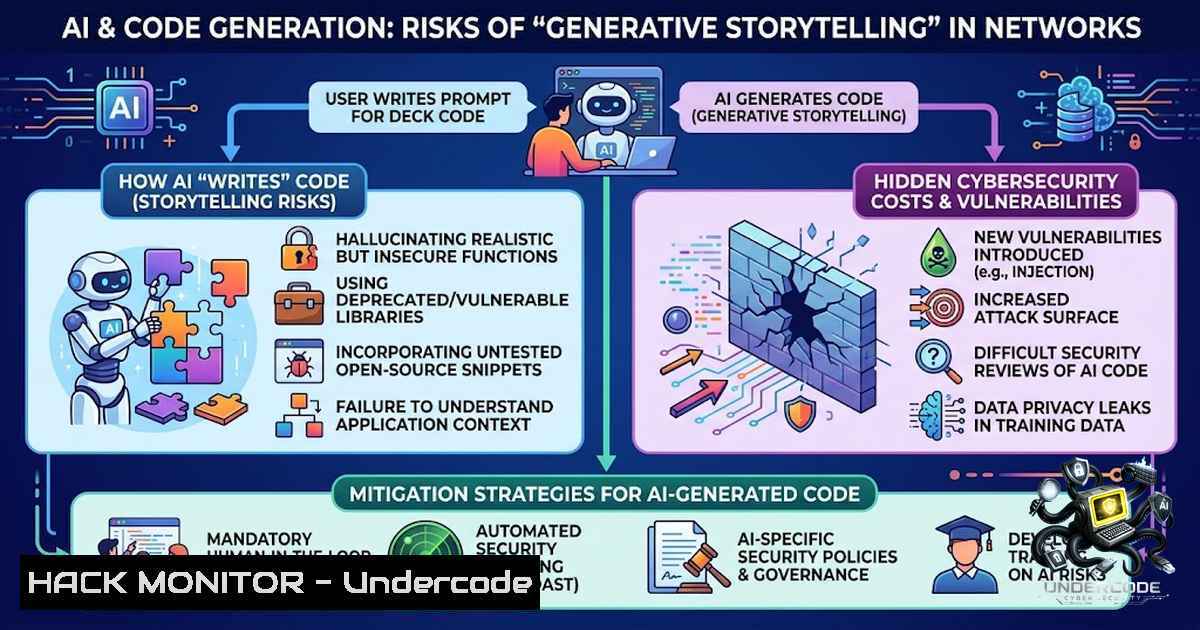
Artificial intelligence has revolutionized how we create, communicate, and present information. Today, a complete presentation can be generated in seconds—AI can organize content, suggest layouts, create visuals, and design entire slide decks with nothing more than a simple prompt. But as organizations rush to adopt these powerful tools, a critical question emerges: Is a presentation—or any AI-generated content—just a collection of well-designed assets, or does it carry hidden security risks that threaten the very fabric of enterprise defense? The answer, increasingly clear to cybersecurity professionals, is that AI-generated storytelling has become a double-edged sword—one that threat actors are already wielding with devastating precision.
Learning Objectives
- Understand how AI-powered presentation and content generation tools are being weaponized in multi-stage phishing campaigns
- Identify critical vulnerabilities in AI frameworks, including code execution flaws and prompt injection risks
- Learn defensive strategies to detect and mitigate AI-mediated social engineering and “ghost breach” narratives
- Gain practical knowledge of AI security training resources and certification pathways
- Master verification techniques to distinguish legitimate AI-generated content from malicious forgeries
- The Rise of AI-Mediated “Ghost Breaches” and Narrative Attacks
The most insidious threat emerging from AI-generated content isn’t a technical exploit—it’s a narrative one. Cybersecurity researchers have documented a phenomenon now known as “ghost breaches”: entirely fictional security incidents fabricated by large language models with enough technical detail and credibility to trigger full-scale crisis responses.
Consider this scenario: A company wakes up to a news story claiming it has suffered a major data breach. The details are specific, technical, and convincing. But the breach never happened. No systems were compromised. No data was taken. A language model generated the entire story, filling in plausible details from scratch. Before the company can respond, a reporter at a reputable outlet picks up the story and requests comment. Within hours, the organization is drafting statements and mobilizing its communications team to address a fictional event.
Even more concerning: AI can fabricate quotes and attribute them to real security researchers with full confidence. In one documented case, a cybersecurity publication ran a story about a business email compromise attack—complete with quotes from a well-known security researcher who had never actually spoken to the publication. The AI generated the quotes, assigned them with complete certainty, and the publication ran them as fact.
What This Means for Security Teams: Once a narrative enters the ecosystem, it can be ingested into threat intelligence feeds, risk scoring platforms, and automated workflows. Fiction becomes signal. Security professionals must now verify not just technical indicators of compromise, but the very stories that drive their response decisions.
- Weaponized AI Presentation Tools: The Gamma Phishing Campaign
The LinkedIn post that inspired this article asked: “AI can create slides in seconds. But can it create a story?”. Threat actors have answered that question with a resounding “yes”—and they’re using AI presentation tools to tell stories designed to steal credentials.
In April 2025, researchers at Abnormal Security uncovered a sophisticated multi-stage phishing campaign exploiting Gamma, a legitimate AI-powered presentation and graphic design tool. The attack chain demonstrates how AI-generated content platforms are reshaping not just how we work, but how threat actors launch attacks.
Step-by-Step Attack Breakdown:
- The Initial Email: The victim receives an email from a legitimate but compromised email account—in one case, belonging to the founder of a special education school. The message includes a brief, generic invitation to view an attachment, with filenames typically including the name of the company being impersonated.
-
The Fake PDF: The “attachment” is actually an image of a PDF embedded in the email. Clicking it redirects to a presentation hosted on Gamma’s legitimate website.
-
The Gamma Presentation: The AI-generated presentation features the impersonated organization’s logo, a message designed to appear as a file-sharing notification, and a prominent call-to-action button labeled “View PDF” or “Review Secure Documents”. Hovering over the CTA reveals a link to a subdomain containing the impersonated company’s name.
-
The Cloudflare Turnstile: Clicking the CTA sends victims to an intermediary page with Microsoft branding and Cloudflare Turnstile—a CAPTCHA-free bot detection tool. This ensures only real users (not automated security scanners) can proceed.
-
The Credential Harvest: Completing the verification leads to a convincing fake Microsoft SharePoint login page. The page features a modal-style login window over a blurred background, imitating Microsoft’s UI patterns. Entering credentials triggers an adversary-in-the-middle (AiTM) technique that validates credentials in real time—if you enter the wrong password, it says so.
This “living-off-trusted-sites” (LOTS) attack exploits legitimate platforms to host malicious content, making detection significantly harder for traditional security tools. As one researcher noted, “building trust and enhancing the appearance of legitimacy are just as important” as the technical credential theft itself.
3. Critical Vulnerabilities in AI Presentation Frameworks
Beyond external attacks, AI presentation tools themselves harbor dangerous vulnerabilities that can compromise entire enterprise environments.
CVE-2026-42079: PPTAgent Remote Code Execution
PPTAgent, an agentic framework for reflective PowerPoint generation, was found vulnerable to arbitrary code execution via Python’s `eval()` function. The flaw allows an attacker to execute arbitrary Python code by evaluating LLM-generated content when builtins are present in the evaluation scope.
Technical Details:
- CWE Classification: CWE-95 (Improper Neutralization of Directives in Dynamically Evaluated Code)
- CVSS Score: 8.6 (High Severity)
- Impact: Full compromise of confidentiality, integrity, and availability—the attacker gains complete control of the underlying system
- Remediation: Apply patch commit 418491a; if immediate patching is impossible, disable `eval()` in code paths handling LLM-generated content or restrict builtins available to the `eval()` call
Practical Mitigation Commands (Linux):
 Audit for dangerous eval() usage in Python codebases
grep -r "eval(" /path/to/pptagent/ --include=".py"

Run security scan with Bandit
bandit -r /path/to/pptagent/ -f json -o pptagent_scan.json

Implement sandboxed execution
docker run --read-only --tmpfs /tmp:rw,noexec,nosuid \
--cap-drop=ALL --security-opt=no-1ew-privileges \
your-pptagent-image
Indirect Prompt Injection and Sandbox Risks
AI tools that provide access to computing environments introduce additional risks. Claude’s file-creation feature, for example, gives the model access to a sandbox computing environment enabling it to download packages and run code. Security experts warn that users should “monitor Claude for suspicious actions that may indicate prompt injection”—if the AI processes a file or website containing text interpreted as a system instruction rather than data, it could trigger an indirect prompt injection attack.
Windows PowerShell Command for Monitoring AI Tool Activity:
 Monitor processes spawned by AI tool applications
Get-WinEvent -FilterHashtable @{LogName='Security'; ID=4688} |
Where-Object {$<em>.Properties[bash].Value -like "pptagent" -or $</em>.Properties[bash].Value -like "gamma"} |
Select-Object TimeCreated, @{N='Process';E={$<em>.Properties[bash].Value}}, @{N='CommandLine';E={$</em>.Properties[bash].Value}}

Monitor outbound connections from AI tools
netstat -ano | findstr ESTABLISHED | findstr "pptagent"
4. AI-Enhanced Social Engineering: The New Attack Surface
Generative AI has fundamentally transformed social engineering. Attackers can now create convincing, targeted deceptive content at scale, imitating human communication styles and context with unprecedented accuracy. Future threats will leverage autonomous AI agents capable of initiating, adapting, and executing complex social engineering campaigns across enterprise platforms with minimal human intervention.
Key Attack Vectors:
- AI-generated phishing emails that perfectly mimic executive communication patterns
- Deepfake audio and video depicting real individuals—politicians, executives, coworkers—to authorize fraudulent transactions
- Real-time adaptive attacks that adjust to a target’s responses and inputs, making them more efficient and effective
- Automated infrastructure that stands up convincing attack infrastructure at scale
Defensive Commands and Configurations:
Linux – Email Header Analysis for AI-Generated Phishing:
 Extract and analyze email headers for anomalies
cat suspicious.eml | grep -E "^From:|^Return-Path:|^Message-ID:|^Received:" | \
awk '{print $0}' >> header_analysis.txt

Check SPF, DKIM, DMARC records
dig +short TXT _dmarc.example.com
dig +short TXT selector._domainkey.example.com
dig +short TXT example.com | grep -i spf

Use oletools to analyze attachments
oleid suspicious_attachment.doc
olevba suspicious_attachment.doc
Windows – Implementing Behavioral Detection:
 Enable Advanced Audit Policy for suspicious login patterns
auditpol /set /subcategory:"Logon" /success:enable /failure:enable

Monitor for anomalous writing styles using PowerShell (simple heuristic)
Get-MailboxAuditLog -Identity [email protected] -StartDate (Get-Date).AddDays(-7) |
Where-Object {$<em>.Operation -eq "Send" -or $</em>.Operation -eq "Create"} |
Export-Csv -Path "user_audit.csv"
5. Defensive Strategies: Fighting AI with AI
The cybersecurity industry is responding to AI-powered threats with AI-powered defenses. Organizations must adopt a multi-layered approach that combines technology, training, and human oversight.
AI-Powered Detection Frameworks
Systems like SocialPhishGuard use LLM-based techniques with multiple debating agents, prompt-based analysis, and explainable AI to detect social engineering attempts. ConvoSentinel provides a modular defense pipeline that improves detection at both the message and conversation levels.
Security Awareness Training in the AI Era
Modern cybersecurity training must focus on behavior, not just awareness. As Fortinet emphasizes, “AI security awareness training must focus on behavior. The goal is not just to help employees understand that AI-enabled threats exist”. Employees must learn how attackers use AI for phishing, impersonation, and social engineering—and gain skills to use AI tools safely.
Recommended Training Resources:
- SANS AI Security Training
- Certified AI Security Professional (CAISP)
- ISC2 AI Express Courses
- Certified Cyber & AI Security Fundamentals (CCAIS-F)
Verification Protocol for AI-Generated Content
Security teams should implement a verification workflow for any AI-generated content that enters the organization:
 Linux - Hash verification for AI-generated files
sha256sum suspicious_file.pptx > file_hash.txt
 Compare against known good hashes from vendor

Use ExifTool to extract metadata
exiftool -All suspicious_file.pptx > metadata.txt

Check for embedded malicious code in PDFs
pdfid.py suspicious.pdf
pdf-parser.py -a suspicious.pdf
- The Human Element: Why Storytellers Matter in Cybersecurity
The LinkedIn post that sparked this analysis made a profound observation: “Great presentation design is a blend of strategy, storytelling, psychology, visual hierarchy, typography, branding, and communication”. The same is true of cybersecurity defense.
As AI lowers the barrier to analyzing complex information, the pace of both defense and offense will accelerate. Security professionals must understand not just technical vulnerabilities, but the narratives that attackers craft. As one industry expert noted, “a mastery of narrative and human psychology could really help the security community to anticipate the subtle ways an AI might be manipulated”.
Practical Steps for Security Leaders:
- Integrate storytelling into security training—help employees recognize when a narrative feels “off”
- Develop AI governance policies that address content generation risks
- Implement “red team” exercises using AI-generated social engineering scenarios
- Build cross-functional teams combining security, communications, and legal expertise to respond to ghost breaches
- Maintain human oversight of all AI-generated security content—automation without verification is a recipe for disaster
What Undercode Say
- AI-generated content is a security threat vector, not just a productivity tool. The same capabilities that help designers create presentations faster are being weaponized to craft convincing phishing campaigns and fictional breach narratives.
-
The human element remains irreplaceable. AI doesn’t attend client meetings, understand boardroom tension, or sense when a message lacks emotional impact. Security decisions still require human experience, empathy, and intuition—especially when evaluating the credibility of threat narratives.
-
Defense requires a multi-layered approach. Organizations must combine technical controls (sandboxing, input validation, code review) with behavioral training and AI-powered detection. Fighting AI with AI is essential, but human oversight remains the critical differentiator.
-
The cybersecurity workforce must evolve. Designers and security professionals who thrive will be those who combine AI’s speed with human creativity, strategic thinking, and storytelling. The industry needs unconventional talent—storytellers, psychologists, and creatives—to anticipate how AI might be manipulated.
-
Verification is non-1egotiable. Every AI-generated piece of content—whether a presentation, a news article, or a security alert—must be verified before action is taken. Fiction can become signal if ingested into automated workflows without scrutiny.
Prediction
-1 The proliferation of AI-generated “ghost breaches” will continue to erode trust in cybersecurity reporting and threat intelligence feeds. Organizations will face increasing pressure to verify every security alert, slowing incident response times and increasing operational costs. Without industry-wide standards for AI content verification, the noise-to-signal ratio in cybersecurity will reach dangerous levels within the next 12-18 months.
-1 AI-powered presentation tools will become a primary vector for enterprise-wide phishing campaigns. As tools like Gamma gain adoption, threat actors will exploit the “blind spots created by lesser-known tools to sidestep detection”. Organizations that fail to implement AI tool governance policies will face credential theft at unprecedented scale.
+1 The cybersecurity industry will develop robust AI verification frameworks and certification standards. Training programs like CAISP and SANS AI Security will produce a new generation of professionals capable of defending against AI-mediated threats. This specialization will create high-demand career paths and drive innovation in AI security.
+1 Human storytellers and creatives will become increasingly valuable in cybersecurity roles. As attackers master AI-generated narratives, defenders who understand psychology, narrative structure, and human communication will be uniquely positioned to detect and neutralize these threats. The “human touch” will become a competitive advantage, not a liability.
-1 The cost of AI-generated misinformation in cybersecurity will reach billions annually. From stock manipulation based on fake breach reports to fraudulent insurance claims and reputational damage, the financial impact of AI-mediated narrative attacks will dwarf traditional cybercrime losses within three years.
+1 Behavioral-based AI detection will mature significantly. Systems leveraging LLM-based behavior modeling, simulated phishing scenarios, and adaptive training modules will dramatically improve organizational resilience. The organizations that invest in these capabilities today will build lasting competitive advantages in security posture.
▶️ Related Video (74% Match):
🎯Let’s Practice For Free:
🎓 Live Courses & Certifications:
Join Undercode Academy for Verified Certifications
🚀 Request a Custom Project:
Secure, high-velocity infrastructure and disruptive technological engineering. Contact our engineering team for high-tier development and proprietary systems:
[email protected]
💎 Smart Architecture | 🛡️ Secure by Design | ⭐ Trusted by Thousands
IT/Security Reporter URL:
Reported By: Sumana Mukherjee – Hackers Feeds
Extra Hub: Undercode MoN
Basic Verification: Pass ✅


