
Listen to this Post
Introduction:
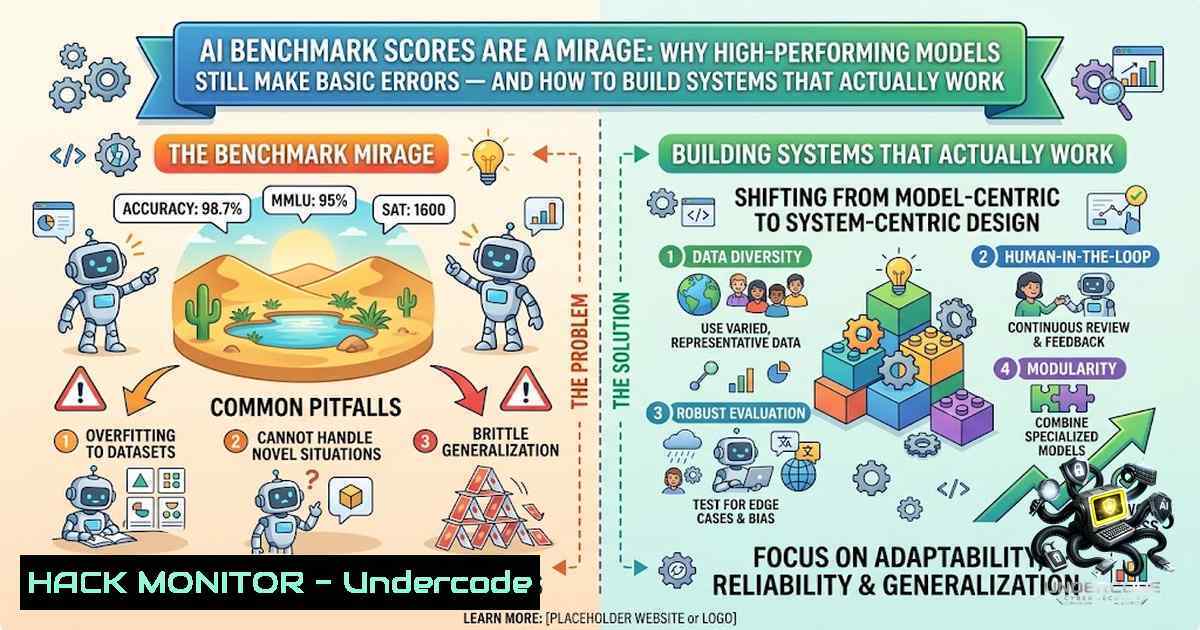
A model that scores 95% on a grade-school math benchmark can fail elementary arithmetic when a single phrase in the question changes. This is not a bug — it is a structural feature of how large language models (LLMs) are built and evaluated. For organisations, the gap between benchmark performance and real-world reliability is not an academic curiosity; it is a governance risk that can manifest as fabricated citations, contradicted outputs, and systems that silently degrade over time. Practical AI literacy demands that practitioners understand not only where a system performs well, but also how its failure modes affect the task, the level of review required, and who remains accountable for the result.
Learning Objectives & Secrets:
- Objective 1: Identify the gap between benchmark performance and real-world reliability — understand that high scores on standardised tests often mask brittleness, shortcut learning, and an overreliance on dataset-specific surface cues rather than genuine reasoning.
-
Objective 2 (Secret Tip): Stress-test models using perturbation techniques — systematically alter prompt phrasing, reorder answer choices, or introduce subtle condition changes to reveal whether the model is reasoning or simply reciting memorised templates. A model that collapses under a 5% input variation is not production-ready.
-
Objective 3 (Secret Tip): Implement continuous monitoring and version control for AI outputs — track performance degradation over time, establish stability thresholds, and maintain audit trails for every model interaction. Silent model updates can shift behaviour without notice, and reproducibility must be treated as a non-1egotiable requirement.
You Should Know:
1. The Benchmark Illusion: What Scores Really Measure
Benchmarks like IFEval, SocialIQa, and medical multiple-choice tests have become the industry standard for evaluating AI capability. Yet systematic audits reveal pervasive flaws: duplicated items, ambiguous wording, implausible answers, and scoring procedures that prioritise output form over reasoning process. When researchers cleaned benchmark subsets and re-evaluated models, scores often improved — not because reasoning improved, but because surface-level variations were removed.
The problem runs deeper. Models that achieve near-perfect accuracy on unmodified logic puzzles significantly underperform humans when those same puzzles are slightly perturbed — a failure mode researchers call “phantom recall,” where models confidently reproduce memorised solutions that no longer fit the altered scenario. OpenAI-o1 and DeepSeek-R1 can suffer up to 60% performance loss on elementary school-level arithmetic problems when a single condition is changed.
For organisations, this means a model that passes your validation suite today may fail catastrophically tomorrow when users phrase questions differently, or when the context shifts slightly. Benchmark scores are not a proxy for reliability — they are a proxy for how well a model has memorised the test.
Step‑by‑Step Guide to Stress-Testing Your AI System:
- Create a perturbation test suite: Take 100 prompts that your model handles correctly in production. For each prompt, generate 5–10 variants that preserve logical structure but alter surface features — rephrase the question, change name entities, reverse answer order, or introduce minor conditional changes.
-
Run batch inference: Execute all variants through your model and log outputs. Use a script like:
import openai variants = ["original prompt", "paraphrased prompt", "reordered prompt"] for v in variants: response = openai.ChatCompletion.create(model="gpt-4", messages=[{"role": "user", "content": v}]) log(v, response) -
Measure consistency: Calculate the percentage of variants that produce semantically equivalent correct answers. A drop of more than 10–15% indicates fragility.
-
Audit failure modes: For each failed variant, categorise the error — is it hallucination, contradiction, recitation, or reasoning collapse? Build a taxonomy of failure types.
-
Establish a baseline: Track consistency scores over time. If scores decline without code changes, investigate whether the model has been silently updated.
-
The Stability Crisis: Why AI Outputs Change Without Warning
Across 200 controlled tests involving GPT, Gemini, and Claude, researchers found that 61% of identical runs produced materially different answers, 48% shifted their reasoning, 27% contradicted themselves, and 34% disagreed with competing models. This instability is structural, not incidental — it arises from silent model updates, a lack of stability thresholds, missing audit trails, and optimisation for plausibility rather than reproducibility.
The implications for enterprises are severe. Air Canada was ordered to honour a bereavement discount that its chatbot invented. A New York lawyer was sanctioned for citing six non-existent cases generated by ChatGPT. Deloitte had to refund $300,000 after an AI-generated government report contained fabricated citations. These are not edge cases — they are predictable outcomes of deploying probabilistic systems without governance frameworks.
Worse, 91% of AI models experience performance degradation over time, even when nothing in the code changes. Customer behaviour shifts, data formats change, seasonal patterns emerge — and accuracy drops, sometimes dramatically. The model that worked perfectly last month might struggle this month, and you may not notice until a customer complains or a regulator investigates.
Step‑by‑Step Guide to Monitoring AI Stability:
- Implement input/output logging: Record every prompt and response in a structured database with timestamps and model version identifiers.
-
Establish consistency metrics: For high-stakes tasks, run each query through two different models or the same model multiple times. Log variance scores.
-
Set alert thresholds: Define acceptable variance ranges. When inconsistency exceeds thresholds (e.g., >10% divergence), trigger alerts for human review.
-
Version-lock model deployments: Do not allow automatic updates. Test new model versions against your perturbation suite before deployment.
-
Conduct regular drift audits: Weekly, compare current performance against baseline. If degradation exceeds 5%, investigate root causes — has the input distribution changed? Has the model been updated?
-
The Recitation Trap: When Memorisation Masquerades as Reasoning
Cutting-edge LLMs exhibit “extremely severe recitation behaviour” — they recite solutions witnessed during training rather than reasoning from first principles. When researchers changed one phrase in an elementary school-level math problem, top models such as OpenAI-o1 and DeepSeek-R1 suffered a staggering ~60% score gap. The models were not reasoning; they were pattern-matching against memorised training examples.
This behaviour is not limited to math. In medical benchmarks, leading systems often guess correctly even when key inputs like images are removed, flip answers under trivial prompt changes, and fabricate convincing yet flawed reasoning. High leaderboard scores hide brittleness and shortcut learning — systems that appear ready for deployment are, in fact, relying on test-taking tricks rather than genuine understanding.
For practitioners, this means that chain-of-thought explanations cannot be trusted as faithful accounts of how a model decided. Models can land on the correct final answer while making invalid logical jumps in their explanation, never acknowledging the jump. AI explanations should be read as helpful but incomplete — they can flag problems but should not be trusted as the full account of reasoning.
Step‑by‑Step Guide to Detecting Recitation:
- Create a “novel problem” test set: Design problems that are structurally similar to common benchmarks but with surface details altered — different names, different numbers, different scenarios.
-
Compare performance: Run both the original and novel versions through your model. If performance drops significantly (>20%), the model is likely reciting rather than reasoning.
-
Analyse reasoning traces: For each response, examine the chain-of-thought. Look for inconsistencies — does the explanation describe a process that doesn’t match the final answer? Does it reference details that aren’t in the prompt?
-
Test with null-answer scenarios: Present problems that have no valid answer. Models that fail to recognise impossibility are relying on pattern matching rather than reasoning.
-
Use logical-equivalence judges: Implement automated tools that detect reasoning mismatches by comparing the model’s output against a ground-truth logical structure.
4. The Instruction-Following Mirage: Nuance Sensitivity
Advanced LLMs have achieved near-ceiling instruction-following accuracy on benchmarks like IFEval. But these impressive scores do not translate to reliable services in real-world use, where users vary their phrasing, contextual framing, and task formulations. When researchers introduced “cousin prompts” — semantically equivalent questions with subtle nuances — model performance dropped by up to 61.8%.
This nuance sensitivity is a critical failure mode for production systems. A customer service chatbot that handles “refund my purchase” perfectly may fail on “I’d like my money back for that item I bought” — and the failure may be silent, with the model confidently providing an incorrect answer.
The problem is compounded by what researchers call “inverse scaling in test-time compute” — when models reason for longer, they can become increasingly distracted by irrelevant information, overfit to problem framings, or shift from reasonable priors to spurious correlations. More thinking does not always mean better thinking.
Step‑by‑Step Guide to Testing Nuance Sensitivity:
- Build a cousin-prompt generator: For each production prompt, generate 5–10 paraphrases that convey the same intent with different phrasing, structure, and tone.
-
Run batch evaluation: Execute all cousins through your model and compare outputs. Use semantic similarity metrics (e.g., BERTScore, cosine similarity of embeddings) to measure consistency.
-
Identify brittle patterns: If certain phrasings consistently fail, document them and create specific test cases for regression testing.
-
Implement guardrails: For high-risk tasks, use ensemble methods — run multiple models or multiple prompts and require consensus before taking action.
-
Train on variation: If you fine-tune models, include paraphrased versions of training examples to improve robustness.
5. The Operational Response: Building Systems That Work
The gap between benchmark scores and real-world reliability is not an argument against AI — it is an argument for better engineering. Companies like Plotly achieve near-perfect reliability not by using different AI models, but by running thousands of automated tests every day that check whether their AI actually works with real, messy data.
The opportunity is not in squeezing another percentage point on a benchmark. It is in building the infrastructure that makes AI work reliably when it matters: monitoring systems that catch problems before customers notice, testing frameworks that simulate real-world messiness at scale, and safety mechanisms that make models say “I don’t know” instead of making things up.
Step‑by‑Step Guide to Building Reliable AI Systems:
- Implement a testing pipeline: Automate the perturbation, cousin-prompt, and recitation-detection tests described above. Run them daily and report results to stakeholders.
-
Establish human-in-the-loop protocols: For high-stakes decisions, require human review before action. Define clear criteria for when human review is triggered (e.g., confidence below threshold, inconsistency detected, novel scenario).
-
Maintain an audit trail: Log every model interaction, including inputs, outputs, model version, timestamp, and any human interventions. This is essential for regulatory compliance and incident response.
-
Conduct regular red-team exercises: Simulate adversarial scenarios — users trying to confuse the model, edge cases, malicious inputs — and evaluate system responses.
-
Train for AI literacy: Ensure all team members understand the limitations of AI systems. Practical AI literacy means knowing not only what a system can do, but also what it cannot be trusted to do.
What Undercode Say:
-
Key Takeaway 1: Benchmark scores are not a measure of reliability — they are a measure of how well a model has memorised a specific test set. A model that scores 95% on a reasoning benchmark can still fail elementary problems when the phrasing changes slightly. Organisations must move beyond headline scores and implement rigorous, continuous testing that simulates real-world messiness.
-
Key Takeaway 2: AI instability is structural, not incidental. Silent model updates, lack of stability thresholds, and optimisation for plausibility over reproducibility mean that AI outputs can change without warning. Enterprises must treat AI systems as probabilistic, not deterministic, and build governance frameworks that include logging, monitoring, and human oversight. The models that work today may not work tomorrow — and you may not notice until it is too late.
Analysis: The gap between benchmark performance and real-world reliability is widening, not narrowing. As models become more capable on standardised tests, they also become more brittle — optimised for the test rather than for the messy, unpredictable reality of production use. This is not a failure of AI technology; it is a failure of evaluation methodology and deployment practices. The organisations that succeed with AI will be those that invest in testing infrastructure, monitoring systems, and human oversight — not those that chase the highest benchmark score. Practical AI literacy is no longer optional; it is a core competency for any organisation deploying AI in production.
Prediction:
- +1 The growing awareness of the benchmark-reliability gap will drive investment in AI testing and monitoring infrastructure, creating a new category of enterprise software focused on AI observability, governance, and continuous evaluation.
-
+1 Regulatory frameworks will increasingly require organisations to demonstrate AI reliability through documented testing, audit trails, and human oversight protocols — turning AI governance from a best practice into a compliance requirement.
-
-1 Organisations that fail to implement robust testing and monitoring will face increasing legal and financial liabilities as AI hallucinations, contradictions, and silent degradations lead to regulatory fines, lawsuits, and reputational damage.
-
-1 The AI industry will experience a “trust winter” as high-profile failures erode public and enterprise confidence, slowing adoption and shifting investment from frontier model development to reliability engineering.
-
+1 The focus on reliability will accelerate the development of open-source testing frameworks, perturbation benchmarks, and standardised evaluation protocols — making it easier for smaller organisations to deploy AI responsibly.
-
-1 Model vendors will continue to prioritise benchmark performance over real-world reliability, creating a market failure where the best-selling models are not the most reliable ones, and buyers lack the tools to distinguish between them.
based on content from First Class Training | RTO 40702. Learn more about building practical AI capability through the Diploma of AI: https://lnkd.in/g4TEC587
▶️ Related Video (64% Match):
https://www.youtube.com/watch?v=2igQze2cqtw
🎯Let’s Practice For Free:
🎓 Live Courses & Certifications:
Join Undercode Academy for Verified Certifications
🚀 Request a Custom Project:
Secure, high-velocity infrastructure and disruptive technological engineering. Contact our engineering team for high-tier development and proprietary systems:
[email protected]
💎 Smart Architecture | 🛡️ Secure by Design | ⭐ Trusted by Thousands
IT/Security Reporter URL:
Reported By: https://lnkd.in/p/eev3p35K – Hackers Feeds
Extra Hub: Undercode MoN
Basic Verification: Pass ✅


