Listen to this Post
Introduction:
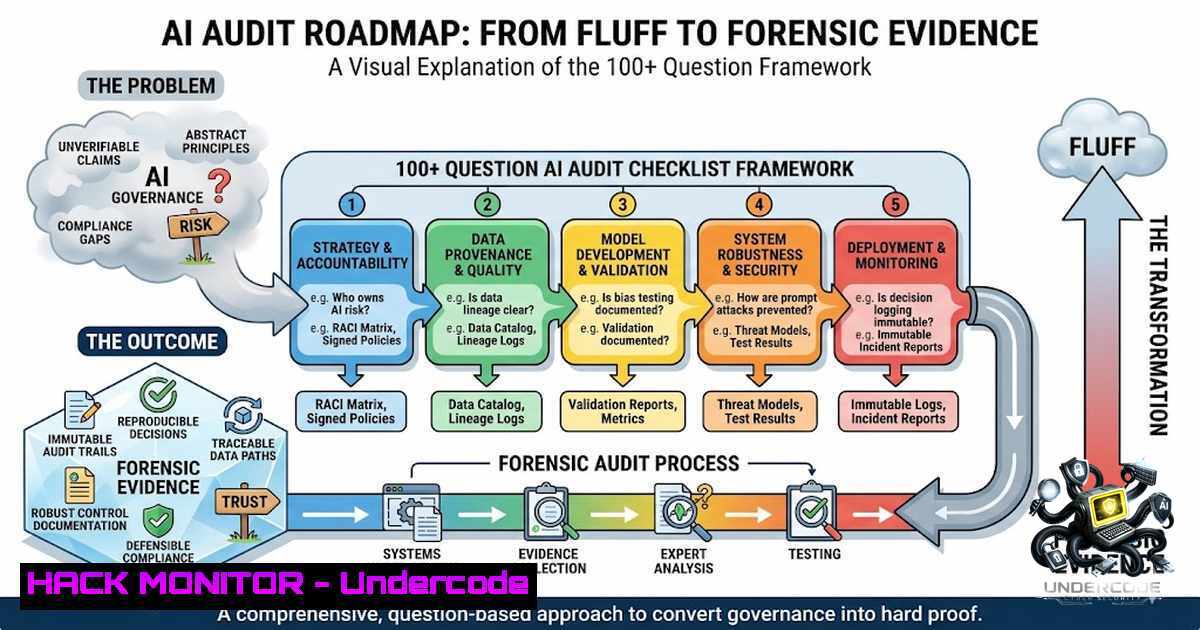
The gap between AI principles and AI proof is where audits fail—and where regulators, clients, and boards are now looking first. Organizations routinely publish responsible AI policies, yet when asked for the actual policy document, bias test results, rollback plan, or SIEM integration log, they come up empty. The AI Audit Checklist by Kamran Iqbal, released through Certified Trainers and Consultants (CTC Global), addresses this exact problem by transforming abstract governance concepts into 100+ verifiable audit questions with concrete “how to check” guidance. Covering ISO 42001, NIST AI RMF, GDPR, EU AI Act, CCPA, OECD AI Principles, and technical controls including SHAP, LIME, Fairlearn, IBM AI Fairness 360, and drift monitoring, this operational playbook provides internal audit, compliance, risk, security, and privacy teams with a structured mechanism to prove control operation before a regulator asks.
Learning Objectives:
- Master the structure and application of a comprehensive AI audit checklist spanning governance, compliance, bias, security, explainability, performance, and incident response.
- Learn to verify AI controls using specific evidence-gathering techniques, including log reviews, configuration audits, and tool-based assessments.
- Acquire hands-on commands and procedures for auditing AI security, API configurations, cloud hardening, and model drift detection across Linux and Windows environments.
1. AI Governance and Regulatory Compliance Auditing
The foundation of any AI audit begins with documented governance and regulatory alignment. The checklist demands evidence, not assertions: Where is the AI governance framework document? Where are the meeting minutes of the AI ethics committee? Where is the GDPR 35 DPIA or the EU AI Act conformity assessment?
Step‑by‑step guide for auditing AI governance:
- Locate and review the AI governance framework document. Verify it defines roles, responsibilities, and decision-making authority for AI systems. Check version control and approval dates.
- Map AI risk management processes to ISO 42001, NIST AI RMF, and GDPR. Use a compliance mapping table. For ISO 42001, confirm the AIMS (AI Management System) scope, AI policies, risk assessments, and treatment plans are documented. For NIST AI RMF, verify alignment across the four functions: Govern, Map, Measure, and Manage.
- Audit the AI ethics committee. Request meeting minutes, charters, and evidence of decision-making authority. Confirm the committee has reviewed high-risk AI use cases.
- Review legal compliance documentation. Verify GDPR data processing policies, CCPA disclosure notices, and sector-specific regulatory filings. Check that AI data processing activities have documented legal bases (consent, contract, legitimate interest, etc.).
- Examine AI transparency and explainability documentation. Confirm model documentation includes parameters, assumptions, feature importance, and decision-making justifications.
Linux command for document integrity verification:
 Verify integrity of governance documents using SHA-256 checksums
sha256sum /path/to/governance/policy.pdf /path/to/risk/assessment.docx
 Audit file metadata for last modification timestamps
stat /path/to/governance/policy.pdf
 Search for specific compliance keywords across documents
grep -rni "ISO 42001|NIST AI RMF|GDPR" /path/to/document/repository/
Windows PowerShell command for document audit:
 Generate file hashes for integrity verification
Get-FileHash -Path "C:\AI_Governance.pdf" -Algorithm SHA256
 Retrieve last access and modification times
Get-ChildItem -Path "C:\AI_Governance\" | Select-Object Name, LastWriteTime, CreationTime
 Search for compliance keywords in documents
Select-String -Path "C:\AI_Governance.txt" -Pattern "ISO 42001|NIST AI RMF|GDPR"
2. AI Bias Detection and Fairness Auditing
Bias is not a philosophical concern—it is a measurable control failure. The checklist requires auditors to verify that training data is diverse, that models have been tested for racial, gender, and socioeconomic biases, and that fairness metrics such as Equalized Odds, Disparate Impact, and Statistical Parity are calculated and flagged for corrective action.
Step‑by‑step guide for bias and fairness auditing:
- Review dataset composition reports. Verify demographic distributions and data collection sources. Confirm that preprocessing techniques like data balancing, re-weighting, or adversarial debiasing have been applied.
- Examine bias testing reports. Look for fairness analysis results, past bias mitigation efforts, and evidence of regular monitoring.
- Check for explainability tools. Confirm that models are equipped with SHAP, LIME, Integrated Gradients, or similar frameworks.
- Verify external fairness validation. Check if AI models have been tested with IBM AI Fairness 360, Fairlearn, or Aequitas.
- Audit human oversight mechanisms. Confirm there is a human-in-the-loop (HITL) or human-on-the-loop (HOTL) process for AI decisions, and that users can challenge AI-generated decisions in high-risk applications.
Hands‑on bias detection with Fairlearn (Python):
 Install Fairlearn
pip install fairlearn

Basic fairness assessment
from fairlearn.metrics import MetricFrame, selection_rate
from sklearn.metrics import accuracy_score

Assuming y_true, y_pred, and sensitive_feature (e.g., gender) are defined
mf = MetricFrame(
metrics={"accuracy": accuracy_score, "selection_rate": selection_rate},
y_true=y_true,
y_pred=y_pred,
sensitive_features=sensitive_feature
)
print(mf.by_group)
print(mf.difference())
Using IBM AI Fairness 360 (AIF360):
 Install AIF360
pip install aif360

Binary label dataset fairness metrics
from aif360.datasets import BinaryLabelDataset
from aif360.metrics import BinaryLabelDatasetMetric

Assuming dataset is loaded
metric = BinaryLabelDatasetMetric(dataset,
unprivileged_groups=[{'race': 0}],
privileged_groups=[{'race': 1}])
print("Disparate Impact:", metric.disparate_impact())
print("Statistical Parity Difference:", metric.statistical_parity_difference())
Linux command to audit bias testing logs:
 Search for fairness test execution logs
find /var/log/ai/ -1ame "fairness.log" -mtime -30
 Extract fairness metric results from logs
grep -E "Disparate Impact|Statistical Parity|Equalized Odds" /var/log/ai/fairness_.log
3. AI Security and Adversarial Attack Protection
AI models are software systems—and software systems get hacked. The checklist mandates verification of RBAC, MFA, encryption (AES-256, TLS 1.3), logging, adversarial robustness testing, and penetration testing using tools like Microsoft Counterfit and CleverHans.
Step‑by‑step guide for AI security auditing:
- Verify access controls. Confirm RBAC policies are implemented and MFA is enforced for AI system access. Review access logs for anomalies.
- Check encryption. Verify AI models are encrypted at rest (AES-256) and in transit (TLS 1.3).
- Audit adversarial robustness testing. Review reports for evasion, poisoning, and model inversion attacks. Confirm penetration testing has been performed.
- Inspect AI API security. Verify OAuth 2.0 authentication, rate limiting, and API monitoring for unauthorized queries.
- Review cloud security configurations. For AWS, Azure, or Google Cloud, check encryption settings, access control policies, and compliance with ISO 27001, SOC 2, and NIST CSF.
Linux command for AI security auditing:
 Check TLS configuration for AI API endpoints
openssl s_client -connect ai-api.example.com:443 -tls1_3
 Verify file encryption for model weights
file /path/to/model/weights.bin
 Check for running AI-related services and their permissions
ps aux | grep -E "tensorflow|pytorch|mlflow|ray" | awk '{print $1, $11}'
 Review authentication logs for anomalies
sudo grep -E "Failed password|Invalid user" /var/log/auth.log | tail -20
Windows PowerShell command for AI security audit:
 Check TLS configuration
Invoke-WebRequest -Uri "https://ai-api.example.com" -Method Head

Verify folder permissions for AI model storage
Get-Acl -Path "C:\AI_Models\" | Format-List
 Check Windows event logs for authentication failures
Get-WinEvent -LogName Security | Where-Object { $_.Id -in 4625, 4648 } | Select-Object -First 20
4. AI Explainability and Transparency Auditing
Black-box AI is an audit nightmare. The checklist requires comprehensive model documentation, clear decision explanations, SHAP/LIME implementation, GDPR’s “Right to Explanation” compliance, and an explainability dashboard for auditors.
Step‑by‑step guide for explainability auditing:
- Review model documentation. Confirm it includes system design, training logs, parameters, assumptions, and feature importance analysis.
- Test explainability tools. Verify SHAP, LIME, or Integrated Gradients are integrated and produce human-understandable explanations.
- Audit GDPR compliance. Confirm the “Right to Explanation” is implemented, including user-facing disclosure of AI-generated decisions.
- Inspect the explainability dashboard. Verify it is accessible to auditors and compliance teams and provides consistent, unbiased justifications.
- Check data sourcing ethics. Confirm training data is open-source, legally obtained, and ethically sourced with proper licenses.
Hands‑on SHAP explainability (Python):
 Install SHAP
pip install shap

import shap
import xgboost as xgb

Train a model
model = xgb.XGBClassifier().fit(X_train, y_train)

Create explainer and compute SHAP values
explainer = shap.TreeExplainer(model)
shap_values = explainer.shap_values(X_test)

Visualize feature importance
shap.summary_plot(shap_values, X_test)
LIME implementation for local explanations:
 Install LIME
pip install lime

from lime.lime_tabular import LimeTabularExplainer

explainer = LimeTabularExplainer(X_train, feature_names=feature_names,
class_names=['Class 0', 'Class 1'],
discretize_continuous=True)
exp = explainer.explain_instance(X_test[bash], model.predict_proba)
exp.show_in_notebook()
5. AI Model Performance and Drift Monitoring
Models degrade. Data drifts. The checklist mandates accuracy testing (precision, recall, F1-score, AUC-ROC), real-world validation, trend analysis, automated drift detection, retraining schedules, and tools like Evidently AI, AWS Model Monitor, and Azure ML Monitoring.
Step‑by‑step guide for performance and drift auditing:
- Review accuracy testing reports. Confirm precision, recall, F1-score, and AUC-ROC are calculated and reviewed regularly.
- Validate against real-world datasets. Check for overfitting risks and edge case testing.
- Audit drift detection. Verify automated drift detection logs and monitoring alerts are configured.
- Check retraining schedules. Confirm AI models are retrained with fresh data according to a formal policy.
- Verify monitoring tool integration. Confirm Evidently AI, AWS Model Monitor, or Azure ML Monitoring are implemented and alerting.
Hands‑on drift detection with Evidently AI:
 Install Evidently AI
pip install evidently

from evidently.dashboard import Dashboard
from evidently.dashboard.tabs import DataDriftTab

Create data drift dashboard
data_drift_dashboard = Dashboard(tabs=[bash])
data_drift_dashboard.calculate(reference_data, current_data, column_mapping=None)
data_drift_dashboard.show()
Linux command for monitoring AI performance logs:
 Check model performance logs for degradation patterns
tail -f /var/log/ai/model_performance.log | grep -E "accuracy|f1|auc"
 Monitor drift detection alerts
journalctl -u ai-monitor.service -f | grep -i drift
Windows PowerShell for performance audit:
 Parse performance logs for metrics
Get-Content "C:\AI_Logs\performance.log" | Select-String "Accuracy|F1|AUC"
 Check scheduled retraining tasks
Get-ScheduledTask | Where-Object { $_.TaskName -like "AIRetrain" }
6. AI Deployment, Incident Response, and Post-Implementation Risk
Deployment is where theory meets reality—and where failures become public. The checklist requires verification of deployment security, RBAC, cloud security standards, real-time monitoring, rollback mechanisms, SIEM integration, and human-in-the-loop intervention.
Step‑by‑step guide for deployment and incident auditing:
- Review deployment security. Confirm RBAC restricts AI model changes and deployment environments are protected.
- Verify cloud security alignment. Check ISO 27001, SOC 2, and NIST CSF compliance for cloud deployments.
- Audit encryption. Confirm models are encrypted at rest and in transit.
- Inspect real-time monitoring. Verify dashboards track AI performance and anomaly detection is configured.
- Test incident response. Confirm predefined failure protocols, rollback mechanisms, and SIEM integration are in place.
Linux command for deployment security audit:
 Check cloud security group rules (AWS CLI)
aws ec2 describe-security-groups --group-ids sg-12345678
 Verify Kubernetes RBAC for AI deployments
kubectl get clusterroles | grep ai
kubectl get clusterrolebindings | grep ai
 Check SIEM integration logs
tail -100 /var/log/siem/ai_alerts.log
Windows command for rollback testing:
 Check model version history
Get-ChildItem -Path "C:\AI_Models\Versions\" | Sort-Object LastWriteTime
 Verify rollback script existence
Test-Path "C:\Scripts\rollback_ai_model.ps1"
 Test SIEM alert integration
Write-EventLog -LogName Application -Source "AIAudit" -EventId 1001 -Message "SIEM integration test"
7. Ethical Compliance and Responsible AI Auditing
Beyond technical controls, the checklist demands alignment with OECD AI Principles, UNESCO AI Ethics, FAT (Fairness, Accountability, Transparency) principles, human rights guidelines, and third-party fairness audits.
Step‑by‑step guide for ethical compliance auditing:
- Review responsible AI framework alignment. Confirm adherence to OECD AI Principles, UNESCO AI Ethics, ISO 42001, and EU AI Act.
- Audit FAT principles. Verify AI model design documentation includes fairness, accountability, and transparency principles.
- Check human oversight. Confirm HITL/HOTL mechanisms and user appeal processes.
- Review third-party audits. Verify external fairness and inclusivity audit reports.
- Audit GDPR compliance. Confirm “Right to Explanation,” AI Act risk classification, and anti-discrimination law adherence.
What Undercode Say:
- Key Takeaway 1: The AI Audit Checklist transforms responsible AI from a marketing statement into an evidence-based control framework. Organizations that adopt this structured approach can proactively identify gaps before regulators or clients do, turning compliance from a reactive burden into a strategic advantage.
- Key Takeaway 2: The technical depth of the checklist—covering adversarial attack protection, API security, drift monitoring, and explainability tools—makes it equally valuable for security engineers and IT auditors. The inclusion of specific tools like SHAP, LIME, Fairlearn, IBM AI Fairness 360, and drift monitoring platforms bridges the gap between governance theory and operational reality.
Analysis: What makes this checklist particularly timely is the convergence of multiple regulatory pressures—ISO 42001 certification, EU AI Act conformity assessments, GDPR enforcement, and NIST AI RMF adoption—all demanding verifiable evidence of control operation. The checklist’s structure—audit area, audit question, how to check, and compliance status—mirrors the evidence-based approach of financial and IT audits, making it accessible to traditional audit teams while addressing AI-specific risks. The emphasis on “how to check” rather than “what to believe” is critical; it forces auditors to look for actual policies, logs, test results, dashboards, and rollback plans. This operational rigor is what separates effective AI governance from window dressing. For organizations preparing for their first AI audit, this checklist serves as both a readiness assessment and a gap analysis tool. For mature programs, it provides a benchmark for continuous improvement. The inclusion of security controls—RBAC, MFA, encryption, adversarial testing, SIEM integration—acknowledges that AI systems are not special snowflakes but software systems subject to the same cyber threats as any other critical infrastructure.
Prediction:
- +1 Organizations that implement this checklist as a living audit framework will achieve ISO 42001 certification 30-40% faster than those relying on ad-hoc governance, because the structured evidence-gathering approach directly addresses certification requirements.
- +1 The demand for AI auditors skilled in both governance frameworks and technical tools (SHAP, LIME, Fairlearn, drift monitoring) will surge, creating a new specialization within IT audit and GRC teams over the next 18-24 months.
- -1 Organizations that treat AI governance as a one-time compliance exercise rather than an ongoing control process will face significant regulatory fines and reputational damage as EU AI Act enforcement ramps up in 2026-2027, particularly for high-risk AI systems.
- -1 The operational burden of maintaining evidence across 100+ checklist items will overwhelm understaffed audit teams, leading to checklist fatigue and superficial compliance unless organizations invest in automated evidence collection and continuous monitoring tools.
▶️ Related Video (76% Match):
🎯Let’s Practice For Free:
🎓 Live Courses & Certifications:
Join Undercode Academy for Verified Certifications
🚀 Request a Custom Project:
Secure, high-velocity infrastructure and disruptive technological engineering. Contact our engineering team for high-tier development and proprietary systems:
[email protected]
💎 Smart Architecture | 🛡️ Secure by Design | ⭐ Trusted by Thousands
IT/Security Reporter URL:
Reported By: Gmfaruk Ai – Hackers Feeds
Extra Hub: Undercode MoN
Basic Verification: Pass ✅


