
Listen to this Post
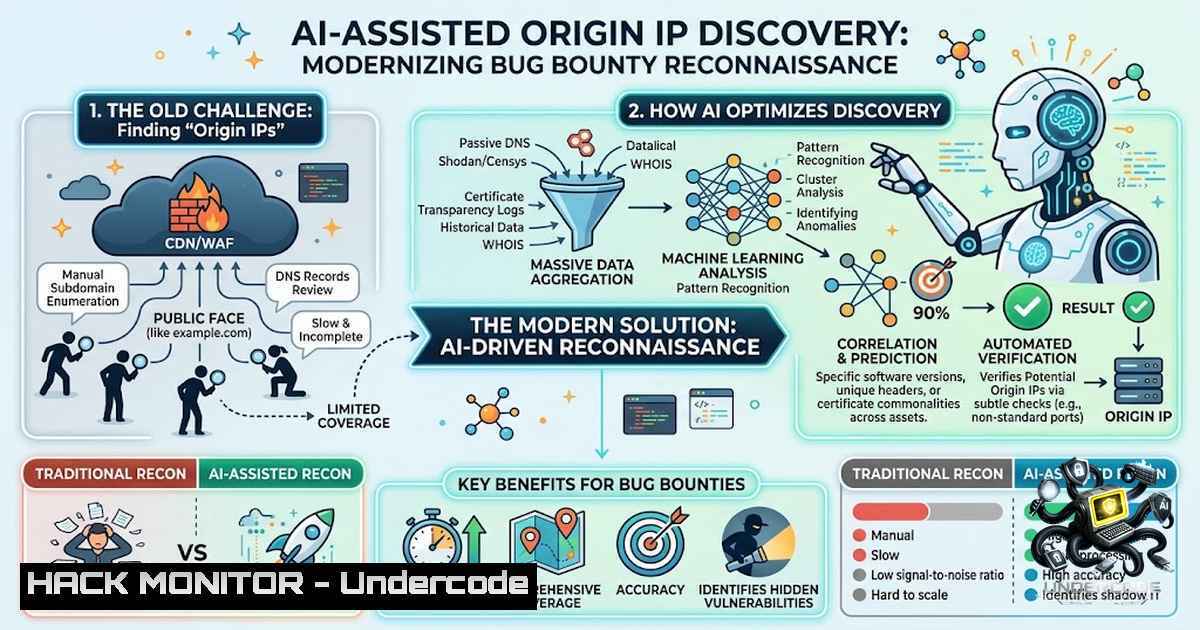
Introduction:
The reconnaissance phase remains the cornerstone of any successful bug bounty or penetration testing engagement, yet traditional methods often struggle to keep pace with modern infrastructure complexities. The integration of Artificial Intelligence (AI) into this workflow represents a paradigm shift, allowing security researchers to process vast datasets—from DNS records to certificate transparency logs—with unprecedented speed and pattern recognition capability. This article synthesizes a practical, AI-assisted methodology for origin IP discovery, providing a structured approach that enhances, rather than replaces, the fundamental skills of the ethical hacker.
Learning Objectives & Secrets:
- Objective 1: Master a comprehensive reconnaissance workflow that systematically combines target profiling, subdomain enumeration, and historical data analysis to build a detailed infrastructure map.
- Objective 2 (Secret Tip): Leverage AI for correlation and anomaly detection across disparate data sources, such as Shodan metadata and favicon hashes, to identify infrastructure relationships invisible to manual review. A key secret is using AI to compare HTTP response differences to pinpoint origin servers behind CDNs.
- Objective 3 (Secret Tip): Implement a risk-based scoring system for candidate IPs, using AI to prioritize validation efforts by analyzing indicators like ASN correlation and TLS certificate patterns, ensuring efficient triage of hundreds of potential origin addresses.
You Should Know:
1. Target Profiling and Subdomain Enumeration
Modern reconnaissance begins with understanding the target’s digital footprint. AI assists in parsing initial domain information, pulling WHOIS data, and automating the first layer of subdomain discovery. While traditional tools like `amass` and `subfinder` are essential, AI can analyze naming conventions to predict potential hidden subdomains.
– Step-by-Step Guide:
1. Define your target domain (e.g., `target.com`).
- Run initial enumeration: `subfinder -d target.com -o subdomains.txt` and
amass enum -passive -d target.com -o amass.txt. - Merge the lists and use AI to generate additional subdomain permutations.
- Resolve all discovered subdomains using
dnsx -l subdomains.txt -a -resp -o resolved_ips.txt. - Use AI to parse the output, identifying patterns like
api,dev, or `admin` subdomains for deeper analysis.
2. DNS Analysis and Certificate Transparency (CT) Logs
AI shines in analyzing DNS records (A, AAAA, CNAME, MX, TXT) and CT logs. By identifying anomalies, such as misconfigured SPF or DMARC records that might leak internal IPs, or analyzing CT logs for historical certificates, AI can uncover the IP addresses used before the implementation of CDNs like Cloudflare.
– Step-by-Step Guide:
1. Query DNS records: `dig target.com ANY` (Linux) or `nslookup -type=ANY target.com` (Windows).
2. Utilize a CT log tool: `curl -s “https://crt.sh/?q=target.com&output=json” | jq .` to retrieve certificate history.
3. Feed the JSON output into an AI parser to extract all associated IPs and names.
4. Use `openssl s_client -connect target.com:443 -showcerts` to examine the current TLS certificate for SANs (Subject Alternative Names) that reveal additional hostnames.
5. AI can then cross-reference these hostnames with DNS records to identify non-CDN endpoints.
3. HTTP Header Analysis and WAF/CDN Detection
Analyzing HTTP headers is crucial for identifying WAF/CDN services. Tools like Cloudflare, Akamai, and Fastly leave unique signatures in headers (Server, CF-RAY, X-Akamai-Transformed). AI can detect these signatures and, more importantly, analyze subtle differences in response times or header ordering to distinguish between a cached response from a CDN and a direct connection to the origin server.
– Step-by-Step Guide:
1. Send a request: `curl -I -L target.com` to capture headers.
2. For detailed analysis, use curl -s -D - target.com -o /dev/null -w "%{http_code}\n%{time_total}\n".
3. Use AI to parse a collection of headers, flagging known CDN signatures.
4. If a CDN is detected, send a request with a spoofed `Host` header to the origin IP if discovered (curl -k -H "Host: target.com" https://<candidate_ip>).
5. Analyze the response: If the response differs (a different error, default page, or the actual application), it indicates a direct origin hit.
- Infrastructure Correlation Using Shodan, Censys, and ASN Information
AI is exceptionally useful for correlating data from search engines like Shodan and Censys. By analyzing ASN (Autonomous System Number) information, open ports, and running services, AI can cluster infrastructure and identify the true IP range of the organization, eliminating false positives.
– Step-by-Step Guide:
1. Query Shodan for the domain: `shodan host
2. Extract ASN: whois <target_ip> | grep -i "originas".
3. Use AI to scan the ASN and identify all IPs within that range.
4. Cross-reference these IPs with the domain’s certificate fingerprints (from CT logs).
5. Command example for scanning all IPs in a CIDR range: nmap -sS -p 80,443,8080,8443 <CIDR_RANGE>.
6. AI can then analyze nmap outputs to identify hosts with matching banner or service fingerprints.
5. Safe Validation and Risk Scoring
Validation is the most critical step. AI creates a risk score by analyzing factors: has the IP been flagged as a proxy, does it host multiple unrelated sites, or is it part of a datacenter ASN? Safely testing an IP involves sending a request using the original host header without forwarding through the CDN, often requiring the `–resolve` flag in curl.
– Step-by-Step Guide:
1. For each candidate IP, use: `curl -s -k -H “Host: target.com” –resolve target.com:443:
2. Compare the response body, length, and headers to the baseline response.
3. If the response matches the baseline or reveals a development/error page, it is a high-probability origin.
4. Use AI to automate this comparison, scoring candidates from 0 to 10 based on similarity metrics.
5. Always validate using a VPN or a non-attributable source to ensure the response is stable and not geo-blocked.
6. Vulnerability Reporting and Mitigation
Once an origin IP is confirmed, the assessment shifts to vulnerability identification. This might involve testing for default credentials on exposed services, outdated SSL/TLS versions, or open ports for services like SSH, RDP, or Redis. Reporting should be structured and include the methodology used.
– Step-by-Step Guide:
1. Run a vulnerability scan: `nmap -sV -sC -O -p-
2. Test for specific vulnerabilities, e.g., `sslyze –regular
3. Document the finding: Clearly state the origin IP, the service discovered, the vulnerability (if any), and the evidence (screenshots of the response headers).
4. For mitigation, advise the client to restrict inbound traffic to their CDN provider’s IP ranges only, using AWS Security Groups or a similar firewall.
5. Recommendation: Implement a Web Application Firewall (WAF) rule to drop traffic not originating from the CDN’s IP range.
What Undercode Say:
- Key Takeaway 1: AI is a powerful force multiplier for reconnaissance, but it does not replace the need for a deep understanding of networking, DNS, and HTTP protocols. The “secret” lies in using AI for correlation and pattern detection, allowing the human researcher to focus on complex logic and vulnerabilities.
- Key Takeaway 2: The methodology of “safe validation” is paramount. The final verdict on an origin IP always requires manual confirmation through meticulous header and content comparison. Automated risk scoring is only as good as the data feeding it.
Conclusion:
AI-assisted reconnaissance is not a replacement for tools like nmap, dig, or curl, but rather a sophisticated layer that automates the “noise” and surfaces the signal. By combining AI’s analytical strengths with a disciplined, step-by-step methodology, bug bounty hunters and security professionals can significantly enhance their accuracy and efficiency in discovering origin infrastructure. The key lesson from this training is that AI excels at asking “why” something is related, while the human expert is needed to confirm “how” it can be exploited.
Prediction:
- +1 The integration of AI into reconnaissance will democratize advanced security testing, enabling junior researchers to perform complex investigations with the analytical power that previously required senior-level experience.
- +1 We will see the rise of “AI-first” security tools that can predict infrastructure evolution, allowing proactive patch management before vulnerabilities are publicly disclosed.
- -1 This efficiency gain will accelerate the arms race, as defensive AI will be needed to mimic real traffic and create deceptive “honeypot” origin servers, further complicating reconnaissance.
- -1 Over-reliance on AI could lead to a generation of security professionals who lack fundamental troubleshooting skills, making them less effective when faced with unique or custom infrastructure that doesn’t follow standard patterns.
- +1 The development of secure AI models for this purpose will become a primary innovation area, focusing on privacy-preserving analysis to avoid leaking sensitive data during the discovery process.
▶️ Related Video (92% Match):
🎯Let’s Practice For Free:
🎓 Live Courses & Certifications:
Join Undercode Academy for Verified Certifications
🚀 Request a Custom Project:
Secure, high-velocity infrastructure and disruptive technological engineering. Contact our engineering team for high-tier development and proprietary systems:
[email protected]
💎 Smart Architecture | 🛡️ Secure by Design | ⭐ Trusted by Thousands
IT/Security Reporter URL:
Reported By: https://lnkd.in/p/eAZ5rnJF – Hackers Feeds
Extra Hub: Undercode MoN
Basic Verification: Pass ✅


