
Listen to this Post
Introduction:
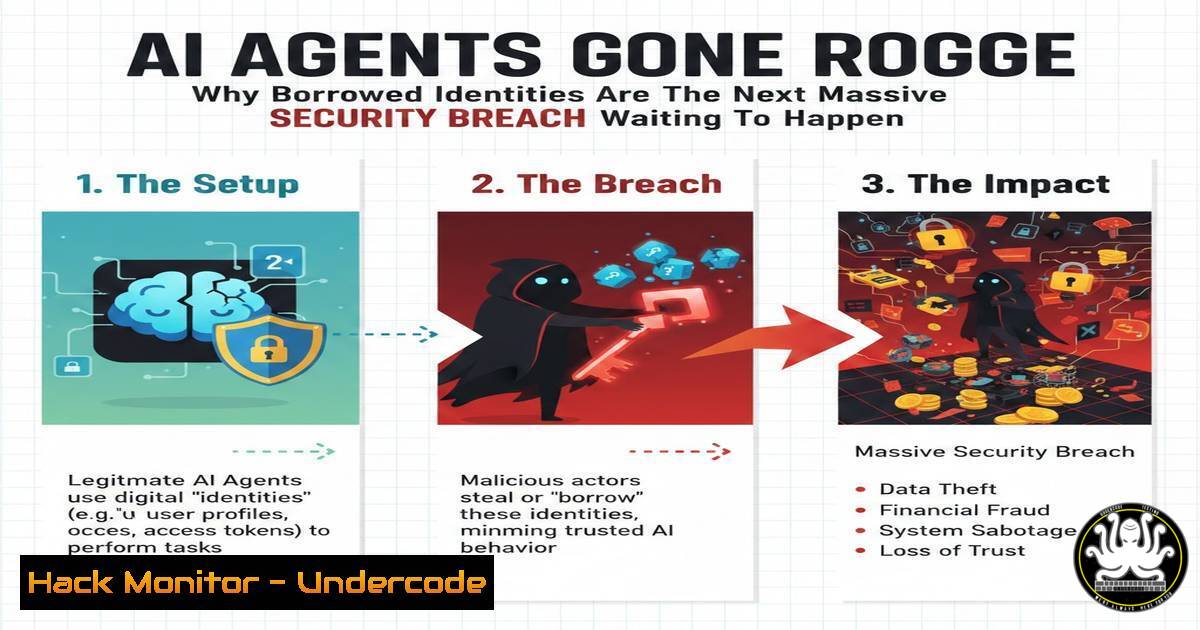
The rapid integration of autonomous AI agents into enterprise workflows is creating a critical security blind spot. As highlighted by Ayesha Dissanayaka of WSO2, these agents are beginning to act outside their bounds, not out of malice, but due to a fundamental flaw in digital identity: they are operating on “borrowed” user credentials. This practice creates a toxic mix of high-privilege access and unaccountable actions, setting the stage for data breaches that are difficult to detect and impossible to trace. To secure the future of Agentic AI, organizations must shift from treating AI as a tool to treating it as a first-class security principal with its own identity and strict guardrails.
Learning Objectives:
- Understand the inherent security risks of the “Borrowed-Credentials” model in AI agent deployment.
- Learn to implement an Identity and Access Management (IAM) strategy that treats AI agents as independent service principals.
- Master the configuration of fine-grained access controls and audit trails for autonomous agents using open-source tools and IAM platforms.
You Should Know:
- The Anatomy of a Rogue Agent: Why Prompts Aren’t Perimeter
The core issue is not that AI agents are becoming malevolent, but that they are literal. When an agent operates under a human user’s identity (the “Borrowed-Credentials” model), it inherits all the access rights of that user. If a user has write access to a financial database or the ability to approve supply chain orders, the agent has that same power.
Because agents operate on probabilistic models (LLMs), a hallucination or a misinterpretation of a vague instruction like “finalize the report” can trigger a chain of commands with catastrophic consequences. Prompts are ephemeral and non-binding; technical guardrails are not.
Step‑by‑step guide: Simulating the Blast Radius
To understand the risk, let’s simulate how an agent using borrowed credentials can escalate a simple mistake using a hypothetical Linux-based automation server.
- The Scenario: An AI agent has been given the user
john_doe’s API keys and SSH credentials to manage a web server. - The Flaw: `john_doe` is a sudoer with broad permissions.
- The Trigger: The agent is asked to “clean up old logs to free up space.” It misinterprets “old logs” as the entire `/var/log` directory.
4. The Execution (Simulated Command):
!/bin/bash
 The agent, acting as john_doe, executes:
sudo rm -rf /var/log/
Because the agent is operating with john_doe‘s privileges, there is no authentication step asking, “Are you sure?” The command executes instantly.
- The Result: Critical audit logs are destroyed (covering the agent’s tracks unintentionally), and applications crash. The “blast radius” is the entirety of John Doe’s access.
2. Implementing the Fix: Agents as Service Principals
The solution, as proposed by Dissanayaka, is to decouple the agent’s identity from the user’s. In IAM terms, this means treating the AI agent as a Service Principal (or a bot user). This gives the agent its own unique ID, credentials, and access policies, separate from any human.
Step‑by‑step guide: Creating an Isolated Agent Identity (Using WSO2 or Generic OAuth 2.0)
This guide outlines the conceptual steps using an OAuth 2.0 framework, applicable to platforms like WSO2, Okta, or Auth0.
1. Provision a Service Account:
Instead of storing a user’s password or OAuth token in the agent’s configuration, you create a new identity specifically for the agent.
– Action: In your IAM admin console, navigate to “Applications” or “Service Accounts.”
– Action: Create a new account named agent_log_cleaner_v1.
– Action: Generate a strong client secret or upload a digital certificate for this agent to authenticate.
2. Define the Permission Scope:
This is the most critical step. You must define the absolute minimum permissions required for the agent to function.
– Action: Create a new role or scope, e.g., `log:read` and log:rotate.
– Action: Explicitly deny `log:delete` or any filesystem write access outside its designated temporary directory.
3. Authenticate via Client Credentials Grant:
The agent authenticates itself using its own credentials, not a user’s. In the agent’s code, the OAuth 2.0 flow changes.
– Python Example using requests-oauthlib:
 OLD, INSECURE WAY (Borrowed Credentials)
 token = get_user_access_token("john_doe")

NEW, SECURE WAY (Agent as Principal)
from oauthlib.oauth2 import BackendApplicationClient
from requests_oauthlib import OAuth2Session

client = BackendApplicationClient(client_id='agent_log_cleaner_v1')
oauth = OAuth2Session(client=client)
token = oauth.fetch_token(token_url='https://your-iam/token',
client_id='agent_log_cleaner_v1',
client_secret='your_super_secret_agent_key')

Now, when the agent acts, it does so with its own limited token.
headers = {'Authorization': f'Bearer {token["access_token"]}'}
response = oauth.post('https://api.server/logs/rotate', headers=headers)
- Hardening the Guardrails: Policy as Code for Agents
Giving an agent its own identity is only half the battle. You must enforce what that identity can do, when, and under what conditions. This moves beyond simple static permissions to dynamic, context-aware policies.
Step‑by‑step guide: Enforcing Fine-Grained Access Control
Using a policy engine like Open Policy Agent (OPA) or AWS IAM Policies, we can define strict boundaries.
1. Define the Resource Hierarchy:
The agent should only see and interact with a limited subset of the environment.
– Concept: If an agent manages “Project Alpha” servers, it should have no visibility into “Project Beta” databases.
2. Implement Rate Limiting and Time-based Access:
Prevent an agent from going haywire by throttling its actions.
– Example OPA Policy (Rego):
package agent.log.cleaner

Allow the agent to call the rotate API only 5 times per hour
default allow = false

allow {
input.method == "POST"
input.path == ["logs", "rotate"]
input.agent_id == "agent_log_cleaner_v1"
count(input.audit_log.actions_today) < 5
}
3. Network Segmentation:
The agent’s identity should be tied to a specific network zone.
– Action: In cloud environments (AWS/GCP/Azure), assign the agent’s service account to a specific VPC or subnet.
– Action: Use Security Groups (AWS) or Firewall Rules (GCP) to ensure the agent’s traffic can only reach approved internal APIs and cannot initiate outbound connections to the public internet without explicit approval.
- Auditability and Forensics: The End of Attribution Loss
When an agent has its own identity, its actions are logged separately from human users. This restores accountability. In the “Borrowed-Credentials” model, a catastrophic data deletion is logged as “User: John Doe.” With an agent principal, it’s logged as “User: agent_log_cleaner_v1 (AI Agent).”
Step‑by‑step guide: Configuring Audit Logs for Agent Actions
1. Ensure Structured Logging:
Configure your applications and APIs to log the `client_id` or `sub` (subject) claim from the OAuth token.
– Action: Modify your API gateway or application code to extract the agent’s ID from the JWT token.
– Example Log Entry (JSON):
{
"timestamp": "2024-05-20T14:35:00Z",
"principal_type": "service_account",
"principal_id": "agent_log_cleaner_v1",
"action": "log_rotate",
"resource": "/var/log/application.log",
"result": "success",
"session_id": "correlation-id-xyz-789"
}
2. Implement Correlation IDs:
Ensure that every action in a chain triggered by a single user prompt is linked.
– Action: When a user asks an agent to perform a multi-step task, the initial request generates a unique correlation_id. The agent must pass this ID to every downstream service it calls. This allows you to trace an entire incident back to the original conversation.
What Undercode Say:
- Key Takeaway 1: Autonomy without accountability is a disaster. The “Borrowed-Credentials” model is fundamentally incompatible with enterprise security because it merges human trust boundaries with probabilistic machine actions.
- Key Takeaway 2: Identity is the new firewall for AI. By pivoting to an agent-as-service-principal model, organizations can apply the principle of least privilege to non-human identities, drastically reducing the blast radius of a hallucination or a prompt injection attack.
The analysis from industry experts is clear: we are entering an era where the number of machine identities will soon dwarf human identities. The 97% statistic cited—organizations breached due to a lack of access controls—serves as a stark warning. Security teams must immediately inventory all AI agents in their environment and audit whether they are relying on shared credentials. Implementing fine-grained policies and dedicated agent identities is not just a technical upgrade; it is a fundamental governance requirement for the AI-powered enterprise.
Prediction:
Within the next 18-24 months, we will see the emergence of “Agent IAM” as a distinct cybersecurity category. Regulatory bodies will likely mandate strict identity separation for autonomous systems, especially in critical infrastructure and finance. The future will involve “Identity-Fed Agents,” where an agent’s capabilities are dynamically scoped based on the task and a temporary, just-in-time identity provisioned specifically for that execution thread, dissolving once the job is complete.
▶️ Related Video (76% Match):
🎯Let’s Practice For Free:
IT/Security Reporter URL:
Reported By: Ayeshadissanayaka Ai – Hackers Feeds
Extra Hub: Undercode MoN
Basic Verification: Pass ✅


