Listen to this Post
Introduction:
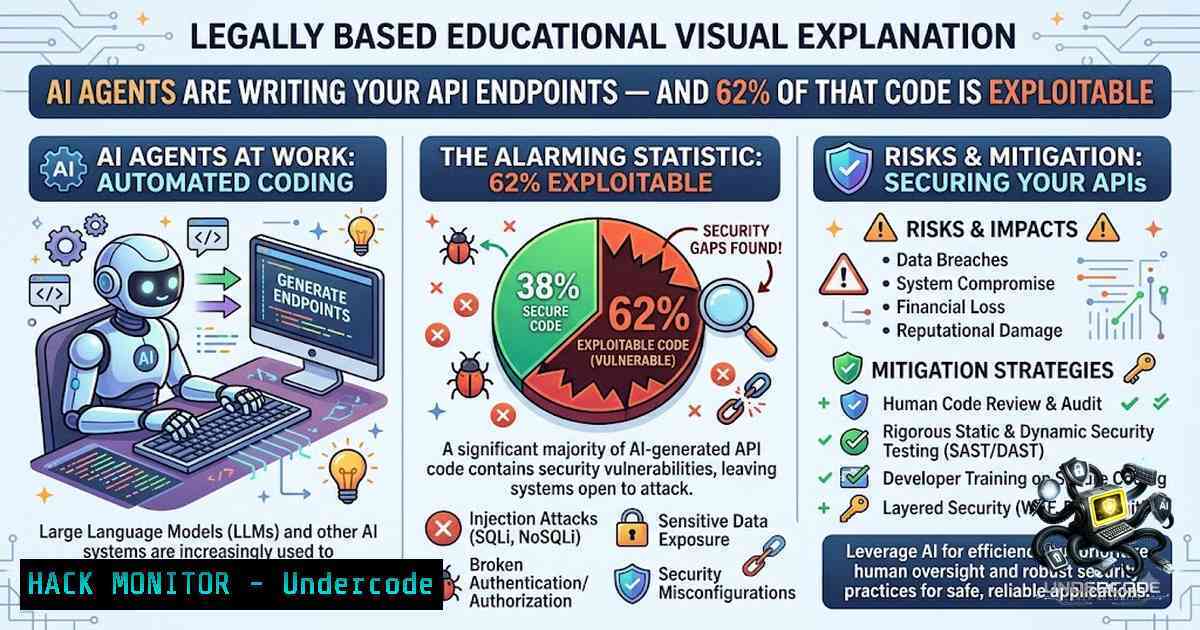
The promise of AI-powered coaching tools that turn passive content into interactive client experiences is electrifying — but it masks a dangerous reality. When AI agents write code, configure APIs, and orchestrate workflows with minimal human oversight, they introduce vulnerabilities at machine speed. Singapore’s Cyber Security Agency (CSA) recently warned that autonomous AI agents, including OpenClaw, can pose serious cybersecurity risks if deployed without appropriate safeguards. Meanwhile, research reveals that 62% of code generated by the latest LLMs contains at least one exploitable vulnerability. The gap between “this is incredibly powerful” and “I really hope this thing doesn’t do something we didn’t intend” is the new frontier of AI security.
Learning Objectives:
- Master the security architecture of AI agents, including prompt injection, memory poisoning, and tool-call exploitation vectors.
- Implement production-grade API security hardening, including TLS enforcement, rate limiting, and input validation.
- Apply Linux and Windows command-line techniques for auditing AI infrastructure and detecting unauthorized access.
- Deploy Zero Trust principles, least-privilege identities, and policy-as-code guardrails for autonomous AI systems.
- Understand OWASP Top 10 2026 vulnerabilities — especially Broken Access Control (BAC) and Broken Object Level Authorization (BOLA) — in the context of AI-generated code.
You Should Know:
- The AI Agent Attack Surface: From Chatbots to Autonomous Operators
Today’s AI agents are fundamentally different from the chatbots of 2024. They can call APIs, write tickets, change configurations, orchestrate workflows, and act on behalf of users in production systems. Each agent is less like a passive model and more like a junior engineer who never sleeps — and can execute actions at machine speed.
The threat landscape in 2026 includes prompt injection attacks that manipulate model behavior through adversarial prompts, training data poisoning that introduces malicious data into datasets, model extraction that reverse-engineers proprietary algorithms, and over-permissioned AI agents that create larger-scale breaches. Singapore’s CSA specifically warns of unpatched vulnerabilities, weak access controls, sensitive data exposure, malicious third-party skills, and memory poisoning.
Step‑by‑Step: Auditing Your AI Agent Infrastructure
Linux: Check for unauthorized AI-related processes and network connections
 List all listening ports and associated processes
ss -tulpn | grep -E ':(8000|5000|8080|3000)'

Find Python/Node processes that might be running agent frameworks
ps aux | grep -E 'python|node|ollama|langchain' | grep -v grep

Check for unexpected outbound connections from AI containers
sudo netstat -tunap | grep ESTABLISHED | grep -E ':(443|80)'
Windows (PowerShell): Audit AI tool installations and running services
 List all running processes related to AI/ML frameworks
Get-Process | Where-Object { $_.ProcessName -match 'python|node|ollama|docker' }

Check for open ports that might expose agent APIs
Get-1etTCPConnection -State Listen | Where-Object { $_.LocalPort -gt 1024 }

Review audit policies for AI-related activity
auditpol /get /category:"Detailed Tracking"
- API Security Hardening: Protecting the Digital Nervous System
APIs are the connective tissue of modern applications — and AI agents depend on them exclusively. BOLA (Broken Object Level Authorization) ranks first among API vulnerabilities and remains close to invisible to conventional scanners. Why? Because detecting it requires knowing which user should own which record — context that automated tools lack. With 34% of all API test failures having a direct security implication, and 38% of all security failures being authentication and authorization issues, API security is non-1egotiable.
Step‑by‑Step: API Gateway Hardening (NGINX Example)
Step 1: Enforce TLS 1.2+ with strong ciphers
 /etc/nginx/conf.d/ssl.conf
ssl_protocols TLSv1.2 TLSv1.3;
ssl_ciphers ECDHE-ECDSA-AES128-GCM-SHA256:ECDHE-RSA-AES128-GCM-SHA256;
ssl_prefer_server_ciphers off;
ssl_session_cache shared:SSL:10m;
Step 2: Implement rate limiting to prevent brute-force and DoS attacks
 /etc/nginx/nginx.conf
limit_req_zone $binary_remote_addr zone=api_limit:10m rate=10r/s;
limit_req_zone $binary_remote_addr zone=auth_limit:10m rate=2r/s;

/etc/nginx/sites-available/api
location /api/ {
limit_req zone=api_limit burst=20 nodelay;
proxy_pass http://ai_agent_backend;
proxy_set_header Host $host;
proxy_set_header X-Real-IP $remote_addr;
}
Step 3: Implement strict CORS policies
location /api/ {
if ($request_method = 'OPTIONS') {
add_header 'Access-Control-Allow-Origin' 'https://yourdomain.com';
add_header 'Access-Control-Allow-Methods' 'GET, POST, PUT, DELETE';
add_header 'Access-Control-Allow-Headers' 'Authorization, Content-Type';
return 204;
}
}
Step 4: Validate and sanitize all inputs server-side
 Python with Pydantic for API input validation
from pydantic import BaseModel, validator

class AgentPrompt(BaseModel):
prompt: str
max_tokens: int = 1000

@validator('prompt')
def sanitize_prompt(cls, v):
 Block prompt injection patterns
forbidden = ['ignore previous', 'system:', 'forget', 'override']
if any(pattern in v.lower() for pattern in forbidden):
raise ValueError('Invalid prompt content')
return v
- Identity and Least Privilege: Treat Agents as First‑Class Identities
Every AI agent needs a unique, well‑governed identity rather than a shared API key. Singapore’s CSA explicitly recommends dedicated and regularly rotated credentials, policy-enforcing proxies, and Zero Trust principles for autonomous agents. Over‑permissioned AI agents — when given more access than they need — create greater risk that an attacker could exploit excessive access.
Step‑by‑Step: Implementing Least‑Privilege for AI Agents
Linux: Create dedicated service accounts with minimal permissions
 Create a dedicated agent service account with no login shell
sudo useradd -r -s /usr/sbin/nologin -m -d /opt/ai-agent ai-agent

Restrict access to only necessary directories
sudo setfacl -R -m u:ai-agent:rx /opt/ai-agent/models
sudo setfacl -R -m u:ai-agent:rwx /opt/ai-agent/temp

Verify permissions
sudo -u ai-agent ls -la /opt/ai-agent/
Linux: Enforce short-lived tokens with automatic rotation (systemd timer)
 Create a token rotation script
cat > /usr/local/bin/rotate-agent-token.sh << 'EOF'
!/bin/bash
 Generate new API key for agent
NEW_TOKEN=$(openssl rand -hex 32)
 Update secrets manager or vault
vault kv put secret/ai-agent token="$NEW_TOKEN"
 Restart agent service to pick up new token
systemctl restart ai-agent.service
EOF

chmod +x /usr/local/bin/rotate-agent-token.sh

Schedule rotation every 12 hours
systemctl enable --1ow rotate-token.timer
Windows (PowerShell): Create a managed service account for AI agents
 Create a new managed service account
New-ADServiceAccount -1ame "AIAgentSvc" -Enabled $true

Install the service account on the agent host
Install-ADServiceAccount -Identity "AIAgentSvc"

Assign minimal permissions via Group Policy
 Grant only required folder and registry access
4. Policy‑as‑Code: Turning Guardrails into Executable Controls
Hardening AI agent infrastructure requires turning security and compliance rules into executable code rather than hopeful documentation. Tools like OPA (Open Policy Agent) and Rego enable organizations to block unsafe actions before execution and maintain a full audit trail of every decision. This is critical as agentic AI scales across data, APIs, and cloud resources.
Step‑by‑Step: Implementing Policy‑as‑Code for AI Agents
Step 1: Define a Rego policy to restrict tool access
 policy/agent_tools.rego
package agent_tools

default allow = false

Allow only read-only tools for standard agents
allow {
input.tool == "read_database"
input.user_role == "analyst"
}

Allow write tools only with human approval
allow {
input.tool == "write_database"
input.approved == true
input.approved_by == "human"
}

Block access to production secrets
deny[bash] {
input.tool == "get_secret"
input.secret_type == "production"
msg = "Access to production secrets requires elevated privileges"
}
Step 2: Integrate OPA as a sidecar container with your AI agent
 docker-compose.yml for AI agent with OPA sidecar
version: '3.8'
services:
ai-agent:
image: my-ai-agent:latest
environment:
- OPA_URL=http://opa:8181/v1/data/agent_tools/allow
networks:
- agent-1etwork
opa:
image: openpolicyagent/opa:latest
command:
- "run"
- "--server"
- "--addr=0.0.0.0:8181"
- "/policies"
volumes:
- ./policy:/policies
networks:
- agent-1etwork
Step 3: Audit every tool call with persistent logging
 Linux: Configure auditd to monitor agent activity
sudo auditctl -w /opt/ai-agent/ -p wa -k ai_agent_activity
sudo auditctl -w /var/log/ai-agent/ -p wa -k ai_agent_logs

View audit logs
sudo ausearch -k ai_agent_activity --format text
5. Runtime Protection: Monitoring and Anomaly Detection
Because agents are autonomous, you must be able to answer “what did it do?” at any time. This requires logging every tool call — including inputs, outputs, and timestamps. CloudWatch alarms should be configured for anomalous usage patterns, and model invocation logging should capture input and output content for forensic analysis.
Step‑by‑Step: Setting Up Runtime Monitoring
Linux: Monitor AI agent API usage with custom bash script
!/bin/bash
 monitor_ai_api.sh - Monitor AI agent API usage patterns

LOG_FILE="/var/log/ai-agent/api_usage.log"
ALERT_THRESHOLD=100  requests per minute

Count requests per minute from the API log
REQUESTS=$(tail -1 1000 $LOG_FILE | \
grep -c "$(date +%Y-%m-%dT%H:%M)")

if [ $REQUESTS -gt $ALERT_THRESHOLD ]; then
echo "ALERT: Unusual API usage detected - $REQUESTS requests" | \
mail -s "AI Agent Alert" [email protected]
fi

Check for abnormal error rates
ERRORS=$(tail -1 1000 $LOG_FILE | grep -c "ERROR")
if [ $ERRORS -gt 50 ]; then
echo "ALERT: High error rate detected - $ERRORS errors" >> /var/log/ai-agent/alerts.log
fi
Windows (PowerShell): Monitor AI agent activity with Event Logs
 Create a scheduled task to monitor AI agent events
$Action = {
$Events = Get-WinEvent -LogName "Application" |
Where-Object { $<em>.ProviderName -match "AIAgent" -and $</em>.TimeCreated -gt (Get-Date).AddMinutes(-5) }
if ($Events.Count -gt 50) {
Send-MailMessage -To "[email protected]" -Subject "AI Agent Alert" -Body "High event count detected"
}
}
Register-ScheduledTask -TaskName "MonitorAIAgent" -Action $Action -Trigger (New-ScheduledTaskTrigger -Daily -At "00:00")
What Undercode Say:
- AI agents are writing critical infrastructure code at scale, and 62% of that code is vulnerable — the security community is racing to catch up, but traditional SAST and DAST tools lack the context to identify logic flaws like BOLA.
-
The threat is not theoretical — Singapore’s CSA has already issued formal advisories on autonomous AI agent risks, citing real-world concerns about agent hijacking, unauthorized tool abuse, and sensitive data exposure. Organizations deploying AI agents without Zero Trust, least-privilege identities, and policy-as-code guardrails are effectively running production systems without seatbelts.
-
The solution lies in treating agents as first-class security principals — not as chatbots, but as autonomous entities with dedicated identities, short-lived tokens, and scoped permissions. Every agent action must leave a trace, and every tool call must be authorized by policy, not by default.
-
API security is the critical bottleneck — with BOLA topping the OWASP API Security Top 10 for years and AI-generated code multiplying shadow APIs, organizations must shift security left, embedding controls into the CI/CD pipeline and developer workflow.
-
The regulatory environment is catching up — the EU AI Act (2024, enforcement 2025-2026) and NIST AI 600-1 are establishing compliance frameworks that will make AI security not just a best practice, but a legal requirement.
Prediction:
-
+1 The AI security market will explode in 2026-2027, with policy-as-code platforms, AI-specific CSPM tools, and runtime protection solutions becoming as essential as traditional firewalls. Organizations that adopt Zero Trust for AI agents early will gain a competitive advantage in compliance and customer trust.
-
-1 The average enterprise will experience at least one AI-agent-related security incident by Q4 2026, driven by over-permissioned agents, shadow AI deployments, and unpatched vulnerabilities in open-source agent frameworks like OpenClaw.
-
-1 Regulatory fines under the EU AI Act will hit high-risk AI deployments that fail to implement human oversight, conformity assessments, and transparency requirements, creating a new class of compliance-driven security spending.
-
+1 AI-powered security tools will eventually outperform human analysts at detecting logical vulnerabilities like BOLA, with AI-generated test suites already covering 2.7x more OWASP categories than manually authored ones. The irony is that AI will both create and solve the security crisis.
-
-1 The talent gap in AI security will widen dramatically, with demand for professionals who understand both machine learning and infrastructure security far exceeding supply. Organizations will increasingly rely on automated tooling to compensate, creating a dangerous feedback loop.
▶️ Related Video (78% Match):
https://www.youtube.com/watch?v=0BZYvm4c1m0
🎯Let’s Practice For Free:
🎓 Live Courses & Certifications:
Join Undercode Academy for Verified Certifications
🚀 Request a Custom Project:
Secure, high-velocity infrastructure and disruptive technological engineering. Contact our engineering team for high-tier development and proprietary systems:
[email protected]
💎 Smart Architecture | 🛡️ Secure by Design | ⭐ Trusted by Thousands
IT/Security Reporter URL:
Reported By: Russellbrunson Were – Hackers Feeds
Extra Hub: Undercode MoN
Basic Verification: Pass ✅


